



Three months ago, a product team at a fintech startup told me their ideation process had completely fallen apart. They'd grown from 12 people in one office to 47 across Singapore, London, and San Francisco. What used to be quick whiteboard sessions turned into 3am calls where half the team couldn't contribute properly because they were barely awake.
The breaking point came when their Q3 innovation sprint produced exactly four decent ideas. Not because the team lacked creativity — but because their synchronous brainstorming sessions meant only about 30% of people could actually participate meaningfully at any given time.
This happens constantly when companies try to scale ideation globally. You end up with either exhausted teams doing zombie brainstorming at 2am, or you exclude entire time zones from the creative process. Most companies respond by either forcing everyone into terrible meeting times or giving up on collaborative ideation altogether.
When you structure ideation cycles properly — with the right schedules, participation agreements, and synthesis rituals — distributed teams actually generate better ideas than co-located ones. The 24-hour refinement cycle and cross-timezone perspective checking produces innovations that work globally from day one.
Why Traditional Ideation Breaks at Scale
The standard ideation playbook assumes everyone can get in a room together. Design thinking workshops, innovation sprints, brainstorming sessions — they're all built on synchronous participation. Even the "modern" versions just move the same broken model to Zoom.
Take a typical innovation team spread across time zones. When San Francisco hits 9am, it's already 5pm in London and 1am in Singapore. There's literally no overlap where everyone is at peak cognitive performance.
The dominant time zone wins. Usually this means headquarters runs sessions at their convenience while satellite offices dial in during off-hours. The Singapore team stops contributing meaningful ideas because nobody wants to be creative at midnight. You get participation theater instead of actual collaboration.
People show up to calls but they're checking email, half-listening, waiting for the meeting to end. One innovation manager told me their London team started sending junior analysts to late-night sessions as proxies — defeating the entire purpose of collaborative ideation.
Ideas get lost in translation too. When someone in Tokyo has a breakthrough at 2pm their time, they either wait 18 hours to share it (by which point the context is gone) or dump it in Slack where it gets buried under 200 other messages.
Most companies know this is happening but feel trapped. They've invested in innovation programs, hired creative talent globally, set ambitious ideation targets — then watch it all fail because they can't figure out how to get everyone thinking together when nobody's actually together.
Building Time-Zone Native Ideation Cycles
Asynchronous ideation isn't about eliminating real-time collaboration — it's about structuring creative work so time zones become irrelevant. Teams that nail this follow a specific rhythm that maximizes both individual thinking time and collaborative synthesis.
Capture, evaluate, and act on ideas without friction.
GoIdeafy streamlines the entire innovation lifecycle from idea submission to implementation.
- Centralized idea capture
- Collaborative evaluation tools
- Progress tracking & analytics
No credit card required
Instead of cramming ideation into intense workshop sessions, you spread it across rolling windows that respect natural work patterns. A pharmaceutical company I worked with switched from quarterly innovation workshops to continuous 14-day cycles. Each cycle has four phases: prompt release, individual ideation, peer building, and synthesis voting.
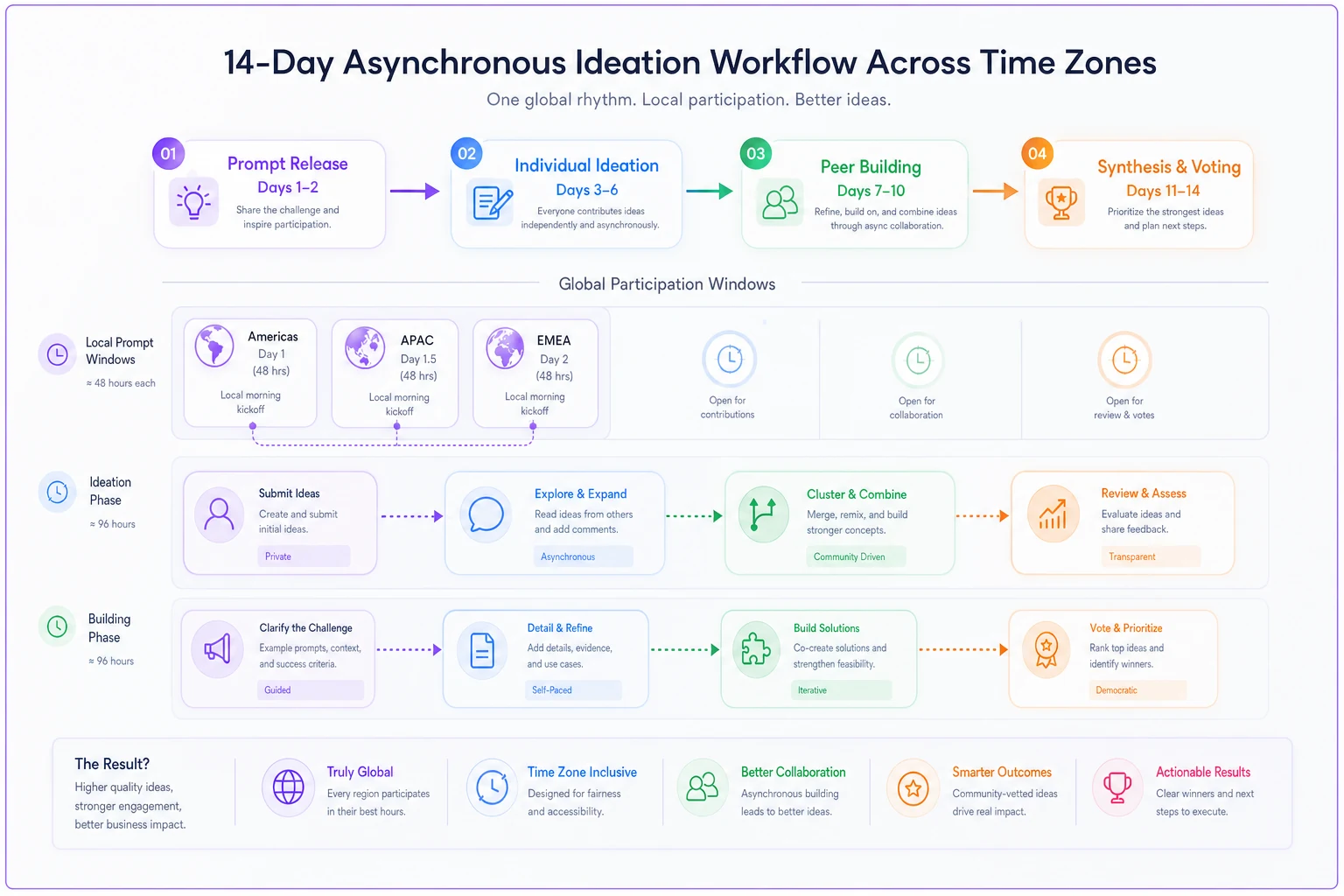
Their schedule works like this:
Days 1-2: Prompt Release Window
-
Monday 9am PST
Prompt goes live for Americas
-
Monday 5pm PST
APAC teams see prompt at start of Tuesday
-
Tuesday 1am PST
EMEA teams see prompt at start of Tuesday
Everyone gets the prompt at the beginning of their workday, with two full days to absorb and think about it before ideation begins.
Days 3-6: Individual Ideation Window
-
96-hour window for initial idea submission
-
No meetings, no calls, no synchronous pressure
-
Ideas flow in as people hit their creative peaks
Days 7-10: Peer Building Window
-
Team members can build on, combine, or fork existing ideas
-
Comments and iterations happen asynchronously
-
Natural clusters start forming around strong concepts
Days 11-14: Synthesis and Voting
-
Structured voting with clear criteria
-
Async discussion threads for clarification
-
Final synthesis document prepared by rotating leads
While San Francisco sleeps, Singapore builds on their ideas. When London wakes up, they see both contributions and add their perspective. Ideas get 24-hour continuous refinement instead of 2-hour workshop treatment.
The Prompt Library That Actually Drives Ideas
Bad prompts kill asynchronous ideation faster than any time zone challenge. When people can't clarify in real-time, vague questions produce vague ideas. Clear patterns emerge around which prompts generate actionable concepts versus philosophical rambling.
Prompts that consistently produce implementable ideas are narrow enough to be actionable but open enough to allow creative interpretation. More importantly, they include context that would normally come from discussion.
Prompt comparison from two different companies:
Weak Prompt: "How might we improve customer experience?" Strong Prompt: "Our enterprise customers take an average of 47 days from trial to purchase, with 60% dropping off during security review (days 15-25). How might we reduce friction specifically during the security review phase without compromising our SOC2 requirements? Consider: we cannot change the review requirements themselves, budget is capped at $200k for Q1 implementation, and any solution needs to work for both self-serve and sales-led motions."
The second prompt eliminates about fifteen clarifying questions that would normally eat up meeting time. People can immediately start ideating instead of wondering what "improve" means or which customers we're talking about.
A logistics company structured their prompt library into five categories:
| Prompt Type | Template | Example |
|---|---|---|
| Operational Efficiency | We currently [metric/process]. How might we [improvement] while maintaining [constraint]? | We currently spend 3.5 hours per driver on daily route planning. How might we reduce this to under 45 minutes while maintaining our 97% on-time delivery rate? |
| Customer Problem | Customers in [segment] experience [friction point] resulting in [impact]. How might we solve this without [breaking constraint]? | SMB customers experience 4-day delays getting shipping quotes for irregular items, resulting in 23% cart abandonment. How might we provide instant quotes without expanding our customer service team? |
| Revenue Expansion | Our [product] generates [current revenue] from [segment]. How might we expand revenue by [target] through [vector]? | Our API generates $2.3M annually from enterprise customers. How might we expand this by 40% through self-serve adoption without cannibalizing existing sales? |
| Cost Reduction | [Process] currently costs [amount] per [unit] due to [cause]. How might we reduce this by [target]? | Manual data entry costs $47 per order due to non-standard supplier formats. How might we reduce this by 70% while maintaining accuracy? |
| New Capability | Competitors offer [capability] which our [segment] requests [frequency]. How might we deliver similar value with [constraint]? | Competitors offer real-time inventory sync which our retailers request weekly. How might we deliver similar value with our constraint of legacy POS systems? |
Each prompt needs three supporting elements: context documentation, success criteria, and idea format requirements. The context doc provides background that would normally come from a kick-off meeting. Success criteria clarify what a good idea looks like. Format requirements ensure ideas come in comparable, actionable formats.
Context docs should answer: Why does this problem matter right now? What have we already tried? What constraints are non-negotiable? Who are the key stakeholders? What metrics define success?
Success criteria might include: Must be testable within 30 days. Must not require hiring new team members. Must improve target metric by at least 15%. Must work for both new and existing customers.
Format requirements keep submissions comparable: Problem statement (1 sentence). Proposed solution (2-3 sentences). Rough effort estimate. Key assumptions. Success metric.
Lightweight Voting and Synthesis Rituals
Traditional innovation programs love complex scoring matrices. Teams rate ideas on innovation level, feasibility, strategic alignment, risk profile, resource requirements — turning every evaluation into a PhD thesis. This completely breaks in asynchronous settings where you can't have lengthy discussions about what "feasibility" means.
Teams that make asynchronous voting work use deliberately simple mechanisms. A mobility startup reduced their evaluation to three binary questions:
-
Can we test this in under 30 days? (Yes/No)
-
Does this address one of our three strategic priorities? (Yes/No)
-
Could this plausibly affect our target metric by 10%+? (Yes/No)
Ideas need two "yes" votes to advance. No lengthy scorecards, no calibration sessions, no arguing about whether something is a 6 or 7 on the innovation scale.
Synthesis happens between voting and implementation. Raw voting identifies promising directions but doesn't create actionable plans. The synthesis ritual transforms voted ideas into implementation candidates.
The synthesis happens through structured async collaboration over 72 hours:
Hour 0-24: Clustering Phase The synthesis lead (rotates each cycle) groups similar ideas and identifies patterns. They create initial clusters with descriptive labels, not evaluative ones. "Ideas about reducing documentation" not "Good ideas about documentation."
Hour 24-48: Combination Phase Team members can suggest combinations, identify dependencies, or flag conflicts between clustered ideas. This happens through threaded comments, not meetings. Someone in Berlin might notice that two ideas from Tokyo and New York actually solve each other's implementation challenges.
Hour 48-72: Specification Phase Top clusters get turned into one-page specifications by volunteer owners. The spec includes: problem statement, proposed solution, 30-day test design, success metrics, and required resources. These specs become the input for resource allocation, not the raw ideas.
A B2B software team shared their synthesis results from last quarter: they started with 156 raw ideas, clustered into 12 themes, combined into 7 specifications, and launched 4 experiments. The whole process took two weeks with zero synchronous meetings.
Participation SLAs That Keep Momentum
Asynchronous processes die from two causes: either nobody participates because deadlines feel optional, or everyone burns out because they're constantly on-call for input. You need explicit Service Level Agreements that set expectations without creating pressure.
Minimum Viable Participation:
-
Submit at least one idea OR one build per cycle
-
Vote on at least 20% of submitted ideas
-
Participate in synthesis for owned ideas only
Response Time Commitments:
-
Prompts
Acknowledge within 48 hours
-
Voting
Complete within 72-hour window
-
Synthesis comments
Respond within 24 hours if tagged
Quality Standards:
-
Ideas must include
problem statement, proposed solution, rough effort estimate
-
Builds must add meaningful extension, not just "+1"
-
Votes must include one-sentence rationale
Make SLAs visible without making them punitive. A retail innovation team displays participation metrics on their dashboard — not to shame people but to spot when the system needs adjustment. When APAC participation dropped below 40%, they realized their prompts were consistently releasing at 6pm Singapore time. Moving release time by three hours brought participation back to 85%.
You need escape valves too. People travel, get sick, have deadlines. The SLA should include acceptable reasons to skip a cycle and a simple way to flag non-participation in advance. One team uses a simple emoji system in Slack: 🏝️ means out this cycle, 🚦 means limited participation, 🏃 means fully engaged.
Sample Schedule: 14-Day Innovation Cycle
Here's exactly how this runs in practice with a real schedule from a 50-person product team distributed across San Francisco, Austin, London, and Singapore.
Pre-Cycle (Thursday-Friday before Day 1):
-
Innovation lead prepares prompt based on strategic priorities
-
Previous cycle synthesis documents are finalized
-
Team is notified that new cycle starts Monday
Day 1-2 (Monday-Tuesday): Prompt Release
-
Monday 6am PST
Prompt posts to innovation channel
-
All teams acknowledge receipt within their working hours
-
Clarifying questions posted asynchronously
-
Innovation lead answers questions within 24 hours
Day 3-6 (Wednesday-Saturday): Individual Ideation
-
No scheduled meetings about the prompt
-
Ideas submitted to shared platform as they emerge
-
Early ideas visible to inspire others
-
Saturday included to accommodate flexible schedules
Day 7-10 (Sunday-Wednesday): Peer Building
-
Team members build on existing ideas
-
Natural idea clusters start forming
-
Comments and iterations happen continuously
-
Sunday included for those who think better on weekends
Day 11-12 (Thursday-Friday): Voting Window
-
All ideas locked for voting
-
Everyone votes on their own schedule
-
Results tallied automatically
Day 13-14 (Monday-Tuesday): Synthesis Sprint
-
Synthesis lead creates clusters
-
Team reviews and comments asynchronously
-
Final synthesis document prepared
-
Next cycle prompt prepared based on learnings
The schedule repeats every two weeks, creating predictable rhythm without meeting fatigue. Teams know exactly when they need to participate and can plan their deep work accordingly.
Templates for Async Ideation
Templates eliminate about 80% of clarifying questions and ensure ideas come in comparable formats. Every async ideation process needs these three:
Problem: [One sentence describing the specific problem] Solution: [Two sentences maximum describing your approach] Effort Estimate: [Small/Medium/Large with rough time estimate] Success Metric: [How we'll know if this worked] Inspiration: [Optional: where this idea came from] Dependencies: [What needs to be true for this to work]
Original Idea: [Link to idea you're building on] Enhancement: [What you're adding/changing] Why This Helps: [One sentence on why this makes it better] Additional Effort: [None/Minor/Significant]
Cluster Name: [Descriptive title for this group of ideas] Problem Statement: [Combined problem these ideas address] Proposed Solution: [Synthesized approach from multiple ideas] 30-Day Test: [Specific experiment we could run] Success Criteria: [Measurable outcome that proves this works] Required Resources: [People, budget, tools needed] Risk Factors: [What could go wrong] Contributing Ideas: [Links to original ideas in this cluster]
These templates should live in whatever tool your team already uses. Don't introduce new software just for templates — that kills participation. A construction company keeps theirs in Google Docs. A software startup uses Notion. A consulting firm has them as Slack workflows. The format matters less than consistency and accessibility.
One logistics company discovered their best innovations consistently came from ideas that got refined at least three times across different time zones. They started tracking "refinement depth" as a leading indicator of implementation success. Ideas that only got built on once rarely made it to production. Ideas with 4+ refinements had an 87% implementation rate.
Making Global Teams More Creative Than Local Ones
Asynchronous ideation isn't a compromise necessitated by distributed teams — it's actually superior to traditional brainstorming for generating implementable innovations. The forced structure, extended thinking time, and written documentation create better outcomes than any workshop.
A distributed insurance team tracked their metrics across six months. Their asynchronous process generated 3x more ideas per person than their previous quarterly workshops. Implementation rate jumped from 12% to 34%. Ideas were more refined, better documented, and had natural owners from the building phase.
The 24-hour idea refinement cycle means concepts get stress-tested across cultural contexts and time zones before implementation. An idea from Austin gets refined by Singapore's operational perspective and London's regulatory awareness. This natural filtering produces ideas that work globally, not just at headquarters.
You avoid the pitfalls of synchronous ideation too. No more dominant voices drowning out introverts. No more recency bias where the last idea mentioned wins. No more performance anxiety killing creativity. People contribute when they're at their cognitive peak, not when the calendar says they should be creative.
The documentation trail becomes invaluable for learning. You can trace exactly how a successful innovation evolved from initial prompt through synthesis to implementation. This visibility would be impossible in traditional brainstorming where insights get lost in verbal discussion.
Modern AI-powered operational software makes managing these complex cycles much easier. Instead of manually tracking participation, clustering ideas, and managing voting windows, platforms can automate the administrative burden while humans focus on actual creative thinking. The software handles the coordination logistics while preserving the human creativity and judgment that drives actual innovation.
Modern AI-powered operational software makes managing these complex cycles much easier. Instead of manually tracking participation, clustering ideas, and managing voting windows, platforms can automate the administrative burden while humans focus on actual creative thinking. The software handles the coordination logistics while preserving the human creativity and judgment that drives actual innovation.
When Async Ideation
Ready to transform your innovation process?
Join 2,000+ companies using GoIdeafy to unlock team creativity, prioritize impactful ideas, and accelerate growth.