



Three months ago, a consumer electronics company discovered their Berlin office had spent eight weeks developing almost the exact same supply chain optimization tool that their Taiwan team launched internally back in January. Different names, different interfaces, nearly identical functionality. Combined development cost: $280,000. Value if they'd shared from the start: probably double the impact at half the cost. This wasn't a communication failure. Both teams posted updates in the company innovation portal. They attended the monthly innovation calls. The Berlin team even did a search for similar projects. The problem ran deeper—their innovation governance models created blind spots that made this duplication inevitable.
The structural problem hiding in plain sight
Innovation governance models fail in predictable ways once organizations hit certain thresholds. Not because people stop collaborating, but because the governance structure itself creates information bottlenecks and decision delays that push teams to work around the system rather than through it.
The pattern usually emerges around 400-500 employees, accelerates at 1,000, and becomes critical by 2,000. Teams start building "quick fixes" that duplicate existing work. Innovation committees get overwhelmed evaluating proposals. Regional teams develop their own evaluation criteria that make cross-unit collaboration nearly impossible.
A pharmaceutical company with 1,400 employees recently mapped their actual innovation flow versus their official governance structure. The official structure showed ideas flowing up through business units to a central committee, then resources flowing back down. The actual flow? Seventy percent of innovation happened through informal networks, unofficial budgets, and creative interpretations of existing project scopes.
Their governance model had become decoration while real innovation found its own paths. The fundamental tension: you need enough structure to prevent chaos and duplication, but not so much that teams route around the system to get anything done. Most organizations swing between these extremes every 18-24 months, never quite finding balance.
Centralized governance and its breaking points
Centralized innovation governance puts decision-making authority in one place—typically a committee or dedicated innovation team. Every significant idea goes through the same evaluation process, uses the same criteria, competes for the same resource pool.
Capture, evaluate, and act on ideas without friction.
GoIdeafy streamlines the entire innovation lifecycle from idea submission to implementation.
- Centralized idea capture
- Collaborative evaluation tools
- Progress tracking & analytics
No credit card required
When centralization actually works
Small to mid-size organizations often thrive with centralized models. A medical technology firm with 380 employees runs all innovation through a five-person committee that meets weekly. Their entire innovation portfolio—usually 8-12 active projects—fits on a single dashboard. The committee knows every project intimately and can shift resources between initiatives within days. This same company tried maintaining centralized governance as they grew to 600 employees. The weekly meetings stretched to three hours. The project pipeline backed up. Teams started labeling innovation work as "process improvement" to avoid committee review. By 750 employees, they'd functionally abandoned centralization even while maintaining its structure on paper.
Building a centralized charter that lasts
Effective centralized charters need five components, but most organizations only build three:
Decision Authority Matrix Define who can approve what without committee review. A logistics company sets these thresholds:
-
Under $5k
Direct manager approval
-
$5k-25k
Innovation lead approval
-
$25k-100k
Committee approval required
-
Over $100k
Executive sponsor needed
Evaluation Framework Skip the complex scoring matrices. A software company uses three questions:
-
Does this solve a problem affecting 100+ users or customers?
-
Can we build a prototype in under 60 days?
-
Will the solution work in at least two business units?
Two "yes" answers trigger fast-track approval.
Resource Allocation Rules Pre-assign resources to avoid negotiation paralysis:
-
40% to customer-facing improvements
-
30% to operational efficiency
-
20% to new capability development
-
10% to experimental/moonshot projects
Knowledge Capture Requirements Every project, regardless of outcome, documents three things:
-
What we tried
-
What broke
-
What we'd do differently
Escalation Triggers Automatic escalation when:
-
Budget overrun exceeds 25%
-
Timeline slips past 45 days
-
Cross-unit dependencies emerge
-
Compliance concerns surface
Sample centralized RACI
| Activity | Committee | Sponsor | Team Lead | PMO | Finance |
|---|---|---|---|---|---|
| Idea evaluation | Accountable | Consulted | Responsible | Informed | Consulted |
| Resource approval | Accountable | Informed | Consulted | Responsible | Responsible |
| Implementation | Informed | Accountable | Responsible | Responsible | Informed |
| Scaling decision | Accountable | Responsible | Consulted | Responsible | Consulted |
| Performance review | Accountable | Responsible | Responsible | Informed | Informed |
The key: limit "Accountable" assignments. When everyone's accountable, nobody is.
Federated governance: distributed power, multiplied problems
Federated models give each business unit or region their own innovation governance. Like giving every department their own credit card—it speeds up purchasing but complicates expense tracking.
The federation sweet spot
Organizations between 1,000-5,000 employees often find federated models reduce innovation friction without losing complete control. An industrial equipment manufacturer with 2,800 employees gives each of their six business units $150k-$300k annual innovation budget. Units can approve projects up to $50k independently, collaborate on projects up to $150k, and only need corporate approval above that threshold.
In two years, they launched 127 improvements versus 31 in the previous two years under centralized governance. But they also had eleven duplicate projects and four instances where units solved the same problem incompatibly, making enterprise-wide rollout impossible.
Federation charter essentials
Autonomy boundaries Define clear lanes:
-
What each unit can decide alone
-
What requires peer consultation
-
What triggers corporate involvement
-
What remains centrally controlled
A chemical company uses revenue percentage: units can invest up to 1.5% of their annual revenue in innovation without corporate approval, but must report quarterly on portfolio performance.
Coordination mechanisms Federation without coordination becomes chaos. Successful companies build forcing functions:
-
Monthly virtual innovation showcases (30 minutes, 3 units present)
-
Quarterly in-person innovation summit
-
Shared project database with tagging requirements
-
Innovation leader rotation program (6-month assignments)
-
Mandatory cross-unit pilot participation (each unit must partner quarterly)
Minimum viable standards Every unit must maintain:
-
Public innovation pipeline
-
Quarterly outcome reporting
-
Monthly knowledge sharing session
-
Standard evaluation criteria (can add local criteria but not remove core ones)
-
10% of budget reserved for cross-unit initiatives
Federated RACI structure
| Activity | Corporate | Unit Leadership | Innovation Team | Other Units |
|---|---|---|---|---|
| Strategy alignment | Accountable | Responsible | Consulted | Informed |
| Local innovation | Informed | Accountable | Responsible | Informed |
| Cross-unit projects | Consulted | Accountable | Responsible | Responsible |
| Resource allocation | Consulted | Accountable | Responsible | — |
| Best practice sharing | Responsible | Accountable | Responsible | Consulted |
The twist that makes federation work: rotating accountability for cross-unit coordination. Each quarter, a different unit leads enterprise knowledge sharing.
Federation failure patterns
The silo spiral: Units optimize locally, creating incompatible solutions. A retail chain's regional units each built their own inventory prediction models. None could share data with others, forcing corporate to maintain four separate systems.
The innovation inequality: Well-funded units innovate while struggling units fall behind. Strong units get stronger through innovation while weak units can't invest in improvement, widening performance gaps.
The knowledge hoarding: Units treat innovations as competitive advantages against other units rather than shared assets. A transportation company's midwest region hid their route optimization solution for six months to maintain their performance lead.
Hybrid governance: complex but occasionally worth it
Hybrid models split innovation governance between central control for strategic initiatives and local control for incremental improvements. Think of it as running two parallel innovation systems that occasionally intersect.
Making hybrid models work
The only organizations that successfully run hybrid models have clear classification systems. A technology services company with 1,600 employees uses three categories:
Transform: Enterprise-wide, strategic, over $250k
-
AI platform implementation
-
New service line development
-
Major technology shifts
-
Centrally governed, CEO sponsors
Enhance: Multi-unit improvements, $50k-$250k
-
Customer experience upgrades
-
Process standardization
-
Shared tool development
-
Jointly governed, rotational leadership
Improve: Single-unit changes, under $50k
-
Local workflow optimization
-
Team-specific tools
-
Regional customization
-
Locally governed, unit discretion
Projects can move between categories as scope becomes clear. What starts as a local improvement might reveal enterprise potential and shift to central governance.
Hybrid charter requirements
Classification triggers Define exactly when projects shift categories:
-
Budget threshold exceeded
-
Multiple units express interest (define "interest")
-
Strategic implications emerge (be specific)
-
Compliance/risk issues surface
-
Technology dependencies identified
Dual reporting structures Hybrid models need two parallel reporting paths:
-
Local innovations report to unit leadership monthly
-
Strategic innovations report to executive committee monthly
-
Both feed quarterly board updates
-
Annual portfolio review combines both streams
Resource allocation formula Split innovation resources explicitly:
-
60% to strategic initiatives (centrally managed)
-
30% to local improvements (unit managed)
-
10% to experimental projects (either path)
A financial services firm adjusts these percentages annually based on previous year's ROI from each category.
Hybrid model RACI
| Activity | Strategic Path | Local Path | Transition Points |
|---|---|---|---|
| Central team | Accountable | Informed | Accountable |
| Unit leadership | Responsible | Accountable | Responsible |
| Project teams | Responsible | Responsible | Consulted |
| PMO | Responsible | Consulted | Responsible |
| Finance | Consulted | Informed | Responsible |
The critical element: transition points need different governance than either path. Many hybrid models fail because nobody owns the classification and transition process.
Escalation paths that prevent bottlenecks
Most escalation paths fail because they rely on project teams to self-report problems. Teams naturally resist escalating—it feels like failure. By the time issues surface, they're often unfixable.
Automatic escalation triggers
Level 1 (Team to Department)
-
Budget variance exceeds 15%
-
Timeline slips 3+ weeks
-
Key resource becomes unavailable
-
Scope creep exceeds 20%
Resolution window: 72 hours Authority: Department head can reallocate within department
Level 2 (Department to Business Unit)
-
Budget variance exceeds 30%
-
Timeline slips 6+ weeks
-
Cross-department conflict emerges
-
Original success metrics become unachievable
Resolution window: 5 business days Authority: BU leadership can reallocate across departments
Level 3 (Business Unit to Executive)
-
Project failure imminent
-
Strategic misalignment identified
-
Major compliance risk emerged
-
Investment exceeding 2x original budget
Resolution window: Next executive meeting Authority: CEO or designated executive committee
Escalation velocity metrics
-
Level 1 to Level 2
Should happen within 10 days maximum
-
Level 2 to Level 3
Should happen within 15 days maximum
-
Level 3 to resolution
Should happen within 5 days maximum
A telecom company discovered their average Level 1 to Level 2 escalation took 47 days—problems festered for over a month before getting proper attention. They added automatic triggers and cut this to 8 days.
Visualising the escalation workflow helps spot bottlenecks and clarify handoffs.
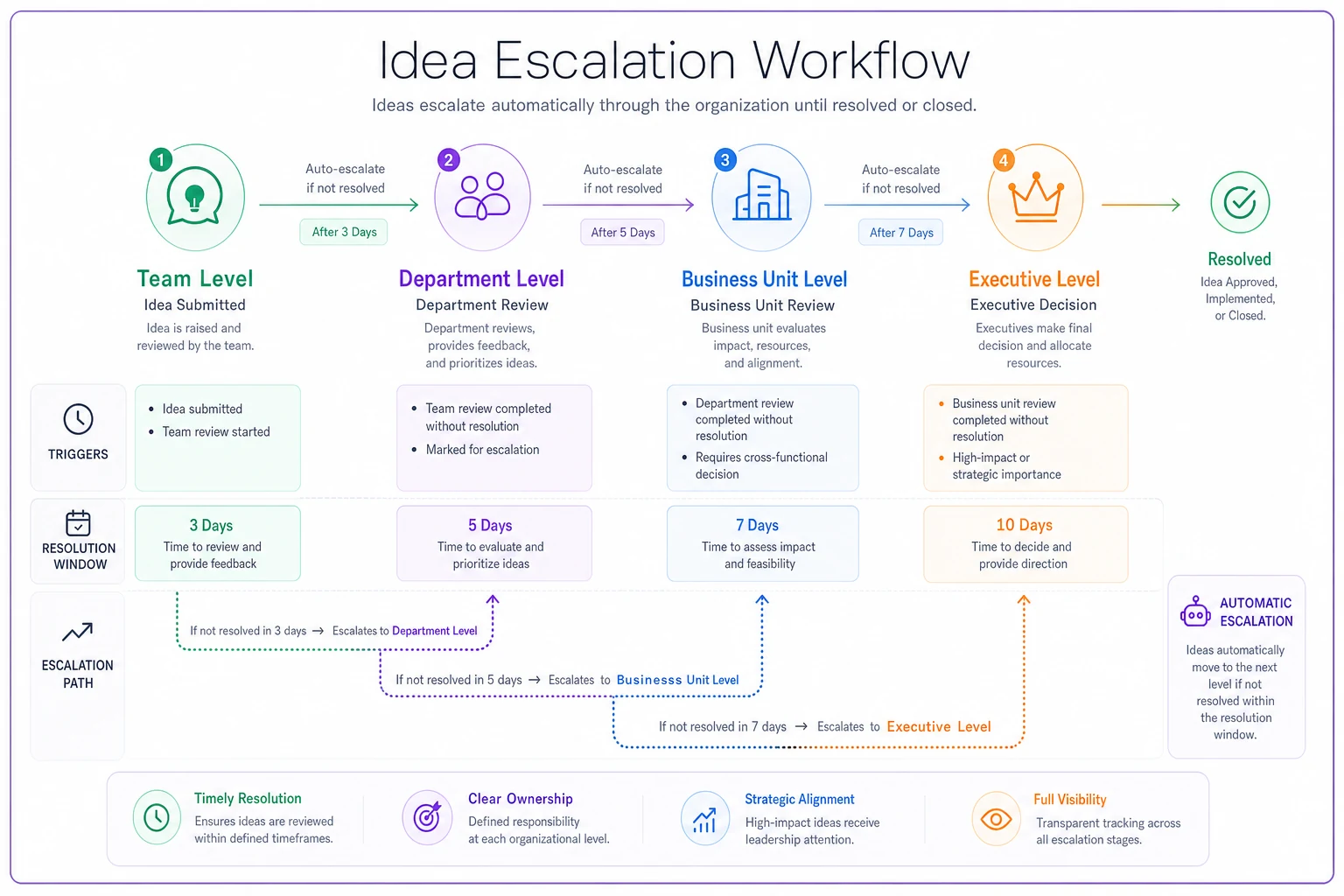
Use escalation velocity metrics to measure and improve how quickly issues move between levels.
The governance model decision matrix
Choose your model based on organizational reality, not aspiration:
Centralized works when:
-
Under 500 employees
-
Single primary business model
-
Innovation budget under $2M annually
-
Need rapid strategic pivots
-
Building initial innovation capability
-
Strong cultural alignment exists
Federated works when:
-
1,000-5,000 employees
-
Multiple distinct business units
-
Geographic distribution significant
-
Local market knowledge critical
-
Innovation maturity varies by unit
-
Cultural differences between units
Hybrid works when:
-
750-3,000 employees
-
Mix of strategic and incremental innovation
-
Some units mature, others developing
-
Both transformation and optimization needed
-
Resources for parallel governance paths
-
Strong program management capability exists
Red flags you've chosen wrong:
Centralized breaking:
-
Committee meetings exceed 3 hours
-
Innovation backlog exceeds 30 proposals
-
Shadow projects proliferating
-
Talent hoarding in central team
Federated breaking:
-
Duplicate solutions emerging
-
Knowledge sharing declining
-
Innovation inequality growing
-
Integration costs escalating
Hybrid breaking:
-
Classification disputes constant
-
Projects stuck in transition
-
Dual reporting creating conflicts
-
Resource allocation unclear
Selecting the wrong model creates measurable operational drag; watch for these signals and adjust quickly.
How AI-powered platforms reduce governance overhead
Innovation governance isn't really about making decisions—it's managing information flow that enables good decisions. Scaling organizations see coordination overhead grow exponentially. Every new project creates dependencies, every new team member adds communication paths, every new unit multiplies complexity.
AI-powered operational software addresses this by automating the administrative layer that typically consumes most governance effort. Not the decisions themselves, but the information gathering, routing, tracking, and reporting that enables decisions.
A consumer goods company avoided twelve duplicate projects in six months using automated similarity scoring. Natural language processing analyzes new proposals against existing project database, flagging potential duplicates before teams waste months on parallel development.
Proposals automatically route to appropriate evaluators based on content analysis, not manual classification. Technical proposals reach technical reviewers, market-facing ideas get commercial assessment, all without human intervention. Progress summaries generate from existing project management tools, code repositories, and communication platforms automatically. Governance committees review exceptions and decisions, not status updates.
As projects evolve, automated systems continuously map dependencies between initiatives, flagging when separate projects begin affecting shared resources or systems. This prevents the surprise conflicts that delay launches. Post-project reviews get automatically analyzed to extract lessons learned, which inform future similar projects. Failed experiments become institutional knowledge without manual documentation.
Organizations using AI-enhanced governance platforms typically see measurable improvements: evaluation cycles drop from weeks to days, duplicate projects decrease significantly, and governance committees spend most time on strategic decisions rather than administrative review.
Use similarity scoring early in the proposal intake process to prevent duplicate projects before they start.
The key isn't replacing human judgment but eliminating the friction that makes governance feel like bureaucracy. When information flows automatically and accurately, governance becomes strategic enablement rather than operational bottleneck.
The evolution path most organizations follow
Organizations rarely get governance right initially. The typical progression follows predictable stages:
Months 1-6: Organic emergence Innovation happens wherever enthusiasm exists. No formal governance, just motivated individuals driving projects. Some succeed brilliantly, others fail quietly, most duplicate effort unknowingly.
Months 7-12: Control reaction Leadership sees chaos and implements strict centralized control. Every idea needs approval, every project needs oversight. Innovation velocity drops precipitously. Shadow projects emerge.
Months 13-24: The loosening Recognizing the bottleneck, organizations add autonomous elements. Some units get budgets, some projects get fast-tracked. Coordination challenges emerge as different groups optimize locally.
Months 25-36: Finding balance The right model emerges through iteration. Clear boundaries develop, escalation paths solidify, teams learn the system. Innovation becomes operational rhythm rather than special initiative.
Months 37+: Continuous adjustment Governance evolves with organizational growth. What worked at 500 employees needs adjustment at 1,000. Regular reviews and modifications keep the model relevant.
A software company compressed this timeline by starting with hybrid governance and clear metrics from day one. Instead of reacting to problems, they anticipated stage transitions and adjusted proactively. Their innovation velocity never dropped below 80% of peak, while most organizations see significant drops during governance transitions.
Making governance sustainable
The best innovation governance models share three characteristics that enable long-term sustainability. First, they match organizational reality rather than organizational charts. If your sales team operates independently from product development, your governance model should reflect that separation rather than force artificial collaboration.
Second, they minimize administrative burden through systematic automation. When humans focus on judgment and strategy rather than tracking and reporting, innovation maintains momentum even as complexity grows. Third, they build in evolution mechanisms. Regular reviews, clear modification triggers, and feedback loops ensure governance adapts rather than calcifies.
The difference between organizations that innovate consistently and those that struggle isn't creativity or resources—it's governance models that enable rather than constrain. Get the structure right, and innovation becomes sustainable capability. Get it wrong, and watch good ideas die in committee rooms while competitors move faster with inferior concepts but better coordination.
The path forward depends on honest assessment of your organizational reality, commitment to reducing friction through operational improvements, and willingness to evolve as you grow. Most importantly, it requires recognizing that governance serves innovation, not the other way around.
The path forward depends on honest assessment of your organizational reality, commitment to reducing friction through operational improvements, and willingness to evolve as you grow. Most importantly, it requires recognizing that governance serves innovation, not the other way around.
Ready to transform your innovation process?
Join 2,000+ companies using GoIdeafy to unlock team creativity, prioritize impactful ideas, and accelerate growth.