


Most employee suggestion experiments fail before they even start. Not because the ideas are bad, but because the path from "hey, what if we tried..." to actual testing takes three months of meetings, approval chains, and bureaucratic death-by-committee.
Last month I watched a retail chain's innovation team review 47 employee suggestions from Q3. By the time they finished their formal evaluation process, the seasonal opportunity for 12 of those ideas had already passed. The warehouse team's suggestion about holiday fulfillment routing? Finally approved in January. The customer service rep's idea about Black Friday chat responses? Green-lit right before Christmas.
Companies don't lack good employee ideas. They just treat a simple experiment suggestion like it's a million-dollar capital investment proposal.
The Triage Layer Most Companies Skip Entirely
What kills employee suggestion experiments before they start? Treating every idea like it needs the same level of scrutiny.
A cashier suggesting a different greeting script doesn't need the same evaluation process as an engineer proposing a new product line. Yet most innovation programs funnel everything through identical review stages. The fastest-moving companies use a simple triage system that sorts ideas in under 10 minutes:
-
Immediate Test Territory (can run tomorrow)
- Changes nothing permanent - Costs under $500 - Affects fewer than 50 customers - Reversible in one day - One person can execute alone
-
Quick Validation Needed (can test within 72 hours)
- Minor process adjustments - Costs $500-$2000 - Affects one department - Reversible within a week - Needs 2-3 people involved
-
Full Review Required (standard process)
- System changes - Costs over $2000 - Cross-department impact - Hard to reverse - Needs multiple approvals
A support agent at a software company suggested changing their password reset email subject line from "Reset Your Password" to include the company name. Classic immediate test territory. Instead of waiting for the monthly innovation review, they changed it that afternoon. Password reset completion jumped 23% because customers stopped thinking it was spam.
Another company would've put the same suggestion through: innovation submission form → monthly review meeting → IT approval → legal review → implementation planning → quarterly roadmap. Four months for a subject line change.
Fast Validation Without the Spreadsheet Marathon
Once an idea passes triage, most companies either skip validation entirely or build elaborate business cases. Both approaches miss the point.
Capture, evaluate, and act on ideas without friction.
GoIdeafy streamlines the entire innovation lifecycle from idea submission to implementation.
- Centralized idea capture
- Collaborative evaluation tools
- Progress tracking & analytics
No credit card required
You need just enough validation to know if testing makes sense. Not a PowerPoint deck. Not a financial model. Just answers to four questions that actually matter. The validation checklist that actually works:
-
1. Can we measure success in under 2 weeks? If you can't tell whether something worked within 14 days, the experiment design is wrong. A restaurant server suggested offering dessert samples while delivering the check. They tracked dessert sales for two weeks. Clear metric, fast feedback.
-
2. What breaks if this fails completely? Not "what could go wrong" but "what actually breaks." A manufacturing team wanted to test a new quality check sequence. The worst case? They'd need to re-inspect one day's production. Manageable. Green light.
-
3. Who loses money/time/reputation? Be specific. A customer success manager wanted to test proactive check-in calls to quiet accounts. Who loses if it backfires? The CSM loses 10 hours. Three customers might get annoyed. The company risks nothing. Run it.
-
4. Can we stop mid-experiment? If you can't pull the plug halfway through, it's not an experiment. A retail employee suggested playing different music in fitting rooms versus the main floor. They could revert in seconds if customers complained.
This isn't about building consensus or covering your back. It's about spending 20 minutes to avoid wasting 20 days.
Micro-Experiment Templates That Skip the Guesswork
The biggest friction in running employee suggestion experiments? Employees don't know how to design experiments. They know their idea might help. They don't know how to prove it.
Instead of sending them to read books on A/B testing, give them templates that already work.
The "Different Words" Template What changes: Email subject, script, signage, button text Duration: 5-10 business days Measure: Click rate, response rate, conversion Sample size needed: 100-500 interactions A bank teller suggested changing "May I help you?" to "What brings you in today?" They tested it for a week, tracking product inquiries. The new phrase triggered 3x more conversations about additional services. Total experiment design time: 10 minutes using the template.
The "Different Timing" Template What changes: When something happens Duration: 2 weeks minimum Measure: Response rate, completion rate, satisfaction Sample size needed: Same volume, different schedule A warehouse worker suggested moving safety briefings from 6 AM to 6:10 AM, after everyone had coffee. They tested it for two weeks, tracking incident reports and briefing attendance. Incidents dropped 40%, attendance went up 15%. The template made it clear they needed two full weeks of data, not just a few days.
The "Different Sequence" Template What changes: Order of steps Duration: 50-100 complete cycles Measure: Time to completion, error rate, drop-off Sample size needed: Enough for 50 cycles each way A hotel front desk employee suggested checking guests in before taking payment, reversing the usual order. The template specified they needed 50 check-ins each way. Result: 2-minute faster check-ins, 60% fewer payment issues because guests were less rushed.
The "Add One Thing" Template What changes: One additional step/item/option Duration: 1-2 weeks Measure: Uptake rate, impact on main metric Sample size needed: 200-300 opportunities A coffee shop barista suggested mentioning the seasonal drink special while taking orders, not just relying on signs. The template helped them track 200 orders with and without the mention. Seasonal drink sales jumped 28% when mentioned.
Keep a short library of these templates where employees can copy and paste to speed experiment setup.
These templates remove the experiment design barrier. Employees focus on their idea, not on becoming data scientists.
Go/No-Go Rules That End Analysis Paralysis
After running the experiment, most companies get stuck in analysis paralysis. The data shows improvement, but is it enough? Should we roll it out to one location or all locations? What if the sample size was too small?
Clear go/no-go rules set before the experiment starts eliminate this friction.
-
Automatic Green Light Rules - Primary metric improves 15%+ with no negative secondary effects - Cost neutral or positive with 5%+ improvement in experience metric - Reduces time/effort by 20%+ with same or better outcome - Fixes a compliance/safety issue regardless of other metrics
-
Automatic Red Light Rules - Customer complaints increase by any measurable amount - Employee injury/stress increases at all - Primary metric drops or stays flat - Creates downstream problems that offset gains
-
Extended Testing Required - Improvement between 5-15% (run for 2 more weeks) - Positive primary metric but negative secondary metric - Strong results but sample size under minimum - Seasonal/contextual factors might skew results
A grocery store deli employee suggested pre-slicing popular lunch meats during slow morning hours. The experiment showed 30% faster service during lunch rush, no increase in waste. Automatic green light. No committee needed. They rolled it out the next week.
Another store tested having cashiers bag groceries differently. 8% faster checkout, but 3x more customer complaints about bruised produce. Automatic red light. Killed immediately.
These rules need to be decided before the experiment runs, not after you see the results. Otherwise you'll rationalize your way into or out of anything.
Why Traditional Innovation Programs Miss Employee Gold
Corporate innovation pipelines treat employee suggestions like venture capital pitches. Committee reviews, ROI projections, stakeholder alignments. By the time you've proven the idea is worth testing, the employee who suggested it has either forgotten about it or left the company.
Employee suggestion experiments work best when they move at the speed of actual operations, not strategic planning.
A restaurant chain switched from quarterly innovation reviews to weekly micro-experiments. Their previous system: employees submitted ideas through a portal, innovation committee reviewed them quarterly, approved ideas went to department heads for implementation planning, pilot programs launched 4-6 months after submission.
| Result |
|---|
| 12 quarterly reviewed ideas → 156 tested experiments |
| 6-month implementation → 48-hour testing |
| 8% adoption rate → 34% successful experiments scaled |
| 3 employee submissions per month → 47 per month |
The quality of ideas didn't change. The friction disappeared.
Building the Actual Pipeline
The full funnel that makes employee suggestion experiments actually work:
-
Hour 0-1
Submission and Triage
Employee submits idea through any channel (email, Slack, conversation). Manager uses triage criteria to categorize immediately. Immediate test territory goes straight to validation. Others follow standard process. -
Hour 1-4
Fast Validation
Person who will run the experiment answers the four validation questions. If all pass, move forward. If any fail, either adjust the experiment design or table it. -
Hour 4-8
Experiment Design
Select appropriate template. Fill in the specific details. Define exact metrics and measurement method. Set start date within 48 hours. -
Day 2-14
Run Experiment
Execute according to template. Collect data daily. No analysis until complete. No early stopping unless something breaks. -
Day 14
Go/No-Go Decision
Apply pre-set rules. Make decision immediately. Communicate result to suggester same day. -
Day 15+
Scale or Stop
If go: implement at appropriate scale. If no-go: document learning and move on. If extended testing needed: run for specified additional period.
The entire cycle from idea to decision takes two weeks maximum. Most traditional programs take two weeks just to schedule the first review meeting.
Here's a visual you can use to explain the pipeline to managers and teams.
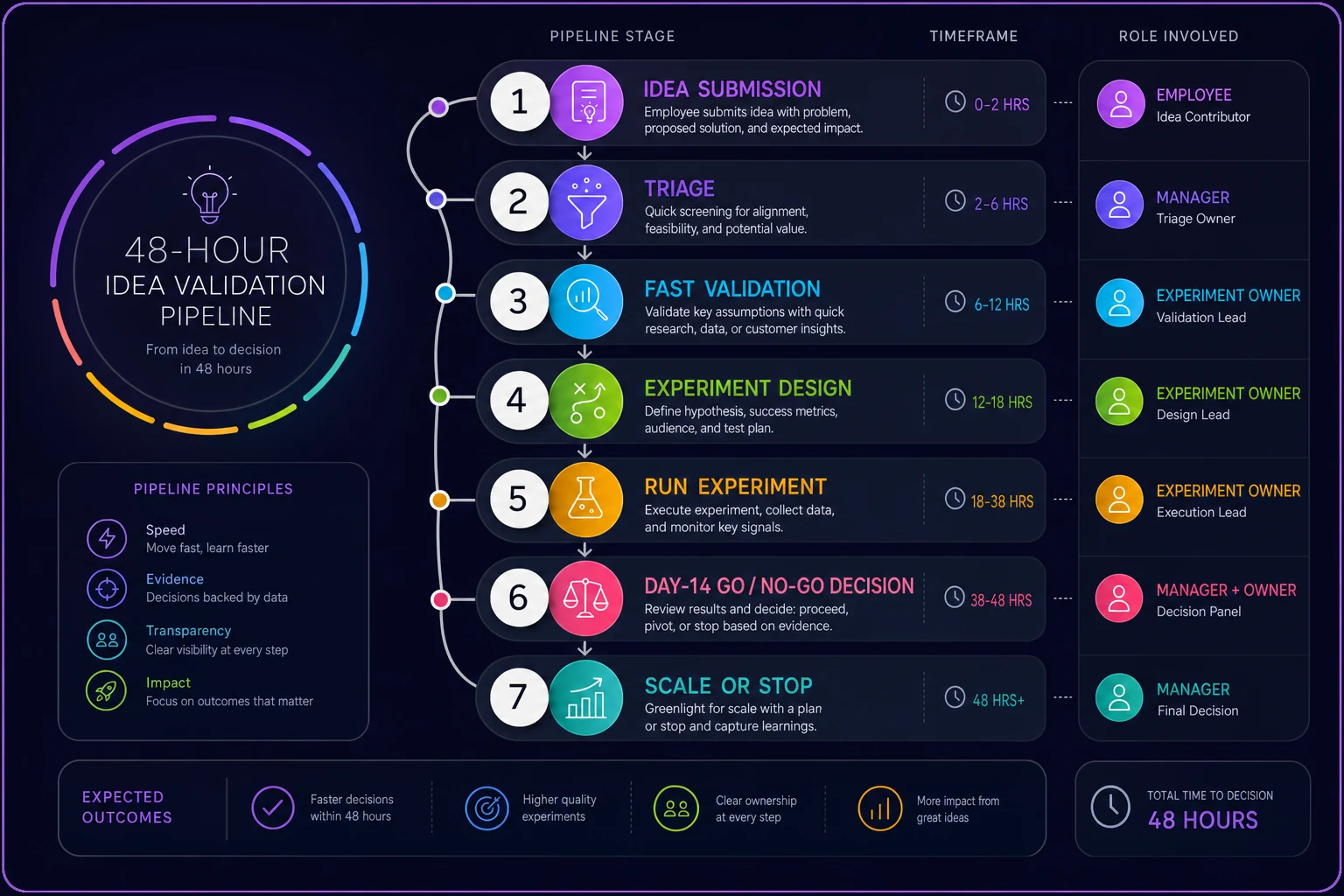
The whole point: move from idea to decision in two weeks, not two months.
Common Failure Points and Fixes
Even with a lightweight funnel, certain patterns kill employee suggestion experiments repeatedly.
-
The Perfectionist Trap Teams spend weeks perfecting the experiment design instead of running a rough test. A call center wanted to test a new greeting. They spent three weeks debating the exact wording, creating training materials, setting up complex tracking. By week four, the employee who suggested it had given up. Fix: Use templates, cap design time at 4 hours.
-
The Authority Vacuum Nobody knows who can actually approve a micro-experiment. Every manager assumes they need their boss's permission. A simple change bounces between five people before someone makes a decision. Fix: Anyone who manages 3+ people can approve experiments under $500. Period.
-
The Measurement Theater Companies create elaborate dashboards for experiments that run for one week. A retailer built a custom analytics setup to track a two-week test of checkout lane configurations. The setup took longer than the experiment. Fix: Use existing metrics. If you can't measure it with current tools, simplify the experiment.
-
The "Not Invented Here" Resistance Middle managers resist employee ideas because they didn't think of them first. They find reasons why experiments won't work or aren't necessary. Fix: Measure managers on experiments run, not just successful outcomes. Make experimentation part of their performance metrics.
Fixes are straightforward but require leadership to accept small, reversible risks and to change approval norms.
When This Approach Actually Makes Sense (And When It Doesn't)
This lightweight funnel works when you have:
-
Employees who interact directly with operations daily
-
Processes that can change without system overhauls
-
Managers empowered to make small decisions
-
Metrics you already track
It fails when:
-
Your compliance requirements mandate extensive documentation
-
Changes require union negotiations
-
Your operations are life-critical (healthcare, aviation)
-
You have no measurement infrastructure at all
A dental office successfully used this approach for scheduling, patient communication, and waiting room improvements. They couldn't use it for anything involving actual dental procedures or medical records.
A construction company applied it to tool organization, break schedules, and safety briefings. They kept their standard process for anything involving actual construction methods or materials.
Know where the boundaries are before you start.
The Workflow Automation Angle Most Companies Miss
The biggest bottleneck in employee suggestion experiments isn't approval or design—it's coordination. Someone suggests an idea on Tuesday, the manager approves it Wednesday, but then nothing happens for two weeks because nobody tracked it, assigned ownership, or set deadlines.
AI-powered operational software changes this entirely. Not by replacing human judgment, but by eliminating the administrative quicksand that kills momentum.
A distribution center started using an operational platform with built-in experiment tracking. Employee submits idea through a simple form, system automatically routes to appropriate manager based on experiment type, manager gets notification with pre-filled validation checklist, approval triggers automatic task creation for experiment setup, daily data collection reminders go to designated person, and results dashboard updates in real-time.
What used to require six spreadsheets, twelve emails, and three check-in meetings now happens automatically. The platform doesn't make decisions—it just ensures decisions actually get made.
This reduction in coordination overhead means experiments that would've died from lack of follow-up actually run. Managers spend time evaluating results, not chasing down status updates.
Making It Actually Stick
Rolling out a lightweight experiment funnel sounds simple. Getting it to actually work requires fixing the invisible friction points.
Start with one department, not company-wide. Pick a team that already suggests lots of ideas informally. They'll provide natural momentum while you work out the kinks.
Train managers on the templates first, before announcing to employees. If managers don't understand how to run micro-experiments, employee enthusiasm hits a brick wall immediately.
Run your first 10 experiments yourself before scaling. You'll discover which templates need adjustment, which validation questions don't work, and which go/no-go rules need refinement.
Track everything but report selectively. Collect data on every experiment, but only share highlights initially. Information overload kills new programs faster than lack of information.
Celebrate fast failures as much as successes. An employee suggested reorganizing inventory shelves. The experiment showed no improvement. The company celebrated it anyway—they learned something in one week instead of arguing about it for six months.
The goal isn't to run hundreds of experiments. It's to turn employee observations into tested improvements faster than your competition can schedule a meeting about maybe considering the possibility of potentially evaluating the idea.
Most employee suggestions die in committee. The ones that survive take months to implement. This funnel changes that timeline from months to days, from committees to quick tests, from theoretical debates to actual data.
Your employees see operational problems and opportunities every single day. They just need a way to test solutions that doesn't require a master's degree in project management and political navigation. This funnel provides that path.
Most employee suggestions die in committee. The ones that survive take months to implement. This funnel changes that timeline from months to days, from committees to quick tests, from theoretical debates to actual data.
Your employees see operational problems and opportunities every single day. They just need a way to test solutions that doesn't require a master's degree in project management and political navigation. This funnel provides that path.
Ready to transform your innovation process?
Join 2,000+ companies using GoIdeafy to unlock team creativity, prioritize impactful ideas, and accelerate growth.