



The gap between "we validated this" and "the delivery team knows what to build" is where most innovation programs quietly bleed value. You did the hard part — ran the experiments, killed the assumptions that didn't hold, found the two or three that did. Then the idea moves to a product squad, a business-unit owner, or an implementation team, and within a month someone in that room is asking the exact question your validation already answered.
That's the failure mode this piece is about. Not governance, not scoring, not intake. Just the transfer itself — the moment a validated concept leaves the people who learned things about it and lands with people who didn't. The goal is a tight, repeatable idea handoff template: one page, a 30‑minute sync, and a readiness checklist that stops learnings from evaporating in the move.
Why Validation Learnings Evaporate in the Handoff
Validation produces a lot of tacit knowledge. Half of what you learned in a pilot never made it into a slide. It lives in the head of the person who ran three customer interviews and noticed that everyone hesitated at the same step. It lives in the Slack thread where someone said "actually the pricing test was inconclusive, we only got 11 responses." It lives in the throwaway comment about why you dropped variant B.
-
The "validated" label travels but the confidence level doesn't. The receiving team treats a weak signal (11 survey responses) the same as a strong one (three completed paid pilots).
-
Risks get dropped because they're inconvenient. The validation team knew about a compliance blocker but it wasn't "their problem" to solve, so it never crossed the transfer boundary.
-
Success metrics quietly change definition. What "adoption" meant during validation and what it means to the delivery team are two different numbers, and nobody notices until the QBR.
-
Open questions are treated as answered. Anything not explicitly flagged as unresolved gets assumed to be resolved.
The core issue: handoffs optimize for volume of information (a big deck) instead of fidelity of the decisions and the uncertainty around them.
The Real Cost, in Rough Numbers
Take a mid-size company running 15–20 validated ideas through to delivery in a year. If even a third of those handoffs lose enough context to trigger re-work, you're looking at teams spending two to four weeks each rediscovering what was already known.
Capture, evaluate, and act on ideas without friction.
GoIdeafy streamlines the entire innovation lifecycle from idea submission to implementation.
- Centralized idea capture
- Collaborative evaluation tools
- Progress tracking & analytics
No credit card required
A typical example: a validated internal-tooling idea handed to a platform team. The validation work had already established that only two of five proposed features drove any measurable time savings. That nuance didn't make the transfer. The platform team scoped all five, built for a quarter, and shipped three features nobody used. Call it 8–10 engineering weeks on work the validation data had already told them to skip — somewhere in the range of $40k–$60k loaded cost, plus whatever else that team could've shipped instead.
None of it was a hard problem. It was a transfer problem. The learning existed. It just didn't make it across the wall.
The One‑Page Handoff Packet
Resist the urge to make this comprehensive. The whole point is that it fits on one page, because a one‑page document forces you to write down only what the next team actually needs to make good decisions. If it sprawls to four pages, people skim it, and skimming is how nuance dies.
| Section | What goes here | What people get wrong |
|---|---|---|
| Context | The problem, who it's for, and why now. Two or three sentences. | Writing a history essay instead of the current state. |
| What we validated | The specific assumptions tested and the result — with the confidence level attached. | Listing conclusions without the strength of evidence. |
| What we did NOT validate | Assumptions still untested, explicitly flagged. | Leaving this blank, implying everything's proven. |
| Risks & blockers | Known risks, especially cross-team ones the validation team couldn't own. | Only listing risks the sending team cared about. |
| Success metrics | The exact metric, its definition, and the target — written so two teams can't interpret it differently. | Vague words like "adoption" or "engagement" with no formula. |
| Open questions | The unresolved decisions the receiving team now owns. | Disguising open questions as recommendations. |
The two sections people skip are the ones that matter most: What we did NOT validate and Open questions. Those two boxes are the honest inventory of your uncertainty. A handoff packet without them is just a highlight reel.
Put the "What we did NOT validate" and "Open questions" boxes where reviewers will see them first so they can't be skipped.
On the confidence column under "What we validated" — don't overthink the scale. Something like strong / moderate / weak with a one-line reason does the job. "Pricing tolerance — moderate — based on 11 responses, directionally positive but small sample" tells the next team exactly how much weight to put on it.
The 30‑Minute Sync Template
The packet alone isn't enough, because the tacit stuff still needs a voice. But the sync should be short and structured, or it drifts into a re-litigation of the whole project. Thirty minutes, one page open on screen, fixed running order.
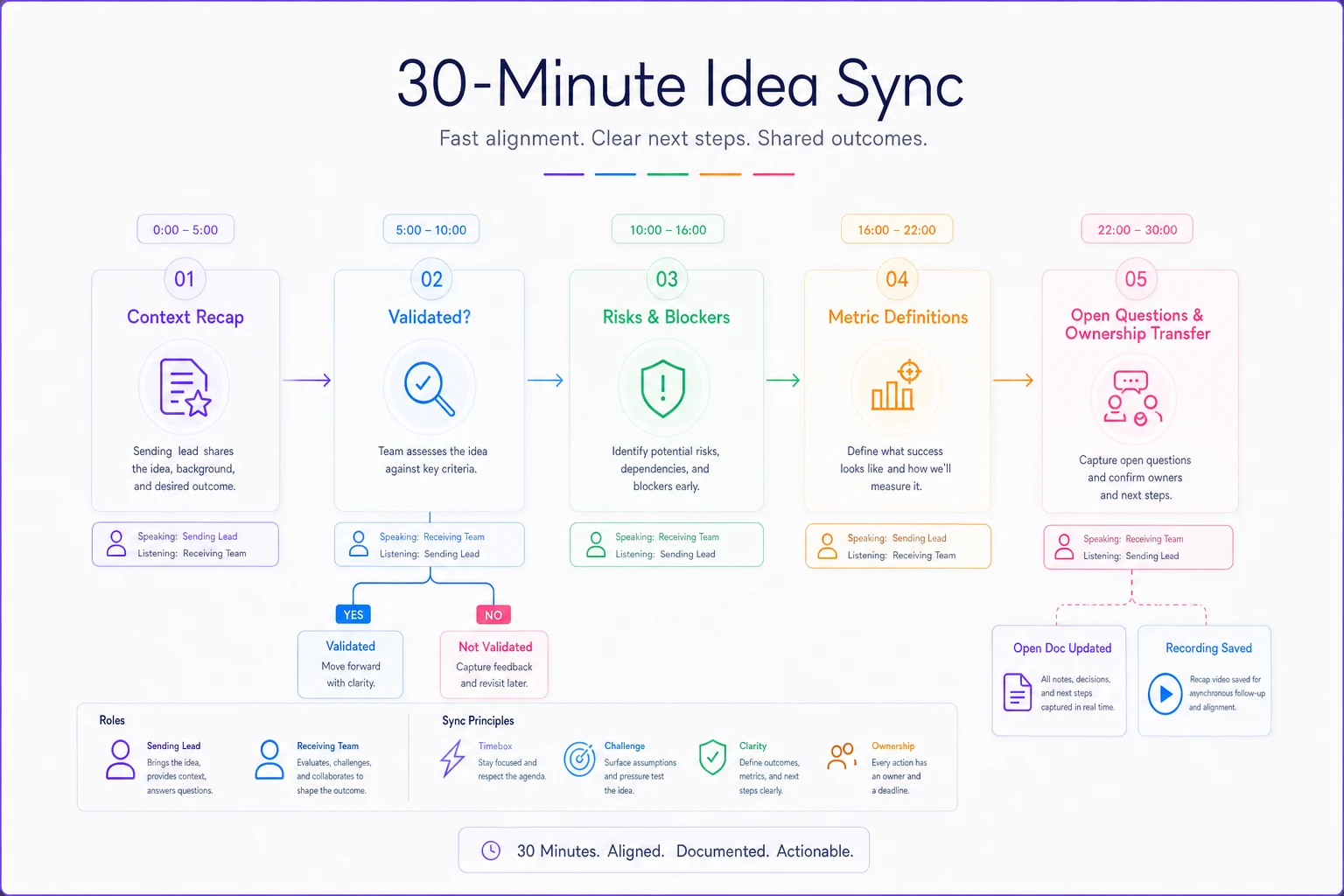
Below is a process flow for how the sync should run:
Use this simple visual during the call so everyone can track time and expectations.
-
Context recap (3 min). The sending lead reads the context box out loud. No slides. This forces alignment on the current framing, not the origin story.
-
Walk the validated / not-validated split (8 min). Go line by line. The receiving team's only job here is to challenge confidence levels — "you're calling that strong, what was the sample?"
-
Risks and blockers (7 min). Spend the most time here. This is where cross-team ownership gets negotiated. Every risk needs a named owner by the end of this block, even if the owner is "unassigned — needs escalation."
-
Metric definitions (5 min). Read each success metric and have the receiving team restate it in their own words. If the restatement differs from the packet, you just caught a future argument early.
-
Open questions and ownership transfer (7 min). The receiving team formally accepts the open questions. This is the actual handoff — the moment ownership moves.
Step 4 is the single most useful move in that whole agenda. It sounds almost too simple, but definition drift is the quietest killer in this process, and forcing someone to say the metric back in their own words surfaces the mismatch in real time instead of six weeks later.
One thing that helps: record the sync or keep a shared doc open so decisions land somewhere durable. Plenty of teams run this through their existing workflow or innovation-management platform, letting the packet, the recording, and the open-question owners live in one place instead of scattered across a deck, a calendar note, and someone's memory. When the receiving team hits a wall two months in, they can trace exactly what was decided and why — without hunting down the person who ran the pilot.
The Readiness Checklist
Before you schedule the sync, the packet should pass this check. If it can't, you're not ready to hand off — you're ready to have a meeting that generates confusion.
-
[ ] Every "validated" claim has a confidence level and a one-line evidence note
-
[ ] The "not validated" section has at least one honest entry (if it's empty, you're kidding yourself)
-
[ ] Each risk has a proposed owner, including cross-team ones
-
[ ] Every success metric has a formula or explicit definition, not just a label
-
[ ] Open questions are phrased as questions, not disguised as recommendations
-
[ ] Someone on the receiving team has been named as the accepting owner
-
[ ] The whole thing fits on one page
That last box is the discipline mechanism. The moment your packet spills onto a second page, ask what you're padding — usually it's context nobody needs or conclusions restated three different ways.
When This Makes Sense — and When It Doesn't
This process is built for genuine ownership transfers: validation team to delivery team, incubator to business unit, a central innovation group handing off to an operating team. That's where the knowledge gap is real and the cost of losing it is high.
It's overkill when the same people who validated the idea are the ones building it. If there's no wall to cross, don't manufacture ceremony — a shared working doc is plenty. Forcing a formal packet and sync on a team that never split ownership just adds friction and teaches people that the process is bureaucratic theater.
It's also a bad fit for ideas that were never really validated in the first place. A handoff packet can't manufacture confidence that doesn't exist. If the "validation" was one enthusiastic stakeholder and a hunch, the honest packet will have a nearly empty "validated" section and a very full "open questions" list — which is actually useful information, but it means the idea should probably go back into experimentation, not forward into delivery.
A Short Real Scenario
A financial-services firm's innovation group had validated a customer-onboarding simplification — real pilots, roughly 200 users, clear reduction in drop-off. They handed it to a product squad the old way: big deck, kickoff call.
The squad rebuilt their own understanding and, three sprints in, started A/B testing a step the validation had already proven out, because the deck presented it as a "recommendation" rather than a settled result. About five weeks of squad time went to re-proving a solved question.
The next handoff, the group ran the one-page packet and the 30‑minute sync. Confidence levels were spelled out, the two genuinely open questions were formally accepted by the squad lead, and the metric definitions got restated on the call — which immediately surfaced that the two teams meant different things by "completed onboarding." That single catch saved an argument that would've shown up at the first review. Re-work on that handoff dropped close to zero, and the squad started delivery roughly a sprint earlier than the previous one.
Nothing exotic happened. They just stopped throwing away what they'd already learned.
The One Habit Worth Keeping
Treat your uncertainty as the most valuable thing you're transferring, not the least. Most handoffs are proud of what they proved and silent about what they didn't. Flip that.
A team receiving a validated idea can move fast when they know exactly where the solid ground ends and the open questions begin — and slow, expensively, when they have to find that edge by falling off it themselves. The one-page packet, the short structured sync, and the readiness checklist all exist to serve that single idea. Keep them lightweight, keep them honest, and the learnings you fought to earn will actually make it to the people who need them next.
Treat your uncertainty as the most valuable thing you're transferring, not the least. Most handoffs are proud of what they proved and silent about what they didn't. Flip that.
A team receiving a validated idea can move fast when they know exactly where the solid ground ends and the open questions begin — and slow, expensively, when they have to find that edge by falling off it themselves. The one-page packet, the short structured sync, and the readiness checklist all exist to serve that single idea. Keep them lightweight, keep them honest, and the learnings you fought to earn will actually make it to the people who need them next.
Ready to transform your innovation process?
Join 2,000+ companies using GoIdeafy to unlock team creativity, prioritize impactful ideas, and accelerate growth.