



Most innovation programs fail because they're missing the connective tissue between ideation and execution. You get these pockets of creative energy — hackathons here, innovation labs there, maybe some design sprints scattered around — but no actual operating system that moves ideas through funding gates, assigns clear ownership, and tracks what's working.
After building operational software for companies ranging from 50-person startups to 5,000-employee enterprises, the pattern becomes obvious. Organizations that consistently ship innovative products don't just have better ideas. They have better plumbing. They've built innovation operating models that function like production lines — ideas go in one end, funded experiments come out the other, and successful pilots scale into real business outcomes.
The disconnect usually starts around the handoff points. Product comes up with something interesting, but nobody knows if operations should prototype it or if finance should fund it first. Engineering builds a proof of concept that sits in limbo because there's no clear path to get budget approval for the next phase. These aren't creativity problems. They're organizational design problems.
The Core Architecture: Four Stages, Clear Gates
An innovation operating model needs four distinct stages, each with its own funding tier, success criteria, and handoff protocol. Think of it like a venture capital firm operating inside your company — except instead of external startups, you're funding and scaling internal experiments.
Stage 1: Ideation Pool ($0 budget) This is where ideas live before they become projects. No funding yet, just collection and initial filtering. The goal here is volume and diversity — you want ideas from customer service, operations, sales, engineering, everywhere. Most companies mess this up by either making it too formal (innovation committee meetings that nobody attends) or too chaotic (random Slack messages that disappear into the void). What works: A simple intake form that takes 3 minutes to complete, weekly synthesis by a designated innovation coordinator, and monthly review sessions where ideas get tagged for exploration or archived with explanation.
Stage 2: Exploration ($1k-$5k per experiment) Ideas that pass initial screening get micro-funding for quick validation. This isn't about building products — it's about answering specific questions. Can we technically do this? Do customers actually want it? What would it cost at scale? The critical piece here is the experiment owner role. This person (not committee) has full authority over their micro-budget and 30 days to deliver a clear yes/no on viability. No lengthy presentations, no consensus building — just rapid testing with real constraints.
Stage 3: Pilot ($25k-$100k per pilot) Validated experiments graduate to pilots where you build the real thing, just smaller. This requires formal project structure — dedicated team members, weekly standups, actual deliverables. The funding jump from exploration to pilot creates natural selection pressure. Only ideas with strong validation data make it through. Pilot teams get 90 days and must hit predefined metrics to unlock scale funding. Revenue targets, user adoption thresholds, operational efficiency gains — whatever matters for that specific innovation. No moving goalposts mid-pilot.
Stage 4: Scale (Full business case funding) Successful pilots trigger the full business case process. This looks more like traditional project funding, except you already have proof it works. The pilot data becomes your investment thesis. Scale funding comes with different ownership too — typically transitioning from innovation team to an operating business unit.
Role Definitions That Actually Prevent Confusion
The biggest organizational friction happens when nobody knows who decides what. Every stage needs clearly defined roles with specific decision rights.
Capture, evaluate, and act on ideas without friction.
GoIdeafy streamlines the entire innovation lifecycle from idea submission to implementation.
- Centralized idea capture
- Collaborative evaluation tools
- Progress tracking & analytics
No credit card required
Innovation Coordinator (Stage 1)
-
Reviews all submitted ideas weekly
-
Tags ideas by theme, potential impact, required resources
-
Schedules ideas for committee review
-
Maintains idea backlog and provides submitters with status updates
-
Has authority to reject obviously unfeasible ideas with documented reasoning
Experiment Owner (Stage 2)
-
Self-selects or gets assigned based on expertise
-
Controls full experiment budget without approval loops
-
Defines success metrics upfront
-
Delivers go/no-go recommendation with evidence
-
Can be anyone in the organization with relevant skills
Pilot Lead (Stage 3)
-
Usually comes from the business unit that would eventually own at scale
-
Manages cross-functional pilot team (3-5 people typical)
-
Reports weekly to innovation steering committee
-
Has hiring authority for contract resources within pilot budget
-
Decides whether to recommend scale funding or shutdown
Scale Sponsor (Stage 4)
-
Senior executive from receiving business unit
-
Takes ownership from innovation team
-
Integrates scaled solution into normal operations
-
Accountable for hitting business case projections
The handoff between Pilot Lead and Scale Sponsor is where most innovations die. The pilot team has all the context but no operational authority. The business unit has the authority but wasn't involved in development. The solution is requiring the Scale Sponsor to join the pilot halfway through — they're involved early enough to influence direction but late enough that the pilot team maintains autonomy during experimentation.
Funding Tiers and Decision Gates
Each funding tier needs specific approval mechanisms that balance speed with oversight. The mistake most companies make is using the same approval process regardless of investment size.
$0 → $5k: Innovation Coordinator approval Single person, same-day decision. The coordinator has a quarterly budget pool they manage autonomously. This eliminates the committee bottleneck for small experiments while maintaining oversight through budget limits.
$5k → $100k: Innovation Committee approval Monthly committee meetings with standardized proposal templates. Committee includes representatives from product, operations, finance, and at least one business unit leader. Decisions made by simple majority vote, documented with specific feedback for rejected proposals.
$100k+: Executive approval with business case Full financial modeling, resource planning, risk assessment. This follows standard capital allocation processes but with fast-track option for pilots showing exceptional metrics. The pilot data differentiates these proposals from speculative projects — you're funding proven concepts, not hopes.
A typical funding decision matrix looks like this:
| Funding Level | Decision Maker | Timeline | Required Documentation | Success Criteria |
|---|---|---|---|---|
| $0-$5k | Innovation Coordinator | Same day | 1-page experiment brief | Clear learning objective |
| $5k-$25k | Innovation Committee | 1 week | 3-page proposal + budget | Defined validation metrics |
| $25k-$100k | Innovation Committee | 2 weeks | 5-page proposal + pilot plan | Specific KPI targets |
| $100k+ | Executive Team | 4 weeks | Full business case | ROI projections + risk analysis |
Each funding tier needs specific approval mechanisms that balance speed with oversight. The mistake most companies make is using the same approval process regardless of investment size.
Handoff Templates That Eliminate Information Loss
The handoff between stages is where institutional knowledge evaporates. The exploration team learns a dozen critical details that never make it to the pilot team. The pilot team discovers operational constraints that the scale team has to rediscover from scratch.
Structured handoff templates fix this. Not lengthy documents nobody reads, but specific formats optimized for knowledge transfer.
Exploration → Pilot Handoff:
-
One-page experiment summary (what we tested, what we learned)
-
Key assumptions validated and invalidated
-
Technical constraints discovered
-
Customer feedback verbatims (maximum 10)
-
Recommended pilot approach with specific hypotheses
-
Contact information for all stakeholders engaged
Pilot → Scale Handoff:
-
Pilot metrics dashboard (actuals vs. projections)
-
Operational playbook (step-by-step implementation)
-
Technology architecture and dependencies
-
Team composition and skill requirements
-
Risk register with mitigation strategies
-
Stakeholder map with engagement history
-
Budget variance analysis with explanations
The format matters less than the discipline. Every handoff happens through these templates, no exceptions. When the pilot lead tries to hand off their project through a 45-minute meeting and some rough notes, you point them back to the template. When the scale sponsor wants to skip the operational playbook because they "know the business," you point them back to the template.
Real Coordination Challenges at Different Scale Points
At 100 employees, innovation coordination happens through informal networks. People know each other, communication flows naturally, and a simple Slack channel might be enough infrastructure.
At 500 employees, those informal networks break. You need formal coordination mechanisms — regular innovation forums, structured intake processes, dedicated coordinators. The challenge here is maintaining velocity while adding structure. Too much process and innovation grinds to a halt. Too little and ideas get lost in organizational noise.
At 2,000+ employees, you're running multiple parallel innovation tracks across different business units. The coordination challenge shifts from managing individual innovations to portfolio management. Which business unit gets innovation resources? How do you prevent duplicate experiments? Who decides when innovations from different units conflict?
AI-powered operational software starts making a difference here. Not for the creative parts — humans still generate ideas and run experiments. But for the coordination layer. Tracking which experiments are running where, automatically flagging similar proposals, maintaining institutional memory across hundreds of experiments, surfacing patterns from failed attempts.
One medical device company had three different teams independently exploring the same IoT monitoring solution. Nobody knew until they all requested pilot funding in the same quarter. That's $300k of duplicate exploration work that could have been prevented with better operational tracking. Their innovation operating model now includes automated similarity detection — when someone submits an idea, the system immediately surfaces related past and current experiments.
Common Failure Patterns and Prevention Mechanisms
The Zombie Pilot Problem Pilots that miss their metrics but refuse to die. The team argues they need "just one more sprint" or "slightly adjusted success criteria." Before you know it, a 90-day pilot has consumed six months and $200k.
Require hard stop dates for pilots to prevent slow deaths.
Prevention: Hard stop dates with no extensions. If a pilot needs more time, it gets shut down and can reapply as a new pilot with updated hypothesis. This forces teams to acknowledge failure and incorporate learnings rather than perpetually extending.
The Political Innovation A senior executive's pet project that bypasses normal evaluation criteria. It gets funding regardless of validation data, consumes innovation resources, and demoralizes teams running legitimate experiments.
Prevention: Even executive-sponsored innovations start at Stage 2. They get fast-tracked experiment funding but still need to show validation data before advancing. This gives political innovations a path forward while maintaining system integrity.
The Orphan Success A pilot succeeds but nobody wants to own it at scale. The innovation team built something valuable but no business unit wants the operational responsibility. It sits in limbo, slowly degrading while teams argue about ownership.
Prevention: Scale sponsor identified before pilot launch. If no business unit commits to eventual ownership, the pilot doesn't get funded. This forces ownership discussions early when stakes are lower.
The Feature Factory Innovation program becomes a feature request system for existing products. Instead of exploring new business models or breakthrough capabilities, it just funds incremental improvements that should come from normal product development.
Prevention: Separate innovation budget from product development budget. Clear criteria distinguishing innovations (new capabilities, new markets, new models) from features (improvements to existing products). Different approval paths for each.
Building Your Implementation Roadmap
Start with Stage 2. Most companies try to build the entire innovation operating model at once — intake processes, committees, funding tiers, scaling protocols. This creates organizational antibodies. Too much change too fast, and the system rejects the new model.
Instead, identify 3-5 experiments already happening informally. Give them official Stage 2 status with micro-budgets and clear success criteria. Run these for 60 days. Use the results to demonstrate value and build organizational buy-in for expanding the model.
-
Month 1-2
Run initial experiments - Select experiment owners - Define success metrics - Allocate micro-budgets - Weekly check-ins, no formal reporting
-
Month 3-4
Add intake process - Create simple submission form - Assign innovation coordinator - Begin weekly reviews - Start building idea backlog
-
Month 5-6
Establish pilot framework - Graduate successful experiments - Define pilot requirements - Form innovation committee - Create handoff templates
-
Month 7-12
Full model implementation - Add remaining stages - Formalize role definitions - Implement tracking systems - Scale successful pilots
The gradual build gives you time to debug organizational friction. Maybe your handoff templates are too complex. Maybe the innovation committee needs different members. Maybe the funding tiers need adjustment for your industry. You discover these issues through controlled implementation rather than big-bang failure.
Metrics That Prove Model Effectiveness
Innovation operating models need their own metrics separate from innovation outcomes. You're measuring the system's ability to process ideas, not just the ideas themselves.
Velocity Metrics:
-
Ideas submitted per month
-
Days from submission to Stage 2 decision
-
Days from Stage 2 to Stage 3 transition
-
Percentage of pilots completing within timeline
Portfolio Metrics:
-
Distribution across stages (healthy pipeline has 100
20:5:1 ratio)
-
Funding utilization by stage
-
Experiment success rate (target 30-40%)
-
Pilot success rate (target 60-70%)
Value Metrics:
-
Revenue from scaled innovations
-
Cost savings from scaled innovations
-
Strategic objectives advanced
-
Capabilities developed
Track these monthly but analyze quarterly. Innovation cycles don't align with monthly business reviews. You need longer horizons to identify patterns and adjust the model.
Technology Infrastructure for Innovation Operations
The tools matter less than the workflows, but the right technology infrastructure dramatically reduces coordination overhead. Most companies cobble together spreadsheets, project management tools, and communication platforms. This works initially but breaks around 20 concurrent experiments.
Purpose-built innovation management platforms solve the coordination problem but often impose rigid frameworks that don't match your operating model. The better approach is configurable operational software that adapts to your specific stages, roles, and decision gates.
This diagram shows the operational workflow for innovation tracking and handoffs.
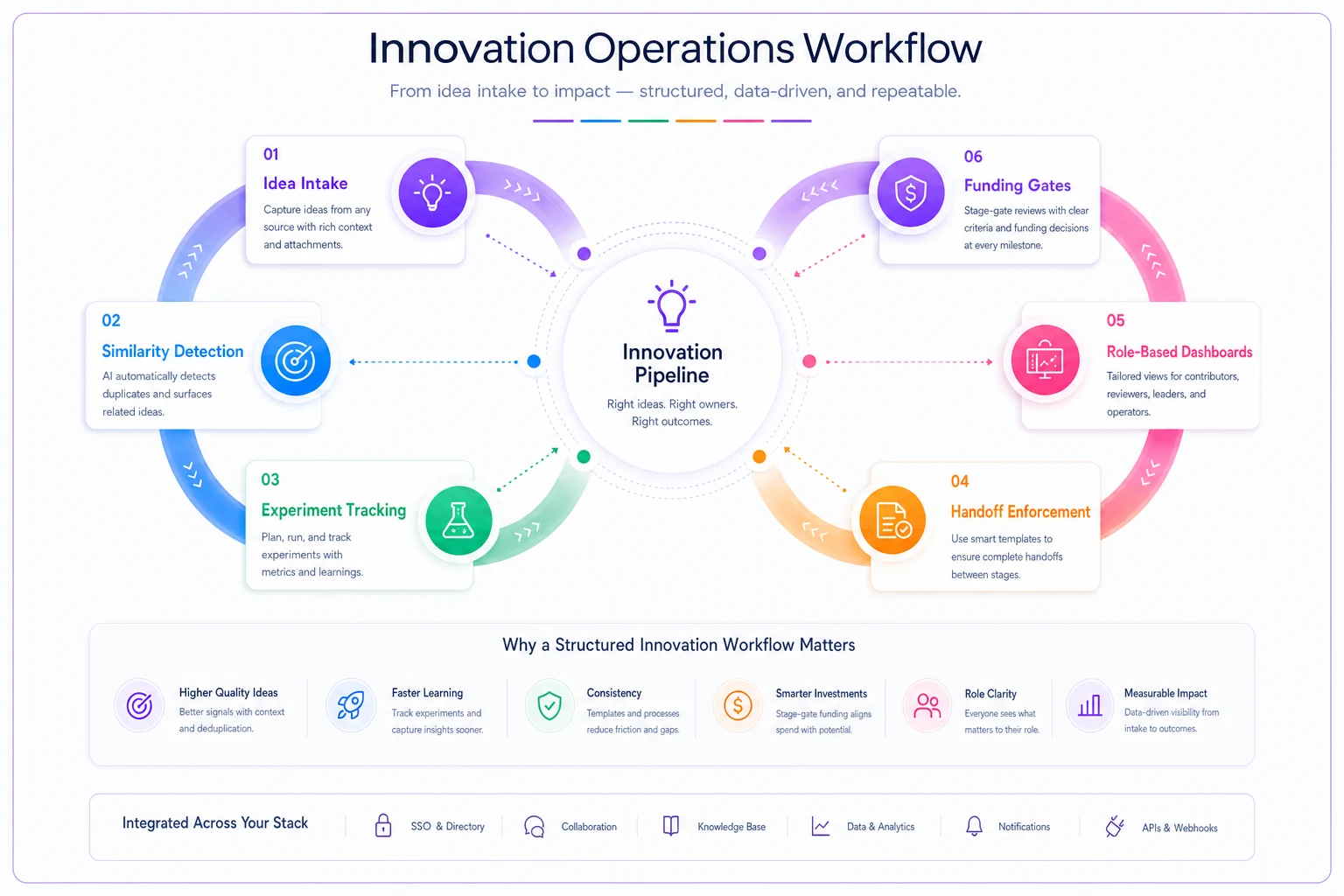
Key capabilities that matter:
-
Idea intake that doesn't require training
-
Experiment tracking with resource allocation
-
Automated similarity detection across proposals
-
Role-based dashboards for different stakeholders
-
Handoff template enforcement
-
Portfolio visualization across stages
The medical device company mentioned earlier reduced their innovation coordination overhead by roughly 60% after implementing proper operational tracking. Not because the software made them more creative, but because it eliminated the administrative friction that was killing momentum. Innovation coordinators spent less time in status meetings and more time helping teams design experiments.
When This Model Makes Sense (And When It Doesn't)
An innovation operating model makes sense when you have:
-
Multiple teams generating ideas
-
Budget to fund experiments
-
Leadership commitment to innovation investment
-
Competitive pressure requiring new capabilities
-
Organizational scale creating coordination challenges
It's overkill when:
-
You're under 50 employees (informal coordination still works)
-
Innovation happens in a single team
-
Your industry rewards operational excellence over innovation
-
You lack budget for even micro-experiments
-
Leadership views innovation as distraction
The model also needs cultural readiness. Organizations with extreme risk aversion struggle with the experimentation mindset. Failed experiments are learning investments, not performance failures. If your culture punishes failure, fix that before implementing structured innovation processes.
Making the Model Stick
Most innovation operating models fail because they're treated as side projects. They get launched with fanfare, run for a few months, then quietly disappear when the first reorg happens or budgets get tight.
Sustainability requires three commitments:
Protected Funding Innovation budgets can't be the first cut when quarters get tough. The amounts are small relative to operational budgets but the signal is huge. Cutting innovation funding tells the organization that innovation is optional.
Executive Sponsorship Not just approval, active involvement. At least one senior executive should review innovation metrics monthly, attend pilot demonstrations, and visibly celebrate both successes and intelligent failures.
Operational Integration The innovation operating model needs to connect with existing business processes. Scaled innovations feed into annual planning. Innovation metrics appear in business reviews. Innovation roles count toward performance evaluations.
The Compound Effect of Systematic Innovation
Companies that implement disciplined innovation operating models see compound benefits over time. Year one might produce a handful of successful pilots. Year three has dozens of experiments running in parallel with multiple innovations reaching scale. Year five has innovation embedded in organizational DNA with every employee understanding how to advance ideas through the system.
The medical device company now runs 40-50 experiments annually with 8-10 reaching pilot stage and 2-3 scaling into significant business impact. Their latest scaled innovation — an AI-assisted diagnostic tool that started as a customer service rep's suggestion — is projected to generate $12M in new revenue next year.
The bigger value isn't individual innovations. It's organizational capability. They've built a machine that consistently turns ideas into experiments, experiments into pilots, and pilots into business outcomes. Market disruptions that might destabilize competitors become innovation opportunities. Customer problems that might fester become experiment triggers.
The Path Forward
Building an innovation operating model isn't about creativity workshops or innovation theater. It's about organizational design, operational discipline, and systematic execution. The companies that get this right don't just have innovation programs — they have innovation engines that generate predictable, repeatable business value.
Start small with a few experiments. Build gradually through demonstrated success. Focus on the mechanics — stages, roles, handoffs, funding — rather than the inspiration. The ideas will come. What matters is having a system that can process them efficiently, fund them appropriately, and scale them successfully.
The gap between companies that talk about innovation and companies that ship innovation isn't creative talent or breakthrough ideas. It's operational infrastructure. Build the system, and the innovations will follow.
The gap between companies that talk about innovation and companies that ship innovation isn't creative talent or breakthrough ideas. It's operational infrastructure. Build the system, and the innovations will follow.
Ready to transform your innovation process?
Join 2,000+ companies using GoIdeafy to unlock team creativity, prioritize impactful ideas, and accelerate growth.