


Your innovation program collects 412 ideas in Q1. Sounds healthy, right? But dig deeper and you discover 89% come from the same 31 contributors. The other 284 people on your innovation roster? Silent. Not because they lack ideas—they're calculating whether speaking up is worth the career risk.
This pattern destroys innovation programs from the inside out. Not dramatically, not obviously, but through slow erosion of participation that leaves you with an echo chamber disguised as an idea pipeline.
The participation cliff nobody talks about
Most innovation managers track idea volume religiously. Ideas submitted, ideas reviewed, ideas implemented. What they miss is the participation distribution curve that predicts program death six months before it happens.
In a dying program: Month one, 67 contributors submit ideas. Month three, you're down to 34. By month six, you've got your "faithful twelve"—the same people submitting variations of the same concepts while everyone else has mentally checked out.
The standard response? Send more emails. Schedule more workshops. Create more incentives. None of it works because you're treating the symptom, not the disease.
Psychological safety in idea programs isn't about making people comfortable. It's about creating conditions where the perceived cost of contributing drops below the perceived value. When that equation flips negative, participation craters.
Why traditional engagement surveys miss the danger signs
Every quarter, you run your employee engagement survey. People rate statements about feeling valued and having their voice heard. The scores come back decent—maybe 3.8 out of 5. Leadership celebrates. Meanwhile, your actual idea submission rate sits at 7% of eligible contributors.
Capture, evaluate, and act on ideas without friction.
GoIdeafy streamlines the entire innovation lifecycle from idea submission to implementation.
- Centralized idea capture
- Collaborative evaluation tools
- Progress tracking & analytics
No credit card required
The disconnect happens because engagement surveys measure sentiment, not behavior. Someone can feel generally positive about the company while simultaneously believing their specific ideas will be ignored, criticized, or stolen. Those are two completely different measurements.
Standard surveys also suffer from selection bias. The people most likely to complete them are either highly engaged or highly frustrated. The silent middle—where most of your potential contributors live—remains invisible.
By the time quarterly results show declining psychological safety scores, you've already lost months of potential contributions. The damage compounds while you wait for the next measurement cycle.
Building a real-time safety monitoring system
Forget quarterly surveys. Psychological safety in idea programs requires weekly pulse measurements combined with behavioral triggers. This isn't about overwhelming people with surveys—it's about creating lightweight, contextual check-ins that capture the actual contributor experience.
Start with submission patterns as your baseline metric. Track not just volume but distribution. When someone who submitted three ideas monthly suddenly goes quiet, that's a signal. When departments show participation rates below 15%, that's a signal. When idea quality scores drop while submission speed increases, people are phoning it in—another signal.
| Metric | What It Measures | Red Flag Threshold |
|---|---|---|
| Comment-to-submission ratio | Peer engagement level | Below 2:1 for three consecutive weeks |
| Revision rate | Response to feedback | Under 30% of ideas revised after initial feedback |
| Cross-functional partnerships | Collaboration breaking down | 50% drop in joint submissions |
| Department participation | Localized safety issues | Below 15% in any single department |
Track comment-to-submission ratios. When people stop commenting on others' ideas, they're disengaging. Monitor revision rates. When contributors stop iterating based on feedback, they've stopped caring. Watch collaboration patterns. When cross-functional idea partnerships disappear, silos are forming.
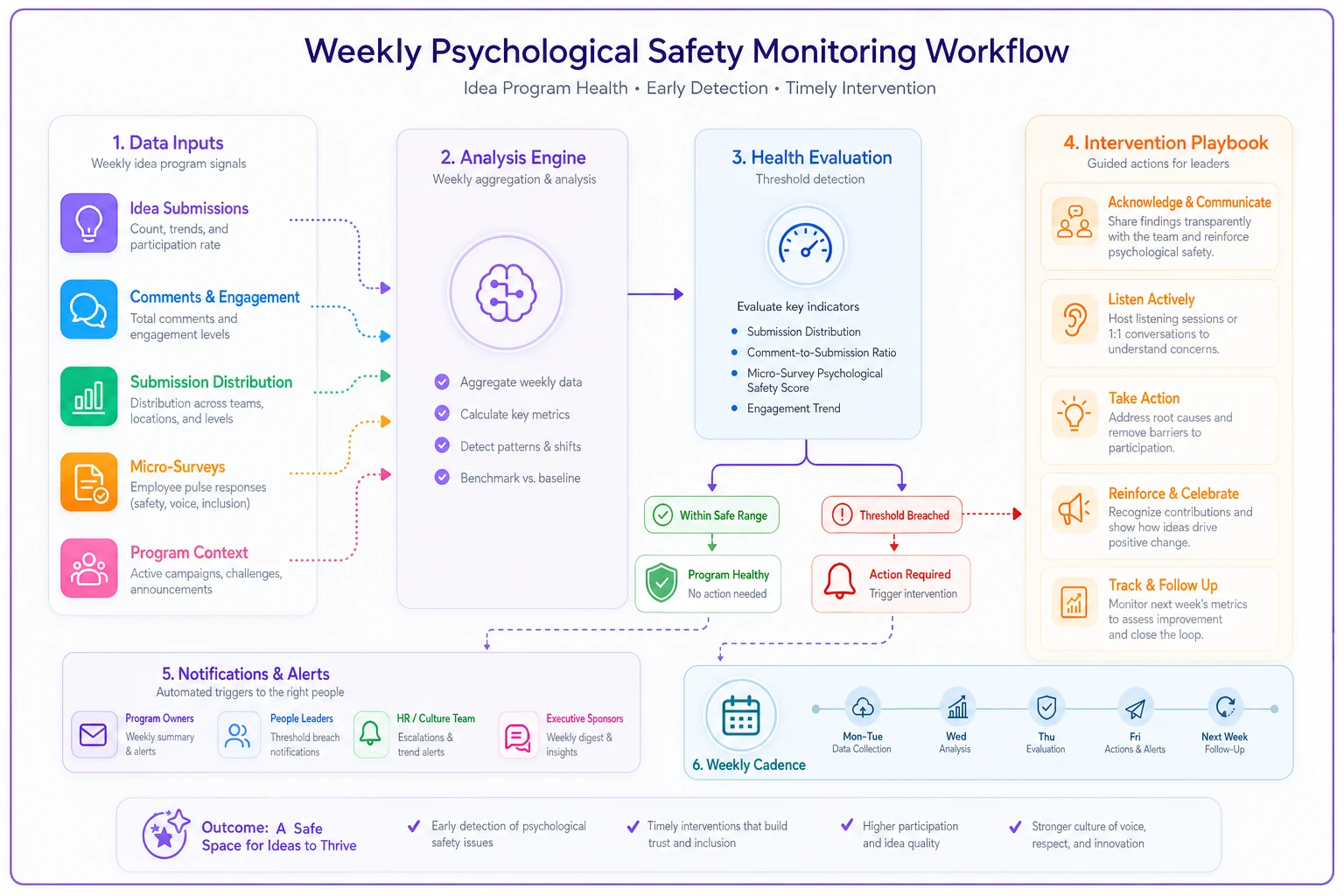
Create threshold triggers for each metric. Participation below 20% in any department triggers a facilitator review. Three consecutive weeks of declining comments triggers a collaboration intervention. Any individual scoring "not really" on confidence twice in a row gets personal outreach.
Here's a simple workflow showing how weekly pulses, metric thresholds, and intervention playbooks connect.
Your behavioral metrics tell the real story:
The intervention playbook most programs never build
Detection without action is just expensive observation. You need specific, pre-planned interventions tied to each threshold breach. Not generic "increase engagement" initiatives, but targeted responses to specific safety breakdowns.
When participation drops in a specific department, the playbook isn't a department-wide meeting. It's one-on-one conversations with the three most influential team members. Not managers—the people others actually listen to. Find out what message they're receiving about innovation priorities. Nine times out of ten, their direct supervisor said something that killed psychological safety without realizing it.
For individuals who've gone quiet, skip the "we value your input" speech. Instead, send them three ideas from other departments and ask for their expertise-based feedback. No pressure to submit their own ideas. Just help evaluate others. This rebuilds confidence without the vulnerability of putting their own concepts forward.
When comment activity drops program-wide, don't launch a "collaboration campaign." Change the comment prompts. Instead of "provide feedback," ask "what would make this idea work in your department?" Instead of "rate this idea," ask "what's one element you'd steal for your own projects?" Specificity drives participation.
Quality drops require the most nuanced response. Usually, people are submitting placeholder ideas to hit metrics while saving their real innovations for safer venues. The fix isn't lowering standards—it's creating a protected channel for high-risk, high-reward concepts. Call it your "experimental track" where failure is explicitly expected and celebrated.
Intervention Response Framework
-
Identify the trigger - Which threshold was crossed and when
-
Assess scope - Individual, department, or program-wide issue
-
Deploy appropriate response - Use pre-written playbook for that scenario
-
Monitor for improvement - Set 2-week checkpoint to measure effectiveness
-
Escalate if needed - Move to next intervention level if no improvement
-
Document learnings - Update playbook based on what worked or didn't
Detection without action is just expensive observation. You need specific, pre-planned interventions tied to each threshold breach. Not generic "increase engagement" initiatives, but targeted responses to specific safety breakdowns.
The hidden cost of safety theater
Some programs create elaborate psychological safety initiatives that actually make things worse. Anonymous submission options, for example. Seems logical—remove the fear of judgment by hiding identity. Except anonymous ideas get less engagement, less feedback, and less implementation. Contributors quickly learn that anonymous equals ignored.
Over-protection also backfires. When every piece of feedback must be "sandwich formatted" with positives, contributors know they're being handled with kid gloves. Real safety comes from honest, respectful, direct feedback—not corporate bubble wrap.
The worst offender? Safety surveys without visible action. You measure psychological safety quarterly, scores decline, and nothing changes. Contributors learn their feedback is performative. Trust erodes further. The very act of measuring without responding becomes evidence that leadership doesn't actually care.
The worst offender? Safety surveys without visible action. You measure psychological safety quarterly, scores decline, and nothing changes. Contributors learn their feedback is performative. Trust erodes further. The very act of measuring without responding becomes evidence that leadership doesn't actually care.
Building your measurement infrastructure
Start simple. Pick three behavioral metrics you can track weekly without new technology. Submission distribution, comment ratios, and revision rates work for most programs. Set up a basic spreadsheet. Track trends, not absolute numbers.
Add one micro-survey per month. Rotate the trigger point—post-submission one month, post-feedback the next. Keep it to one question. Response rates above 60% are good enough. You're looking for directional data, not statistical significance.
Define your thresholds based on your current baseline, not industry benchmarks. If your participation rate is 8%, set your first trigger at 6%, not some arbitrary "best practice" of 25%. You need alerts for degradation from your normal, not deviation from someone else's ideal.
Start with metrics you can track without new tools so you can iterate quickly before automating.
Write your intervention playbooks before you need them. One page per trigger. Who acts, what they do, how they measure success. The middle of a crisis is the wrong time for creative problem-solving.
Connect your measurement system to your regular operations. Psychological safety metrics should appear in your innovation dashboard next to idea volume and implementation rate. When safety drops, you should know before participation craters.
Most programs will resist this level of measurement. Too much work, too many metrics, too much complexity. But failed innovation programs all thought measuring feelings was less important than measuring ideas. They tracked what was easy to count instead of what actually mattered.
The compounding effect of early intervention
A 5% drop in psychological safety seems negligible. Not worth disrupting your quarterly planning to address. But that 5% represents your most vulnerable contributors—the ones barely staying engaged. Lose them and the next tier becomes vulnerable. The cascade accelerates.
Early intervention changes the entire trajectory. When someone scores low on confidence, and you personally reach out within 48 hours to understand their concerns, you don't just save that one contributor. You send a signal to everyone watching: This program actually responds to problems.
Small actions compound. A facilitator who notices someone hasn't submitted recently and sends a personal note saying "your perspective on supply chain innovation would be valuable" doesn't just re-engage one person. They create a story that spreads. "They actually noticed I wasn't participating" becomes "they actually care about my input."
The opposite compounds too. Every ignored signal, every unaddressed score drop, every contributor who silently disengages teaches others that psychological safety is just corporate rhetoric. Once that belief takes hold, no amount of intervention can reverse it.
Making safety measurement operational
Your psychological safety monitoring can't be a special project. It needs to integrate into your existing operational rhythm or it won't survive. This means building it into the platforms and workflows you already use, not creating new ones.
If you're using idea management software, safety metrics should live in the same dashboard as your innovation KPIs. When reviewers log in to evaluate ideas, they should see participation health scores for their area. When contributors submit ideas, they should answer that one micro-survey question as part of the flow.
Modern operational platforms with AI automation can track these patterns without manual effort. They identify participation drops, trigger appropriate surveys, and even suggest interventions based on what's worked in similar situations. The system watches for safety degradation while you focus on facilitating innovation.
The technology isn't the point though. The point is making safety measurement so embedded in your operations that skipping it would be like skipping idea review itself. It becomes part of how you run the program, not an add-on you might forget during busy periods.
The program that caught their own death spiral
A medical device company ran what looked like a successful innovation program. 800 ideas annually, 12% implementation rate, clear ROI. But their new innovation manager noticed something odd in the submission logs. The same 47 people generated 73% of all ideas.
Instead of celebrating their "innovation champions," she dug deeper. Pulse surveys revealed that 80% of silent employees had tried submitting ideas in their first year. All had experiences that taught them to stop trying. Dismissive feedback. Ideas attributed to others. Criticism delivered publicly.
She built what they called their "trust recovery protocol." Any employee who hadn't submitted in 90 days got a personal video message from a senior leader—not asking for ideas, but asking about their experience with the program. What had they observed? What concerned them?
The responses were brutal. And valuable. They rebuilt their feedback process, created protected attribution policies, and most importantly, instituted weekly safety monitoring with specific intervention triggers.
Year two: 1,100 ideas from 312 contributors. Implementation rate dropped to 10% but innovation value increased 3x because they were finally hearing from people closest to actual problems.
When not to measure psychological safety
Some programs shouldn't implement comprehensive safety measurement. If your innovation program is purely voluntary with no career implications, elaborate monitoring might create more anxiety than value. If you're running a small pilot with fewer than 20 participants, personal relationships matter more than metrics.
But most programs exist in a middle space where participation theoretically matters for performance reviews, where contributing is "strongly encouraged," where innovation is supposedly part of the culture. These programs—the vast majority—need safety measurement like they need idea tracking. It's not optional infrastructure.
The question isn't whether to measure psychological safety in your idea program. The question is whether you'll measure it systematically with triggers and interventions, or accidentally through declining participation and program death.
Your next seven days
Don't build a comprehensive measurement system tomorrow. Start with one behavioral metric you can track without new tools. Pick submission distribution or comment ratios. Pull the data for the last three months. Look for patterns.
Set one threshold based on what you see. If average participation is 30%, your threshold might be 25%. If comment ratios are typically 3:1, your threshold might be 2:1. Pick something achievable.
Write a one-page playbook for breaching that threshold. Who gets notified? What do they do first? How do they determine if the intervention worked? Keep it simple enough that someone could execute it without additional training.
Run this micro-system for two weeks. See what you learn. Adjust your threshold if needed. Add one micro-survey if the behavioral metric proves useful. Build gradually.
The goal isn't perfect measurement. It's visibility into the invisible force that determines whether your innovation program thrives or slowly becomes another corporate checkbox that everyone pretends to support while privately ignoring.
Psychological safety in idea programs isn't about feelings. It's about creating conditions where contribution feels less risky than staying silent. That requires measurement, intervention, and most importantly, response. Because every time someone considers sharing an idea, they're calculating whether your program is safe enough for their career.
Make sure their calculation comes out in your favor.
Ready to transform your innovation process?
Join 2,000+ companies using GoIdeafy to unlock team creativity, prioritize impactful ideas, and accelerate growth.