



Most shortlists fall apart for a boring reason: the person running the evaluation falls in love with a demo. The vendor shows a slick dashboard, a few AI‑tagged ideas, maybe a leaderboard — and suddenly the whole "objective evaluation" quietly reorganizes itself around justifying something that was already decided emotionally. Then procurement asks one question — "Can they do SCIM provisioning and give us an audit trail for who changed an idea's status?" — and the whole thing stalls for six weeks.
This brief exists to prevent that specific failure. Not to explain what idea‑management software is, but to give you a repeatable, defensible idea management vendor shortlisting criteria process that actually survives contact with security review, legal, and finance. You'll get a pass/fail gating structure, a weighted scoring matrix with sample weightings, a worked example with three mock vendors, guidance on who scores and how to manage conflicts of interest, and a communication timeline you can actually send.
If you're still figuring out who the players even are, it helps to pair this with a market overview first — our breakdown of idea‑management vendors for mid‑market teams covers pricing and real deployments, which gives you the raw list this process then filters.
Start with gating, not scoring
The mistake that costs the most time: teams build a beautiful 20‑criteria weighted scorecard and start scoring vendors on everything at once. UX, pricing, roadmap, integrations — all mixed together. Three weeks later they discover their top‑scoring vendor can't export data in a usable format, or stores everything in a single US region when half the company sits in the EU.
Gating questions are pass/fail. A vendor either clears them or they're out — regardless of how good the UX is. It's the single highest‑leverage thing you can do early, because it kills non‑viable vendors before anyone wastes a scoring session on them.
Must‑have gating questions (pass/fail)
| # | Gating Question | Pass Condition | Common Fail Pattern |
|---|---|---|---|
| 1 | Do you support SAML/OIDC SSO with our IdP? | Yes, named IdP, no extra tier | "SSO is Enterprise‑only add‑on" |
| 2 | Do you support SCIM for automated provisioning/deprovisioning? | Full SCIM 2.0, create + deactivate | Manual CSV user upload only |
| 3 | Are admin and user actions captured in an immutable audit log? | Status changes, role changes, exports logged with actor + timestamp | "We log logins" and nothing else |
| 4 | Can we export ALL our data (ideas, comments, votes, attachments, metadata) on demand? | Self‑serve structured export (JSON/CSV) incl. attachments | Export is a paid support ticket |
| 5 | Can you contractually guarantee data residency region? | Named region, written into contract | "Hosted on AWS" with no region commitment |
| 6 | What is the deprovisioning / data deletion process at contract end? | Documented, timeboxed, certifiable | Vague "contact us" |
| 7 | Do you carry SOC 2 Type II (or equivalent) and share the report under NDA? | Current report available | Type I only, or "in progress" for 18 months |
Export and residency sit in the gate — not the scorecard — because they're binary trust issues. A vendor who makes it hard to leave is telling you something about the next three years. In practice, the "export is a support ticket" answer almost always correlates with painful renewals.
One nuance worth calling out: for audit logs, push past the yes/no. Ask for a sample log export. A lot of vendors who say "yes, we have audit logs" actually mean a login history — not a record of who changed an idea from "Under Review" to "Rejected." Those are completely different things when legal or a works council asks who killed an employee's idea.
The weighted scoring matrix (for vendors who clear the gate)
Only vendors that pass every gate get scored. Now you're comparing genuinely viable options, which makes the scoring meaningful instead of theatrical.
Capture, evaluate, and act on ideas without friction.
GoIdeafy streamlines the entire innovation lifecycle from idea submission to implementation.
- Centralized idea capture
- Collaborative evaluation tools
- Progress tracking & analytics
No credit card required
Build this in whatever your team actually uses — Excel, Google Sheets, a plain CSV. The structure is simple: six categories, each with a weight, each scored 1–5, then weight × score summed per vendor.
Sample categories and weightings
| Category | Weight | What you're actually measuring |
|---|---|---|
| Integrations | 20% | SSO depth, HRIS sync, Slack/Teams, API quality, webhook support |
| Governance & Workflow | 20% | Custom stages, role‑based permissions, evaluation rubrics, reporting |
| Deployment Timeline | 15% | Realistic time‑to‑first‑campaign, migration support, config effort |
| Pricing Model | 20% | Total cost at your scale, predictability, hidden tiers, overage behavior |
| UX / Adoption | 15% | Submitter friction, mobile, admin usability, time‑to‑competence |
| Support & Roadmap | 10% | SLA, named CSM at your tier, roadmap transparency |
These weightings aren't universal law. If you're in a regulated industry, bump Governance to 25% and drop UX. If adoption has historically been the killer — participation dies after month two — push UX up. Low friction is worth more than feature count when nobody submits anything.
Scoring rules that stop score inflation
-
Anchor every score. Write a one‑line definition of what a 3 vs. a 5 means per category before any demos. For Integrations, a 3 might be "has an API but no prebuilt HRIS connector"; a 5 is "native SCIM + HRIS sync + documented webhooks tested in our environment." Without anchors, everyone scores a 4 and nothing differentiates.
-
No half points. Forcing whole numbers 1–5 prevents the "4.5 because I kind of liked them" fudge that flattens your matrix.
-
Evidence or it didn't happen. Every score above a 3 needs a note citing where that came from — a demo moment, a doc, a reference call. Scores without evidence get capped at 3 during calibration.
A small but important detail: score pricing on your projected seat count and usage, not list price. A vendor that looks cheap at 200 seats can get ugly at 800 once you cross a tier boundary or hit an "active contributor" multiplier. Model it at your real 24‑month number.
A worked example: three mock vendors
Three vendors cleared the gate. Here's how the weighted math exposes what demos hide.
Vendor A — polished UX, loved by everyone in the room, but the API is thin and pricing jumps hard past 500 seats.
Vendor B — enterprise‑grade governance and integrations, slightly clunky admin experience, predictable pricing.
Vendor C — mid‑tier everything, fast to deploy, decent price, nothing exceptional.
| Category | Weight | A (score) | A (wtd) | B (score) | B (wtd) | C (score) | C (wtd) |
|---|---|---|---|---|---|---|---|
| Integrations | 20% | 2 | 0.40 | 5 | 1.00 | 3 | 0.60 |
| Governance | 20% | 3 | 0.60 | 5 | 1.00 | 3 | 0.60 |
| Deployment | 15% | 4 | 0.60 | 3 | 0.45 | 5 | 0.75 |
| Pricing | 20% | 2 | 0.40 | 4 | 0.80 | 4 | 0.80 |
| UX | 15% | 5 | 0.75 | 3 | 0.45 | 3 | 0.45 |
| Support/Roadmap | 10% | 3 | 0.30 | 4 | 0.40 | 3 | 0.30 |
| Total | 100% | 3.05 | 4.10 | 3.50 |
The vendor that "won the room" finishes last. That's the entire point. The demo favored UX, which is only 15% of what actually matters over a three‑year contract. Vendor B wins on integrations and governance — the categories that quietly determine whether the platform survives in production.
Your top‑3 shortlist comes out B, C, A in that order. All three are viable since they passed the gate, so you invite B and C to a paid pilot and keep A as a fallback. Don't drop A entirely until the pilots confirm things. Scorecards narrow the field; pilots make the final call.
Who scores — and how to keep it honest
The scorecard is only as trustworthy as the people filling it in. Two failure modes show up constantly.
The first is the single champion problem: one enthusiastic innovation manager scores everything, and their favorite wins because they scored it. The second is silent conflicts of interest — someone on the panel used Vendor B at their last company, or has a relationship with a sales rep, and never mentions it. Both are more common than people admit.
Scorer roles that balance the panel
-
Innovation / Program Owner — scores Governance, Workflow, UX‑for‑admins. Owns the process but not the final vote alone.
-
IT / Security — scores Integrations and validates gating answers independently. This person has veto power on anything that failed a gate, full stop.
-
A frontline submitter or evaluator — scores UX from the actual user's seat. This is the voice that usually gets ignored and shouldn't be.
-
Finance / Procurement — scores Pricing Model against the 24‑month projection, not list price.
Keep the panel to four or five people. More than that and scores regress to mush; fewer and one person dominates.
Conflict‑of‑interest controls
-
Prior use of any shortlisted vendor
-
Any personal or financial relationship with vendor staff
-
Whether they attended a vendor dinner, event, or received anything of value
Run the two‑minute disclosure on the record before scoring starts.
Anyone with a material conflict either recuses from that vendor's scoring or has their score flagged and discussed openly during calibration. It feels bureaucratic for a small team — it isn't. It's the thing that holds up when the losing vendor's rep calls your CFO to complain the process was rigged.
Vendor communication timeline and template
Vendors behave better when the process is transparent and timeboxed. It also protects you — a documented timeline is your defense if someone claims unequal treatment.
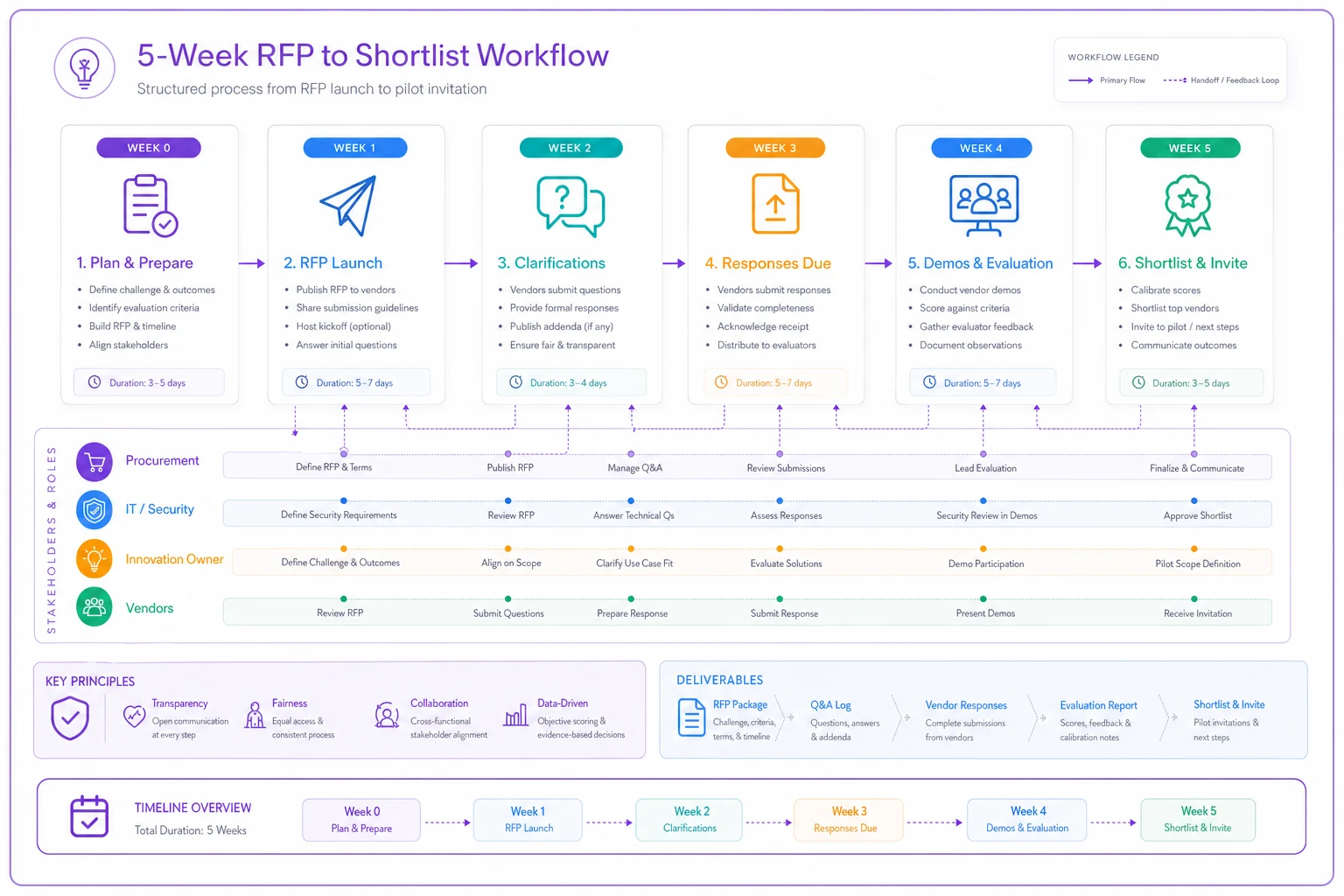
A realistic 5‑week timeline
-
Week 0 — RFP sent. Same document, same questions, same deadline to every shortlisted vendor. Include the gating questions up front so non‑viable vendors can self‑select out.
-
Week 1 — Clarification window. Vendors submit questions in writing; you answer all of them to all vendors simultaneously. No private side‑channels.
-
Week 2 — Responses due. Hard deadline. Late = scored as non‑responsive on Support.
-
Week 3 — Scored demos. 60–90 min each, structured around your anchors, not their standard pitch. Send them the agenda beforehand.
-
Week 4 — Scoring, calibration, references. Panel scores independently, then meets to calibrate outliers. Reference calls for the top two.
-
Week 5 — Shortlist decision + pilot invites. Top‑3 informed, top‑2 invited to paid pilot or RFI.
The five‑week window feels tight until you've run a twelve‑week evaluation and watched vendor enthusiasm (and your internal momentum) quietly evaporate somewhere around week eight.
Use this visual to share the timeline with stakeholders.
Simple outreach template
> Subject: RFP — [Your Org] Idea‑Management Evaluation > > Hi [Name], > You're one of a small number of vendors we're evaluating for an idea‑management platform supporting roughly [X] employees. Attached is our RFP, including mandatory pass/fail requirements (SSO, SCIM, audit logging, data export, residency). > > Timeline: responses due [date], scored demos week of [date], shortlist decision by [date]. Please submit all clarification questions in writing by [date] — we'll share answers with all participating vendors. > > If any mandatory requirement can't be met today, please say so directly. "On the roadmap" is fine, but we'll need a committed date. > > Thanks, > [You]
That last line does quiet work. It signals you'll actually check, which cuts down on the optimistic "yes" that tends to unravel three months into security review.
Tie‑breakers, red flags, and next steps
When two vendors land within roughly 0.2 of each other on the weighted total, don't re‑score — use tie‑breakers in this order:
-
Which one passed the gate more cleanly (full SCIM beats "SCIM‑ish").
-
Reference‑call quality — talk to a customer at your size, not a logo they handpicked.
-
Pricing predictability across the next tier, not today's number.
-
Deprovisioning ease — the cost of leaving is the real cost.
Red flags worth walking away over
-
Export only available via paid support ticket.
-
SSO or SCIM gated behind a tier you weren't quoted.
-
Audit "logs" that are actually just login history.
-
A reference customer they won't let you talk to unsupervised.
-
Pricing that changes between the demo and the written quote.
-
"Roadmap" answers for must‑have controls with no committed date.
Any one of those isn't automatically disqualifying, but two or more clustered together is a pattern — usually a vendor stretching to look bigger than they are.
Next steps
Take your top‑2 into a paid pilot — a real campaign, real users, a fixed 4–6 week window with success criteria written down beforehand — and keep #3 warm as a fallback. Don't sign an annual contract off demos and a scorecard alone. The matrix narrows the field to serious candidates, but only a pilot tells you whether submitters actually use the thing and whether governance holds up under real idea volume.
The whole point of a gated, weighted process is that it's defensible. When finance, legal, and security each ask "why this vendor," you hand them the same answer: here are the hard requirements they cleared, here's the scored comparison, here's who scored it and their disclosures. That's a procurement conversation you can wrap up in one meeting instead of six.
Ready to transform your innovation process?
Join 2,000+ companies using GoIdeafy to unlock team creativity, prioritize impactful ideas, and accelerate growth.