


Most innovation managers spend weeks building a vendor shortlist and then treat the actual purchase like a formality. The demos looked good, the salesperson was responsive, pricing seemed reasonable. Then six weeks into rollout the Jira sync only works one direction, Slack voting double-counts, and nobody can get a clean export of the 900 ideas already sitting in the system.
That gap — between "we picked a vendor" and "we signed something we actually understand" — is where manufacturers with 200 to 1,000 employees lose the most money. If you've already worked through the broader market using something like our breakdown of idea-management vendors for mid-market innovation teams, this is the next step: the structured procurement work that turns a shortlist into a defensible decision.
This is a toolkit, not a theory piece. Lift the questions, test scripts, KPIs, and contract clauses directly into your own process.
Why manufacturers get burned here specifically
A 40-person software startup can tolerate a sloppy idea-management rollout. A manufacturer with 650 people across three plants cannot. The reasons are structural:
-
Identity is non-negotiable. You have an existing SSO setup — Okta, Azure AD, Ping. If the vendor's SCIM provisioning can't deprovision a departed line supervisor automatically, your security team will block the purchase. Usually after you've already signed.
-
Jira is the center of gravity. Engineering and continuous-improvement teams live in Jira. Whether it's Jira Cloud or Data Center changes everything about how the integration actually works, and vendors are frequently vague about which one they support well.
-
Data residency has teeth. If you have operations in Germany or you supply automotive OEMs, "our data lives in US-East" can end a deal.
-
Export is survival. Manufacturers run these programs for years. The ideas accumulated become institutional memory. If you can't get them out cleanly, you're hostage to the vendor's pricing forever.
The pattern that shows up repeatedly: teams evaluate features during the demo and discover constraints during integration. The toolkit below flips that order.
Part 1: The Vendor Questionnaire (30 Questions)
Send this as a structured document — not an email with questions buried in paragraphs. Make vendors answer inline so you can compare responses side by side. Give them a hard deadline; how they handle it tells you something about their support model.
Capture, evaluate, and act on ideas without friction.
GoIdeafy streamlines the entire innovation lifecycle from idea submission to implementation.
- Centralized idea capture
- Collaborative evaluation tools
- Progress tracking & analytics
No credit card required
Identity & Access (Questions 1–6)
-
Do you support SAML 2.0 SSO, and with which specific IdPs have you deployed in production (Okta, Azure AD, Ping, OneLogin)? Name customers if possible.
-
Do you support SCIM 2.0 for automated provisioning and deprovisioning? Is deprovisioning real-time or batch?
-
When a user is deprovisioned via SCIM, what happens to the ideas they submitted — retained, anonymized, or deleted?
-
Do you support role-based access control, and can roles be mapped automatically from IdP group attributes?
-
Can we enforce SSO-only login (disable username/password fallback entirely)?
-
Is MFA enforced at your layer, or do you rely entirely on the IdP?
API, Webhooks & Integrations (Questions 7–13)
-
Is there a documented REST API? Provide a link to public docs, not a gated PDF.
-
Which events fire webhooks (idea created, status changed, comment added, vote cast)? Provide the full event list.
-
Jira specifics Do you support Jira Cloud, Jira Data Center, or both? Which has feature parity?
-
For the Jira integration, is the sync bidirectional? When an idea moves to "Approved," does it create a Jira issue, and when that issue closes, does the status reflect back?
-
Can we control field mapping between an idea and a Jira issue (idea title → summary, submitter → reporter, category → component)?
-
Slack specifics Does your Slack app support idea submission from inside Slack, and does voting inside Slack sync to the core platform in real time?
-
Are API rate limits documented? What are they per minute/hour at our expected volume?
Data, Security & Compliance (Questions 14–21)
-
Where is customer data physically stored? Can we choose a specific region (EU, US)?
-
Is data encrypted at rest and in transit? Specify algorithms (AES-256, TLS 1.2+).
-
Provide your current SOC 2 Type II report under NDA. What was the report period and were there any exceptions?
-
Provide a complete list of subprocessors and their functions (hosting, email, analytics, support tooling).
-
When did you last conduct a third-party penetration test? Will you share a summary or remediation letter?
-
What is your documented RTO and RPO for disaster recovery?
-
What is your backup frequency and retention period, and have you tested a full restore in the last 12 months?
-
Describe your incident notification process and timeline for a data breach.
Licensing, Pricing & Export (Questions 22–30)
-
Is pricing per registered user, per active user, or tiered by bands? Define exactly how "active" is measured.
-
Are evaluator/admin seats priced differently from general submitter seats?
-
What's the overage behavior if we exceed our tier mid-contract? Auto-upgrade, warning, or hard cap?
-
What export formats are supported (CSV, JSON, XML)? Does export include attachments, comments, and vote history?
-
Can we schedule automated recurring exports, or is export manual only?
-
On contract termination, how long do we have to retrieve our data, and in what format?
-
Do you charge for the initial integration setup, data migration, or onboarding? Itemize.
-
What is your published SLA for uptime, and what are the service credits for breaches?
-
What's your standard annual price escalation, and will you cap it in the contract?
A practical tell: watch which questions vendors dodge. The ones who go quiet on subprocessor lists (Q17) or restore testing (Q20) are usually the ones who haven't done that work.
Part 2: The Integration Test Plan
Never trust a demo environment. Demos run on curated data in a sandbox the vendor controls. The test plan below runs against your IdP, your Jira instance, and your Slack workspace during the pilot.
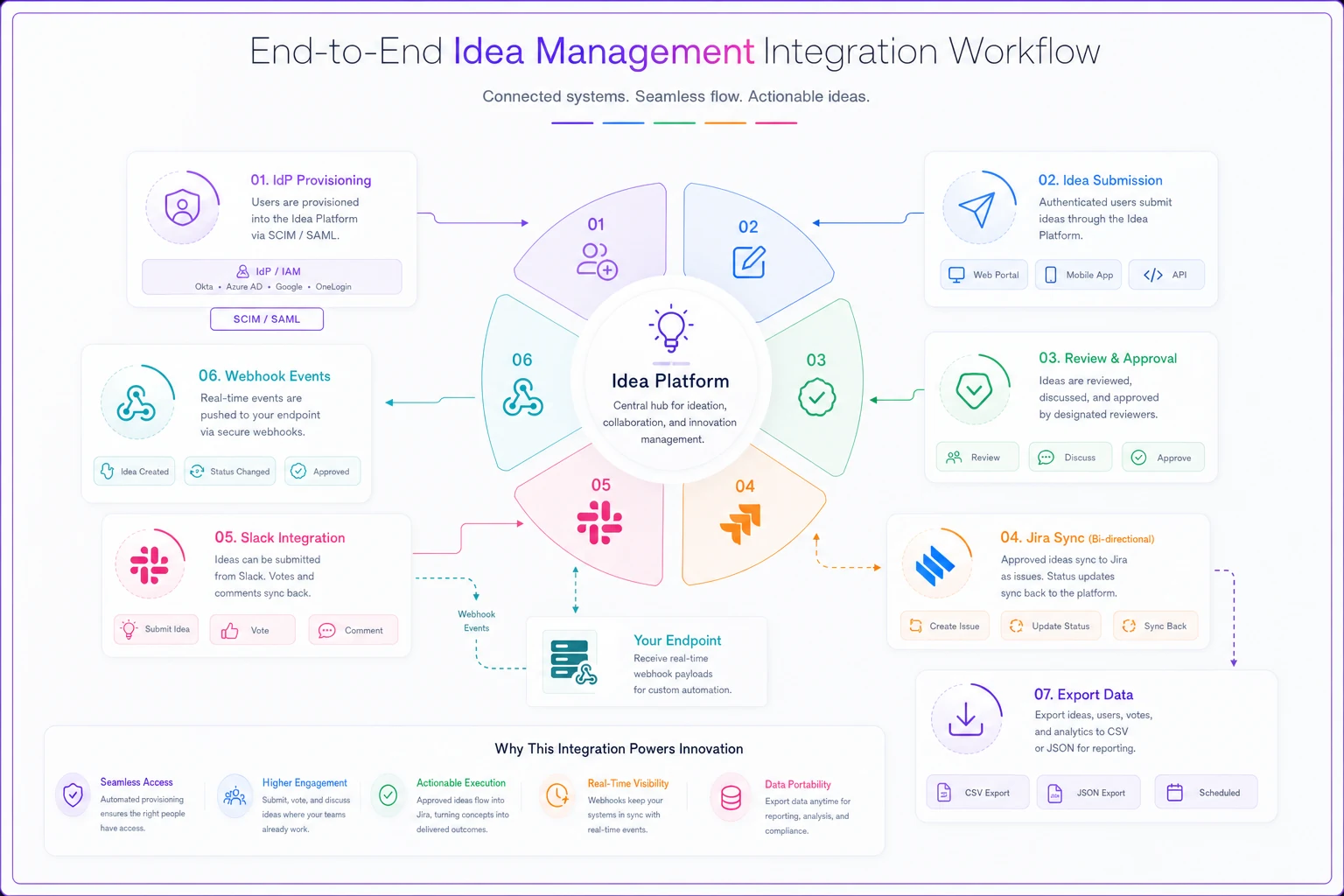
In plain terms, the end-to-end flow you're validating works like this: a plant engineer submits an idea, it gets approved, that approval creates a Jira issue with the right fields mapped, engineering works it in Jira, the status flows back to the idea platform, colleagues vote on it inside Slack, and then you export the whole thing and confirm you can reconstruct it elsewhere. If any link in that chain breaks, the program degrades into manual copy-paste within weeks.
Test Script: Core Flow
-
Provision test users via SCIM. Create three users in your IdP (submitter, evaluator, admin), assign them to groups, confirm they appear in the platform with correct roles within the stated sync window.
-
Submit an idea as the submitter. Fill every field type. Attach a file over 5MB.
-
Approve the idea as the evaluator. Confirm a Jira issue is created automatically.
-
Verify field mapping in Jira. Check that title → summary, submitter name, category → component, and description all landed correctly. Note anything that didn't map.
-
Close the Jira issue. Confirm the idea's status updates on the platform side (this is where one-directional syncs fail).
-
Submit and vote via Slack. Have a different user submit through the Slack app and have two others vote. Confirm vote counts match on the web platform.
-
Trigger a webhook. Point an "idea status changed" webhook at a test endpoint (webhook.site works). Confirm payload structure matches the docs.
-
Run a full export. Export to both CSV and JSON. Open the files. Confirm comments, votes, attachments, and timestamps are all present.
-
Deprovision the submitter via SCIM. Confirm the behavior matches what the vendor said in Q3.
-
Test restore. Take the export and load it into a spreadsheet or staging DB. Can you reconstruct the program from the export alone? If not, you're locked in.
What to document for each step
-
Pass / fail / partial
-
Actual sync latency vs. claimed
-
Any fields that silently dropped
-
Any manual workaround required
The most common failure point: the Jira sync works beautifully one direction (idea → issue) but the reverse path (issue closed → idea updated) requires a paid add-on or simply doesn't exist. You only find this at step 5.
Part 3: The 60–90 Day Pilot Calendar
A pilot without named owners and dated milestones is just an extended free trial nobody drives. Assign one person per workstream. If the same person owns everything, nothing gets tested properly.
| Phase | Days | Key Activities | Owner |
|---|---|---|---|
| Setup | 1–10 | SSO/SCIM config, Jira + Slack connect, field mapping | IT / Integration lead |
| Validation | 11–20 | Run full integration test script, log defects | Innovation ops |
| Soft launch | 21–40 | One plant or department, ~50–75 users, real ideas | Program manager |
| Full pilot | 41–75 | Expand to ~150–200 users, measure KPIs | Program manager |
| Review & decide | 76–90 | KPI review, security sign-off, contract negotiation | Innovation director + procurement |
Start the SOC 2 report and subprocessor review in week one, not week eight.
A realistic note on pacing: setup almost always slips. Budget 10 days, expect 14. Security review of the SOC 2 report and subprocessor list is the usual bottleneck — start that in week one, not week eight.
Part 4: Sample Pilot KPIs for a 500-Employee Manufacturer
Vague pilot goals produce vague decisions. Set numeric targets before the pilot starts so the review meeting isn't a debate about gut feel.
-
Activation rate at least 55–65% of invited users log in and complete one action within the first two weeks.
-
Idea submission volume around 80–120 ideas during the 35-day full pilot.
-
Evaluator throughput 90% of submitted ideas receive a first-pass decision within 5 business days.
-
Jira conversion at least 15–20 approved ideas successfully create and sync Jira issues with correct field mapping.
-
Integration reliability fewer than 3 sync failures requiring manual intervention over the pilot.
-
Export integrity 100% of ideas, comments, and votes present in the export (this is pass/fail, not a percentage goal).
-
Admin time under 4 hours/week of manual admin work once configured.
If activation comes in at 30% and admins are spending a full day a week patching sync issues, that's your answer — regardless of how polished the UI felt during the demo.
Part 5: Contract Negotiation Checklist & Model Clauses
The pilot gives you leverage you'll never have again. Once you're live in production, switching costs make you a captive renewal. Negotiate the exit before you negotiate the entry.
Contract checklist:
-
Pilot terms converted to production terms in writing (not just a verbal "same rate")
-
Price escalation capped (name a percentage)
-
Data export obligations survive termination for a defined window
-
SLA with actual service credits, not best-effort language
-
Rollback/migration assistance committed for offboarding
-
Subprocessor change notification requirement
-
Active-user definition locked so it can't be reinterpreted at renewal
Model clause language (adapt with your legal team — these are starting points, not legal advice):
Pilot conversion: "Pricing and terms established during the Pilot Period shall apply to the initial twelve (12) month production term without modification."
Data export on termination: "Upon termination for any reason, Vendor shall provide Customer, within thirty (30) days, a complete export of all Customer Data in both CSV and JSON formats, including all metadata, comments, attachments, and voting records, at no additional cost."
Price cap: "Annual renewal fees shall not increase by more than five percent (5%) over the prior term's fees."
Rollback assistance: "For a period of sixty (60) days following termination, Vendor shall provide reasonable migration assistance, including data format documentation and up to eight (8) hours of technical support, to facilitate transition to a successor system."
The export and rollback clauses are the ones vendors push back on hardest — which is exactly why they matter most.
Part 6: A Worked TCO Example
Sticker price almost never matches total cost. Below is a realistic three-year comparison for a 500-employee manufacturer where roughly 220 people end up active.
| Cost component | Per-active-user model | Tiered model |
|---|---|---|
| License (Year 1) | 220 × $14/mo × 12 = ~$37k | "Up to 250 users" tier = ~$30k |
| License (Year 2, growth to 280 active) | 280 × $14 × 12 = ~$47k | Bumped to "500 user" tier = ~$52k |
| License (Year 3) | ~$50k | ~$52k |
| One-time integration/setup | ~$6k–$9k | ~$6k–$9k |
| Change management (training, internal comms) | ~$8k–$12k | ~$8k–$12k |
| Approx. 3-year total | ~$155k–$165k | ~$150k–$160k |
The interesting part isn't which column wins — they're close. It's the Year 2 jump in the tiered model. Cross a band boundary by one user and you pay for a whole tier you don't need. Per-active-user scales more smoothly but punishes you if "active" is defined loosely — say, anyone who was ever provisioned counts. That's why Q22's definition of "active" is a pricing question disguised as a technical one.
Worth noting: integration and change-management costs are roughly equal across both models and often exceed a single year of licensing. Teams fixate on the per-seat number and ignore the $14k–$21k of one-time cost sitting right next to it.
Part 7: Security & Compliance Checklist
Hand this to your security team early. Their sign-off is on the critical path.
-
SOC 2 Type II report reviewed; report period current; exceptions understood
-
Encryption confirmed
AES-256 at rest, TLS 1.2+ in transit
-
Penetration test within last 12 months; remediation evidence seen
-
Complete subprocessor list reviewed and approved
-
Data residency confirmed to meet your regulatory obligations
-
RTO/RPO documented and acceptable
-
Backup frequency and tested restore confirmed
-
Breach notification timeline acceptable
-
SSO enforcement and SCIM deprovisioning validated in test
Give your security team the SOC 2 report and subprocessor list on day one of the pilot, not day 60. In most manufacturing environments, security sign-off takes two to three weeks minimum — sometimes longer if your team needs to escalate a subprocessor concern or request a remediation letter from the vendor. Starting that process late is the single most avoidable reason procurement timelines blow up.
When this full process makes sense — and when it's overkill
Do all of this if: you're deploying to 200+ users, you have real Jira/Slack dependencies, you operate under data-residency obligations, or ideas will carry IP and sensitive operational detail. The procurement rigor pays for itself the first time you catch a one-directional Jira sync before signing.
-
Scale it down if you're piloting with a single 30-person team, there's no SSO requirement yet, and you're genuinely treating this as a throwaway experiment. Running a 30-question RFP for a 25-seat trial is its own kind of waste.
Skip the heavy contract clauses if the vendor offers a true month-to-month with clean export built into the product — though in practice, almost none of them do, which is why the clauses exist.
Deliverables to build from this
Turn the sections above into reusable artifacts your team keeps on the shelf:
-
The 30-question RFP as a .docx vendors fill in inline
-
A CSV/JSON export schema defining required fields (id, title, submitter, status, timestamps, votes, comments, attachments) so you can validate exports objectively
-
The integration test script as a checklist with pass/fail columns
-
The pilot Gantt with owner assignments
-
The KPI dashboard template pre-loaded with your numeric targets
-
The contract clause snippets handed to legal before negotiation starts
By the time you're signing, there should be no surprises left. You've watched the Jira sync run both directions against your own instance. You've opened the export file and counted the records. You've read the SOC 2 report and the subprocessor list. The signature becomes the boring part — which is exactly how a procurement decision for software running your innovation program for the next three years should feel.
By the time you're signing, there should be no surprises left. You've watched the Jira sync run both directions against your own instance. You've opened the export file and counted the records. You've read the SOC 2 report and the subprocessor list. The signature becomes the boring part — which is exactly how a procurement decision for software running your innovation program for the next three years should feel.
Ready to transform your innovation process?
Join 2,000+ companies using GoIdeafy to unlock team creativity, prioritize impactful ideas, and accelerate growth.