



Last month, a product innovation team at a 400-person fintech startup discovered they had cataloged the same "mobile payment simplification" concept seventeen different times across three years. Different titles, slightly different angles, but fundamentally the same core concept sitting there, taking up mental space, creating decision paralysis every quarterly planning session.
This happens everywhere. Most innovation programs treat their idea backlogs like infinite storage units rather than living systems that need active maintenance. Teams spend more time navigating through duplicate concepts, outdated suggestions, and zombie ideas than actually evaluating fresh thinking.
Idea backlogs need structured hygiene practices just as much as code repositories need version control. Without proper maintenance workflows, your ideation system becomes a graveyard where good concepts disappear under accumulated noise.
The hidden cost of bloated idea inventories
A telecommunications company had accumulated 3,400 ideas in their innovation management platform over eighteen months. Sounds impressive until you realize their evaluation team was spending twelve hours per week just categorizing and tagging submissions. That's before any actual assessment work began.
The damage happens in three layers. First, duplicate ideas create artificial volume that makes your innovation metrics look healthy while masking that genuine new thinking has stalled. Second, evaluators develop fatigue from repeatedly encountering variations of the same concepts, which leads to rushed assessments and missed opportunities. Third, contributors lose faith in the system when they see hundreds of unprocessed ideas sitting in limbo.
Idea backlog hygiene is particularly challenging because unlike product backlogs, which have clear ownership and sprint cycles, idea systems often exist in organizational limbo. They're everyone's responsibility and therefore no one's priority. The maintenance debt compounds monthly until the entire system becomes functionally unusable.
Practical aging rules that prevent idea fossilization
The most effective approach uses a tiered aging system based on interaction patterns rather than arbitrary time limits. Ideas move through stages based on engagement metrics, not calendar dates.
Capture, evaluate, and act on ideas without friction.
GoIdeafy streamlines the entire innovation lifecycle from idea submission to implementation.
- Centralized idea capture
- Collaborative evaluation tools
- Progress tracking & analytics
No credit card required
Stage 1: Active Consideration (0-60 days) Fresh submissions stay in active rotation for two months. During this window, they need to achieve minimum engagement thresholds: at least three unique viewers, one comment or rating, and assignment to a relevant theme or challenge. Ideas that hit these markers stay active. Those that don't automatically move to Stage 2.
Stage 2: Dormant Review (61-120 days) Ideas enter a holding pattern where they're still searchable but removed from primary evaluation queues. Monthly, a designated reviewer checks dormant ideas for potential revival based on changing business priorities or new market conditions. About 15% of ideas get reactivated from this stage when contexts shift.
Stage 3: Archive Eligible (121+ days) After four months without meaningful interaction, ideas become archive candidates. But archiving isn't automatic. A quarterly review process examines patterns in archived ideas to identify recurring themes that might indicate systemic blind spots in current innovation efforts.
One manufacturing client using this system reduced their active idea inventory from 1,200 to around 280 actionable concepts while maintaining a searchable archive of 900+ ideas for trend analysis. Processing time for new submissions dropped by 65% once evaluators weren't wading through years of accumulated suggestions.
Deduplication workflows that actually scale
The biggest mistake teams make with deduplication is trying to do it manually at scale. You need systematic workflows that combine automated detection with human judgment at key decision points.
Start with semantic clustering rather than keyword matching. Ideas with different terminology but similar intent need to be grouped. A retail innovation team discovered that "customer loyalty program enhancement," "rewards system overhaul," and "points redemption improvement" were all addressing the same core friction in their ecosystem.
Your deduplication workflow should follow this sequence:
Weekly automated similarity scoring Run all new submissions through a comparison algorithm that flags potential duplicates based on semantic overlap above 70%. This catches obvious duplicates before human review begins.
Bi-weekly human validation A rotating team member reviews flagged clusters to determine if ideas should be merged, linked as related, or kept separate. The human element matters because sometimes similar-sounding ideas have critically different implementation approaches.
Visual workflow for deduplication.
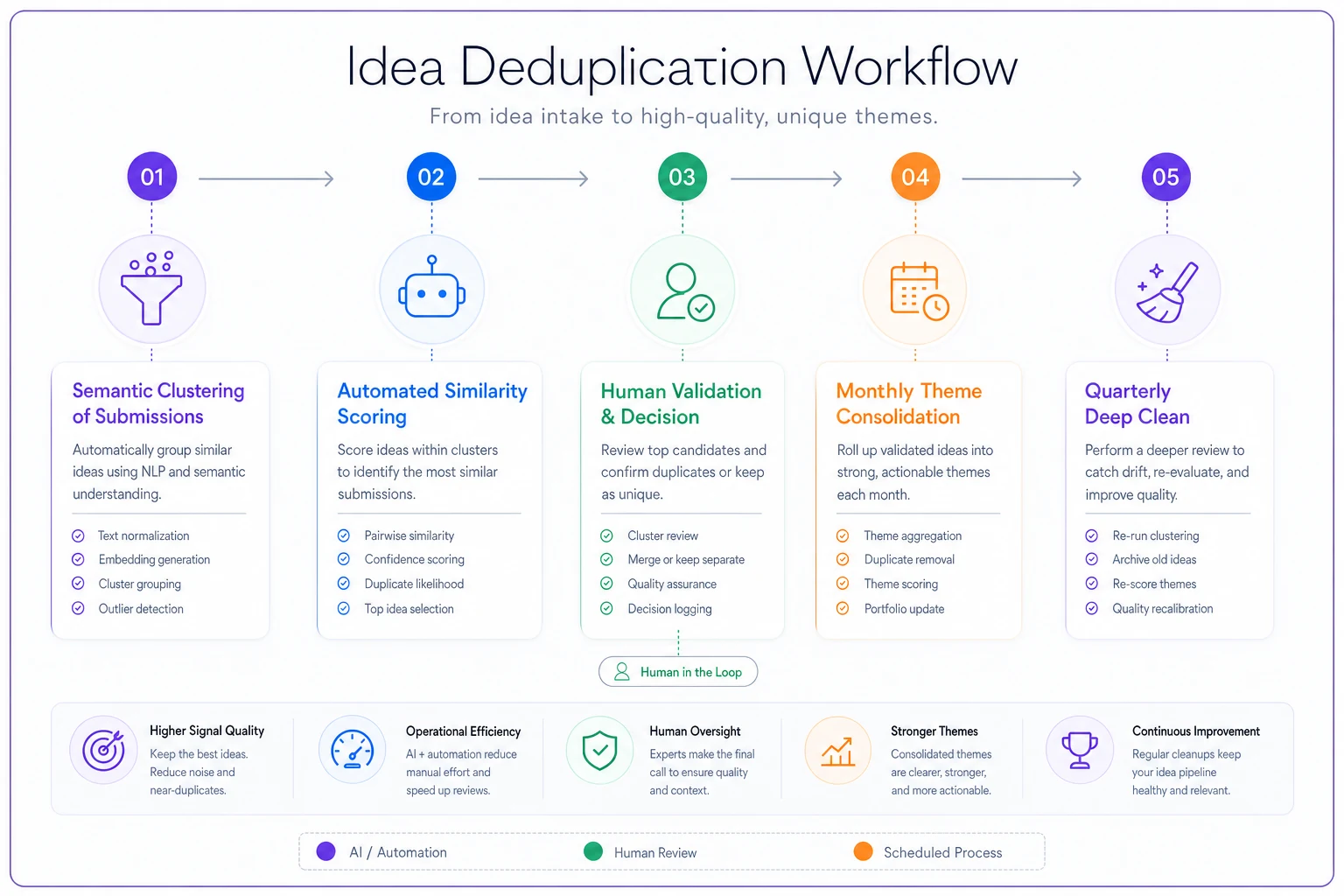
Monthly theme consolidation Look for patterns across duplicate clusters. If you're seeing the same idea surface repeatedly with slight variations, that's signal, not noise. Create a master idea that captures the core insight and link all variations as supporting evidence of demand.
Quarterly deep clean Every three months, run a comprehensive deduplication across your entire active inventory. This catches slow-building redundancies that weekly checks might miss.
Deduplication isn't just about reducing volume. It's about surfacing patterns that indicate where your organization's attention naturally gravitates. Those recurring themes often represent your highest-impact opportunity areas.
Monthly maintenance rituals that compound value
Think of your monthly maintenance routine as preventive care rather than emergency surgery. The teams that maintain clean idea backlogs spend roughly four hours per month on structured maintenance versus the twenty-plus hours others spend on crisis cleanup.
First Monday: Engagement Health Check Review ideas that haven't received interaction in 30 days. Send automated nudges to relevant stakeholders. Flag high-potential concepts that might be getting overlooked due to poor tagging or categorization.
Second Monday: Contributor Re-engagement Identify contributors whose ideas haven't progressed and provide status updates. Nothing kills future participation faster than submitting into a black hole. A simple "your idea is currently in technical feasibility review" maintains momentum.
Third Monday: Tag and Category Cleanup Audit your tagging taxonomy for drift and redundancy. Marketing-related ideas might be scattered across "customer experience," "brand," "growth," and "revenue" tags when they should be consolidated. Clean taxonomy improves discoverability and reduces accidental duplication.
Fourth Monday: Archive and Extract Process ideas moving to archive status. Don't just file them away. Extract key insights, recurring themes, and lessons learned. These become inputs for strategic planning and help identify innovation blindspots.
| Maintenance Ritual | Description |
|---|---|
| First Monday: Engagement Health Check | Review ideas that haven't received interaction in 30 days. Send automated nudges to relevant stakeholders. Flag high-potential concepts that might be getting overlooked due to poor tagging or categorization. |
| Second Monday: Contributor Re-engagement | Identify contributors whose ideas haven't progressed and provide status updates. A simple "your idea is currently in technical feasibility review" maintains momentum. |
| Third Monday: Tag and Category Cleanup | Audit your tagging taxonomy for drift and redundancy to improve discoverability and reduce accidental duplication. |
| Fourth Monday: Archive and Extract | Process ideas moving to archive status and extract key insights and recurring themes for strategic planning. |
Rotate the maintenance reviewer each month to spread ownership and avoid burnout.
A financial services firm following this rhythm reported that their idea-to-pilot conversion rate increased from 2.3% to 7.8% over six months. The improvement wasn't from better ideas coming in, but from better visibility and processing of existing concepts.
Automation hints that reduce manual overhead
The teams succeeding with idea backlog hygiene aren't working harder; they're leveraging strategic automation to handle repetitive tasks while preserving human judgment for high-value decisions.
Auto-tagging based on content analysis Instead of relying on submitters to categorize correctly, use natural language processing to suggest relevant tags based on idea content. This improves consistency and reduces the approximately 40% of ideas that arrive miscategorized.
Intelligent notification cascades Set up escalating reminder sequences for ideas approaching stage transitions. Start with gentle nudges to reviewers, escalate to team leads if no action occurs, and finally trigger executive visibility for high-potential concepts at risk of aging out.
Similarity scoring at submission Before someone can submit, show them similar existing ideas. This reduces duplicates at the source and often leads to contributors building on existing concepts rather than starting from scratch. One software company saw a 60% reduction in duplicate submissions after implementing this check.
Automated insight extraction Monthly, generate summaries of archived ideas grouped by theme. These reports surface patterns humans might miss when reviewing ideas individually. "We've archived 23 ideas about checkout process improvements" tells a different story than seeing those ideas scattered across months of submissions.
Engagement decay alerts Flag ideas experiencing rapid engagement drop-off. An idea that generates initial excitement but quickly loses momentum often indicates either communication gaps or feasibility concerns that need addressing.
The automation sweet spot exists where you reduce mechanical work without removing human insight from the evaluation process. Think of it as giving your innovation team superpowers rather than replacing their judgment.
The operational reality of maintaining idea systems versus product backlogs
Product backlogs have clear owners, defined sprint cycles, and direct connection to delivery. Idea systems exist in a more ambiguous space, which is exactly why they need more structured maintenance protocols.
The fundamental difference is that product backlogs deal with commitment while idea backlogs deal with possibility. You can't apply the same rigor to evaluating possibilities that you apply to committed work, but you absolutely need rigor in maintaining the system itself.
Consider how a consumer goods company restructured their approach. Instead of treating their idea backlog like a suggestion box with infinite capacity, they implemented strict inventory limits. No more than 200 active ideas at any time. New submissions beyond that limit had to either replace an existing idea or wait in a pre-submission queue.
This constraint forced real prioritization conversations. Contributors had to check existing inventory before submitting. Evaluators had to make actual decisions rather than perpetually deferring. The quality of submissions increased because people knew they were competing for limited slots.
Building sustainable hygiene practices without burning out your team
The biggest failure point in idea backlog maintenance isn't the process; it's the sustainability. Teams start strong with weekly reviews and monthly cleanup sessions, then gradually let maintenance slide until they're back to crisis mode.
Sustainable hygiene practices share three characteristics. First, they're distributed rather than centralized. Instead of one person owning all maintenance, different team members rotate through specific responsibilities. Second, they're integrated into existing workflows rather than treated as separate activities. Third, they're measured and visible, creating accountability without micromanagement.
A technology firm made their idea backlog metrics part of their innovation dashboard, tracking metrics like:
-
Average time from submission to first review
-
Percentage of ideas in each lifecycle stage
-
Duplicate detection rate
-
Archive extraction value (insights generated from archived ideas)
Making these metrics visible created natural pressure to maintain good hygiene without requiring constant management attention. Team members could see when the system was getting clogged and took action proactively.
The compound effect of consistent idea backlog hygiene
Most organizations miss how the benefits of idea backlog hygiene compound exponentially over time. A clean, well-maintained idea system doesn't just process current ideas faster; it fundamentally changes how your organization approaches innovation.
When contributors know their ideas will be evaluated promptly and fairly, submission quality improves. When evaluators aren't overwhelmed by volume, they make better decisions. When patterns are visible across ideas, strategic themes emerge naturally. When the system works smoothly, participation increases.
-
Idea submission quality score increased from 3.2 to 4.6 (on a 5-point scale)
-
Time to evaluation dropped from 47 days to 8 days average
-
Duplicate submissions reduced by 71%
-
Ideas progressing to pilot stage increased from 11 per quarter to 34 per quarter
But the real transformation was cultural. Innovation shifted from a separate activity to an embedded capability. The idea system became a trusted tool rather than a bureaucratic burden.
The organizations winning at innovation aren't necessarily the ones with the most ideas. They're the ones with the cleanest, most navigable idea systems that turn possibility into action efficiently. Your idea backlog isn't just a repository; it's an operational system that needs the same maintenance discipline you'd apply to any critical business infrastructure.
This is where AI-powered operational software becomes genuinely valuable for innovation teams. Not as a replacement for human creativity or judgment, but as infrastructure that handles the mechanical aspects of backlog hygiene. Automated duplicate detection, intelligent categorization, engagement tracking, and archive analysis free your team to focus on what humans do best: recognizing potential, making connections, and driving implementation.
Every month you delay implementing proper maintenance workflows, your idea debt compounds. The good news is that starting with even basic hygiene practices creates immediate improvement. Pick one workflow from this article and implement it this week. Your future innovation efforts will thank you for it.
Ready to transform your innovation process?
Join 2,000+ companies using GoIdeafy to unlock team creativity, prioritize impactful ideas, and accelerate growth.