



The numbers that landed at the end of October changed the conversation in a lot of planning meetings. U.S. GDP grew at a 3.4% annualized rate in Q3 2026, and Reuters reported that AI-related business investment was one of the biggest engines behind it, alongside consumer spending. A separate Reuters piece on core capital goods showed business spending on equipment accelerating again, tied heavily to AI build-out.
For innovation teams, this isn't an economics headline. It's a funding signal. When CAPEX and discretionary budgets start tilting hard toward AI, the finance committee that used to fund your three-pilot portfolio is now fielding competing asks from IT, operations, and every business unit with a chatbot idea. The money is moving. The question is whether your pipeline is positioned to catch any of it — or whether you're about to get quietly deprioritized while someone else's AI initiative eats the budget you were counting on.
This piece is about AI investment rebalancing at the operational level: how to adjust your funding gates, pilot scopes, and evaluation rubrics fast enough to compete, without blowing up the discipline that keeps your portfolio honest.
The real problem the surge exposes
Reorder the pipeline before you touch the funding
Tighten the pilot gates (fund narrow, prove fast)
Update the evaluation rubric for AI-readiness
The vendor due-diligence bottleneck nobody budgets time for
A real scenario
When this fast-track approach makes sense — and when it doesn't
The quarter-close reflex
The real problem the surge exposes
Most innovation portfolios weren't built to compete for a specific, time-boxed funding wave. They were built to run a steady cadence — intake, triage, pilot, scale — on a predictable annual budget.
That model breaks the moment funding becomes episodic and contested. When a CFO suddenly has appetite for AI spend this quarter but uncertainty about next, the teams that win aren't the ones with the best ideas. They're the ones who can show up with a scoped pilot, a credible ROI story, and a vendor already cleared through security — within weeks, not the next planning cycle.
What tends to happen instead: the innovation team hears "we're funding AI now" and reacts by relabeling existing pilots. The supplier-portal project becomes an "AI-enhanced supplier portal." The dashboard refresh becomes "AI-driven analytics." Finance sees through this almost immediately, and it damages credibility right when you need it most. The surge doesn't just create opportunity — it exposes which teams were running on substance versus momentum.
Reorder the pipeline before you touch the funding
The instinct is to jump straight to "how do we get the money." That's the wrong order. First you reorder what's in the pipeline, because a pipeline full of 18-month platform plays has nothing to offer a funding window that wants results in a quarter.
Capture, evaluate, and act on ideas without friction.
GoIdeafy streamlines the entire innovation lifecycle from idea submission to implementation.
- Centralized idea capture
- Collaborative evaluation tools
- Progress tracking & analytics
No credit card required
Go through your active and backlogged ideas and sort them against two axes that actually matter right now: time-to-signal (how fast can you learn whether this works) and AI-leverage (does AI meaningfully change the economics, or is it decoration).
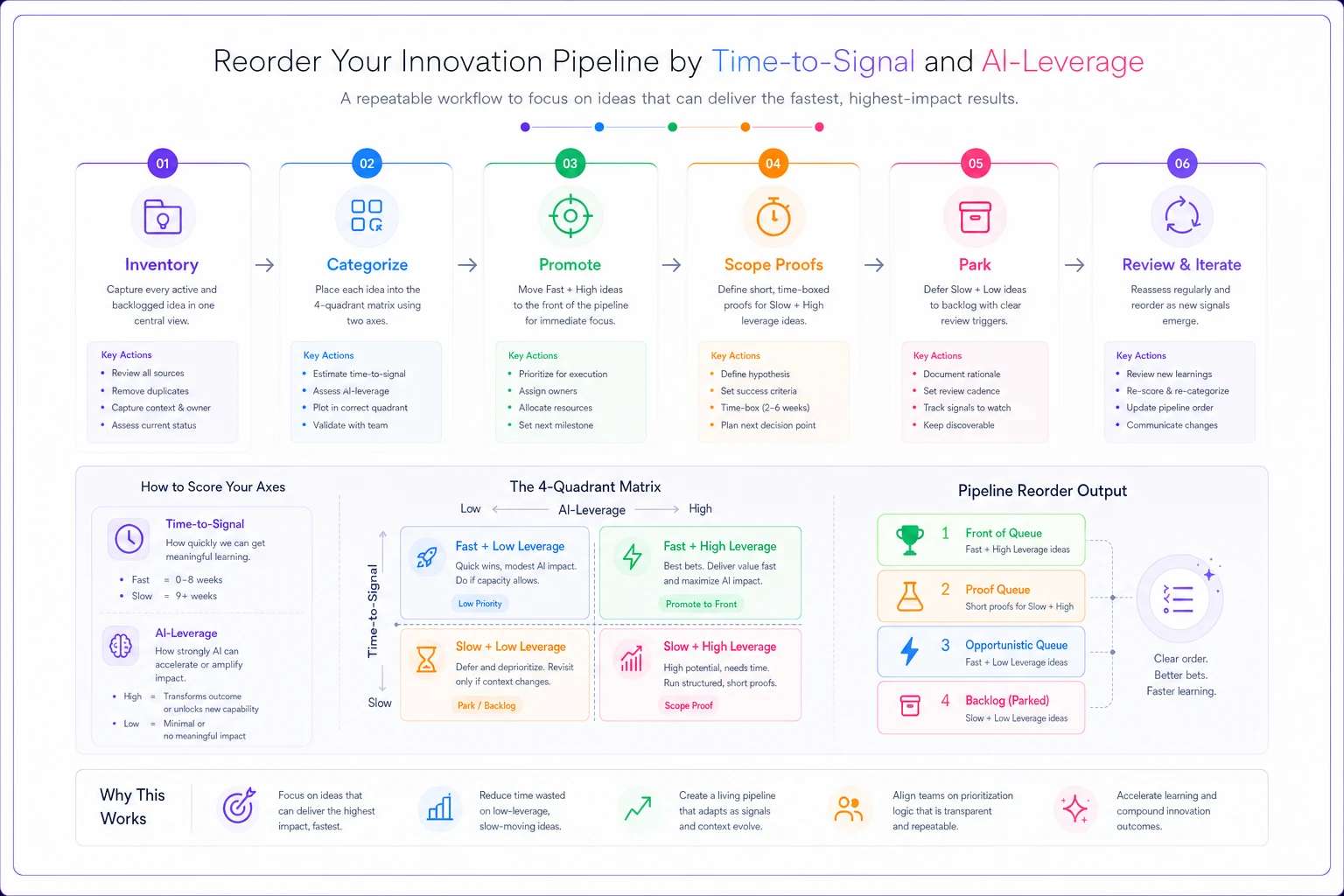
A simple sorting workflow helps you pick front-of-queue pilots quickly.
| Idea profile | Time-to-signal | AI-leverage | What to do with it now |
|---|---|---|---|
| Fast + high leverage | 2–6 weeks | High | Promote to front of queue, scope for funding ask |
| Fast + low leverage | 2–6 weeks | Low | Keep, but don't pitch it as an AI initiative |
| Slow + high leverage | 3–6 months | High | Break into a short first phase that produces a signal |
| Slow + low leverage | 3–6 months | Low | Park it. This window is not for it |
The mistake to avoid: assuming everything needs to be reframed as AI. A genuinely useful process-improvement pilot with nothing to do with AI is still worth running — just don't contort it into the AI ask and dilute both. Being honest about which bucket something belongs in is what lets finance trust the two or three pilots you actually push forward.
This kind of sorting is a tighter, faster version of the portfolio discipline covered in Align Funding to Impact. The difference now is the clock. Normally you rebalance on a cycle; here you're rebalancing against a window that might close.
Tighten the pilot gates (fund narrow, prove fast)
When funding is contested and short-dated, wide pilots are a liability. A pilot with a fuzzy scope and a six-month runway is exactly what gets cut when the quarter tightens. The teams that keep their money scoped narrow enough to show a result before the next budget review.
-
Pre-gate screen (1 day). Does this idea have a measurable signal you can produce in under 6 weeks? If not, it doesn't enter the fast track — it can still live in the normal pipeline.
-
Scope-lock gate. Before any money moves, the pilot owner writes a one-paragraph definition of the single decision this pilot will inform and the single metric that answers it. No metric, no funding.
-
Vendor-readiness gate. If an outside AI tool is involved, security and data-handling review must be in progress or cleared before the pilot starts — not after. More on this below.
-
Kill/continue gate at the halfway mark. Set a hard checkpoint. If the signal isn't trending, you stop and reallocate. This single rule is what makes finance comfortable giving you the next tranche.
A pattern worth noticing across teams that handle these windows well: they fund in small tranches tied to gates, not in lump sums tied to a plan. A $40k pilot released as three $12k–$15k tranches against checkpoints feels completely different to a finance committee than $40k handed over upfront. It signals you'll stop a loser early — which is exactly the behavior that earns you the next round of AI budget.
Update the evaluation rubric for AI-readiness
Your existing scoring rubric probably doesn't ask the questions that separate a fundable AI pilot from a risky one. Add a small, specific layer — not a whole new framework. A few dimensions worth scoring explicitly:
-
Data availability. Does the data this idea needs actually exist, accessible, in usable shape? A lot of AI pilots die here, three weeks in, when someone discovers the "data" is 4,000 PDFs sitting in a shared drive.
-
Signal clarity. Can you define success in a single, measurable way that a non-technical sponsor understands?
-
Reversibility. If this fails or behaves badly, how cleanly can you roll it back? High-reversibility pilots are much easier to fund quickly.
-
Human-in-the-loop fit. Where does a person check the output before it causes harm? Pilots with no review point are slower to clear governance.
-
Marginal economics. Does the AI component change cost-per-unit-of-work in a way you can actually estimate? If the honest answer is "it's interesting but doesn't move cost," score it low.
One caution: don't let the AI-readiness layer quietly become the whole score. A pilot can be perfectly AI-ready and still solve a problem nobody cares about. Keep impact and strategic fit weighted heavily so you don't end up funding technically-impressive pilots with no real business pull.
The vendor due-diligence bottleneck nobody budgets time for
This is where a lot of otherwise-good AI pilots stall. The idea is approved, the budget is there, and then the pilot sits for five weeks because the AI vendor's data-processing terms haven't cleared legal and security. By the time it clears, the funding window has moved on.
With AI spend accelerating across the market, procurement and security teams are drowning in vendor reviews. If your pilot enters that queue cold, you're at the mercy of their backlog.
Teams that move fast do something simple: they pre-clear a short list of vendors before a specific pilot needs them. They run the security and data-handling review on three or four likely AI tools during a quiet week, so when a pilot gets funded, the vendor is already a known quantity. That turns a five-week stall into a same-week start.
Run security and data-handling reviews on a short vendor list during quiet periods so funded pilots can start immediately.
-
Where does our data go, and is it used to train their models?
-
Can we get data deletion on contract exit, in writing?
-
What's the fallback if the vendor has an outage mid-pilot?
-
Is there a human-review or audit trail for the AI outputs?
-
Does the pricing scale predictably if the pilot succeeds and we expand?
None of this is exotic. It's just work that teams keep deferring until it becomes the thing blocking a funded pilot.
A real scenario
A mid-market industrial distributor — somewhere around 600 employees — had an innovation team running four active pilots on an annual budget. When their parent company signaled extra AI funding for the quarter, the team's first move was to pitch all four, lightly reframed. Finance funded none of them. The pitches read as repackaging, and the committee wasn't convinced.
They regrouped and did the boring version instead. They sorted the backlog by time-to-signal and AI-leverage and found exactly one idea that fit: an AI-assisted tool to pre-draft responses to the repetitive quote requests clogging their inside-sales inbox — roughly 900–1,100 requests a month, most of them nearly identical.
They scoped it to a single metric: median time-to-first-response on quote requests. They pre-cleared two vendors in a week. They asked for a small tranche — something in the low five figures — released against a three-week checkpoint.
By the halfway gate, median response time had dropped from around two business days to under half a day on the covered request types, and the inside-sales team was handling the overflow without the usual end-of-month pileup. That single, clean signal got them the next tranche and credibility they hadn't had before. The other three pilots went back into the normal pipeline where they belonged.
The lesson wasn't "AI fixed quoting." It was that narrow scope, one honest metric, and a pre-cleared vendor beat four vague asks every time.
When this fast-track approach makes sense — and when it doesn't
It makes sense when: there's a genuine, time-boxed funding appetite; you have at least one or two ideas with a real near-term signal; and your governance can tolerate small, gated tranches.
It's a bad idea when: you'd have to fabricate AI relevance to qualify. Chasing a funding window with a dishonest reframe costs you more in credibility than the budget is worth.
Who should sit this out: teams whose core pipeline is still immature — where intake, triage, and basic evaluation aren't reliable yet. If you can't currently run a clean pilot on a normal timeline, bolting on a compressed AI fast-track just produces expensive noise. Fix the fundamentals first; the next funding wave will come.
The quarter-close reflex
The deeper pattern here is that funding environments are getting more episodic, not less. AI is this quarter's wave; something else will be next year's. The teams that consistently capture these windows aren't the ones with special AI expertise. They're the ones whose pipeline is always a little bit ready — ideas sorted by time-to-signal, a couple of vendors pre-cleared, gates that fund narrow and kill fast.
Treat this Q3 surge as a rehearsal. Reorder the pipeline, tighten the gates, add the AI-readiness layer to your rubric, and get a short vendor list cleared before you need it. Do that, and you stop reacting to funding waves and start being positioned for them — which, over a few cycles, is the difference between an innovation team that competes for budget and one that keeps getting routed around.
Do that, and you stop reacting to funding waves and start being positioned for them — which, over a few cycles, is the difference between an innovation team that competes for budget and one that keeps getting routed around.
Ready to transform your innovation process?
Join 2,000+ companies using GoIdeafy to unlock team creativity, prioritize impactful ideas, and accelerate growth.