



Most innovation teams struggle with the same funding allocation mess. Fifteen different programs running—accelerators, hackathons, internal ventures, partnership experiments—and everyone's fighting for budget. The CFO wants ROI yesterday. The innovation committee meets quarterly to shuffle money around based on whoever presented best last week. Meanwhile, promising experiments die from underfunding while zombie projects lumber along because nobody wants to admit failure.
The real issue isn't total budget. It's that teams treat innovation funding like ordering appetizers—a little of everything, hope something tastes good. That works when you're spending $50 on dinner. It doesn't work when you're managing a multi-million dollar innovation portfolio across business units.
Why Traditional Budgeting Fails Innovation Programs
Corporate budgeting processes weren't designed for innovation. They were built for predictable operations where you know exactly what you're buying and what return you'll get.
Traditional budget cycles lock funding for 12 months. But innovation programs need flexibility. A pilot showing promise in Q1 might need triple the funding by Q2 to scale properly. A partnership that looked brilliant during planning might reveal fundamental flaws after three months of actual work. Yet most organizations can't move money between programs without triggering a bureaucratic nightmare.
The typical innovation funding approach creates three compounding problems. Programs get funded based on political capital rather than strategic alignment—the executive championing AI gets budget approved while the less flashy supply chain initiative scrapes by. Teams optimize for spending their allocation rather than achieving outcomes, because unspent budget gets cut next year. And there's no systematic way to compare a high-risk moonshot against incremental improvements that generate immediate value.
A Fortune 500 retailer burned through roughly $8 million on innovation initiatives one year with almost nothing to show for it. They had budget. They had smart people. But their funding model treated every program equally—same review process, same success metrics, same timeline. Their blockchain experiment got the same scrutiny as their customer experience improvements. Both mattered, but they had fundamentally different risk profiles and time horizons.
The Portfolio Lens Framework
Think about innovation funding the way venture capitalists think about startup investments. They don't put equal money into every company. They don't expect the same returns from seed investments versus Series B. They actively rebalance based on performance signals.
Capture, evaluate, and act on ideas without friction.
GoIdeafy streamlines the entire innovation lifecycle from idea submission to implementation.
- Centralized idea capture
- Collaborative evaluation tools
- Progress tracking & analytics
No credit card required
Strategic Fit measures how closely each program aligns with actual organizational priorities—not the mission statement on your website, but the priorities your CEO discusses in board meetings. A program might be innovative and exciting, but if it doesn't advance strategic goals, it shouldn't get significant funding.
Risk/Return Profile acknowledges that different innovation types carry different risk levels and potential returns. Incremental improvements to existing products might have 80% success rates with 20% return potential. Breakthrough innovations might have 10% success rates with 10x return potential. Both belong in your portfolio, but they need different funding approaches.
Time-to-Impact recognizes that some innovations deliver value in three months while others need three years. Quick wins need enough resources to execute fast. Long-term bets need sustained funding that survives leadership changes.
Most teams evaluate these factors intuitively. The problem with intuition is that it varies by person, changes with mood, and can't be systematically improved.
Building Your Allocation Model
Start by categorizing innovation programs into three buckets:
| Bucket | Allocation & Description |
|---|---|
| Core Innovation (40-50% of budget) | covers improvements to existing products, operational enhancements, and customer experience upgrades. These have clear business cases, defined customers, and relatively predictable returns. Think 6-18 month timelines with 1.5-3x return expectations. |
| Adjacent Innovation (30-40% of budget) | explores new markets with existing capabilities or new capabilities for existing markets. Higher risk than core, but builds on organizational strengths. Typically 12-24 month timelines with 3-5x return potential. |
| Transformational Innovation (10-20% of budget) | pursues breakthrough technologies or entirely new business models. High failure rates, but potential for market-defining outcomes. These need 2-5 year commitments with 10x+ return possibilities. |
The percentages aren't magic. A startup might allocate 70% to transformational innovation. A regulated utility might cap it at 5%. The key is making the allocation explicit and defendable.
Within each bucket, score programs on three dimensions using a 1-5 scale:
Strategic alignment: How directly does this support stated strategic priorities?
-
5
Directly addresses top-3 strategic priority
-
3
Supports strategic priority indirectly
-
1
Interesting but not strategically aligned
Execution confidence: How likely is successful delivery based on team capability and technical feasibility?
-
5
Proven team with clear technical path
-
3
Strong team with some technical unknowns
-
1
Unproven team tackling hard technical challenges
Value potential: What's the realistic impact if this succeeds?
-
5
Game-changing impact on revenue or cost structure
-
3
Meaningful but not transformational value
-
1
Marginal improvement
Multiply the scores. Programs scoring 75-125 get full funding. Programs scoring 30-74 get partial funding with clear milestones for more. Programs below 30 get killed or merged.
Practical Allocation Scenarios
Scenario 1: The Overloaded Portfolio
A financial services firm had 23 active innovation programs with a $6 million annual budget. After scoring:
-
8 programs scored above 75 (consuming $4.2M)
-
11 programs scored 30-74 (requesting $3.8M)
-
4 programs scored below 30 (allocated $600k)
The reallocation was straightforward but politically difficult. Kill the bottom 4 programs. Reduce funding for the middle 11 to milestone-based tranches totaling $1.8M. This freed capital to properly fund the top 8 programs while creating a $500k reserve for emerging opportunities.
Six months later, 3 of the middle-tier programs hit their milestones and earned additional funding from the reserve. The organization went from 23 underfunded programs to 11 properly resourced ones. Innovation portfolio management suddenly became manageable.
Scenario 2: The Risk Imbalance
A retail company discovered their entire innovation budget went to safe, incremental improvements. Nothing transformational. Nothing that could respond to digital disruption:
-
Core
85% ($4.3M across 12 programs)
-
Adjacent
15% ($750k across 3 programs)
-
Transformational
0%
They restructured to 50/35/15 over two funding cycles—killing several "nice to have" core programs and consolidating others. The freed budget funded two transformational bets in AI-powered operations and alternative fulfillment models. One failed completely. The other is now driving their entire digital strategy.
Scenario 3: The Zombie Graveyard
A healthcare organization had seven innovation programs running for over two years without meaningful outcomes. Combined, they consumed $2.1M annually—35% of the innovation budget. The programs had scored well initially but hadn't been re-evaluated since.
Implementing quarterly scoring revealed five programs no longer aligned with evolved strategic priorities. Two had potential but needed fundamental restructuring. The organization sunset the five zombies over six months, restructured the remaining two, and reallocated $1.5M to new programs with better fit.
Rebalancing Signals and Funding Cadences
Static portfolios die slowly. You need systematic rebalancing triggers tied to your funding cycles.
Quarterly triggers should prompt minor reallocations:
-
Programs missing two consecutive milestone targets
-
Strategic priority shifts from the executive team
-
Competitive moves requiring response
-
Technology breakthroughs changing feasibility
When any trigger hits, rescore affected programs. Move 10-20% of their remaining budget to a reallocation pool. Programs showing exceptional progress can apply for additional funding from this pool.
Annual triggers drive major portfolio restructuring:
-
Full portfolio rescoring with updated strategic priorities
-
Graduation of programs to business-unit operations
-
Sunset decisions for programs past their time-to-impact window
-
Budget reallocation across innovation buckets based on performance
The key is making rebalancing systematic, not reactive. Schedule it. Document decisions. Track whether rebalancing actually improves portfolio performance over time.
A simple rebalancing workflow looks like this.
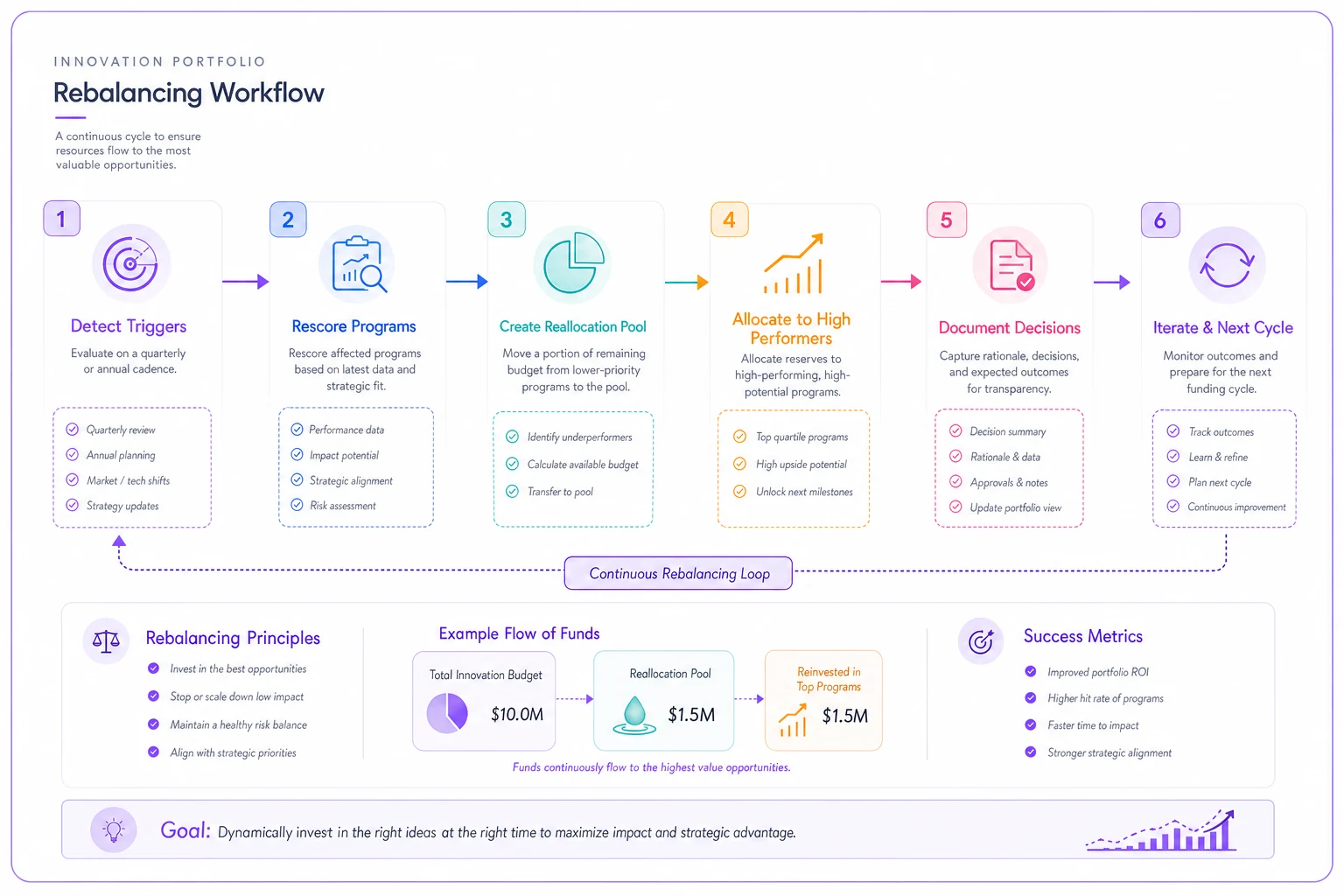
Most organizations resist frequent rebalancing because it feels like admitting failure. Venture capitalists rebalance constantly—it's how they achieve returns despite high failure rates. Your innovation portfolio needs the same discipline.
Creating Your Funding Committee Structure
Innovation Portfolio Owner (usually VP or Director level) owns overall portfolio performance. They prepare allocation recommendations, track metrics, and facilitate rebalancing discussions. This person needs political capital and operational credibility.
Business Unit Representatives provide strategic context and validate alignment scoring. They also identify opportunities for program graduation into operations. Rotate these roles annually to prevent capture by specific interests.
Finance Partner ensures allocation models make financial sense and tracks actual ROI. They translate innovation metrics into language the CFO understands. This role gets overlooked more than it should.
Technical Advisor evaluates feasibility and execution confidence scores. Could be internal CTO or an external expert. Needs to separate technical excitement from business value.
The committee meets monthly for quick reviews, quarterly for rebalancing decisions, and annually for major restructuring. Decisions require simple majority with Portfolio Owner as tiebreaker.
Document every allocation decision with three elements: what was decided, why (including scores), and success criteria for the next review. This creates institutional memory and helps validate the innovation program metrics that actually prove ROI over time.
Operationalizing the Portfolio Approach
Moving from ad-hoc funding to portfolio management requires operational infrastructure most innovation teams lack.
Start with a simple portfolio tracking system. Not complex enterprise software—a structured spreadsheet works fine initially. Track program basics (name, owner, budget, timeline), scores across your three dimensions, current phase (experiment, pilot, scale), and key metrics. Update monthly.
Keep a single master spreadsheet and enforce clear ownership to prevent conflicting updates across stakeholders.
Build three standard templates that every program must complete:
Funding Request Template forces programs to articulate strategic alignment, define success metrics, and propose funding stages tied to milestones. Maximum 3 pages. No 50-slide PowerPoint decks—just operational facts.
Quarterly Review Template captures progress against milestones, updated risk assessment, and any requests for reallocation. Include both quantitative metrics and qualitative insights. One page is usually sufficient.
Sunset Decision Template documents why a program is ending, what was learned, and how insights will be preserved. This prevents the same failed experiments from resurfacing under new names.
The templates seem bureaucratic but they solve real problems. They force consistent information gathering and prevent charismatic leaders from overwhelming data-driven decisions.
Beyond templates, define escalation paths before you need them. What happens when a program wants to exceed its allocation? Who approves emergency funding for time-sensitive opportunities? How do you handle conflicts between business units competing for innovation resources? Otherwise you'll make precedent-setting decisions during stressful moments without thinking through the long-term implications.
Common Pitfalls and How to Avoid Them
The Peanut Butter Problem: Organizations spread funding equally across all programs to avoid difficult decisions. Everyone gets something, nobody gets enough. Combat this by setting minimum viable funding levels. If a program can't be funded properly, it shouldn't be funded at all.
Score Gaming: Smart program owners learn to game your scoring system. They'll reframe initiatives to hit strategic priorities. They'll understate risks. They'll inflate value projections. Regular calibration sessions where the committee scores programs together helps maintain consistency. Also track actual versus projected scores over time—and share publicly which leaders consistently overestimate.
The Incumbent Advantage: Existing programs have relationships, momentum, and sunk cost fallacy working for them. New programs struggle to compete. Reserve around 20% of your budget explicitly for new initiatives. Force existing programs to re-compete for funding rather than assuming renewal.
Analysis Paralysis: Some committees spend months perfecting their allocation model while programs starve for resources. Your first model won't be perfect. Start with something simple, use it for two cycles, then refine based on actual experience.
Political Override: Despite clean models and clear scores, the CEO's pet project gets funded. This will happen. Build it into your model—create a "strategic initiative" bucket that acknowledges some funding decisions transcend portfolio logic. Just keep it under 15% of total budget.
Connecting Portfolio Management to Execution
The best allocation model means nothing if programs can't execute effectively. Your portfolio approach needs operational integration.
Create clear handoffs between innovation and operations. When does a successful pilot graduate to business-as-usual funding? Who owns scaling decisions? How do you prevent successful innovations from dying during transition?
Many organizations lose value at exactly this point. The innovation team declares victory and moves on. The business unit isn't ready to absorb the new program. The innovation withers from lack of ownership.
Build graduation criteria into your initial funding decisions. Define what success looks like. Identify the receiving business unit upfront. Include them in quarterly reviews so they're prepared for handoff.
AI-powered operational software can meaningfully improve this coordination. Instead of managing portfolio data across scattered spreadsheets and email chains, the right platform centralizes program information, tracks milestones automatically, and flags stakeholders when rebalancing triggers hit. Over time, it can surface patterns across your portfolio—which types of programs consistently blow their timelines, which business units successfully scale innovations, which scoring criteria actually predict success.
This isn't about replacing human judgment. It's about making sure decisions are based on complete, current information rather than whoever updated their slide deck most recently.
Measuring Portfolio Performance
Track three levels of metrics:
Portfolio Health Metrics indicate whether your allocation model works:
-
Distribution across risk categories (actual vs. target)
-
Rebalancing frequency and magnitude
-
Programs hitting milestone targets
-
Time from funding to first value delivery
Program Performance Metrics measure individual initiative success:
-
Milestone achievement rate
-
Budget versus actual spend
-
Time-to-market versus plan
-
Value delivery versus projection
Portfolio Return Metrics demonstrate overall impact:
-
Total portfolio ROI (be patient—this takes years)
-
Number of programs graduated to operations
-
Strategic objectives advanced
-
New capabilities developed
Resist the temptation to over-measure. Pick 3-4 metrics per level and track them consistently. Add complexity only after you've mastered the basics.
More importantly, use metrics to improve your allocation model. If programs in certain categories consistently underperform, adjust your scoring criteria. If rebalancing never actually changes allocations, your triggers need work. If portfolio ROI stays flat despite process improvements, your strategic alignment might be off.
Innovation portfolio management isn't a one-time exercise. It's an operational capability that improves with repetition.
Start simple. Score your existing programs. Make one significant reallocation decision. Track what happens. Build confidence in the model before adding complexity.
Get comfortable killing programs. Every zombie project you maintain prevents funding for something with real potential. Your innovation portfolio should be dynamic, not a retirement home for former priorities.
Document everything. Future innovation teams will thank you for clear records of what was tried, why it was funded, and what happened. That institutional knowledge compounds over time.
And accept that perfect portfolio management doesn't exist. Markets change. Strategies evolve. Technologies surprise. Your allocation model provides structure for making better decisions faster—not a guarantee of success.
The organizations winning with innovation aren't the ones with the biggest budgets or the best ideas. They're the ones who systematically allocate resources to the right programs at the right time, then reallocate quickly when reality diverges from plans. Some bets will fail. That's fine. The ones that succeed will more than compensate—if you've allocated wisely.
Ready to transform your innovation process?
Join 2,000+ companies using GoIdeafy to unlock team creativity, prioritize impactful ideas, and accelerate growth.