

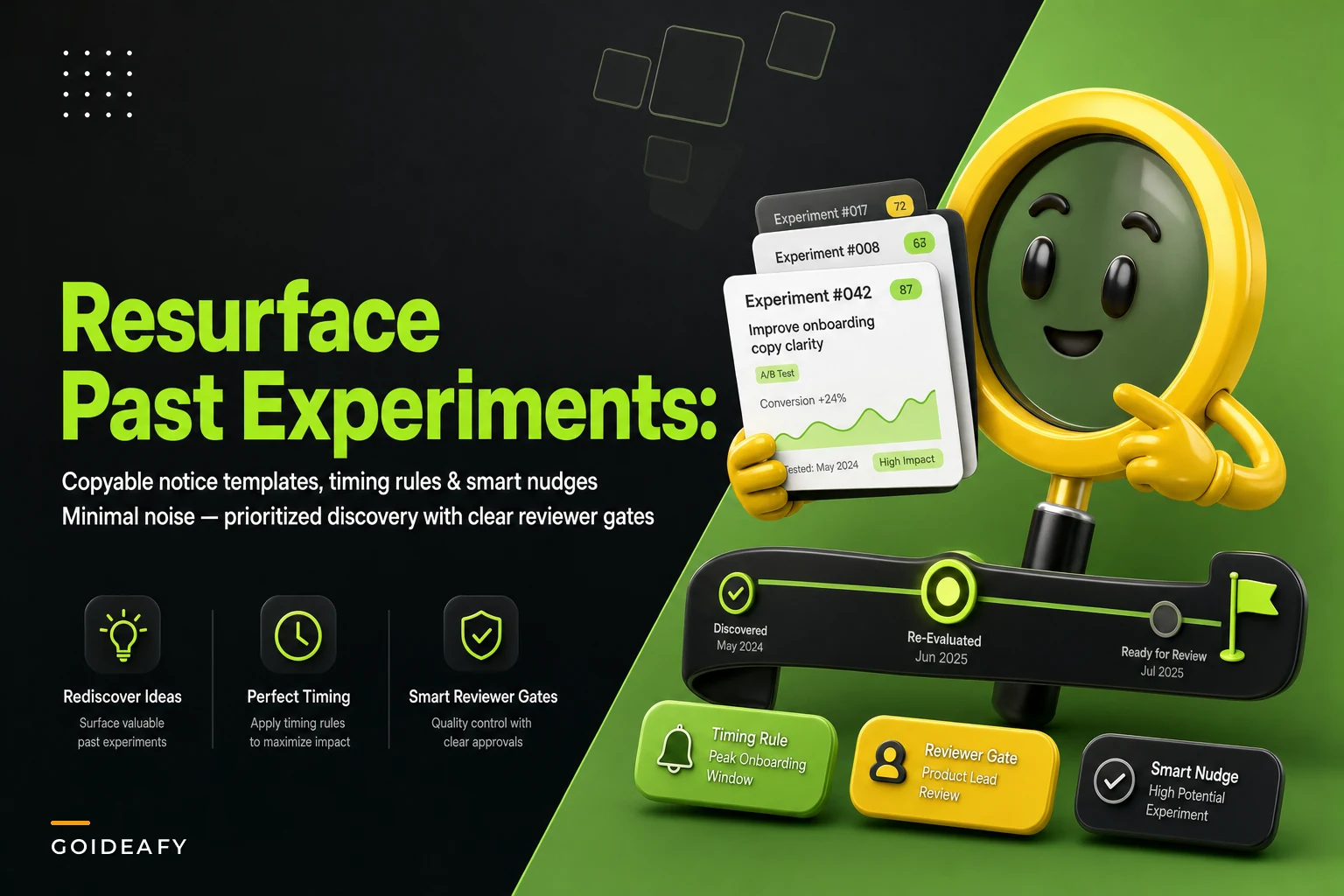

A reuse notice is only useful if it lands at the exact moment someone could still change their decision. Fire it too early and people dismiss it before they've committed to anything. Fire it too late and the team has already booked the sprint, assigned the engineer, and emotionally invested in the idea. Either way, the notice gets marked as noise, and after a few weeks people stop reading them entirely.
That's the real problem with most reuse systems. It isn't that past experiments are invisible — plenty of teams have a searchable catalogue. It's that the nudge to go look at that past work is badly timed, badly worded, or so frequent it trains people to ignore it. This post is specifically about the notice layer: the templated messages, timing rules, summary fields, and human-review triggers that decide whether someone actually pauses and reuses prior work.
If your underlying catalogue is still a mess, fix that first — reuse notices sitting on top of an undiscoverable archive just surface garbage faster. The idea taxonomy and knowledge-reuse system is the foundation. This article assumes you have something searchable and focuses on the messaging that sits on top of it.
The failure pattern nobody names: notice fatigue
Here's the sequence that kills most reuse programs within a quarter.
Someone ships a well-meaning automation: "whenever a new experiment is proposed, check for similar past experiments and notify the submitter." Sounds great. In practice, the matching is loose, so a proposal about "reducing checkout friction" pulls up every experiment that ever touched the words "checkout," "friction," or "reduce." The submitter gets a notice listing eleven vaguely related past experiments. None of them are obviously relevant. They skim, shrug, and proceed.
Two weeks later the same person submits another idea. Another notice. Same wall of marginally-related links. By the third or fourth time, they've learned that the notice is almost never worth reading. Then a genuinely duplicate experiment comes through — the one that would have saved them six weeks — the notice fires and gets the same reflexive dismissal as all the false positives before it.
That's the trap. A reuse notice isn't competing against silence. It's competing against the memory of every useless notice that came before it. Precision matters more than recall here, which is the opposite instinct most teams have when they first build these systems.
What a reuse notice is actually competing with
When someone proposes an experiment, they've usually already decided — at least informally — that it's worth doing. The notice is asking them to stop, reconsider, and potentially admit the idea isn't as original as they thought. That's a real psychological cost, not just a time cost.
Capture, evaluate, and act on ideas without friction.
GoIdeafy streamlines the entire innovation lifecycle from idea submission to implementation.
- Centralized idea capture
- Collaborative evaluation tools
- Progress tracking & analytics
No credit card required
A good notice has to clear a high bar in about five seconds of reading. If it doesn't immediately answer "why should I care about this specific past experiment right now," it loses. This is why dumping a list of links fails — it offloads all the evaluation work onto the person least motivated to do it.
The notices that actually change behavior do the evaluation for the reader and present a conclusion, not a search result.
Timing rules: when the notice should fire
The single biggest lever is when. Most teams fire reuse notices at submission, which feels logical but is actually the worst moment — the person just finished writing up their idea and has maximum attachment to it.
| Trigger point | What's happening | Notice tone | Why it works here |
|---|---|---|---|
| Draft started (before submit) | Person is still forming the idea | Soft: "Related prior work exists" | Lowest attachment, most openness |
| Submission complete | Idea is articulated but not resourced | Medium: specific match + summary | Still early enough to redirect |
| Pre-scoring / triage | Evaluator is about to spend effort | Targeted to the evaluator, not submitter | Protects reviewer time |
| Resource allocation | Sprint/budget about to be committed | Hard: human-review flag if strong match | Last chance before cost is real |
The nuance most teams miss: the draft-stage notice should be deliberately quiet and non-blocking. A small inline hint — "3 past experiments touched this area" — with a link. No interruption, no modal, no required acknowledgment. People who are genuinely curious will click. People who aren't shouldn't be forced through a wall before they've even finished their thought.
The resource-allocation notice, by contrast, should be loud and should sometimes require a human to sign off before the team can proceed. That asymmetry — quiet early, firm late — is what keeps the system from feeling like nagging while still catching expensive duplicates.
The layered model itself roughly follows this logic, moving from low-friction awareness to hard gates only when stakes are real:
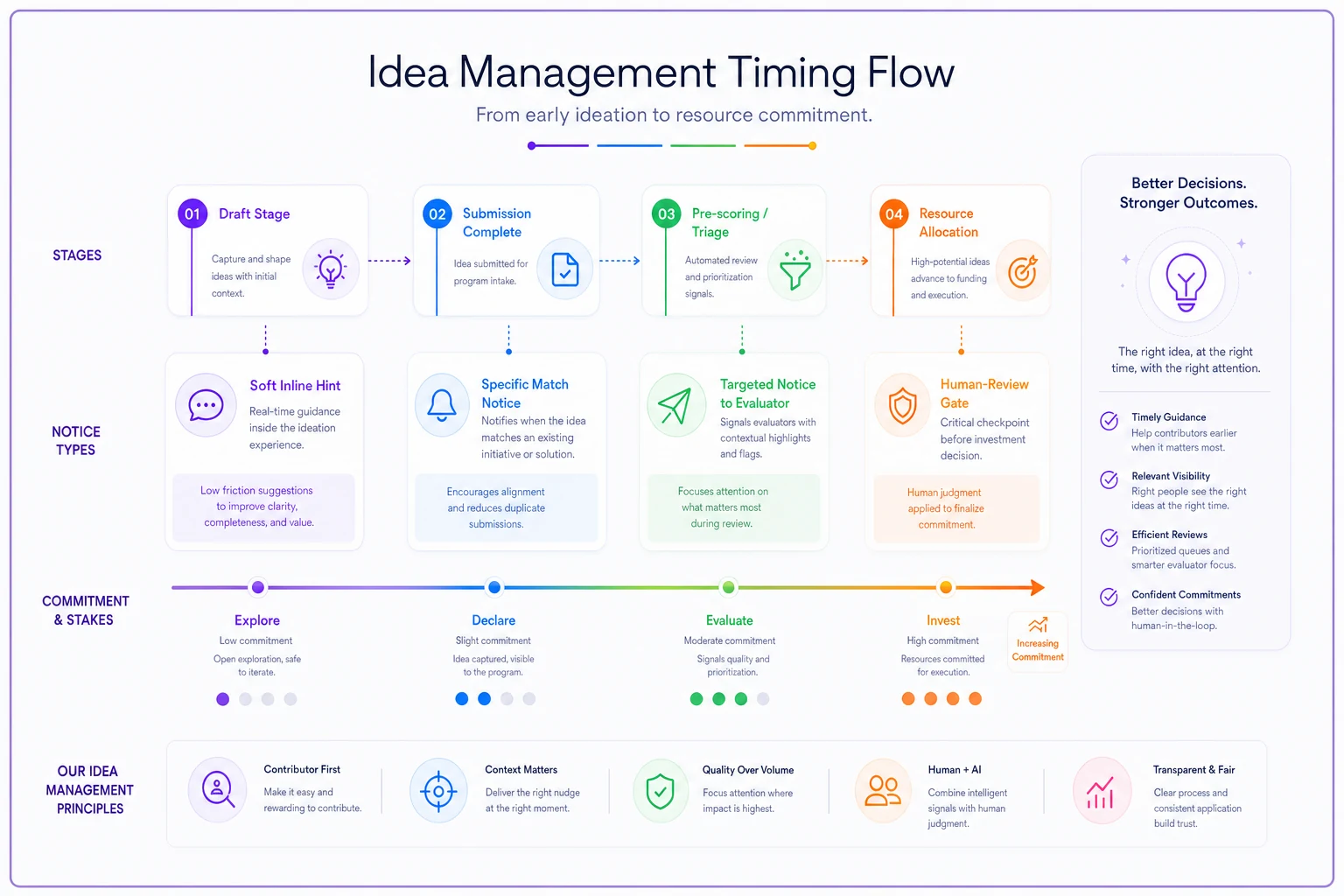
Draft Stage → Soft inline hint (no blocking) ↓ Submission Complete → Specific match notice to submitter ↓ Pre-scoring / Triage → Targeted notice to evaluator ↓ Resource Allocation → Human-review gate (if high-confidence match)
Summary fields: what actually goes in the notice
A reuse notice should never just link to a past experiment. It needs enough of a summary that the reader can make a decision without clicking through. Clicking is friction, and friction is where attention dies.
-
One-line outcome — not the title, the result. "Checkout A/B test, Q2 2024 — no significant lift, 2% sample" tells you more than the title ever will.
-
Match reason — why the system thinks this is relevant. "Same target metric: cart abandonment" beats a silent similarity score.
-
Status and recency — was this abandoned, completed, or still running? A 3-week-old running experiment demands different action than a 2-year-old dead one.
-
Owner — one name, so the reader knows exactly who to ping. This single field drives more actual reuse than anything else, because it turns "go read a report" into "go ask a person."
-
Reuse verdict (if one exists) — did the last team recommend building on this or walking away? If your retrospectives capture a reuse decision, surface it here directly.
What to leave out: full methodology, detailed metrics tables, raw data links. Those live in the catalogue. The notice is a doorway, not the room. Overstuffing it is its own form of noise — people won't read five paragraphs in a nudge any more than they'll click through eleven links.
A notice that reads "Heads up — Priya ran almost this exact test in March, got no lift, and her writeup recommends not retrying without a redesigned variant. Ping her before you scope this." will outperform any similarity-score dashboard you can build.
Templated notices: three you'll actually use
Rather than one generic template, maintain a small set keyed to match strength. The wording matters because the same information delivered as an accusation ("this is a duplicate") lands completely differently than as a helpful heads-up.
Template 1 — Soft awareness (weak/partial match, draft stage)
> A few past experiments touched this area. Not necessarily duplicates — just worth a glance if you haven't seen them: [2–3 one-liners]. Carry on if they're not relevant.
Template 2 — Specific match (medium match, submission stage)
> This looks close to [experiment name] run by [owner] in [date]. Outcome: [one-line result]. Before this moves forward, worth a 10-minute look at what they found. Link: [catalogue entry].
Template 3 — Strong match, review required (high match, resource stage)
> This closely overlaps [experiment name] ([owner], [date]), which [key outcome]. This proposal is flagged for reuse review. [Owner] or a program lead will confirm whether to proceed, adapt, or reuse before resources are allocated.
The tonal shift across the three is deliberate. The first invites, the second nudges, the third gates. Flatten all three into one "possible duplicate detected" message and you lose the ability to match intensity to confidence — and that mismatch is exactly what breeds notice fatigue.
Human-review triggers: where automation should stop
Automated matching will produce false positives. That's fine as long as you don't let the machine make the final call on anything expensive. Automation can inform and suggest at every stage, but only a human should issue a "stop and reuse" verdict that blocks work.
-
Match confidence above your high threshold (whatever your matching produces — similarity, shared metric, shared owner-team). Not "above zero." The threshold should be tuned so that maybe 5–10% of proposals hit it, not half of them.
-
AND the proposal is past the draft stage — you don't want human reviewers burning time on half-formed ideas.
-
AND resources haven't been committed yet — this is your last useful intervention point.
When all three are true, route to a named reviewer — ideally the owner of the matched experiment, since they have the most context. Give them three clean verdict options: proceed anyway (with a one-line reason), adapt the prior work, or reuse directly and close the new proposal. Capturing that reason matters; it's how you later audit whether your notices are catching real duplicates or just annoying people.
The mistake to avoid: auto-killing proposals on a high similarity score with no human in the loop. The false-positive rate on text matching is high enough that you will block legitimate new work, and nothing destroys trust in a reuse system faster than it wrongly telling someone their idea already exists.
Rules to cut noise while increasing discoverability
These two goals sound opposed — fewer notices but more past work surfaced — but they're actually complementary once you stop treating every match equally.
Track dismissals per user per cluster to avoid re-firing the same notice.
-
Suppress repeats. If a person already dismissed a match on this topic last week, don't re-fire the same one. Track dismissals per user per cluster.
-
Cap frequency per person. No one should get more than a couple of reuse notices in a short window. Beyond that, batch them into a digest rather than firing live.
-
Raise the bar on blocking, lower it on awareness. Soft hints can be generous. Hard gates must be rare and high-confidence.
-
Decay old experiments differently. A 2-year-old abandoned test is context, not a blocker. A 1-month-old running test is a near-certain conflict. Weight recency into how forcefully you surface each.
-
Let people subscribe to clusters. The highest-value discoverability isn't the blocking notice — it's letting someone opt in to "tell me when anyone proposes something near payments experiments." That turns the reuse system from a gate into a radar, and the people who opt in are the ones most likely to spot real overlaps.
This last point connects to backlog health more broadly. If your pipeline is full of near-duplicate zombie entries, your matcher will drown in noise no matter how good your notices are. The backlog hygiene and deduplication work directly improves notice precision, because a clean backlog means fewer junk matches to surface.
A real scenario
A mid-sized product org — roughly 40 people across three squads running internal experiments — had a reuse notice system that fired on every submission. Over a typical month they were pushing somewhere around 90–110 notices. When they audited them, fewer than 1 in 5 were genuinely relevant, and their internal survey showed most people had stopped reading them. Meanwhile they'd rerun at least two experiments that quarter that near-perfectly duplicated prior work — the notices had fired correctly both times and been ignored both times.
They didn't rebuild their catalogue. They rebuilt the notice layer. Three changes: moved the loud notice from submission to resource-allocation, added the owner name and one-line outcome into the notice body, and introduced a human-review gate that only triggered on high-confidence matches past the draft stage.
Notice volume dropped to roughly 25–35 a month. But the ones that fired now got read, because people had relearned that a reuse notice meant something. Over the next two quarters they caught three duplicates before resourcing them — each representing a few weeks of a squad's time they didn't spend rebuilding something that already existed. The qualitative shift mattered as much as the numbers: people stopped treating the notices as spam and started occasionally replying "good catch, pinging the owner now."
When this makes sense — and when it doesn't
Worth building reuse notices when you have enough experiment volume that people genuinely can't hold the full history in their heads, you already have a halfway-decent catalogue, and you're seeing actual duplicated work. Below a certain scale — a single small team running a handful of experiments a quarter — a good catalogue and a shared channel beat any automated notice system. The overhead isn't worth it.
A bad idea when your catalogue is incomplete or poorly tagged. Notices built on a weak catalogue surface weak matches, and you'll train people to ignore the system before it ever earns trust. Fix the catalogue first. The internal experiment catalogue structure — record templates, mandatory metadata, lifecycle governance — is what makes reliable matching possible in the first place.
One more case worth flagging: teams with low psychological safety or a blame-heavy culture. A "duplicate detected, review required" gate in that environment reads as "you didn't do your homework" and makes people route around the system entirely. In that case, stick to soft awareness notices only until the culture can handle gentle friction without defensiveness.
The thing most teams get backwards
The instinct is to maximize coverage — catch every possible duplicate, surface every related experiment, never miss a match. But a reuse notice system doesn't win on recall. It wins on earned trust. Every false-positive notice spends a little of that trust, and once it's gone, even accurate matches get ignored.
The real design goal isn't "surface more past work." It's "make every notice worth reading." Fire less often, say more in the body, put a human in front of anything expensive, and keep the loud notices rare enough that people still pay attention when one shows up. Get that balance right and the reuse system stops feeling like a filter people route around — and starts feeling like a colleague who happens to remember everything the team has already tried.
The real design goal isn't "surface more past work." It's "make every notice worth reading." Fire less often, say more in the body, put a human in front of anything expensive, and keep the loud notices rare enough that people still pay attention when one shows up. Get that balance right and the reuse system stops feeling like a filter people route around — and starts feeling like a colleague who happens to remember everything the team has already tried.
Ready to transform your innovation process?
Join 2,000+ companies using GoIdeafy to unlock team creativity, prioritize impactful ideas, and accelerate growth.