



Most innovation teams don't have a shortage of experiments. They have a shortage of findable experiments. The A/B test someone ran on onboarding copy in Q1 is sitting in a Notion page nobody links to. The pricing pilot from last year lives in a slide deck attached to a Slack thread. The churn experiment marketing ran is documented in someone's personal Google Doc that got shared once and then forgotten.
So when a new person joins, or a new quarter starts, or a VP asks "have we tried X?" — the honest answer is usually "probably, but I'd have to ask around." And asking around is expensive. It's how you end up with two teams running near-identical experiments six months apart and reaching different conclusions because they measured different things.
An experiment catalogue fixes this, but not the way most people think. It's not a folder. It's a governance system — prescriptive record templates, mandatory metadata, lifecycle states, ownership rules, and cross-referencing rules that stop the same idea from being re-tested from scratch. The catalogue is only as good as the discipline behind it, and that discipline is where most implementations quietly fall apart.
Why "just document your experiments" always fails
Telling teams to document their experiments is like telling people to eat healthier. Everyone nods. Nobody sustains it. The reason isn't laziness — it's that documentation gets treated as an afterthought instead of part of the actual workflow.
The pattern tends to go the same way. A team spins up a shared drive or wiki, drops in a template, and announces the catalogue. For about three weeks, records look decent. Then someone's in a rush and writes two sentences instead of filling the fields. Someone else copies an old record and forgets to update half of it. A third person creates their own version because they didn't like the official template. Within a quarter you have forty records in six different formats, and the search function returns garbage because half of them have no tags.
The failure isn't the tool. It's the absence of constraints. A free-text page will always decay into whatever the least motivated contributor is willing to type. If a field can be left empty, it will be. If metadata is optional, it gets skipped. The catalogue that actually works is the one that refuses to save an incomplete record.
There's a second, quieter failure: nobody owns records after they're written. An experiment gets logged, results come in, and then nothing. It sits at "in progress" forever because the person who ran it moved teams. Nobody archives it, nobody marks it superseded, and two years later it shows up in search as if it's still live. Lifecycle governance is the part everyone forgets, and it's the part that determines whether the catalogue stays trustworthy.
The anatomy of a record that actually gets reused
A reusable experiment record isn't longer than a bad one — it's more structured. The difference between a record someone finds and actually uses versus one that just sits there is almost entirely in the metadata and whether people filled it in consistently.
Capture, evaluate, and act on ideas without friction.
GoIdeafy streamlines the entire innovation lifecycle from idea submission to implementation.
- Centralized idea capture
- Collaborative evaluation tools
- Progress tracking & analytics
No credit card required
At minimum, every record needs a prescriptive template with these required fields:
-
Hypothesis — one sentence, in "we believe X will cause Y" form. No essays.
-
Owner and team — a named person, not a department. Departments don't answer questions.
-
Lifecycle state — where this record sits right now (more on states below).
-
Domain tags — the area it touches (pricing, onboarding, retention, supply chain, etc.), pulled from a controlled list, not free text.
-
Metrics measured — the actual metrics, with baseline and result.
-
Sample size and duration — so future readers can judge whether the result is trustworthy.
-
Outcome — succeeded / failed / inconclusive, plus a two-line "what we learned."
-
Related records — cross-references to prior or overlapping experiments.
The tags matter more than people expect. Free-text tags are where searchability dies. One person writes "onboarding," another writes "user onboarding," a third writes "new-user-flow," and now three related experiments never surface together. A controlled vocabulary — a fixed dropdown of allowed domain tags — is the single highest-leverage rule in the whole system. It's boring. It works.
The related records field is what turns a pile of documents into a network. When someone logging a new pricing experiment is required to search existing pricing records and link the relevant ones, two things happen: they discover prior work before they start, and they build connective tissue that makes the next person's search faster. It's the same principle behind good backlog maintenance — the deduplication workflows and monthly maintenance rituals that keep an idea backlog from turning into noise apply almost directly here.
Use a controlled vocabulary for domain tags and require a search for related records before saving a new entry.
The related records field is what turns a pile of documents into a network. When someone logging a new pricing experiment is required to search existing pricing records and link the relevant ones, two things happen: they discover prior work before they start, and they build connective tissue that makes the next person's search faster. It's the same principle behind good backlog maintenance — the deduplication workflows and monthly maintenance rituals that keep an idea backlog from turning into noise apply almost directly here.
Lifecycle states: the part that keeps the catalogue honest
A record without a lifecycle state is a lie waiting to happen. It tells the reader nothing about whether the experiment is running, done, trustworthy, or obsolete. Define a small set of states and enforce transitions between them.
Here's a workable set:
| State | Meaning | Who can move it |
|---|---|---|
| Proposed | Idea logged, not yet started | Owner |
| Running | Experiment live, data collecting | Owner |
| Complete | Results in, conclusion written | Owner |
| Validated | Reviewed by a second person, trusted | Curator / reviewer |
| Superseded | A newer experiment replaced this | Curator |
| Archived | Kept for history, not active guidance | Curator |
The important detail: not every transition is self-service. An owner can push their record to "Complete," but moving to "Validated" requires a second set of eyes. That small bit of friction is what separates a catalogue people trust from one they double-check anyway. If a record says "Validated," a reader should be able to act on it without re-running the analysis themselves.
Here's a simple visual of the lifecycle and who moves records between states.
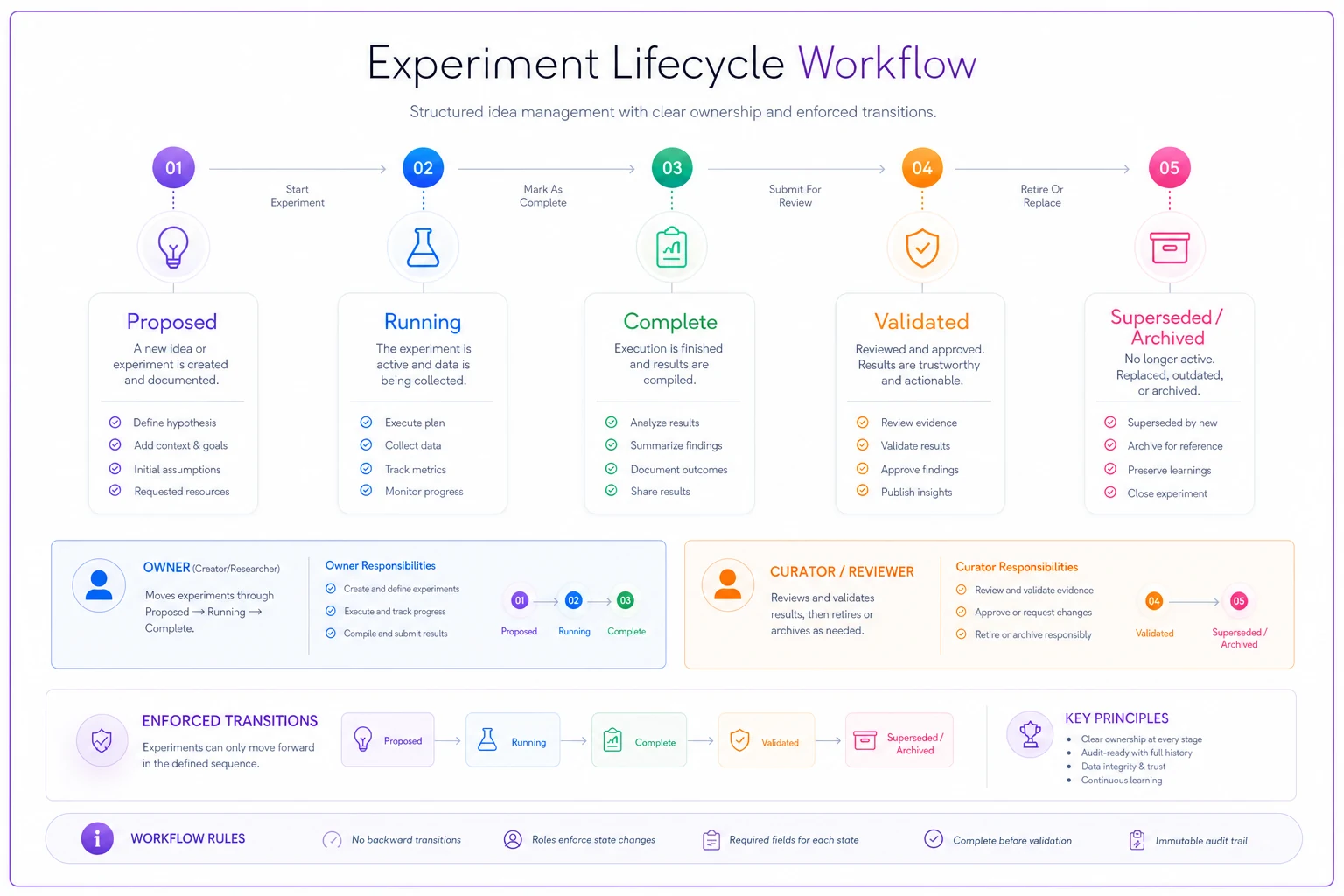
The states people consistently skip are Superseded and Archived, and that's exactly why old catalogues become useless. When a 2024 retention experiment gets replaced by a better-designed 2025 version, someone has to mark the old one superseded and link to the new one. Otherwise both show up in search with equal weight, and a newcomer might act on the outdated one. Governance means somebody's job — usually a curator — includes walking the catalogue periodically and retiring records that no longer reflect reality.
What breaks at scale
At ten experiments, none of this matters much. You know all of them. The catalogue feels like bureaucracy.
At a hundred experiments across four teams, everything changes. Here's what actually breaks, in roughly the order it breaks:
-
Search returns duplicates and near-duplicates. Without controlled tags and cross-references, the same question gets logged under three different labels.
-
Ownership goes stale. People change roles. Records point at owners who left. Nobody can answer questions about half the catalogue.
-
Trust erodes. Someone acts on a record that turned out to be inconclusive or superseded, gets burned, and stops trusting the catalogue entirely. Once trust drops below a certain point, people go back to asking around — and now you're maintaining a system nobody uses.
-
Format drift. New teams onboard, don't adopt the template exactly, and create parallel formats. The catalogue fragments.
Scale converts small inconsistencies into systemic noise. A single record with sloppy tags is invisible in a set of ten. In a set of two hundred, sloppy tags on 15% of records means roughly thirty records that never surface in the right searches — thirty potential re-tests nobody catches.
This is also why the catalogue isn't a standalone artifact. It sits inside the broader machinery of how ideas move from proposal to funded outcome. If you've thought carefully about your innovation operating model, the experiment catalogue is the memory layer underneath it — the thing that stops each cycle from starting cold.
A real scenario
A mid-market fintech's product org — around 40 people across four squads — was running experiments constantly but tracking them across a mix of Jira tickets, Confluence pages, and one squad's private Airtable. Over eighteen months they'd logged around 130 experiments in some form.
The problem surfaced when two squads independently tested reducing the number of onboarding steps, four months apart. One found a lift in activation, the other found no change. Both were technically "right" — they'd measured different activation events and run different sample durations. But leadership walked away confused about whether onboarding simplification worked at all, and the team lost credibility in a quarterly review.
They rebuilt around a single catalogue with mandatory metadata and a controlled tag list. The rules were strict: no record saved without a hypothesis, owner, sample size, and at least a search for related records. A curator spent about half a day a week validating completed records and retiring superseded ones.
The change wasn't dramatic on paper, but it was real. Over the following two quarters, the team caught roughly four experiments that duplicated prior work before running them — cases where someone searched, found a validated record, and either skipped the test entirely or redesigned it to build on the earlier one. Assuming each avoided experiment tied up two engineers for a couple of weeks, that's a meaningful chunk of reclaimed capacity. More importantly, when leadership asked "have we tried X," the answer became a link instead of a shrug.
Where tooling helps — and where it doesn't
You can run a catalogue in a spreadsheet. Plenty of teams do, and for small volumes it's fine. The point where plain documents start costing you is when enforcement becomes the bottleneck — when the problem isn't storing records but making sure they're complete, tagged consistently, and kept current.
This is where operational software with some automation behind it earns its keep. Required fields that block saving an incomplete record. Controlled dropdowns instead of free-text tags. Automatic flags when a record has sat in "Running" longer than its stated duration. Reminders to the owner when their record hasn't been touched in 90 days. A nudge to search existing records before creating a new one, surfacing likely duplicates based on the hypothesis text. None of this is exotic — it's just the difference between hoping people follow the rules and having the system quietly hold the line.
The trap is thinking the tool creates the discipline. It doesn't. A platform can enforce that a field is filled; it can't make the content good. The curator role stays essential regardless of what software you run. Automation removes mechanical friction so that person can spend their time on judgment instead of chasing people for missing metadata.
When a formal catalogue makes sense — and when it doesn't
When it makes sense:
-
You run more than roughly 20–30 experiments a year across multiple teams.
-
Different teams touch overlapping domains and can't see each other's work.
-
People change roles often enough that institutional memory keeps walking out the door.
-
Leadership regularly asks "have we tried this?" and gets vague answers.
When it's overkill:
-
A single small team that runs a handful of experiments and remembers all of them.
-
Very early-stage teams where the process changes weekly and any rigid template just gets abandoned.
Who should not do this: teams that won't fund a curator. A catalogue with mandatory metadata and lifecycle states requires someone whose job explicitly includes tending it. If nobody owns validation and retirement, the governance layer collapses within a quarter and you're left with the same messy folder you started with, plus a template nobody follows. Don't launch the system until you've named that person and given them the time.
The quiet payoff
The value of an experiment catalogue isn't the records themselves. It's the questions you stop having to re-answer. Every time someone finds a validated result instead of re-running a test, every time two teams catch their overlap before duplicating effort, every time a new hire gets up to speed by reading the catalogue instead of scheduling six meetings — that's compounding time saved.
Getting there is unglamorous. Prescriptive templates, controlled vocabularies, enforced lifecycle states, a curator who actually retires stale records. None of it feels like innovation. But it's the infrastructure that lets the actual innovation stop repeating itself — and for a team of any real size, that's the whole point.
The value of an experiment catalogue isn't the records themselves. It's the questions you stop having to re-answer. Every time someone finds a validated result instead of re-running a test, every time two teams catch their overlap before duplicating effort, every time a new hire gets up to speed by reading the catalogue instead of scheduling six meetings — that's compounding time saved.
Getting there is unglamorous. Prescriptive templates, controlled vocabularies, enforced lifecycle states, a curator who actually retires stale records. None of it feels like innovation. But it's the infrastructure that lets the actual innovation stop repeating itself — and for a team of any real size, that's the whole point.
Ready to transform your innovation process?
Join 2,000+ companies using GoIdeafy to unlock team creativity, prioritize impactful ideas, and accelerate growth.