

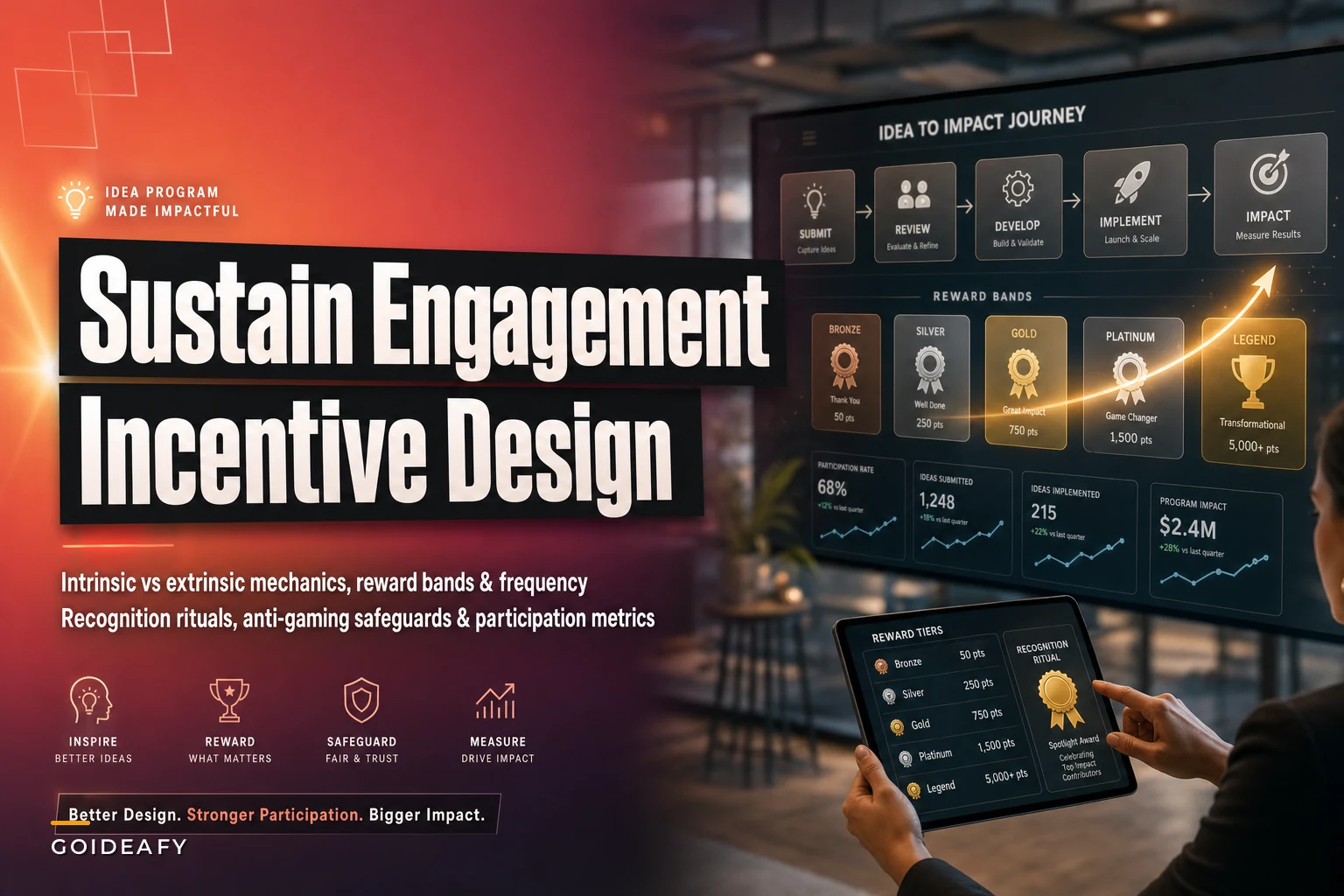

Almost every idea program that launches with a gift-card giveaway sees the same graph: a sharp submission spike in month one, a smaller bump in month two, then a slow decline until you're back to the four or five die-hards who'd contribute regardless. The rewards didn't fail because they were too small. They failed because they were built around the wrong mechanic.
The core decision — the one most innovation managers make on instinct and regret later — is whether to lean on intrinsic or extrinsic motivation. Get this wrong and no reward band, no leaderboard, no quarterly ceremony will save you. Get it right and participation holds steady even when the prize budget shrinks.
What follows is a comparison of both mechanics, plus templates you can actually deploy: reward bands, cadence, recognition rituals, safeguards against gaming, and the metrics that tell you whether engagement is real or just juiced.
The two mechanics, side by side
Extrinsic motivation is the stuff you can put on a spreadsheet: cash, gift cards, points, prizes, public rankings. Intrinsic motivation is harder to budget for: autonomy, mastery, seeing your idea shipped, being credited by a leader who matters to you.
The mistake isn't choosing one over the other. It's assuming they're interchangeable. They behave very differently over time.
| Dimension | Extrinsic mechanics | Intrinsic mechanics |
|---|---|---|
| Speed to activate | Fast — works in week one | Slow — builds over months |
| Durability | Short; decays without escalation | Long; compounds if reinforced |
| Cost trajectory | Rises over time (you need bigger prizes) | Flat or falling |
| Failure mode | Gaming, volume over quality | Fades if effort goes unseen |
| Best for | Kickstarting a cold program | Sustaining a warm one |
| What it signals | "This is worth doing for the prize" | "This is worth doing, period" |
Extrinsic rewards are excellent for starting participation and terrible for sustaining it. The moment the reward becomes expected, it stops being a reward and becomes a baseline — and baselines don't motivate, they just anchor. Take the gift card away and people feel punished, even though nothing was actually taken from them.
Intrinsic mechanics work the opposite way. They're weak at cold-starting because they require a track record — you can't feel the satisfaction of seeing your idea shipped until you've seen it happen once. But once that loop closes even a single time, it self-reinforces.
The practical implication: use extrinsic to launch, then deliberately shift toward intrinsic before the extrinsic effect decays. Most programs never make that handoff. They keep escalating prizes until the budget dies, and participation dies with it.
Where extrinsic rewards quietly backfire
There's a well-documented effect where paying people for something they'd do anyway reduces how much they do it once the pay stops. In idea programs, this shows up in a specific way.
Capture, evaluate, and act on ideas without friction.
GoIdeafy streamlines the entire innovation lifecycle from idea submission to implementation.
- Centralized idea capture
- Collaborative evaluation tools
- Progress tracking & analytics
No credit card required
A typical example: a logistics company offered $50 per submitted idea in a "safety improvement" drive. Submissions jumped from about a dozen a month to over 200. Sounds like a win. Except when the finance team reviewed them, roughly 70% were low-effort — reworded versions of existing rules, duplicates, or vague complaints reframed as "ideas." The program had trained people to submit anything because volume paid. When they capped it at three paid submissions per person, participation collapsed to below where it started, because now people associated submitting with a rejected paycheck.
That's the trap. Per-unit extrinsic rewards optimize for the thing you measure, which is almost never the thing you actually want. You want good ideas; you get a lot of ideas. Those aren't the same thing, and the reward structure made the second problem worse.
The subtler damage is to your best contributors. The person who was submitting thoughtful ideas out of genuine interest now watches colleagues farm gift cards with junk. Their intrinsic motivation — the durable kind — gets crowded out. You've spent money to demotivate exactly the people you most needed.
Reward band template: pay for outcomes, not activity
If you're going to use extrinsic rewards, tie them to stages of value, not to the act of submitting. The further an idea travels, the more real value it's demonstrated, and the more it's worth rewarding.
A band structure that's worked across a range of program sizes:
-
Submission accepted into triage — recognition only, no cash. A thank-you, a visible status update, name on the board.
-
Idea advances to evaluation — small token
roughly $15–$25, or an equivalent points allocation.
-
Idea approved for a pilot — meaningful reward
around $150–$300, plus public credit to the individual and their manager.
-
Pilot delivers measurable results — the big one
a percentage of first-year impact, capped, split across the contributor and the implementation team. Something like 2–5% of validated savings, capped at a few thousand dollars.
-
Idea scales across units — recognition-heavy
a leadership spotlight, a development opportunity, or a role in the rollout.
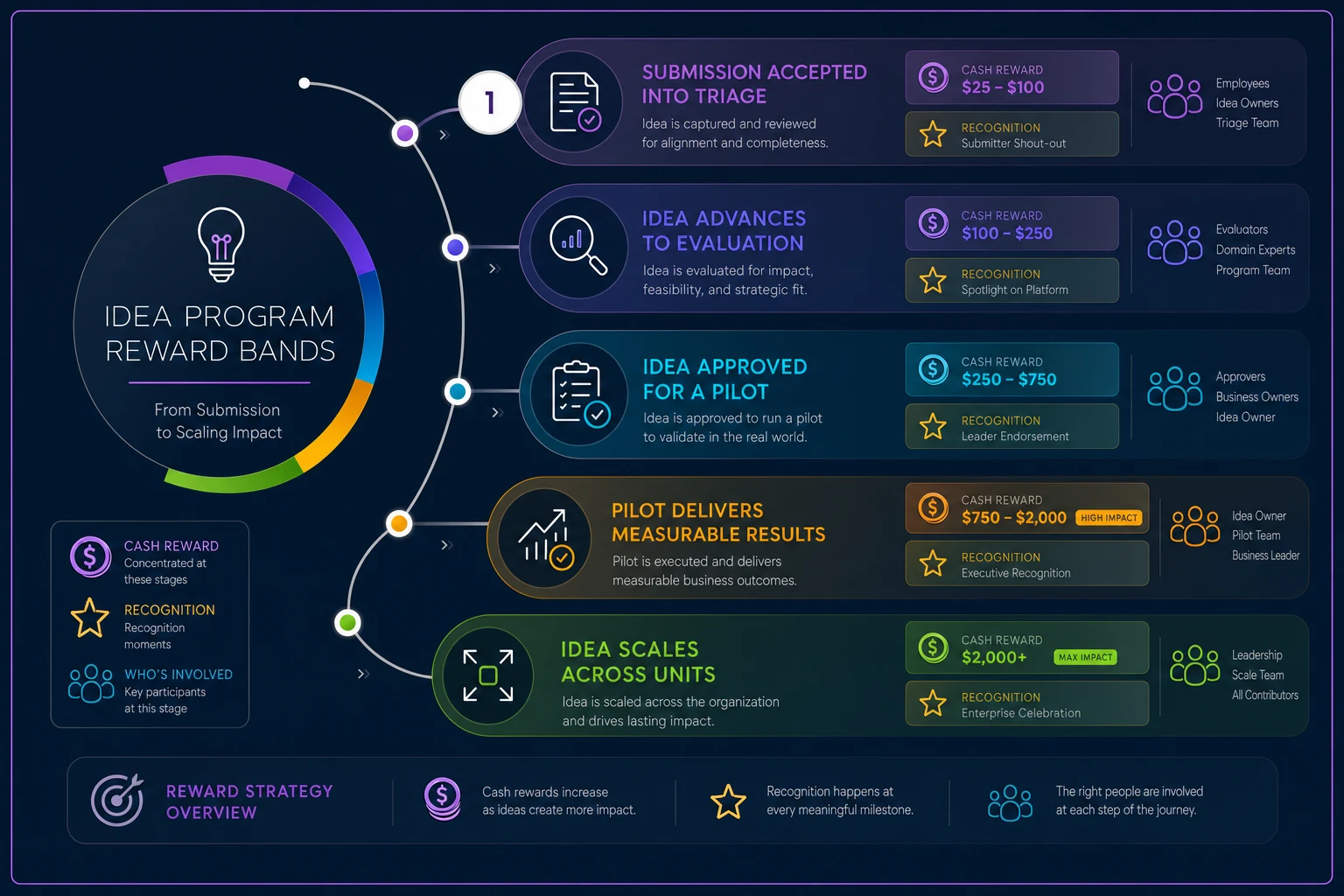
The visual shows where money and recognition concentrate along the funnel and the handoff points between stages.
Notice the shape. The money concentrates where value is proven, not where effort is claimed. This kills volume-farming automatically — there's nothing to farm at the front of the funnel — and it aligns rewards with outcomes your executives actually care about.
One thing to watch: don't make the top-tier payout so large it triggers politics. Once a reward crosses a few thousand dollars, people start fighting over attribution, managers start claiming credit, and the whole thing turns adversarial. Keep the cash meaningful but not life-changing, and load the top of the ladder with recognition and career value instead.
Recognition rituals that carry the intrinsic load
Recognition is where durable motivation lives, and it's almost always underbuilt. Most programs treat it as an afterthought — a name in a newsletter nobody reads.
Effective recognition has three properties: it's specific, it's witnessed by people the contributor cares about, and it's timely. A generic "great job to our innovators this quarter" hits none of these. Naming an idea, explaining what problem it solved, and having a director say it in front of the person's own team hits all three.
A cadence that holds up over time:
-
Weekly — automated status transparency. When an idea moves a stage, the contributor and their manager are notified. No ceremony, just visibility. This is the drip that keeps people feeling seen between big moments.
-
Monthly — a short "ideas in motion" segment in an existing team meeting. Not a separate event nobody attends — bolt it onto something that already happens. Highlight 2–3 ideas that advanced, with the contributor's name and the actual problem addressed.
-
Quarterly — a real spotlight for ideas that reached pilot or delivered results. Leadership present. Contributor speaks briefly about the problem, not just the solution.
-
Annually — reserve for scaled, high-impact contributions. This is where career-relevant recognition belongs: mention in performance reviews, exposure to senior leadership, a stretch assignment.
Programs that last prioritize recognition frequency over recognition size. A small, specific acknowledgment every week beats a lavish annual gala. People need to feel the loop closing regularly, not once a year.
This is closely tied to whether people feel safe contributing in the first place. If your recognition rituals are strong but participation is still thin, the problem may be upstream — worth reading how to measure psychological safety in your idea program before assuming it's a rewards problem.
Anti-gaming safeguards
Any reward system will be gamed if the reward is worth more than the effort to game it. Your job isn't to prevent gaming entirely — it's to make gaming less profitable than genuine contribution.
-
Reward outcomes, not submissions. Already covered, but it's the single biggest safeguard. If there's no payout for volume, volume-farming disappears.
-
Cap front-of-funnel recognition per person per period. If someone submits 40 ideas in a week, they don't get 40 acknowledgments — the noise itself is a signal that something's off.
-
Require a problem statement, not just a solution. Junk submissions collapse when people have to articulate the actual problem and who it affects. Gaming a real problem statement is harder than gaming an idea box.
-
Attribute credit to teams where implementation is collaborative. Solo credit for group work breeds resentment and encourages people to hoard ideas rather than build on each other's.
-
Rotate evaluators and use calibration. If the same reviewer decides who advances, contributors learn to write for that reviewer, not for value.
-
Watch for duplicate and near-duplicate spikes. A sudden cluster of similar ideas right after a reward announcement is a gaming signal, not an innovation surge.
Require a clear problem statement up front — it raises the effort required to farm low-quality submissions.
The behavioral tell: when submission volume rises but the advance rate — the share of ideas that make it past triage — falls, you're being gamed. Genuine engagement raises both. Gaming raises volume and drops quality.
Metrics that measure *sustained* participation
Most programs measure the wrong thing: total submissions. It's the vanity metric of innovation. High submission counts can coexist with a dying program if the same handful of people are submitting and everyone else has checked out.
-
Repeat participation rate — what share of contributors submit again within 90 days? This is your single best sustainability signal. A healthy program keeps this well above the one-and-done rate.
-
Participation breadth — how many distinct people contributed this quarter, as a percentage of eligible employees? Rising submissions with flat breadth means you're leaning on the same few people.
-
Advance rate — share of submissions that clear triage. Your quality proxy and your gaming detector.
-
Time-to-first-acknowledgment — how long between submission and the contributor hearing anything. Silence is the number one killer of repeat participation. Keep this in days, not weeks.
-
Loop-closure rate — of ideas submitted, what percentage received a clear final outcome (piloted, shipped, or declined with a reason)? Unclosed loops teach people their input disappears into a void.
-
Recognition reach — how many contributors received specific, witnessed recognition this period. If this is low, your intrinsic engine isn't running.
Track these as trends, not snapshots. A program can look healthy in any single month and be quietly bleeding contributors. Repeat rate and breadth over rolling quarters tell the real story.
When extrinsic rewards actually make sense
Cash and prizes aren't the enemy. They're the right tool in specific situations:
-
Cold-starting a brand-new program where there's no track record to build intrinsic motivation on yet.
-
Targeted campaigns with a narrow, time-boxed goal — "we need cost-reduction ideas this quarter" — where you want a deliberate short spike.
-
Rewarding proven outcomes at the back of the funnel, where the payout reflects real, validated value.
Cash and prizes aren't the enemy. They're the right tool in specific situations:
When extrinsic rewards are a bad idea
Sustaining an established program. If you're already warm, escalating prizes will erode the intrinsic motivation you've built.
-
Sustaining an established program. If you're already warm, escalating prizes will erode the intrinsic motivation you've built.
-
When quality matters more than quantity. Per-submission rewards will bury your evaluators in junk.
-
When your culture already has strong contributors. You risk crowding out the people who need no prize.
Sustaining an established program. If you're already warm, escalating prizes will erode the intrinsic motivation you've built.
Who should not lean on rewards at all
If your problem is that people don't feel safe contributing, or that ideas disappear without response, no reward will fix it. A gift card can't compensate for silence. Fix the loop-closure and acknowledgment problems first — otherwise you're paying people to participate in a system that ignores them.
If your problem is that people don't feel safe contributing, or that ideas disappear without response, no reward will fix it. A gift card can't compensate for silence. Fix the loop-closure and acknowledgment problems first — otherwise you're paying people to participate in a system that ignores them.
A short real scenario
A regional insurance firm — around 400 employees — had a suggestion program that launched with a $100-per-quarter prize draw. Month one brought in about 180 submissions. By month four they were down to roughly 30, and repeat participation was under 15%. Same five or six people, drawing prizes, everyone else gone.
They rebuilt around the outcome-based bands: no cash for submitting, small tokens at evaluation, real money only at validated pilot results — paired with a weekly automated status notification and a monthly two-minute spotlight bolted onto the existing all-hands.
Submission count actually dropped at first, settling around 60–70 a month. But the numbers that mattered moved the right direction: repeat participation climbed to somewhere near 40% over two quarters, breadth widened from a handful of regulars to contributors across most departments, and the advance rate roughly doubled because people were submitting real problems instead of farming a draw. The prize budget went down. Engagement went up and held.
The lesson wasn't "spend less." It was "stop paying for the wrong behavior."
The reason participation falls off a cliff a few months after launch is almost never that the rewards were too small. It's that the program relied on a mechanic built for starting, not sustaining — and never made the handoff to the motivation that actually lasts.
Launch with extrinsic if you need to. But treat it as a booster rocket, not an engine. Build the recognition rituals, the loop-closure discipline, and the outcome-based bands that let intrinsic motivation take over before the prize money loses its pull.
Then measure the things that reveal whether engagement is real: repeat participation, breadth, and how fast people hear back. Those numbers, tracked over rolling quarters, will tell you the truth long before your submission count does.
Ready to transform your innovation process?
Join 2,000+ companies using GoIdeafy to unlock team creativity, prioritize impactful ideas, and accelerate growth.