



Most innovation teams don't fail because they run out of ideas. They fail because the small group of people who actually know how to run experiments, secure funding, and navigate the org gets buried. Everyone wants a piece of them. The intake queue grows. The person who was hired to design pilots is now spending Tuesdays reformatting a slide deck for a VP who wants "just a quick look" at the pipeline.
That's the talent bottleneck. And in most companies, it's structural — not a hiring problem you can fix by adding two more headcount.
This is really a question of innovation org design: who does what, how the central team relates to the business units, how demand gets prioritized, and how you keep your best people doing the work only they can do. Get the design wrong and you'll watch a well-funded innovation function grind to a halt with a full pipeline and zero throughput.
Why the Bottleneck Forms in the First Place
The pattern is almost always the same. A company stands up a small central innovation team — maybe three to six people. Early on it works fine because everything is informal. Someone has an idea, they walk over to the innovation lead, and things happen.
Then the program succeeds. Suddenly you've got eight business units who all heard the central team can "help with innovation." None of them know what that actually means, so they ask for everything: facilitation, funding advice, prototyping, vendor scouting, executive storytelling, data analysis. The central team, wanting to be helpful, says yes to most of it.
Within a couple of quarters you get a team where:
-
The lead is in back-to-back meetings and hasn't touched actual strategy in weeks
-
The one person who's good at experiment design is doing intake triage
-
Nobody knows what the team is supposed to say no to
-
Business units treat the team like a free internal consultancy with no cost, no queue, and no expectations
The root issue isn't laziness or bad prioritization. It's that the team has no defined product. When you don't define what you sell, everyone assumes you sell everything.
The Three Problems Tangled Together
Talent bottlenecks in innovation are really three separate problems that people try to solve as one:
Capture, evaluate, and act on ideas without friction.
GoIdeafy streamlines the entire innovation lifecycle from idea submission to implementation.
- Centralized idea capture
- Collaborative evaluation tools
- Progress tracking & analytics
No credit card required
-
Role clarity — nobody knows exactly who owns what, so work drifts to whoever is most senior or most available
-
Career ladders — good people leave because "innovation specialist" is a dead-end title with no visible path
-
Demand management — there's no mechanism for the business to request work, so everything comes in as favors and fire drills
You can't fix demand management without clear roles, and you can't retain people without a ladder that makes those roles worth staying in. They have to be designed together. Take them one at a time, then connect them.
Role Blueprints: Define the Work, Not the Person
The mistake most teams make is hiring "innovation people" — generalists who can do a bit of everything. That works when you're tiny. It falls apart the moment demand outpaces capacity, because generalists can't be parallelized. Everyone becomes a single point of failure.
| Role | Owns | Does NOT Own | Typical Ratio |
|---|---|---|---|
| Innovation Lead / Portfolio Owner | Strategy, portfolio balance, exec relationships, funding decisions | Running individual experiments | 1 per program |
| Experiment / Venture Designer | Designing pilots, hypotheses, success metrics, test plans | Facilitation, intake admin | 1 per ~8–12 active experiments |
| Innovation Coach / Facilitator | Running workshops, coaching BU teams, embedding methods | Portfolio decisions | 1 per 3–4 business units |
| Analyst / Ops Coordinator | Intake triage, pipeline hygiene, dashboards, scheduling | Deciding which ideas advance | 1 per program (until you scale) |
| Embedded Innovation Partner | Sits inside a BU, translates local needs, runs local funnel | Central portfolio | 1 per major BU |
The critical column is the middle one — what each role does not own. That's the part almost everyone skips, and it's exactly where the bottleneck lives. If your Experiment Designer is allowed to get pulled into facilitation, they will be, because facilitation always feels urgent and someone always asks nicely. Then the experiments back up.
Make the 'does not own' list explicit and review it regularly so roles don't creep into one another.
When a role's "does not own" list is empty, that role becomes the bottleneck within about two quarters. Every time.
The Embedded Partner Is the Underrated Move
Most teams centralize everything, then wonder why they can't keep up. Putting one innovation-trained person inside a business unit takes enormous pressure off the center. That person handles local intake, coaches local teams, and only escalates ideas that genuinely need central resources.
A typical setup: a company with five business units keeps a central team of four, and embeds one partner in each of the two largest units. Those embedded partners filter out roughly two-thirds of the noise before it ever reaches the center. The central team's queue drops, and the work that does arrive is already pre-qualified.
Career Ladders: Why Your Best People Leave
The quiet killer. You hire a sharp person as an "Innovation Specialist." They're great. Two years in, they look around and realize there's no next rung. The title above them is "Head of Innovation," which is one person who isn't going anywhere. So they leave — usually to a product or strategy role somewhere else — and they take all the tacit knowledge with them.
Innovation functions are especially bad at this because they're small and flat. But flat doesn't have to mean dead-end. You can build depth into a small team by defining a ladder that grows scope and autonomy rather than headcount underneath someone.
-
Innovation Associate — supports experiments, runs intake, learns the methods. Owns tasks, not outcomes.
-
Innovation Specialist — owns individual experiments end to end. Can design a test, run it, and report results without hand-holding.
-
Senior Specialist / Venture Designer — owns a cluster of related experiments or a theme. Coaches associates. Trusted with ambiguous problems.
-
Innovation Principal — owns a portfolio slice and BU relationships. Makes prioritization calls. Represents the team to leadership.
-
Head of Innovation — owns the whole function, strategy, and budget.
The unlock is that each rung should map to a measurable expansion of decision rights, not just a pay bump. An Associate can recommend killing an experiment; a Specialist can kill their own; a Principal can rebalance a portfolio. When people can see exactly which decisions they'll earn next, they tend to stay around long enough to earn them.
One thing worth being honest about: not everyone wants to manage people. Build a parallel "deep expertise" track so a brilliant experiment designer can reach Principal-level pay and influence without ever running a team. The best venture designers are often terrible managers, and forcing them into management is how you lose them.
The Internal Service Catalog: Charging Your Own Org
This is the piece almost nobody does, and it's probably the single biggest lever for clearing the bottleneck.
When an internal team costs "nothing," demand becomes infinite. Business units will request the central team's time for anything — including things they should handle themselves — because there's no cost to asking. The queue turns into a dumping ground.
The fix is to treat your central team like an internal service provider with an actual bill of services: a catalog of what you offer, what each thing costs (real money or internal chargeback), and what the service level is. This clarifies what you sell, makes demand visible, and forces business units to prioritize what they actually value.
A Sample Bill of Services
| Service | What You Get | Effort / Cost Basis | SLA |
|---|---|---|---|
| Idea triage | Structured review and go/no-go recommendation | Included, no charge | Response within 5 business days |
| Experiment design sprint | 2-week engagement, test plan and metrics | ~15 person-days, charged to BU budget | Scheduled within 3 weeks |
| Pilot facilitation | Coach runs the pilot with BU team | ~10 person-days per month | Requires portfolio approval |
| Executive readout support | Deck and narrative for funding ask | ~3 person-days | 1 week notice minimum |
| Embedded partner (part-time) | Dedicated person, 2 days per week in your BU | Fixed quarterly chargeback | Quarterly commitment |
| Vendor / tech scouting | Curated shortlist and evaluation | ~5 person-days | 4-week turnaround |
You don't have to move real money for this to work. Even a shadow currency — each BU gets a fixed number of innovation credits per quarter — completely changes behavior. Suddenly the VP who wanted a "quick look" every week has to decide whether it's worth spending a credit. Most of the low-value requests disappear on their own.
Prioritization When Everyone Wants the Same Week
The catalog also gives you a defensible way to say no. When two BUs both want an experiment design sprint in the same window, you need a rule that isn't "whoever complained loudest." A simple prioritization stack:
-
Portfolio fit — does this advance a funded strategic theme? (highest weight)
-
Readiness — is the BU actually ready, or will they cancel half the sessions?
-
Credits available — have they spent their quarterly allocation?
-
Reversibility — is this a cheap test or an expensive commitment?
Publish the stack. When people understand how the queue works, they stop treating prioritization as a personal negotiation. That alone removes a big chunk of the relationship-management burden currently eating your senior people's time.
This diagram shows the intake-to-priority flow in a single view.
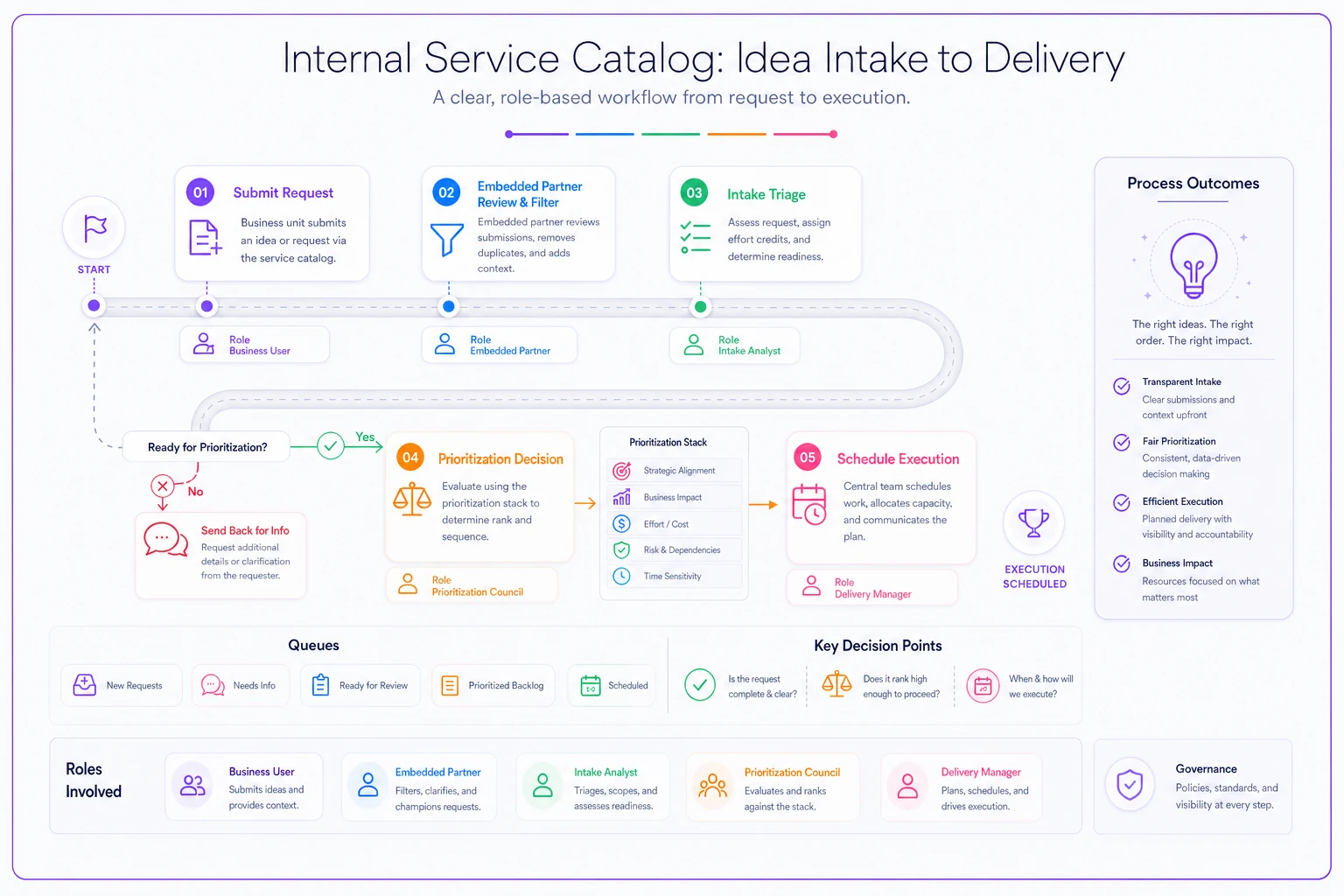
A simple workflow like this helps teams understand the queue and where decisions happen.
Resourcing Formulas: How Many People Do You Actually Need
The vague answer is "it depends." The more useful answer is that you can back into headcount from throughput.
-
Experiment Designers count your target number of active experiments at any time, divide by 8–12. Thirty active experiments means roughly three designers.
-
Facilitators/Coaches one per 3–4 business units you're actively serving.
-
Analyst/Ops one covers the program until you're running more than roughly 40 experiments a year, then you need a second.
-
Embedded Partners one per BU that generates enough demand to justify a dedicated seat — usually the top two or three units.
A worked example: say a mid-sized company wants to run around 24 active experiments across four business units. The math points to:
-
2 Experiment Designers (24 ÷ ~12)
-
1 Facilitator (4 units ÷ 4)
-
1 Analyst/Ops Coordinator
-
1 Innovation Lead
-
2 Embedded Partners in the two largest units
That's a central core of five plus two embedded — a lean team that can genuinely serve four units without collapsing. The temptation is always to hire more generalists and skip the embedded roles. Teams that do that end up with eight people who are all equally overloaded, because they never addressed the demand-side problem.
When This Makes Sense — and When It Doesn't
The full apparatus — catalog, ladders, chargebacks, embedded partners — is overkill for a brand-new program. If you're a two-person team running your first handful of experiments, formalizing a bill of services just adds bureaucracy to something that's working fine informally.
-
You have more than three or four business units actively requesting help
-
Your central team is regularly turning down or delaying work
-
You've lost a key person and felt the knowledge gap acutely
-
Requests keep arriving as favors and fire drills rather than structured asks
-
Your program is still proving it can deliver anything at all
-
Leadership hasn't committed to funding a stable central team
-
You'd be designing career ladders for roles that might not survive the next budget cycle
If your "innovation team" is really one person doing it alongside their actual job, don't build a service catalog. Build credibility first. The structures here are for when demand has genuinely outgrown your capacity — not before.
A Real Scenario
A regional insurance company had a central innovation team of four serving six business units. On paper it looked healthy — full pipeline, dozens of ideas, decent executive support. In practice it was stalling. The two most experienced people were spending most of their weeks in intake meetings and status updates. Actual experiment throughput had dropped to about one launched pilot a quarter, down from three or four the year before.
They didn't hire anyone. They restructured. Published a bill of services with a quarterly credit allocation per BU, embedded one part-time partner in each of the two highest-demand units, and clarified who owned what — specifically pulling their senior designer out of facilitation entirely. Within roughly two quarters, launched experiments climbed back to three per quarter. Intake noise dropped by more than half because the embedded partners were filtering locally. The senior designer, who had been quietly interviewing elsewhere, stayed — partly because the new Principal-track role finally gave her somewhere to go. No new headcount. Just a design that stopped routing every request through the same three people.
How the Pieces Reinforce Each Other
The reason these three things — roles, ladders, and the catalog — have to be designed together is that each one plugs a hole the others open.
Clear roles without a catalog means everyone knows their job and still gets buried in undifferentiated demand. A catalog without clear roles means requests come in cleanly and then hit a team that argues over who handles them. Ladders without either means you've built a nice career path for a job that's structurally impossible to do well, so people burn out one rung in.
Together they form the operating layer underneath your broader innovation operating model. The operating model tells you how ideas become funded outcomes; the org design tells you whether you have the human machinery to actually run it without breaking your best people.
The Takeaway
Talent bottlenecks in innovation aren't solved by finding more talented people. They're solved by designing a system where talent isn't the constraint — where demand is visible and priced, roles are bounded, and the people doing specialized work aren't the same people fielding every drive-by request.
Start with the "does not own" columns. Publish a simple catalog even if the currency is fake. Give your people a next rung they can actually see. Do those three things and the same team will suddenly have room to breathe — and the pipeline that's been stuck will start moving again.
Start with the "does not own" columns. Publish a simple catalog even if the currency is fake. Give your people a next rung they can actually see. Do those three things and the same team will suddenly have room to breathe — and the pipeline that's been stuck will start moving again.
Ready to transform your innovation process?
Join 2,000+ companies using GoIdeafy to unlock team creativity, prioritize impactful ideas, and accelerate growth.