

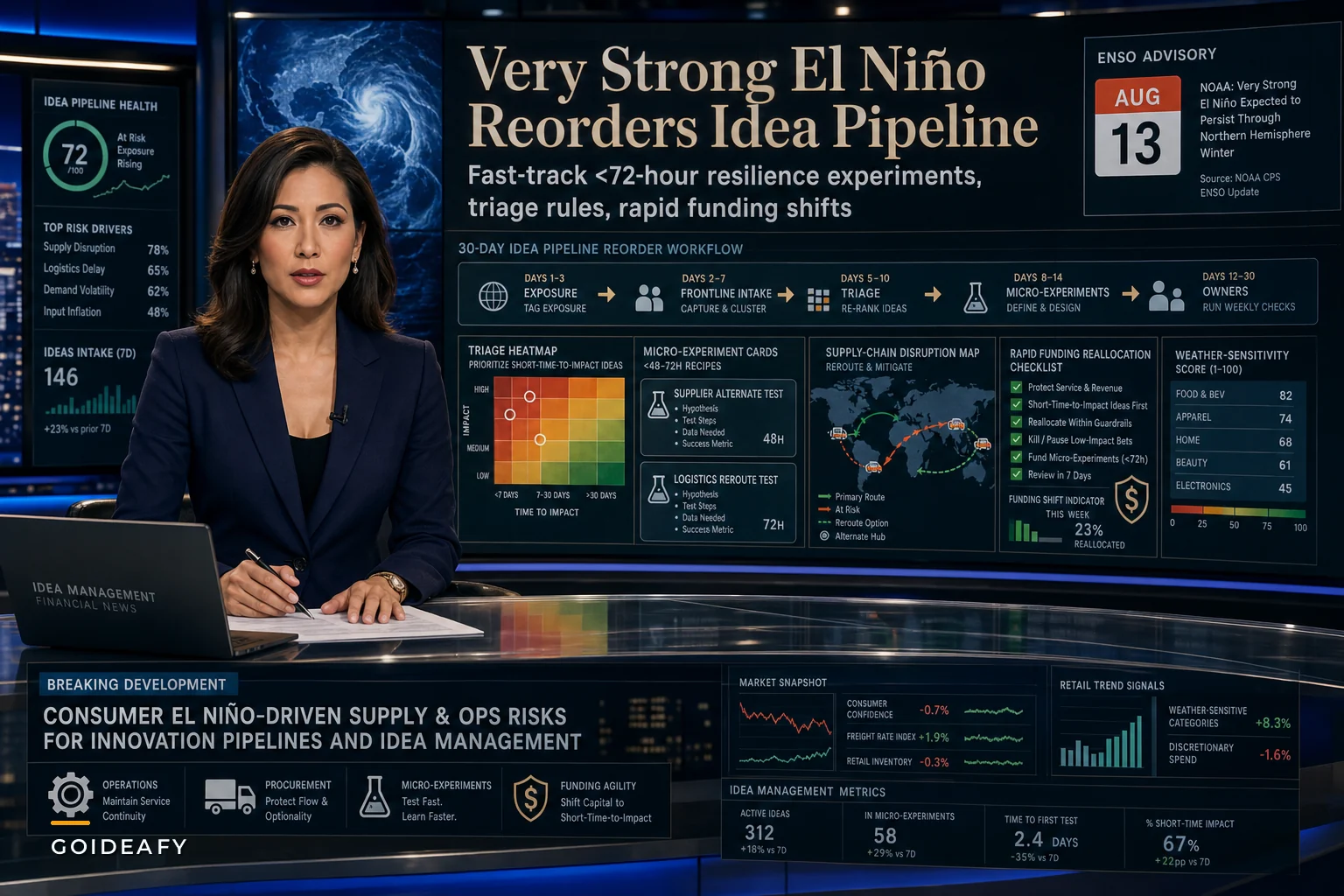

NOAA's Climate Prediction Center put out its latest ENSO Diagnostic on August 13, 2026, and the headline number is hard to ignore: greater than 90% odds that this El Niño strengthens into a very strong event through fall and winter 2026–27. Reuters covered it the same day, noting that forecasters now put the risk of a very strong El Niño above 90%, which is a meaningfully different situation than the "watch and see" language we'd been living with.
If you run an innovation program, this isn't a weather story. It's a portfolio-timing story. A very strong El Niño reshapes precipitation, temperature, and storm patterns across large chunks of North and South America, and those shifts hit the exact things your pilots depend on — shipping lanes, agricultural inputs, regional demand, energy costs, and the availability of the people and trucks that move physical goods. The teams that handle this well won't be the ones with the best forecast. They'll be the ones who reorder their experiment pipeline fast enough to actually learn something before the disruption arrives.
Why a climate signal belongs in your idea backlog at all
Most innovation pipelines run on a comfortable assumption: next quarter looks roughly like this quarter. A very strong El Niño breaks that on a known timeline. That's actually rare and useful — you don't often get a heads-up that says "the next two quarters will be weirder than usual, and here's roughly when."
The problem is that innovation teams tend to treat weather as an ops-team problem, not an idea-program problem. So the signal comes in through the CPC's ENSO advisory, the logistics folks start muttering about port delays, and the innovation pipeline just keeps running its pre-planned experiments about onboarding flows and loyalty features. Nothing wrong with those experiments. They're just sitting in a queue behind risks that got a lot more expensive to ignore.
What this exposes is a sequencing problem, not a creativity problem. Your teams can generate resilience ideas. What they usually can't do is quickly re-rank an existing backlog when an external shock changes the expected value of every item in it. A resilience experiment that looked like a "maybe someday" in March is suddenly a "run it in the next 30 days" in September — and most pipelines have no mechanism to make that jump cleanly.
The kinds of ideas that suddenly become urgent
When a supply-chain shock is on a forecastable clock, the same categories of ideas surface across almost every operations-heavy business. Frontline people already know most of them. The value is in triaging fast. Here's the rough shape of what tends to move up the priority list:
Capture, evaluate, and act on ideas without friction.
GoIdeafy streamlines the entire innovation lifecycle from idea submission to implementation.
- Centralized idea capture
- Collaborative evaluation tools
- Progress tracking & analytics
No credit card required
-
Inventory buffer experiments — testing whether a modest safety-stock increase on a handful of weather-exposed SKUs actually prevents stockouts, without blowing up carrying costs.
-
Alternative supplier qualification — running a small, real order through a backup supplier in a different geography before you need them in a crisis.
-
Route and mode substitution — testing rail vs. truck vs. a different port for a specific lane, measuring landed cost and reliability, not just quoted rates.
-
Localized demand shifts — piloting different assortments or promo timing in regions where El Niño historically changes buying behavior (think heating vs. cooling, rain gear, certain fresh categories).
-
Flexible labor and capacity plans — small tests of on-call scheduling or cross-training so a weather week doesn't idle a whole shift.
The mistake teams make here is treating these as big strategic initiatives instead of experiments. "Diversify our supplier base" is a program that takes a year. "Place one 15% test order with a backup supplier in a different region and measure lead-time variance" is an experiment you can run in three weeks and actually learn from.
A quick triage framework: what to run now, later, or never
Not every resilience idea deserves a pilot. The point of triage is to spend your limited experiment slots on the ideas where the shock genuinely changed the math.
| Idea characteristic | Run now (next 30 days) | Queue for later | Probably skip |
|---|---|---|---|
| Exposure to weather-disrupted geographies | High and direct | Indirect | None |
| Time to see a result | Weeks | A quarter+ | Longer than the season |
| Cost to test | Low to moderate | Moderate | High with unclear payoff |
| Reversibility if it fails | Easy to unwind | Some lock-in | Hard to reverse |
| Value if the disruption is mild | Still useful | Marginal | Wasted effort |
That last row matters more than people expect. A 90%+ probability of a very strong event is high, but very strong still covers a wide range of actual outcomes. The experiments worth running now are the ones that pay off even if the winter turns out milder than feared. A backup supplier you qualified is useful regardless. A giant one-season inventory bet that only makes sense in a worst-case scenario is a gamble, not a resilience experiment.
A 30-day process to reorder the pipeline without chaos
The trap is either doing nothing or blowing up your entire roadmap in a panic. Here's a sequence that keeps the pipeline moving while making room for the time-sensitive stuff.
-
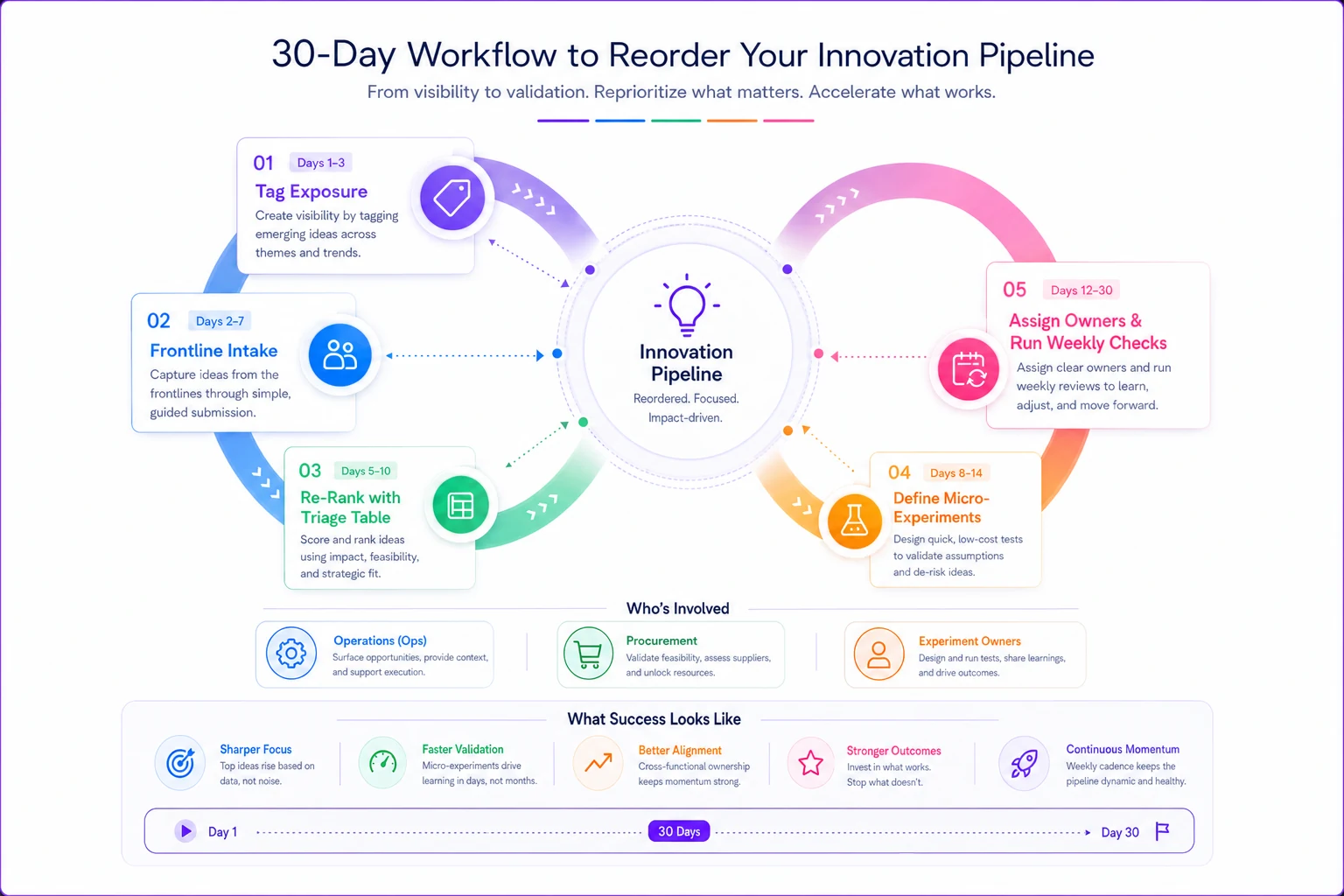
Tag exposure across the existing backlog (days 1–3). Go through your active and queued ideas and mark which ones touch physical supply chains, regional demand, or seasonal capacity. You're not scoring yet — just flagging what's weather-exposed.
-
Pull a rapid frontline intake (days 2–7). Ask people in ops, procurement, and regional teams a narrow question: "What breaks first if this fall is worse than normal?" Frontline staff usually name the real single points of failure faster than any analysis will.
-
Re-rank using the triage table (days 5–10). Apply the run-now / later / skip filter. Expect to demote a few in-flight pilots. That's the whole point — you're freeing capacity, not just adding work.
-
Define micro-experiments, not projects (days 8–14). Each surviving idea needs a hypothesis, one or two metrics, a small scope, and a hard end date. If it can't produce a signal before the disruption window, it isn't a now experiment.
-
Assign owners and a weekly check (days 12–30). Short cadence, tight scope. The goal is learning fast enough to change a real decision — an order, a route, a staffing plan — before the season fully hits.
Here's a simple visual of that sequence.
Pro-tip: scope micro-experiments so they can return a clear signal within the season window.
The teams that stumble here usually stumble at step 3. They pile resilience experiments on top of everything else and burn out their people. Reordering means something gets bumped. Say it out loud when you do it.
The deeper problem this exposes
Strip away the weather and you're left with a familiar weakness: most idea programs are optimized for generating ideas and terrible at re-prioritizing them under time pressure. The intake works. The scoring rubric works. But the moment an external event changes the value of everything in the queue, the machinery jams because it was never built for fast re-ranking.
This is where a lightweight path from raw idea to small test earns its keep. If your only two speeds are "big funded pilot" and "sits in the backlog forever," you can't respond to a shock on a season's notice. You need a well-worn groove for turning a frontline observation into a scoped micro-experiment in days. That's exactly the muscle described in our walkthrough on going from suggestion box to fast micro-experiments — and an El Niño advisory is a good excuse to pressure-test whether that funnel actually works when it matters.
Where operational software helps is quieter than most vendors admit. It's not about predicting the weather. It's about being able to filter your backlog by exposure, re-rank quickly against a shared rubric, route frontline intake to the right owner, and track a batch of short experiments without living in spreadsheets and Slack threads. A workflow platform with light AI automation can flag which queued ideas touch weather-exposed lanes, cluster duplicate frontline submissions so you're not triaging the same "we need a backup for the Gulf port" idea fifteen times, and keep experiment deadlines visible so nothing quietly slips past the season. That's coordination work, not magic — but it's the coordination work that decides whether your re-prioritization actually happens or just gets talked about in one meeting and forgotten.
A realistic scenario
Consider a mid-sized regional food distributor — the kind that supplies restaurants and small grocers across a few states. Two winters ago, a stretch of unusual rain and flooding knocked out a couple of produce suppliers for close to three weeks. They scrambled, paid spot-market prices on short notice, and ate roughly $40k–$50k in extra costs plus a batch of unhappy accounts they spent months rebuilding.
This time, with the advisory out early, their small ops-and-innovation group ran three micro-experiments over about six weeks: a test order through a backup supplier two states over, a modest safety-stock bump on around a dozen weather-sensitive items, and a quick reshuffle of delivery routing for their most flood-prone lanes. None of it was dramatic. The backup supplier came in a little pricier per unit but reliable. The safety stock added some carrying cost but nothing alarming. When a rough two weeks did hit in December, they held service levels on most accounts and avoided the panic-buying premium entirely. The rough math put avoided costs somewhere in the low tens of thousands — mostly from not buying on the spot market in a crisis. The bigger win, honestly, was that they didn't lose customers.
That outcome didn't come from a better forecast. It came from re-ranking the pipeline early and running small tests while there was still time to learn.
When this is worth it — and when it isn't
Reordering your pipeline around a climate signal makes sense when a real chunk of your operations or your pilots depend on physical goods, regional demand, or weather-sensitive capacity. If you're a services or software shop with no physical supply chain, most of this is noise — don't manufacture urgency where there isn't any.
It's also a bad idea to overreact by freezing your whole roadmap and pouring everything into worst-case bets. A very strong El Niño is a strong probability, not a guarantee of any specific local outcome, and experiments that only pay off in a disaster are just expensive insurance you might not need. Favor the tests that leave you better off across a range of outcomes.
And if your program can't currently move an idea from "someone noticed a problem" to "we're running a small test" in under a couple of weeks, fix that funnel first. Trying to re-prioritize a pipeline that has no fast lane just produces a longer list of things you won't get to in time. The weather gave you a deadline. The real question is whether your idea pipeline can move at deadline speed.
Ready to transform your innovation process?
Join 2,000+ companies using GoIdeafy to unlock team creativity, prioritize impactful ideas, and accelerate growth.