



Last week's chaos started with a single Slack message from legal: "Everyone needs to read the new AI executive order. Meeting tomorrow at 8am."
Twenty-three innovation managers across different organizations I work with received some version of that message in early June. The White House executive order on advanced AI dropped like a compliance bomb, and suddenly every innovation team with AI-powered ideas in their pipeline had to figure out what it meant for their evaluation processes.
The order sounds straightforward—frontier AI developers should voluntarily share model details with the government, agencies need to issue guidance on AI security and governance. But dig into the operational reality and you'll find innovation teams facing a much messier challenge. Every AI-related idea submission now needs additional layers of review. Vendor assessments that used to take days now stretch into weeks. Implementation timelines are getting blown up by security reviews nobody budgeted for.
Most innovation governance frameworks weren't built to handle this level of technical scrutiny. The typical idea evaluation rubric focuses on market potential, feasibility, strategic alignment—not whether a third-party AI model might trigger federal reporting requirements or if the data processing approach aligns with emerging security standards that haven't even been written yet.
The governance gap nobody saw coming
Organizations built their innovation processes assuming technology choices were implementation details, not governance triggers.
A pharmaceutical company had a solid governance structure—stage gates, cross-functional review boards, clear evaluation criteria. Worked great for traditional R&D proposals. Then someone submitted an idea for using large language models to accelerate clinical trial documentation. Suddenly their neat process hit a wall. Legal wanted AI vendor assessments. Compliance needed data residency guarantees. IT demanded architecture reviews for systems that didn't exist yet. The review board spent three meetings arguing about who had authority to approve AI-related risks.
This scenario repeats constantly. A retail innovation team evaluating an AI-powered inventory optimization proposal discovered their standard business case template had no place for algorithmic bias assessments. A financial services firm realized their innovation charter didn't specify whether the Chief Data Officer or Chief Risk Officer had final say on AI initiatives. Manufacturing companies found their stage-gate processes assumed you could pilot first and worry about compliance later—an assumption that falls apart when AI governance requires upfront documentation.
The executive order forces a reckoning with a fundamental mismatch: innovation processes designed for flexibility meeting AI requirements that demand rigidity. Your governance model might handle scaling ideation across business units, but it probably wasn't designed for scenarios where a single technology choice triggers enterprise-wide compliance obligations.
What actually changes in your evaluation rubric
Forget adding a checkbox for "AI compliance reviewed." The shifts required go deeper.
Capture, evaluate, and act on ideas without friction.
GoIdeafy streamlines the entire innovation lifecycle from idea submission to implementation.
- Centralized idea capture
- Collaborative evaluation tools
- Progress tracking & analytics
No credit card required
Most teams use some variation of impact, feasibility, and strategic fit. Now you need a fourth dimension: regulatory exposure. Not just "does this violate regulations" but "how much ongoing compliance overhead does this create?" An AI idea that scores high on business impact might become a resource drain if it requires quarterly model audits, continuous bias monitoring, and dedicated governance staffing.
The scoring mechanics change too. Traditional rubrics assume evaluators understand what they're scoring. But how does a marketing innovation lead accurately assess whether a proposed AI tool constitutes "advanced AI" under federal definitions? How does an operations manager evaluate if a vendor's model training practices align with voluntary disclosure expectations?
One technology company solved this by creating evaluation tiers. Basic automation ideas follow the standard rubric. Anything touching AI gets a preliminary technical review first, determining the governance pathway before business evaluation even starts. High-risk AI proposals trigger a completely different process with technical, legal, and security stakeholders leading evaluation, business value almost secondary.
Timeline assumptions embedded in evaluation rubrics also need reworking. That "quick win" category for ideas implementable in under 90 days? Probably doesn't apply to AI initiatives anymore. Between vendor assessments, security reviews, and governance documentation, even simple AI implementations stretch to 4-6 months minimum. One financial services innovation team restructured their entire scoring system after realizing every AI idea was failing their speed-to-market criteria.
The vendor assessment nightmare
AI vendor assessment became everyone's least favorite part of innovation governance. Pre-executive order, you might check pricing, features, integration complexity. Now? Welcome to the world of model cards, training data audits, and algorithmic impact assessments.
A healthcare innovation team recently shared their vendor evaluation checklist. It went from 2 pages to 14 pages overnight. New sections include: model architecture documentation requirements, data lineage tracking capabilities, bias testing methodologies, ongoing monitoring commitments, incident response procedures for model failures, transparency reporting standards, and willingness to support federal voluntary disclosure requirements.
The practical challenge isn't just the length—it's that vendors often can't or won't provide this information. Smaller, innovative AI companies might have the best solutions but lack the compliance infrastructure larger enterprises now demand. Your innovation pipeline gets biased toward established vendors who can check all the governance boxes, even if their actual AI capabilities lag behind.
Who on your innovation team actually understands model architecture well enough to evaluate vendor documentation? Can your procurement lead meaningfully assess whether a vendor's bias testing methodology meets federal guidance that's still being written?
The timeline impact cascades through everything. A consumer goods company told me their average vendor assessment went from 3 weeks to roughly 11 weeks for anything AI-related. That's before negotiating contracts that now need extensive AI-specific clauses. Their innovation team had to completely recalibrate sponsor expectations about how quickly they could move from idea to pilot.
Some teams are building pre-approved vendor lists to speed things up, but that creates problems. Innovation often comes from unexpected sources. If you limit AI ideas to pre-approved vendors, you might miss breakthrough opportunities. But if you don't, every new AI proposal triggers a months-long vendor review that kills momentum.
Building speed back into AI idea implementation
The compliance overhead is real, but smart teams are finding ways to maintain innovation velocity despite new governance requirements.
Parallel processing becomes essential. While legal reviews vendor contracts, technical teams can start data preparation. During security assessments, business teams refine success metrics. A logistics company cut their AI implementation timeline by 40% simply by identifying which governance activities could happen simultaneously rather than sequentially.
Template standardization helps more than most teams expect. Create standard AI addendums for vendor contracts. Develop boilerplate security questionnaires. Build reusable documentation templates for common AI use cases. One innovation team created twelve standard AI implementation patterns—each with pre-drafted governance documentation. New ideas just need to map to a pattern rather than starting from scratch.
The biggest speed gain comes from creating clear AI governance tiers. Not every AI initiative needs the same scrutiny level. Using pre-trained models for basic classification? That's different from fine-tuning models on sensitive data or deploying autonomous decision-making systems.
| Governance Tier | AI Type | Review Requirements | Timeline Impact |
|---|---|---|---|
| Standard | Low-risk AI (pre-trained models, basic automation) | Standard vendor check, basic security review | +2-4 weeks |
| Enhanced | Customer-facing AI, sensitive data processing | Full vendor assessment, bias testing, legal review | +6-8 weeks |
| Comprehensive | Autonomous decision-making, high-risk applications | Complete technical audit, ethics review, executive approval | +12-16 weeks |
Pre-pilot governance reviews save time later. It sounds counterintuitive—adding reviews before you even test an idea. But catching governance issues early prevents the painful scenario where a successful pilot can't scale due to compliance concerns. Run lightweight governance assessments during ideation. Flag potential AI requirements before teams invest heavily.
Automation helps, though the irony isn't lost on anyone. Using workflow automation to manage AI governance processes speeds up routine assessments. Automated vendor questionnaires, templated risk assessments, standardized approval workflows—these cut days or weeks from each AI initiative.
Cross-functional approval paths that don't kill momentum
The traditional innovation approval path—business sponsor, finance, maybe IT—doesn't work for AI initiatives. Now you need legal, security, data governance, risk management, procurement, and often ethics committees. Getting all these stakeholders aligned without creating bureaucratic paralysis requires rethinking how approvals flow.
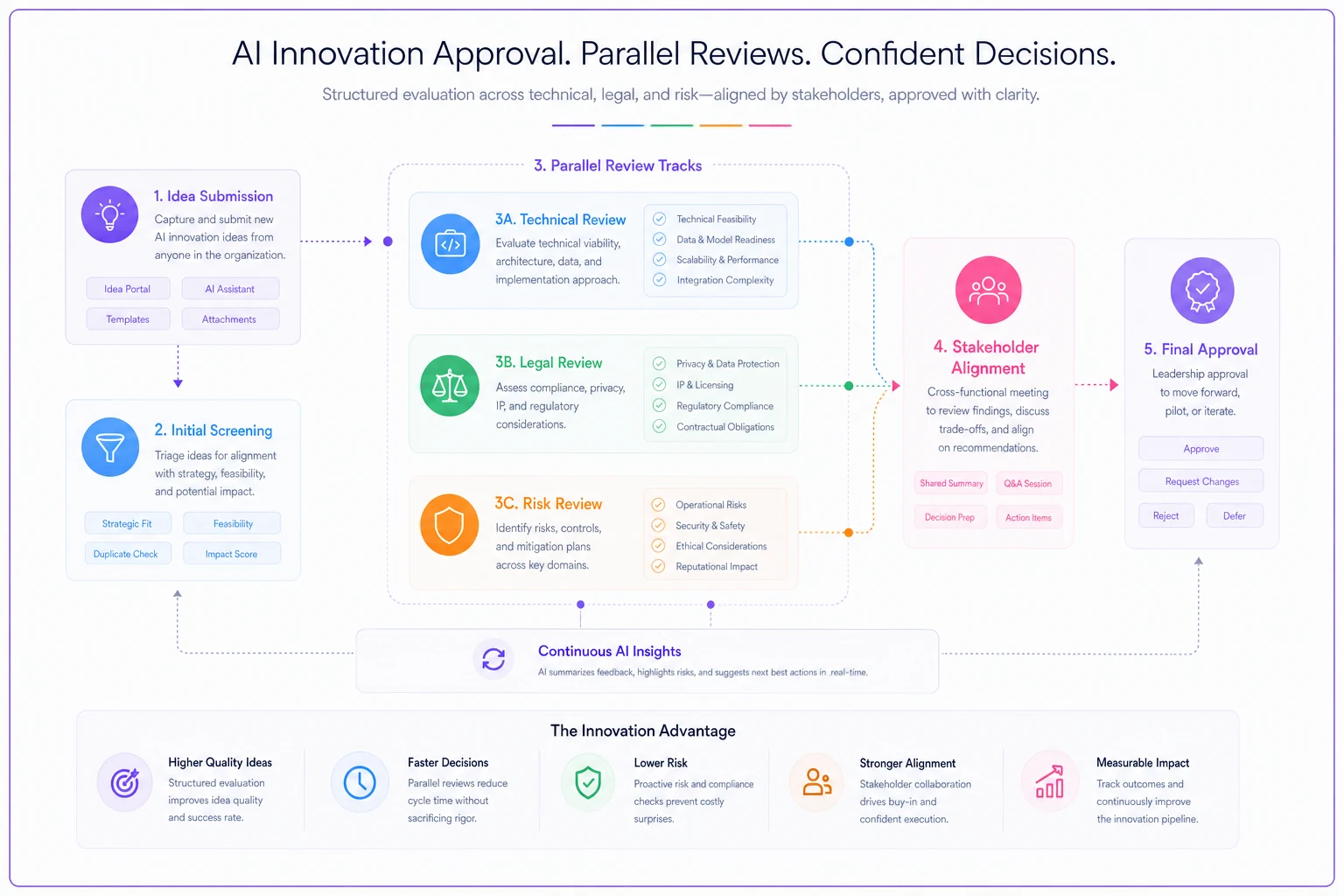
Sequential approvals are innovation killers. Legal reviews, then security reviews, then risk reviews—by the time you get through everyone, months have passed and the opportunity is gone. Parallel approval paths work better, but only with clear ownership boundaries.
AI Innovation Approval Process:
-
Initial business case submission
-
Parallel technical assessment (security, architecture, data governance)
-
Legal and risk evaluation (concurrent with technical review)
-
Stakeholder alignment meeting
-
Final approval or escalation
Define what each function actually needs to approve versus what they just need to be informed about. Does legal need to approve every AI pilot, or just those using external data? Does security need to review every vendor, or only those with system access? A technology firm streamlined approvals by creating a RACI matrix specifically for AI initiatives.
Parallel approval paths work better, but only with clear ownership boundaries.
Pre-approval frameworks speed things up significantly. Rather than reviewing each AI idea individually, functions pre-approve certain categories. Using AWS or Azure AI services? Pre-approved from security. Working with anonymized internal data? Pre-approved from legal. Implementing within existing systems? Pre-approved from IT architecture.
Some organizations create AI innovation committees—cross-functional groups meeting weekly to review proposals together. Instead of serial reviews taking weeks, stakeholders discuss concerns simultaneously, resolve conflicts in real-time, make decisions collectively.
The hidden budget impact of AI governance
Nobody budgeted for this level of AI governance overhead. Not in time, resources, or actual dollars.
Consider a mid-sized financial services firm's innovation budget. Pre-executive order, they allocated roughly 5% to governance and compliance activities. Post-order, that jumped to 22% for AI initiatives. Extra vendor assessments, specialized legal reviews, technical audits, ongoing monitoring—it adds up fast.
The human resource impact might be worse than the financial one. AI governance requires specialized expertise most innovation teams lack. You need people who understand model architectures, data lineage, algorithmic bias, federal AI guidance—skillsets that barely existed in most organizations two years ago.
One retail innovation team calculated the true cost of their new AI governance requirements: approximately $400K annually in additional headcount, $200K in external assessments and audits, roughly 30% longer implementation timelines translating to delayed value realization. For a team with a $3M annual budget, that's a massive hit.
The indirect costs hurt too. Longer evaluation cycles mean ideas lose momentum. Extended implementation timelines mean competitors might move first. Increased documentation requirements mean teams spend more time on paperwork than experimentation.
Smart organizations are finding ways to spread these costs. Centralized AI governance teams serving multiple innovation programs. Shared vendor assessment resources. Reusable governance frameworks. But even with optimization, the budget reality is clear: AI innovation now costs significantly more than traditional innovation.
Making AI governance work with your existing innovation model
The temptation is to build an entirely separate process for AI initiatives. Don't. The operational complexity of running parallel innovation systems will kill you. Instead, adapt your existing model to handle AI requirements without losing what already works.
Start with your governance charter. Most innovation charters focus on strategic alignment, resource allocation, success metrics. Add explicit sections on technology governance triggers, risk assessment requirements, and escalation paths for emerging compliance needs.
Your stage-gate criteria need adjusting, not replacing. Keep your existing gates but add AI-specific tollgates where needed. Maybe Gate 2 now includes an AI technology assessment. Gate 3 adds vendor governance review. Gate 4 includes bias testing requirements. The core process stays familiar while accommodating new requirements.
Integration with existing systems matters more than most teams realize. Your idea management platform probably wasn't built for AI governance workflows. But replacing it means retraining everyone and losing historical data. Better to extend what you have. Add AI-specific fields to submission forms. Create automated workflows for AI assessments. Build dashboards showing governance status alongside traditional metrics.
Communication structures need evolution too. Your monthly innovation review probably doesn't include legal, security, and risk stakeholders. But having them in every meeting wastes time. Create a tiered communication model. Standard reviews continue as normal. AI initiatives get additional technical review sessions. Critical decisions trigger expanded stakeholder meetings.
The measurement framework requires the biggest mindset shift. Traditional innovation metrics—ideas generated, pilots launched, ROI achieved—don't capture governance effectiveness. Add metrics like: time from AI idea submission to governance clearance, percentage of AI initiatives requiring governance exceptions, cost per AI initiative versus traditional initiatives.
Early lessons from teams adapting quickly
Some organizations moved faster than others in adapting to the new requirements.
A pharmaceutical innovation team went all-in on documentation standardization within days of the executive order announcement. They created 15 template documents covering common AI scenarios—everything from vendor assessments to bias evaluation frameworks. Any new AI idea starts with templates, not blank pages. They estimate this saves 3-4 weeks per initiative.
A technology firm took the opposite approach: maximum flexibility with minimum structure. Instead of rigid processes, they created an AI governance "toolkit"—resources teams can use as needed. Teams self-select tools based on risk level. It requires more judgment but avoids over-engineering governance for simple use cases.
One pattern emerges across successful adaptations: they started preparing before requirements were final. Rather than waiting for detailed federal guidance, they built flexible frameworks ready to accommodate whatever comes. Governance processes designed for adjustment. Documentation systems built for versioning. Approval workflows with variable paths.
The failed adaptations share patterns too. Organizations that treated AI governance as purely compliance exercise struggled most. Their processes became bureaucratic checkboxes rather than value-adding reviews. Teams found ways around them rather than through them. Innovation velocity dropped to near zero.
Speed of initial response mattered less than thoughtfulness of approach. Organizations that rushed to implement governance often built processes they had to tear down weeks later. Those that took time to understand their actual risk exposure built more sustainable solutions.
Practical next steps for innovation teams
Stop waiting for perfect clarity on federal requirements. It won't come soon enough, and your innovation pipeline can't stay frozen.
Map your current AI exposure. How many active initiatives involve AI? Which vendors are you using? What types of models and data are involved? You can't govern what you don't understand. A simple spreadsheet beats analysis paralysis.
Create an AI governance tiger team. Pull one person each from legal, security, IT, and innovation. Give them two weeks to draft initial AI governance guidelines. Not perfect, comprehensive documentation—just enough structure to start moving again. Focus on three things: vendor assessment requirements, risk categorization criteria, and approval authorities.
Run a governance simulation on your highest-priority AI initiative. Take it through your proposed process end-to-end. Document every friction point, every delay, every missing piece of information. Use this learning to refine before rolling out broadly.
Build your pre-approved vendor list now. Start with the big, obvious players—major cloud providers' AI services, established enterprise AI platforms. Get legal and security comfortable with standard terms. Every vendor you pre-approve is weeks saved on future initiatives.
Adapt your innovation metrics immediately. Add tracking for governance-related delays and costs. You need baseline data to improve from. If you don't measure the impact now, you won't be able to demonstrate improvement later or justify additional resources.
Most importantly, communicate reality to stakeholders. AI innovation timelines and costs have fundamentally changed. Pretending otherwise leads to failed expectations and killed initiatives. Better to reset expectations now than apologize for blown deadlines later.
Wrapping up
The executive order on AI isn't just another compliance requirement to check off. It's forcing a fundamental rethink of how innovation teams evaluate and implement AI-powered ideas. The organizations succeeding aren't the ones with perfect processes—they're the ones acknowledging the new reality and adapting quickly.
Your innovation governance model was probably working fine six months ago. Today, it needs significant evolution to handle AI requirements without grinding to a halt. The changes go deeper than adding review stages or documentation requirements. You need different evaluation criteria, new stakeholder involvement models, adjusted budget allocations, and modified success metrics.
The operational impact is real and lasting. AI initiatives now take longer, cost more, and require broader stakeholder alignment than traditional innovation. But they also carry more transformative potential than almost anything else in your pipeline.
Ready to transform your innovation process?
Join 2,000+ companies using GoIdeafy to unlock team creativity, prioritize impactful ideas, and accelerate growth.