

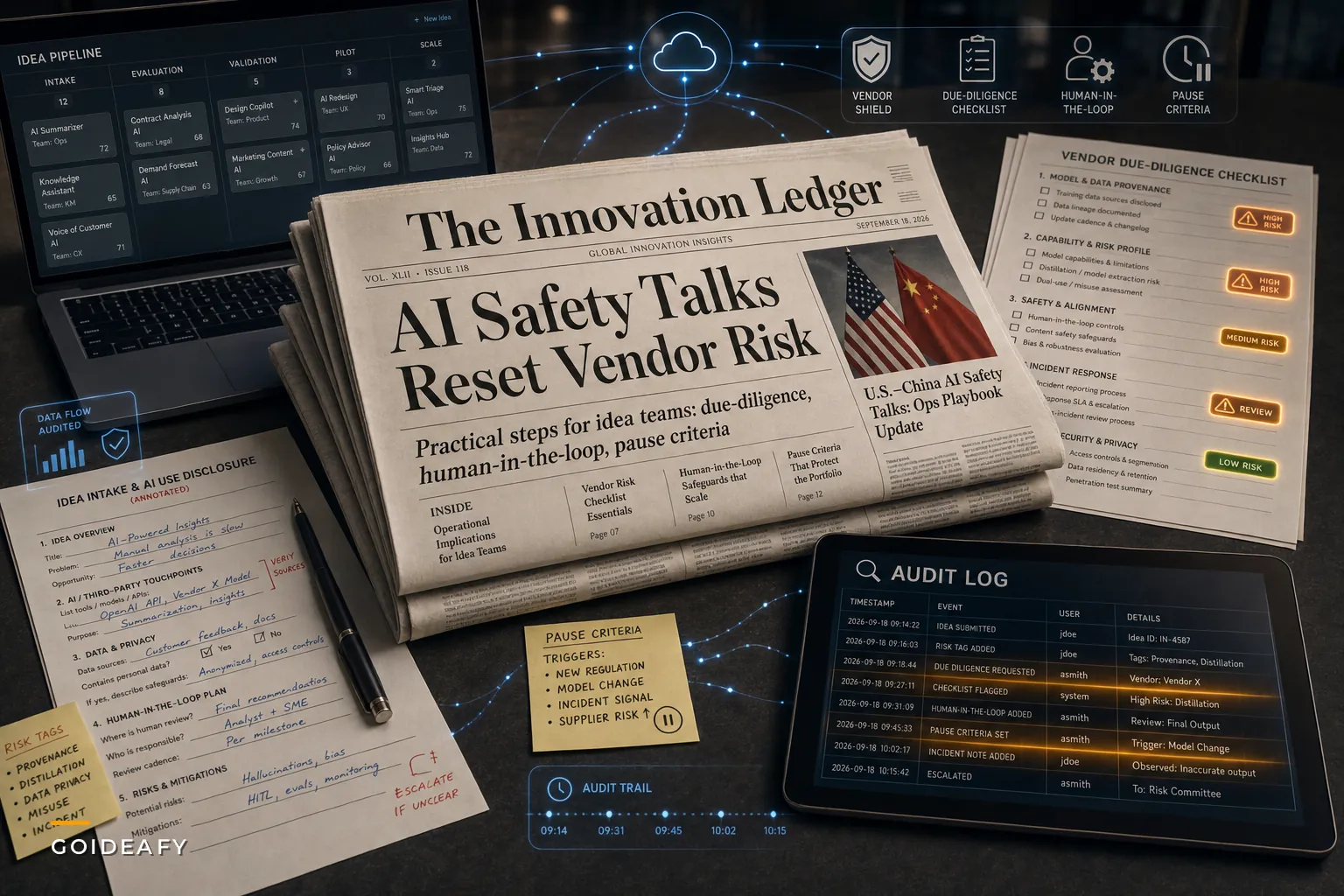

Most innovation teams treat AI vendor risk as something that lives two floors away in security or procurement. It doesn't anymore. When the U.S. and China sat down to prepare for mid-September bilateral AI safety talks, the signal wasn't really about geopolitics. It was about direction of travel: model provenance, incident reporting, and monitoring expectations are shifting from "nice to have someday" toward something closer to a shared baseline — one your vendors, and by extension you, will eventually be expected to meet.
If your team uses ML to triage, score, or route ideas, you're now a small part of an AI supply chain. Supply chains get audited.
The part nobody in innovation wants to hear
Most idea-evaluation setups quietly accumulate AI dependencies nobody formally tracks. A scoring model here. An LLM summarizer for intake there. A vendor feature that "uses AI" without anyone knowing which model, trained on what, hosted where.
When coordinated safety norms tighten — and the fact that two of the world's largest AI players are even at the table suggests they will — questions that used to be theoretical become procurement blockers. Where did this model come from? Was it distilled from something with unclear licensing? Can the vendor produce audit logs? Who gets notified when it behaves unexpectedly?
A recent CNBC report on the talks framed the discussions around safety cooperation and monitoring. For innovation teams, the practical translation is pretty simple: the informal era of "we plugged in an AI scoring tool and it works great" is closing. You'll need to show your work.
What actually changes in your operations
"Governance is changing" is useless without operational detail. Here's what shifts, and roughly on what timeline.
Capture, evaluate, and act on ideas without friction.
GoIdeafy streamlines the entire innovation lifecycle from idea submission to implementation.
- Centralized idea capture
- Collaborative evaluation tools
- Progress tracking & analytics
No credit card required
| Operational Area | Before (typical setup) | What tightening norms push you toward |
|---|---|---|
| Vendor onboarding | 2–3 week trial, security review optional | Provenance + distillation disclosure, 6–10 week diligence |
| Idea scoring models | Automated, minimal logging | Audit logs, versioning, human-in-the-loop checkpoints |
| External idea intake | Open submission, light IP consent | Explicit consent, data-handling disclosure, model-use notice |
| Pilot documentation | Slide deck + results | Incident reporting SLA, model behavior logs |
| Vendor risk reviews | Annual, if at all | Continuous, with re-assessment triggers |
Everything gets slower before it gets safer — that's the trade-off nobody advertises. Your vendor onboarding cycle roughly doubles. A tool you could have piloted in a sprint now needs a diligence pass first. Teams that don't plan for this end up either blocked or quietly routing around procurement, which is exactly what creates unlogged AI dependencies in the first place.
The deeper problem: you don't actually know what your scoring model is doing
This is what the safety-talks conversation exposes that a lot of innovation leaders have been avoiding.
If a regulator, a client's security team, or your own legal counsel asked you tomorrow to explain why your triage model rejected a particular idea, could you? Not "the model scored it low" — I mean the actual signals, feature weights, confidence level, the fallback logic when the model was unsure.
In a lot of programs, the honest answer is no. The model is a black box the vendor handed over, and the team trusts it because the outputs seem reasonable. That's fine until provenance and explainability stop being optional. "It seems reasonable" is not a defensible position when someone official starts asking.
This is why human-in-the-loop matters more now than it did even a year ago. If you've already built transparent scoring — where humans can see and override the signals — a lot of the incoming diligence burden is already half-solved. We covered the mechanics of this in Don't Deploy Black-Box Scoring, and the core argument holds up even better in this environment: opaque scoring isn't just a quality risk, it's a compliance liability waiting to surface.
A real scenario
A mid-market industrial-products company ran an internal idea program processing somewhere around 400–500 submissions per quarter. They used a third-party idea platform with a built-in "AI relevance score" that auto-triaged submissions into review tiers. Nobody on the innovation team could explain how the score was computed — it was just a vendor feature.
When their parent company rolled out stricter AI vendor requirements (partly anticipating exactly the kind of provenance expectations these talks signal), the innovation team got a questionnaire: model source, training data disclosure, audit-log availability, incident process. They couldn't answer three of the seven questions. The vendor took about five weeks to respond, and two answers came back as "not available."
Their AI scoring got suspended for roughly a quarter while alternatives were assessed. Submissions kept coming in — around 450 that quarter — but everything reverted to manual triage. Evaluation backlog grew to something like three weeks behind. Not a catastrophe. Just a very avoidable slowdown that came entirely from not knowing their own AI supply chain.
The lesson wasn't "AI scoring is bad." It was that they'd outsourced a decision-making function without retaining any ability to explain or defend it.
The vendor-risk questions worth asking now
Before your next AI-assisted tool renewal or trial, get answers to these. If a vendor can't answer them, that's itself a signal.
-
Provenance What base model powers this feature, and can you document its origin and licensing?
-
Distillation risk Was this model distilled or fine-tuned from another provider's model, and are those terms clean?
-
Logging Can you export audit logs of scoring decisions with version stamps?
-
Human override Can our evaluators see the signals behind a score and override it, with that override recorded?
-
Incident process What's your notification SLA if the model produces harmful, biased, or anomalous outputs?
-
Data handling Where does our submission data go, and is it used for training?
-
Hosting & jurisdiction Where is the model hosted and processed?
You don't need every answer to be perfect. You need to know the answers — because the gap between "we don't know" and "here's our documented position" is the entire game right now.
A practical response sequence
If you want to get ahead of this without turning your program into a compliance department, work through it in order:
Requesting provenance and logging docs early often separates reliable vendors from the ones that will slow you down later.
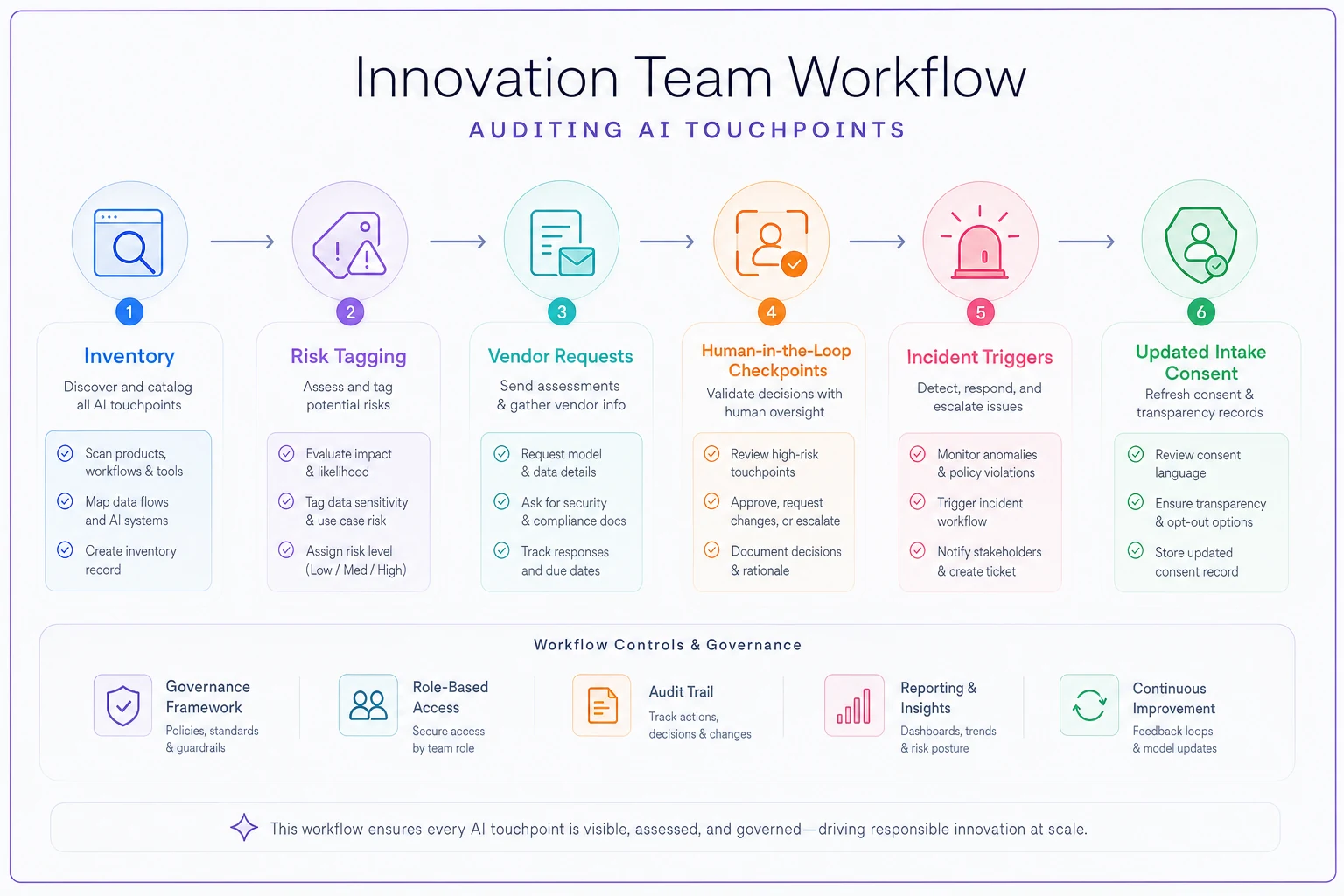
Here's a visual of the practical sequence to follow for auditing AI touchpoints in your idea pipeline.
-
Inventory every AI touchpoint in your idea pipeline — intake, scoring, summarization, routing, duplicate detection. Most teams find 2–3 they'd forgotten about.
-
Tag each one by risk exposure. A model that auto-rejects ideas is higher risk than one that just suggests tags. Prioritize the decision-making models.
-
Request provenance and logging docs from each vendor now, before you're forced to. Response quality tells you a lot about who to trust.
-
Add human-in-the-loop checkpoints anywhere a model makes or heavily influences a rejection or funding decision.
-
Set an incident and re-assessment trigger — a lightweight policy for what happens if a model misbehaves or a vendor's posture changes.
-
Update intake consent and IP language so external submitters know when AI touches their idea and how their data is handled.
Most of this is documentation and process, not technology. That's usually the case. The tooling exists. What's missing is operational discipline to actually track it.
When to slow down — and when not to
This actually makes sense when your AI tools influence go/no-go decisions, when you take external or customer submissions, or when you operate under a parent org or clients with their own AI requirements. Front-loading diligence in those cases saves you from an emergency later.
This is overkill when your AI use is genuinely low-stakes — an internal summarizer for a ten-person team's brainstorm, for example. Don't build a governance apparatus around a tool that just cleans up meeting notes. Match the rigor to the risk.
Who should be careful about overreacting: small teams that respond to this by banning AI-assisted triage entirely and drowning in manual work. That's not risk management, it's risk avoidance, and it usually creates worse bottlenecks than the risk it was meant to prevent.
The quiet advantage in all this
The teams that handle this well won't be the ones with the biggest compliance budgets. They'll be the ones who already treated their scoring logic as something to understand rather than trust blindly. If your evaluation workflow already keeps humans in the decision loop, logs its reasoning, and knows where its models come from, coordinated safety norms are mostly a paperwork exercise for you.
If it doesn't, this is a reasonable moment — before any deadline forces it — to look honestly at how much of your idea pipeline runs on AI you can't explain. The mid-September talks are just the reminder. The underlying work of knowing your own operations was always yours to do.
If it doesn't, this is a reasonable moment — before any deadline forces it — to look honestly at how much of your idea pipeline runs on AI you can't explain. The mid-September talks are just the reminder. The underlying work of knowing your own operations was always yours to do.
Ready to transform your innovation process?
Join 2,000+ companies using GoIdeafy to unlock team creativity, prioritize impactful ideas, and accelerate growth.