



Most predictive scoring projects for idea programs die one of two ways. The first is they never ship because the data science team keeps asking for "more clean training data" that never materializes. The second is worse: the model ships, spits out a number between 0 and 100 for every idea, and within three months nobody trusts it because it scored a genuinely good idea a 34 and a warmed-over duplicate a 91.
That second failure is the expensive one. You've spent political capital convincing reviewers to lean on a model, and they've watched it embarrass itself. Getting that trust back is harder than never having asked for it in the first place.
Start With What "Conversion" Even Means — Because Your Label Is Probably Wrong
Before any feature engineering, you have to define the thing you're predicting. In idea triage the naive answer is "predict which ideas get funded." Almost every team that starts here regrets it, because funding decisions are contaminated by the exact biases you're trying to remove. If senior people's ideas got funded more often historically, a model trained on "did it get funded" will just learn to favor senior people. You've automated the bias and slapped a confidence score on it.
A better label is a downstream outcome — something like: did this idea reach a validated pilot with a measurable result within 9 months? Messier to compute, but far less contaminated. A pilot either hit its success metric or it didn't, regardless of who submitted it.
The problem you'll immediately hit: outcome labels are sparse. If your program ran 1,400 ideas last year and only 60 reached a pilot with a clean result, you have 60 positive labels. That's not a lot. Which brings us to the training-data question most teams get wrong.
How Much Training Data You Actually Need
The instinct is "we need thousands of labeled ideas before this works." That's true for a deep model with hundreds of features. It's not true for what you should actually build, which is a small, interpretable model with a dozen or so carefully chosen features.
Capture, evaluate, and act on ideas without friction.
GoIdeafy streamlines the entire innovation lifecycle from idea submission to implementation.
- Centralized idea capture
- Collaborative evaluation tools
- Progress tracking & analytics
No credit card required
-
Broaden the positive definition slightly. Instead of "reached a pilot with a clean success metric," count "advanced past triage into scoped experimentation." That might take you from 60 positives to 180, which changes everything for a small model.
-
Don't throw away the negatives you're sure about. Ideas that were clear duplicates or out-of-scope are strong, clean negative labels. If your backlog is a mess and you can't tell duplicates from originals, fix that first — a scoring model built on a polluted backlog inherits the pollution. That's its own discipline, and if your backlog is drifting we've written separately about backlog hygiene rules and deduplication workflows that make labels trustworthy before you ever train on them.
The mistake people make is treating "not enough data" as either a reason to wait indefinitely or a reason to over-engineer. Start small, ship a model you can explain, and let it earn the right to get more complex.
Feature Engineering: The Signals That Actually Carry Weight
This is where most of the value lives, and where teams underinvest because feature work is unglamorous. A model is only as good as the signals you hand it, and the best signals are usually the ones you have to construct rather than the ones sitting in a column.
| Feature type | Example signals | What it captures | The trap |
|---|---|---|---|
| Text/semantic | Idea description length, similarity to past winners, presence of a stated metric | Whether the idea is specific and outcome-oriented | Rewards writing skill, not idea quality |
| Submitter context | Team, tenure bucket, first-time vs repeat submitter | Historical patterns in who produces pilots | Directly encodes demographic/seniority bias |
| Engagement | Comments, upvotes, cross-team interest | Whether others see promise | Popularity ≠ viability; herd effects |
| Structural | Has a named owner, has a defined success metric, scoped cost estimate | Readiness to be tested | Can be gamed once people learn it matters |
| Temporal | Days since submission, submission-to-first-review lag | Program responsiveness | Confounds idea quality with ops capacity |
The single most predictive constructed feature, in practice, tends to be a simple binary: does the idea contain a specific, measurable success metric? Ideas that say "reduce onboarding time from 6 days to 2" convert at meaningfully higher rates than ideas that say "improve onboarding." That's not because the model is clever — it's because specificity correlates with the submitter having actually thought it through.
Look at the "submitter context" row carefully. Those features are predictive precisely because they encode historical bias. You have a real choice: include them and monitor tightly, or exclude them entirely. The safer default is to exclude direct seniority and team-identity features from the scoring model and use them only in your bias audit — as things to check the model against, not things to feed it.
The feature that quietly poisons everything
Engagement metrics are the seductive trap. Upvotes look like a clean quality signal and they're easy to get. But in most programs, upvotes cluster around whoever posted, whoever's loud, and whatever got surfaced first in the feed. Feed a model raw upvote counts and you've built a popularity predictor wearing a viability costume. If you must use engagement, normalize it — upvotes relative to views, or engagement velocity in the first 48 hours — to at least strip out pure exposure effects.
A Worked Example: What the Model Actually Decides
Imagine a mid-sized program with about 1,200 historical ideas, roughly 190 of which advanced into scoped experimentation — our positive label, around 16% base rate.
We train a gradient-boosted model on these features: has-a-metric (binary), description specificity score, normalized early engagement, has-named-owner, scoped-cost-present, and days-to-first-review. Submitter seniority and team are deliberately left out.
-
Idea A "Automate the weekly compliance report — cut prep from ~8 hours to under 1." Has a named owner, a cost estimate, moderate engagement.
-
Idea B "Rethink our whole customer experience." No metric, no owner, high early upvotes (it's inspiring and vague).
-
Idea C "Batch the vendor onboarding emails into a single templated flow." Has a metric, named owner, low engagement (nobody noticed it).
A naive engagement-driven system ranks B first. The model ranks them A, C, B — because A and C carry the structural and specificity signals that historically predicted actual experimentation, while B's high engagement gets discounted after normalization and can't overcome its missing metric and owner.
That's the whole point. The model isn't smarter than your reviewers about strategy. It's just more consistent about not being fooled by enthusiasm. It surfaces the quiet, well-specified Idea C that a busy human might have skimmed past.
The model gives B a low score, not a zero. "Rethink our whole customer experience" might be the most important idea in the batch. It's just not triage-ready. Which is exactly where humans come back in.
Human‑in‑the‑Loop: Where Judgment Stays Non‑Negotiable
The score is an input to a decision, never the decision itself. The right design routes ideas differently based on where they fall, and reserves human judgment for the cases where a model is structurally weak.
-
Every idea gets a score, and every score comes with its top three contributing features. No naked numbers. A reviewer should see "scored 78 — driven by: has clear metric, named owner, similar to two past pilots." Transparency isn't a nice-to-have; it's what makes reviewers trust and correct the thing.
-
High-confidence, high-score ideas get fast-tracked to a lightweight review rather than auto-approved. Speed, not autonomy.
-
Mid-range scores go to a human triage queue where the score is context, not verdict. Most of the real work happens here.
-
Low scores get a mandatory second look with a specific prompt "Is this low because the idea is weak, or because it's ambitious and under-specified?" That single question rescues the Idea B's of the world.
-
Reviewers can override, and every override is logged with a reason. Those overrides are your richest retraining signal — they're the cases where human and machine disagreed and the human had context the model lacked.
A workflow diagram helps make the routing clear.
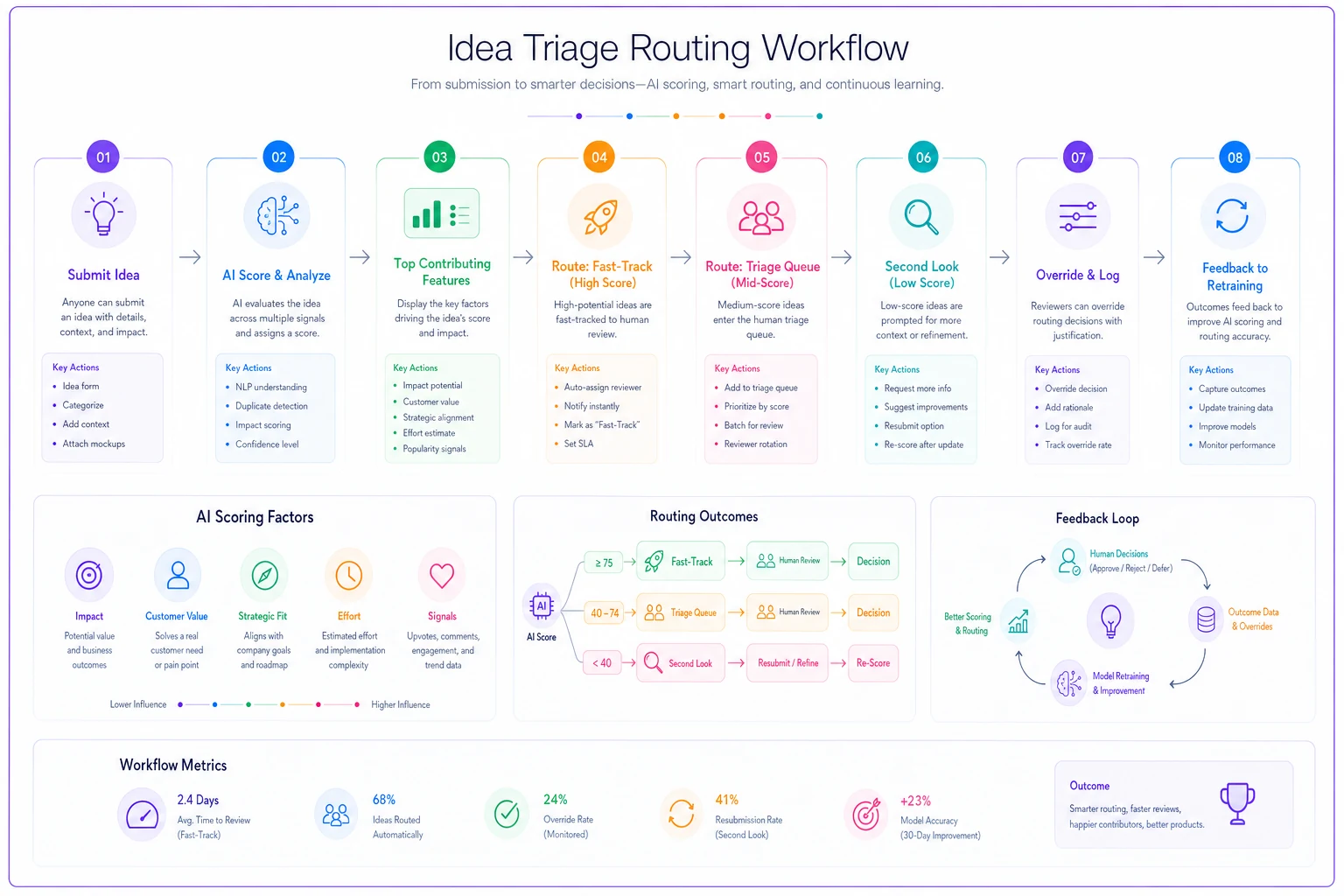
The mistake teams make is using human-in-the-loop as a rubber stamp — reviewers glance at the score, nod, and move on. That's not oversight, it's automation with a human-shaped alibi. If your override rate is under about 5%, your humans have probably stopped thinking. Somewhere in the 10–20% range usually indicates genuine engagement without chaos.
None of this replaces a proper evaluation rubric. The model tells you what's triage-ready; a structured rubric tells you what's worth doing. If you haven't built the human side of that yet, a predictive score sitting on top of scoring-by-vibes just adds a decimal point to guesswork — we've made the case for the underlying rubric and calibration work in why you shouldn't rely on RICE alone.
Bias Checks You Should Run Before and After Deployment
Excluding seniority from the feature set does not make your model unbiased. It makes it less obviously biased, which is arguably more dangerous, because now the bias hides in correlated features. Description specificity, for instance, correlates with writing confidence, which correlates with tenure and language background. The bias walks right back in through the side door.
So you audit outcomes, not just inputs. Run these checks regularly:
-
Score distribution by group. Slice average scores by team, tenure, first-time vs. repeat submitters, and where you can, demographic segments. If one group's median score is systematically lower, dig in — even though you never fed the model that attribute.
-
False negative rate by group. Of the ideas that did end up succeeding, which groups' ideas did the model score lowest? Systematically under-scoring a group's eventual winners is the failure that actually costs you good ideas.
-
Override direction by group. If reviewers override the model upward far more often for one group, the model is under-serving that group and your humans are catching it. That's a fix-the-model signal, not a pat-on-the-back signal.
-
The specificity-language confound test. Take a sample of low-scoring ideas and have a human re-read them ignoring writing quality. If a lot of them are good ideas written plainly, your specificity feature is doing more harm than good.
The pattern worth internalizing: a model can be statistically accurate overall and still quietly disadvantage a group whose ideas look different from last year's winners. Accuracy on the majority hides failure on the margin — and the margin is often where the non-obvious, genuinely novel ideas live.
Retraining Cadence: How Often, and What Triggers It
Retraining on a fixed calendar ("every quarter") is a decent default but a lazy one. The better approach is trigger-based, with a calendar backstop.
Idea programs drift. Strategy shifts, a reorg changes who submits, a new product line changes what "good" looks like. A model trained on last year's definition of success gradually goes stale — not with a crash, but with slowly degrading calibration that nobody notices until reviewers have already stopped trusting the scores.
Retrain when any of these fire:
-
Calibration drift. Track predicted-vs-actual conversion in buckets. If ideas you scored 70–80 used to convert around 70% of the time and now convert 50%, the model's confidence no longer means what it says. Retrain.
-
Override rate climbing. A steadily rising human override rate means the world has moved and the model hasn't. It's your early-warning system.
-
A strategy or portfolio shift. A deliberate change in what the program values should force a retrain — and often a re-labeling — because the definition of a "good" outcome changed.
-
Enough new labeled outcomes accumulated. Roughly every time you add 30–50% more labeled examples, a retrain is worth it just for the added signal.
As a rough operating rhythm: expect to retrain something like every 3–4 months in a healthy, active program, but let the triggers pull it earlier. Version everything — model, feature definitions, and the label logic — so that when someone asks "why did this idea score differently in March," you can actually answer.
When predictive scoring for ideas makes sense — and when it doesn't
It makes sense when you have a genuine volume problem — hundreds of ideas per cycle that human reviewers can't triage consistently — and you have at least a year of outcome history to label. Consistency at scale is the real payoff.
It's a bad idea when your annual volume is in the low dozens. At that scale, a good rubric and disciplined reviewers beat any model, and you don't have enough data to train something trustworthy anyway. You'll spend months building something a spreadsheet and two thoughtful people would out-perform.
Who should not do this: any program whose backlog and labels are a mess. If you can't cleanly say which past ideas succeeded, you cannot train a scoring model — you'll just encode the confusion at higher resolution.
Bringing It Together
The version of predictive scoring that actually survives contact with a real program is almost boring: a small, interpretable model trained on a carefully chosen outcome label, fed a dozen well-constructed features, wrapped in human review, and audited for the biases that excluded features let sneak back in.
The exciting black-box version — the one that produces a confident 91 for a duplicate — is the one that burns your credibility.
The number is never the point. The point is a consistent, transparent second opinion that catches the quiet Idea C, flags the popular-but-empty Idea B for what it is, and shows its reasoning every time so a human can overrule it when they know something the data doesn't. Build it that way and reviewers come to rely on it. Build it as an oracle and they'll be right not to.
Ready to transform your innovation process?
Join 2,000+ companies using GoIdeafy to unlock team creativity, prioritize impactful ideas, and accelerate growth.