

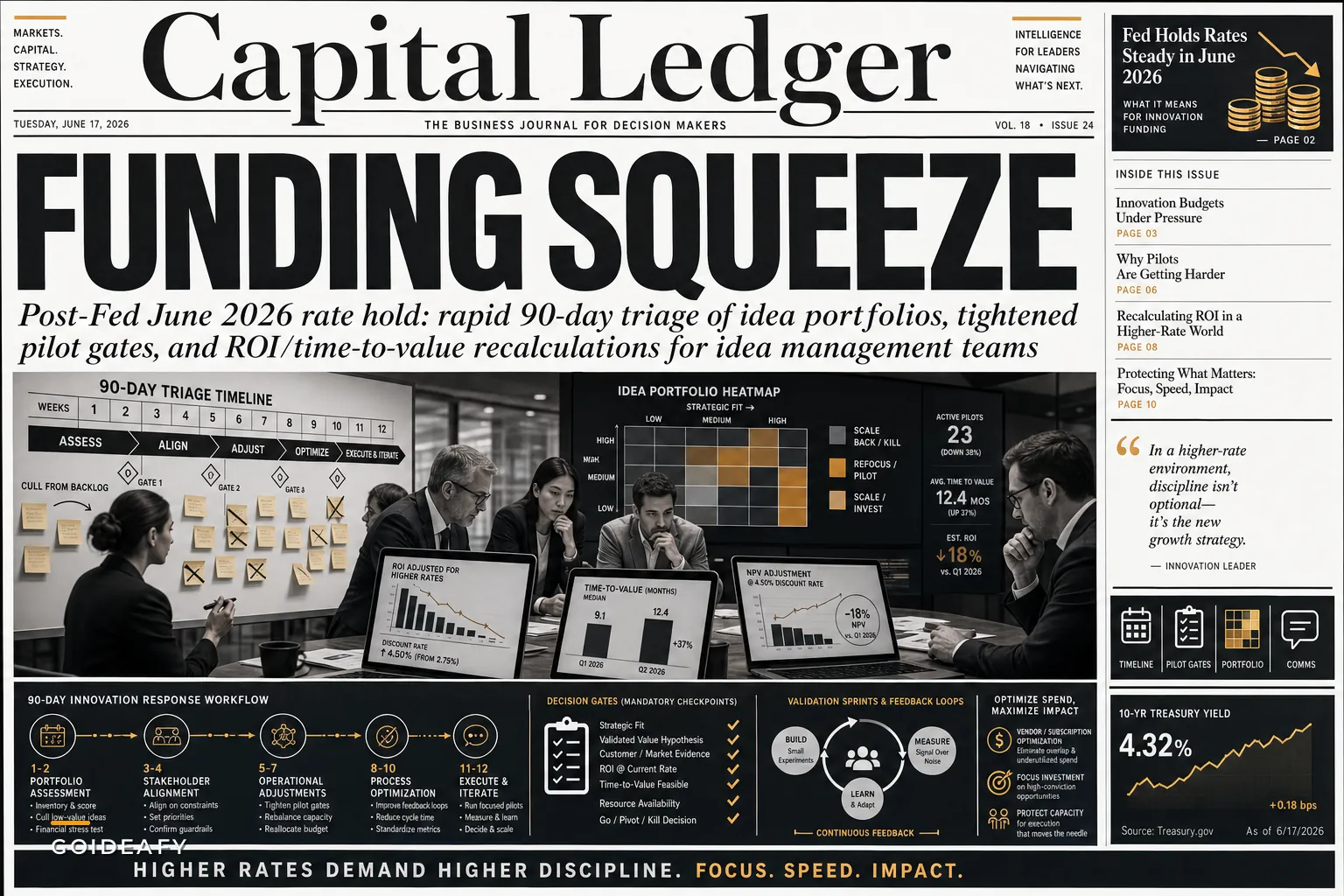

The Federal Reserve held rates steady on June 17, signaling that higher rates will stick through 2026. For innovation teams managing active pilot programs and idea pipelines, this changes how you allocate resources, evaluate experiments, and justify funding requests.
Your CFO is probably already recalculating the weighted average cost of capital. Meanwhile, your innovation portfolio—built when money was cheaper—suddenly looks bloated with low-conviction experiments that made sense at 2% rates but can't justify themselves at 5.5%.
The Immediate Operational Squeeze
Right now, innovation managers across Fortune 500s and mid-market companies are getting the same kinds of emails. Budget committees want revised business cases. Executive sponsors need shorter payback periods. Procurement teams are scrutinizing every vendor contract and SaaS subscription.
The operational reality hits fast. That 18-month pilot you pitched last quarter? Finance wants it compressed to 9 months with monthly checkpoints. The innovation lab headcount request sitting in HR? Frozen. The cross-functional team assembled for that moonshot project? Being pulled back to core operations.
A consumer goods company I worked with had 47 active innovation projects in their pipeline when rates started climbing. After their portfolio review, only 12 survived. The rest weren't necessarily bad ideas—they just couldn't meet the new hurdle rate.
Why Traditional Innovation Metrics Break in High-Rate Environments
Most innovation programs still run on evaluation frameworks built during the low-rate era. These frameworks lean on strategic alignment, long-term potential, and learning value. When capital was essentially free, you could justify experiments purely for organizational learning or capability building.
Capture, evaluate, and act on ideas without friction.
GoIdeafy streamlines the entire innovation lifecycle from idea submission to implementation.
- Centralized idea capture
- Collaborative evaluation tools
- Progress tracking & analytics
No credit card required
When your cost of capital jumps from 3% to 7%, those soft benefits evaporate. A pilot that takes two years to generate returns now costs significantly more in opportunity cost. NPV calculations that once looked positive turn negative. Projects marginally above your hurdle rate are now deeply underwater.
It compounds because innovation funding typically comes from discretionary budgets—exactly the pools that get raided first when CFOs need to preserve margins. Unlike operational expenses that keep the lights on, innovation spending looks optional on a spreadsheet.
Portfolio Rebalancing: From Exploration to Exploitation
The shift from low to high rates changes your optimal portfolio mix. During the cheap money era, the standard advice was 70-20-10: seventy percent core innovations, twenty percent adjacent, ten percent transformational. That assumed you could afford multiple long-term bets.
Now you need something closer to 85-10-5, with most resources flowing to core innovations that enhance existing operations. This isn't about abandoning breakthrough thinking—it's about being more surgical and demanding clearer paths to value.
Here's what an adjusted portfolio might look like:
| Innovation Type | Old Allocation | New Allocation | Focus Shift |
|---|---|---|---|
| Core (Efficiency) | 70% | 85% | Process automation, cost reduction, margin improvement |
| Adjacent (Extension) | 20% | 10% | Only with clear customer pull and quick validation |
| Transformational | 10% | 5% | Platform bets only, no exploratory research |
The emphasis shifts toward innovations that reduce costs, improve cash conversion, or accelerate revenue realization. Process improvements that might have been deprioritized for flashier digital initiatives suddenly jump to the front of the queue.
Tightening the Stage-Gate Process
Your existing stage-gate process probably has too much slack for this environment. Most innovation funnels were designed to nurture ideas, giving teams multiple chances to pivot and iterate. That made sense when the cost of delay was minimal.
Now you need tighter gates with clearer kill criteria. Instead of asking "Could this work?" at each gate, you're asking "Is this still worth the capital cost?" The bar gets progressively higher as projects consume more resources.
Consider implementing these gate modifications:
-
Gate 1 (Ideation to Concept) - Old criteria: Strategic fit, technical feasibility - New criteria: Add immediate cost-benefit analysis, even at concept stage - Kill rate target: 60% (up from 40%)
-
Gate 2 (Concept to Pilot) - Old criteria: Market validation, resource availability - New criteria: Add 12-month payback requirement, validated unit economics - Kill rate target: 70% (up from 50%)
-
Gate 3 (Pilot to Scale) - Old criteria: Pilot success metrics, scaling plan - New criteria: Add demonstrated cash flow positive within 6 months - Kill rate target: 50% (up from 30%)
Define financial kill criteria early so teams can design pilots to surface decisive go/no-go signals.
The key change: killing projects earlier and more decisively. It feels harsh. But it preserves resources for initiatives with clearer value propositions.
Adjusting Pilot Design for Capital Efficiency
Traditional pilots aimed for comprehensive validation across multiple dimensions—technical feasibility, market acceptance, operational integration, scaling potential—all at once. Multi-quarter, multi-million dollar pilots made sense when capital was cheap.
The new model requires decomposed pilots that validate one critical assumption at a time. Instead of building a full prototype, you validate the core value driver first. Only after proving that fundamental assumption do you layer on additional complexity.
Decompose pilots to test the riskiest assumption first to avoid large sunk costs.
A medical device company restructured their pilot approach this way. Their old model: build a fully functional prototype, run a 6-month clinical trial, gather comprehensive data. Cost: around $2.3 million. Timeline: 9 months. Their new approach: start with a basic functional test using existing components ($200K, 6 weeks). If successful, add single-feature prototype testing ($400K, 8 weeks). Only then move to limited clinical validation ($800K, 12 weeks). Total cost if all gates pass: roughly $1.4 million. Timeline: 6 months. But more importantly, they can kill the project after 6 weeks if the core assumption fails.
The Vendor Renegotiation Imperative
Your innovation stack probably includes dozens of SaaS tools, cloud services, and platform subscriptions that accumulated during the growth-at-all-costs era. Many were justified on potential future value rather than immediate returns.
Now's the time for consolidation. Map every vendor against actual usage and value delivery. You'll likely find:
-
Overlapping capabilities across multiple tools
-
Underutilized enterprise licenses
-
Proof-of-concept tools that never graduated to production
-
Features you're paying for but not actually using
One fintech innovation team discovered they were spending around $450K annually on innovation management and collaboration tools. After consolidation and renegotiation, they cut it to roughly $180K while keeping 90% of critical functionality.
The negotiation dynamic has shifted too. Vendors facing their own growth pressures are suddenly flexible on pricing, especially if you're willing to sign longer contracts or pay annually. Use that leverage—but avoid locking in tools you're not certain about. Flexibility matters more than ever right now.
Building the Business Case for Sustained Innovation Funding
When CFOs are in cost-cutting mode, innovation budgets look like easy targets. Saying "we need to innovate to stay competitive" doesn't cut it anymore. That worked when capital was free. Now you need to show immediate, measurable returns.
The most effective framing: position innovation as operational efficiency in disguise. Frame your portfolio as cost-reduction initiatives that happen to build new capabilities. Show how killing underperforming projects actually improves capital allocation.
Document everything in financial terms:
-
Cost savings from process improvements
-
Revenue acceleration from faster time-to-market
-
Margin improvement from automation initiatives
-
Capital efficiency gains from portfolio optimization
Link every innovation metric to a financial outcome. Instead of tracking "number of ideas generated," track "cost savings identified." Instead of "pilots launched," measure "months to cash flow positive."
Creating Rapid Validation Loops
Long experimentation cycles are a luxury that's gone. You need validation frameworks that generate actionable data within weeks, not quarters.
Traditional approach: run a pilot for 3-6 months, gather comprehensive data, analyze results, make a decision. Total timeline: 6-9 months.
High-rate approach: define one critical metric, run a 2-week sprint, analyze data in 48 hours, immediate go/no-go. Total timeline: 3 weeks.
The difference isn't just speed—it's capital efficiency. By validating (or invalidating) faster, you preserve resources for initiatives that show genuine promise. You're not trying to eliminate all risk. You're trying to identify bad bets quickly and stop bleeding capital into them.
Managing Stakeholder Expectations Through the Transition
The hardest part isn't the operational changes—it's the cultural shift. Teams used to patient capital and long runways suddenly face quarterly scrutiny and monthly milestone reviews. Innovation champions who sold transformational visions need to pivot to incremental value stories.
Start by acknowledging the new reality openly. Don't pretend nothing has changed. Be transparent about the constraints while making clear that disciplined innovation often produces better outcomes than unconstrained experimentation anyway.
Reset expectations systematically:
With executives: Focus on capital efficiency metrics, shorter payback periods, and operational improvements. Show how a leaner portfolio actually increases the probability of meaningful returns.
With innovation teams: Emphasize skill development in rapid prototyping, customer validation, and lean experimentation. Position this as building capabilities that matter in any economic environment.
With business units: Shift from "we're exploring possibilities" to "we're solving your immediate problems." Make innovation directly relevant to their operational pressures.
The AI Automation Opportunity in Capital-Constrained Times
Higher rates actually create an opening for specific types of innovation—particularly those that reduce operational costs through automation. When capital is expensive, labor-saving technology with quick payback periods becomes very attractive.
This is where AI-powered operational software earns its place. Unlike moonshot innovations that might pay off in five years, AI automation can deliver measurable efficiency gains within months. The business case is straightforward: reduce manual work, eliminate errors, improve coordination—all with clear ROI tied to actual headcount and process costs.
The key is picking automation opportunities with immediate impact. Skip the complex transformations and focus on repetitive processes that consume significant human hours. Document workflows, identify bottlenecks, calculate what current operations actually cost, then show how automation pays for itself.
For companies trying to maintain innovation momentum while satisfying financial constraints, aligning funding to portfolio impact becomes essential. The framework for portfolio rebalancing isn't just about cutting projects—it's about redirecting resources to initiatives that can actually thrive despite capital constraints.
Building Your 90-Day Response Plan
The Fed's signal is clear: rates aren't dropping anytime soon. According to Reuters, economists expect this higher-rate environment to persist through 2026. Your innovation program needs to adapt now.
Here's your immediate action plan:
-
Weeks 1-2
Portfolio Assessment
- Map all active projects against new hurdle rates - Calculate true cost of capital for each initiative - Identify quick wins vs. long shots -
Weeks 3-4
Stakeholder Alignment
- Present portfolio rebalancing recommendations - Secure commitment to new evaluation criteria - Reset expectations on timelines and outcomes -
Weeks 5-6
Operational Adjustments
- Implement tighter stage-gate criteria - Redesign pilots for rapid validation - Begin vendor consolidation and renegotiation -
Weeks 7-8
Process Optimization
- Document new innovation workflows - Train teams on lean experimentation methods - Establish new reporting cadences -
Weeks 9-12
Execute and Iterate
- Launch restructured pilots - Monitor early indicators closely - Adjust based on initial results
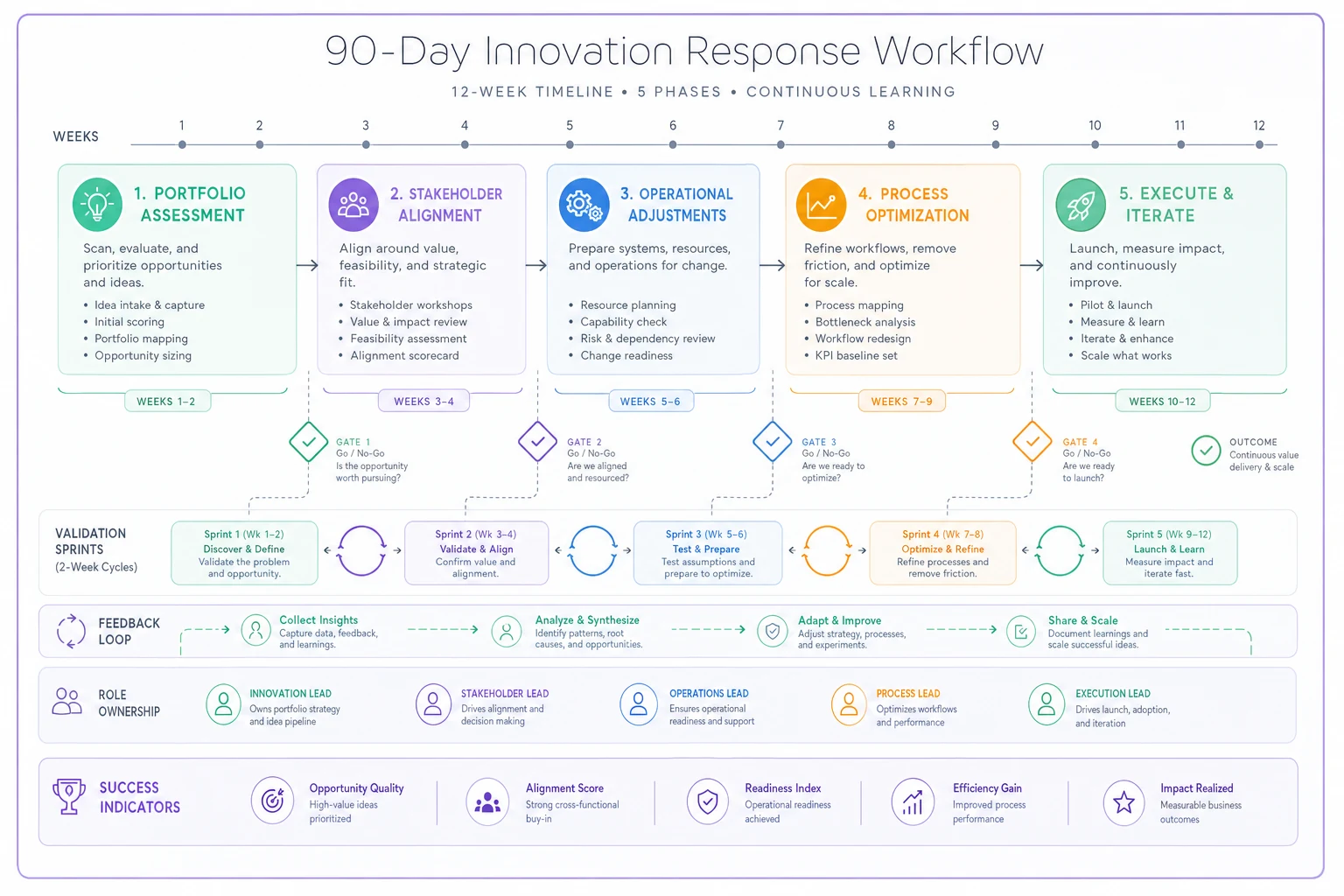
Use the visual to align stakeholders on responsibilities and timing for the 90-day plan.
Making Innovation Resilient to Rate Cycles
The real lesson isn't just about surviving high rates—it's about building an innovation program that can flex with economic cycles. Organizations that do well long-term treat capital efficiency as a permanent discipline, not a temporary constraint.
That means embedding financial rigor into how you run innovation. Every experiment should justify its cost of capital. Every pilot should have a clear payback timeline. Every portfolio review should consider opportunity cost.
But discipline isn't the same as timidity. The goal isn't to stop innovating—it's to innovate with more intentionality. Raising the bar for what gets funded concentrates resources on initiatives with genuine potential. Validating faster means you can actually test more ideas within the same budget. Focusing on operational improvements builds a track record that justifies continued investment even when budgets tighten.
The companies that maintain innovation momentum through this period won't be those that spend the most. They'll be those that spend most wisely. Expensive capital forces a clarity that was optional when money was free. That clarity, if you build it into your process now, will serve you well past the current rate environment.
Your CFO is watching. Your runway is shorter. Your hurdle rate is higher. Time to show that innovation can deliver returns even when capital isn't free.
Your CFO is watching. Your runway is shorter. Your hurdle rate is higher. Time to show that innovation can deliver returns even when capital isn't free.
Ready to transform your innovation process?
Join 2,000+ companies using GoIdeafy to unlock team creativity, prioritize impactful ideas, and accelerate growth.