

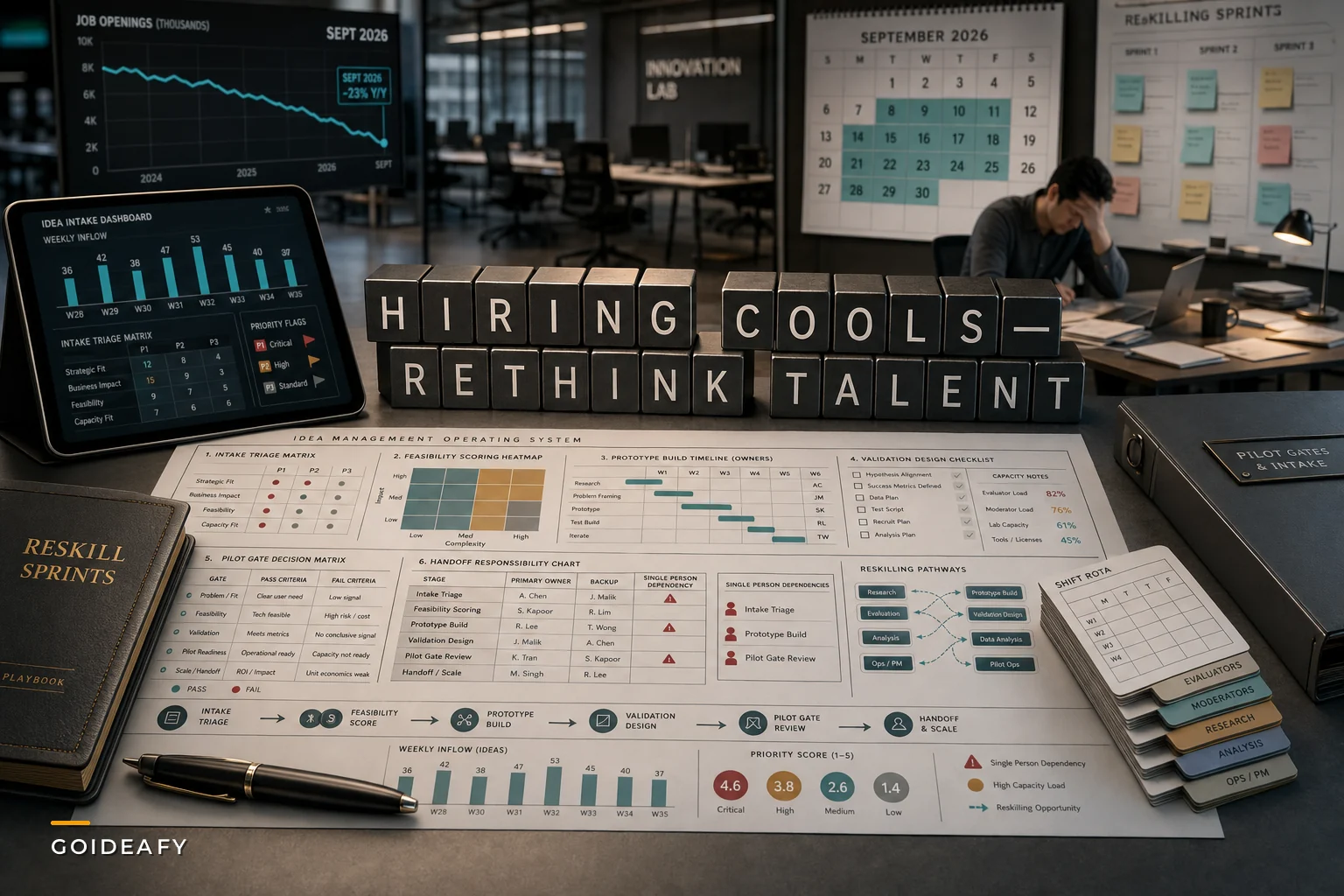

Most innovation teams don't fall apart because they run out of ideas. They stall because the people who actually validate, prototype, and ship experiments get stretched too thin — and when hiring slows, that thinness turns into a backlog nobody notices until a quarter's pipeline is three weeks behind.
That's the situation a lot of teams are quietly walking into right now. The end-of-September JOLTS data showed U.S. job openings falling to around 7.08 million in August 2026, while layoffs stayed historically low. As Reuters reported, it's a cooling-but-still-tight market — employers aren't cutting, they're just hesitating on new hires. The BLS JOLTS release backs that up with the broader turnover picture.
That specific signal matters more for innovation teams than most functions because you plan Q4 resourcing now. Pilot funding, evaluator coverage, implementation capacity for year-end experiments — all of that gets locked in during the same weeks employers are deciding to freeze or slow-walk open reqs. So the exact moment you'd normally reach for an external hire to unblock throughput is the moment that hire becomes a six-week approval fight you probably lose.
This isn't a hiring-freeze doom piece. It's about what you actually do operationally when the external lever is gone and the experiment calendar doesn't care.
The real problem isn't fewer people — it's where your throughput actually lives
When teams model capacity, they think in headcount. "We have four evaluators and two implementers." But throughput doesn't live in headcount. It lives in a handful of specific people who can do the rare steps — the person who can scope a technical feasibility check, the one evaluator everyone trusts for ambiguous submissions, the implementer who can stand up a landing-page test without a full sprint.
Lose access to external hiring and you don't lose capacity evenly. You lose your buffer. The generalist work gets covered fine. The specialist bottlenecks — the ones you were planning to relieve with a new hire — just quietly get worse. The work keeps flowing in, but the one person who unblocks it is now at 110%.
In a lot of programs, roughly 60–70% of experiment delays trace back to two or three named individuals, not to overall team size. When hiring was easy, you papered over that concentration by adding bodies. When it's not, the concentration becomes the whole story.
So the first move isn't "do more with less." It's figure out exactly which steps are single-person dependencies, because those are the ones that break first.
Start by mapping dependency, not workload
Before you reshuffle anything, run a quick dependency map. Half a day, maybe less. Highest-leverage thing you'll do all quarter.
Capture, evaluate, and act on ideas without friction.
GoIdeafy streamlines the entire innovation lifecycle from idea submission to implementation.
- Centralized idea capture
- Collaborative evaluation tools
- Progress tracking & analytics
No credit card required
-
List every stage in your experiment pipeline — intake triage, feasibility scoring, prototype build, validation design, pilot gate review, handoff.
-
For each stage, write down who can actually perform it. Not who's assigned — who's capable.
-
Flag every stage where the answer is one name. Those are your fracture points.
-
Estimate the weekly inflow into each flagged stage. A single-person dependency with low volume is manageable. A single-person dependency with heavy inflow is a countdown timer.
-
Rank the flagged stages by inflow × business criticality. That ranking becomes your reskilling priority list.
What usually surprises people is how few stages are truly bottlenecked. It's rarely the whole pipeline — it's two spots.
Run the mapping as a half-day workshop with the people who do each stage so you get agreement and speed.
A quick visual of the mapping process can help make those fracture points obvious.
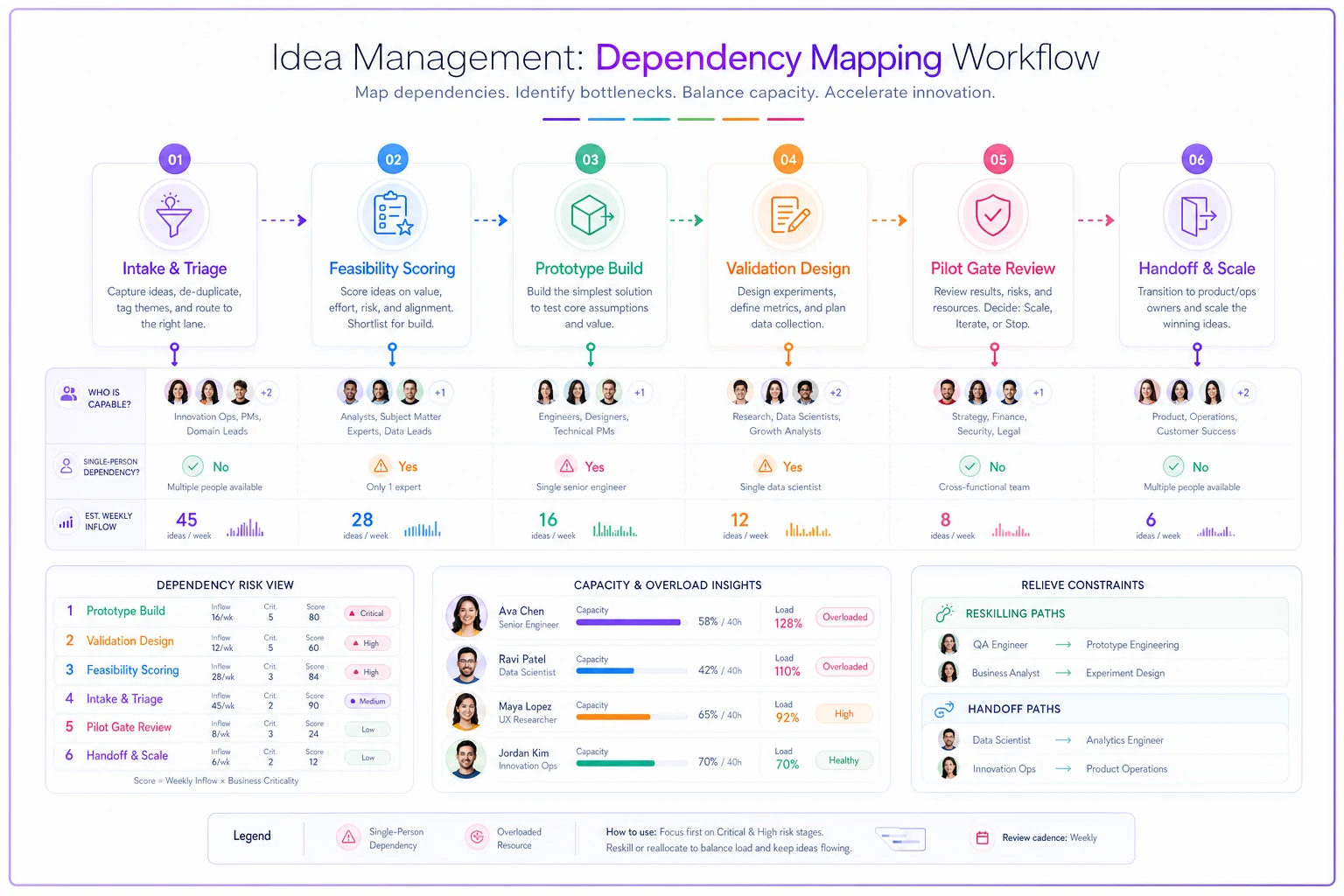
And once you can see them on paper, the next decision stops being a vibe and becomes obvious.
Internal mobility beats external hiring right now (and not just for budget reasons)
The reflex when hiring slows is to treat internal reskilling as the consolation prize. It isn't. For innovation work specifically, internal people bring something a new hire can't fake: context on your business units, your past experiments, and why the last three versions of a given idea died.
A new external evaluator takes, realistically, 8–12 weeks to calibrate to your rubric and your organization's risk tolerance. An internal person who already understands the business and just needs the evaluation mechanics can often be useful in 2–3 weeks. When the clock is the constraint, that gap matters a lot.
If you haven't, it's worth reading through our breakdown on fixing talent bottlenecks with role blueprints and internal service catalogs, because that blueprint structure is exactly what makes rapid reskilling possible instead of chaotic.
When internal mobility makes sense
-
You have people one skill-gap away from covering a bottleneck stage
-
The bottleneck is in judgment work (evaluation, triage) where context matters more than tooling
-
You can protect the borrowed person's original role temporarily
When it's a bad idea
-
The gap is deep technical skill that takes months, not weeks — don't reskill someone into a specialized engineering role under time pressure
-
You'd be stripping another critical function to patch yours
-
The "borrowed" person becomes a new single-person dependency somewhere else — you've just moved the fracture point
This is where having clear role definitions pays off. If you've already done the work of defining what each innovation role actually requires — the skills, the decision rights, the progression path — reskilling internally becomes a matter of matching gaps instead of inventing a job from scratch.
Rapid reskilling that actually sticks in weeks, not quarters
Most reskilling fails because it's treated like training — a course, a doc, a "shadow someone for a bit." That's too slow when you need coverage in a few weeks. The approach that works under time pressure is apprenticeship-on-live-work, structured tightly.
-
Week 1 They evaluate real submissions in parallel with your experienced evaluator. Both score independently, then compare and reconcile. The gap between their scores and the expert's is the whole lesson.
-
Week 2 They lead, the expert reviews and overrides only when needed. Track override rate. A dropping override rate is your readiness signal.
-
Week 3 They run solo on lower-stakes submissions; expert does spot-checks on a sample.
The mistake people make: they skip the parallel-scoring step because it "wastes" the expert's time doing double work. But that double work in week one is precisely what compresses the calibration timeline. Skip it and you get an evaluator who's confident and wrong — which is far more expensive than slow.
Tighten pilot gates to match your real delivery capacity
There's a quieter failure mode that doesn't get talked about enough. When hiring slows, teams often keep approving the same volume of pilots they did when they had buffer capacity. The approvals feel like progress. But if you can only deliver four pilots a quarter with your current people, approving eight doesn't double your output — it creates a pile of half-started experiments that make everyone feel behind.
The fix is unglamorous: your pilot gate should explicitly reference available delivery capacity, not just idea quality. A great idea you can't staff is a parked idea, and parked ideas rot. Four experiments run to completion beats eight limping to the 40% mark every time.
Practically, that means adding a single question to your gate review: "Who is delivering this, and are they already committed elsewhere?" If there's no clean answer, the idea goes to a holding queue — not killed, just honestly queued — rather than approved into a vacuum.
Rework intake triage to favor what you can actually build
The other adjustment is upstream. If your delivery capacity is constrained to existing skills, your intake triage should surface ideas that use those skills — at least temporarily.
This isn't about rejecting ambitious ideas. It's about sequencing. An idea requiring a capability you don't currently have and can't hire for is a longer-horizon bet. An idea that leans on skills already sitting in the room can move this quarter. During a tight period, weighting triage slightly toward the latter keeps the pipeline visibly moving, which matters a lot for program credibility and participation.
A simple way to operationalize this: tag incoming ideas with a rough "capability match" score — does delivering this require skills we have, skills we can reskill into quickly, or skills we'd need to hire? That third bucket doesn't get discarded. It gets a longer timeline and a note to revisit when hiring loosens.
A quick comparison of where to put your energy
The teams that handle a hiring slowdown well don't pick one of these.
| Response | Time to impact | Cost | Risk | Best when |
|---|---|---|---|---|
| External hire | 8–12+ weeks | High (and approvals may stall) | Approval risk, slow calibration | You have a genuine long-term skill gap and budget sign-off |
| Internal reskilling | 2–4 weeks | Low | Depleting another function | Bottleneck is judgment/context work |
| Tightening pilot gates | Immediate | None | Fewer pilots approved | You're approving more than you can deliver |
| Triage reweighting | 1–2 weeks | Low | Short-term bias toward safe ideas | Delivery is capability-constrained |
| Cross-training buffer | Ongoing | Medium | Requires expert time now | You have recurring single-person bottlenecks |
They run the first three almost simultaneously — reskill into the top bottleneck, tighten the gate so you stop over-committing, and reweight triage so the pipeline keeps moving while the reskilling matures.
A real scenario: a mid-market innovation team hitting a Q4 freeze
A corporate innovation group inside a mid-sized logistics company — small team, maybe seven people running ideation across three business units — went into Q4 with an approved plan to hire a second feasibility evaluator. The req got frozen in the general slowdown.
Before adjusting: one evaluator handling essentially all feasibility scoring, inflow of roughly 30–40 submissions a month, and a growing queue where ideas were sitting around 18 days just to get a first read. Pilot approvals had kept pace with prior quarters, so they had about nine pilots "in flight," of which maybe four were genuinely active and the rest were stalled.
-
Reskilled an existing operations analyst into feasibility evaluation using the parallel-scoring approach. By week three the analyst's override rate had dropped enough to run solo on standard submissions.
-
Tightened the pilot gate to require a named, available deliverer. Three of the stalled pilots went into a holding queue, which freed two people.
-
Reweighted triage to prioritize ideas matching current capabilities for the quarter.
The outcome wasn't dramatic in a press-release way, but it was real: first-read wait time dropped from roughly 18 days to under a week, the active-pilot count stabilized at five experiments that actually finished, and the stalled-pilot pile stopped growing. No new hire. The frozen req became almost irrelevant for the quarter.
Who should *not* do this
A few honest caveats, because this playbook isn't universal:
-
Teams with genuine deep-tech gaps. If your bottleneck is a specialized skill that takes months to build, reskilling under time pressure produces false confidence. Queue those experiments and wait for the hiring window to reopen.
-
Teams already running everyone at capacity. Cross-training requires slack from the expert. If your bottleneck person is at 110%, pulling them into teaching makes things worse before better. Relieve their load first — usually by tightening the gate — then reskill.
-
Programs without role clarity. If nobody can articulate what an evaluator actually does, you can't reskill into it cleanly. Fix the role definition first; reskilling without a target is just confusion with extra steps.
If your bottleneck is a specialized skill that takes months to build, reskilling under time pressure produces false confidence.
The underlying lesson
A hiring slowdown doesn't expose a shortage of talent. It exposes how dependent your throughput was on adding talent instead of organizing it. The teams that get quietly stronger during these periods are the ones that find out their pipeline was riding on two people, fix the concentration, and come out the other side less fragile than they went in.
The external hiring lever will loosen again — it always does. What you don't want is to spend the tight quarter approving work you can't deliver and waiting on reqs that aren't coming. Map your dependencies, reskill into the real bottleneck, and make your pilot gate tell the truth about capacity. That's the whole move.
Ready to transform your innovation process?
Join 2,000+ companies using GoIdeafy to unlock team creativity, prioritize impactful ideas, and accelerate growth.