

Most validation sprints die for the same boring reason: nobody agreed beforehand what "it worked" actually means. The team runs a week of activity, everyone feels busy, and then Friday's review turns into a debate about whether the signal was strong enough. Half the room wants to keep going because they're emotionally invested. The other half is bored and wants to move on. No one has a number.
That's the problem these three recipes fix. Each one is built for a team with no engineers — marketers, ops people, support staff, product managers who can't ship code. Each one runs in seven days. And each one has hard decision gates written before the sprint starts, so Friday's meeting is a five-minute check against a threshold, not a philosophical argument.
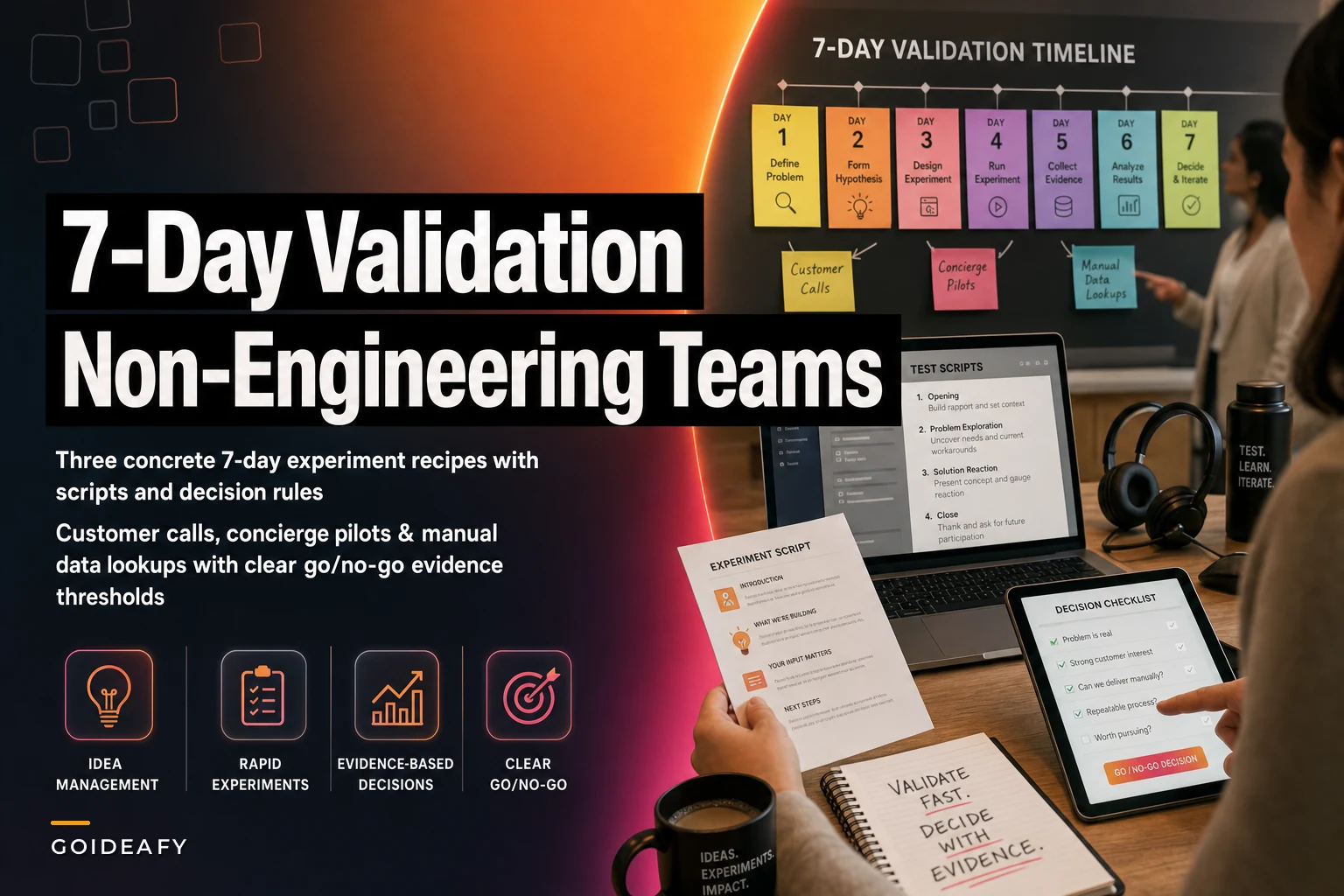
Three complete recipes: a customer-call validation, a concierge pilot, and a data-lookup / manual-back-end test. Scripts, day-by-day cadence, and the specific evidence thresholds for each. Use them as-is or steal the parts you need.
Why 7 days, and why non-technical teams keep getting this wrong
Seven days is long enough to reach real people and short enough that nobody can hide. The failure pattern isn't a lack of effort — it's a lack of pre-commitment. Teams treat validation like a demo instead of an experiment. They collect compliments instead of behavior.
A typical example: a team wants to test a new onboarding service. They spend the week showing mockups to friendly customers, everyone says "oh that's nice," and the team declares victory. Then they build it and adoption is flat. The problem was the evidence type. "That's nice" is an opinion. Opinions are free. What you needed was somebody agreeing to pay, schedule, or do the thing right now — and none of that was measured.
The other recurring mistake is running the test without a kill number. If you don't decide in advance that "fewer than 4 of 15 people commit means we stop," you will never stop. Loss aversion takes over. The week's effort becomes a reason to continue rather than evidence about whether you should.
So before any recipe: write your go/no-go thresholds on day zero and get one skeptical person to sign off on them. If you skip this, the rest of the recipe won't save you.
Recipe 1: The Customer-Call Validation (for demand & pricing signals)
Best for: testing whether a problem is painful enough that people will change behavior or pay to fix it.
Capture, evaluate, and act on ideas without friction.
GoIdeafy streamlines the entire innovation lifecycle from idea submission to implementation.
- Centralized idea capture
- Collaborative evaluation tools
- Progress tracking & analytics
No credit card required
This is the cheapest of the three and the one non-technical teams underuse because they think calls are "just research." Done right, a call isn't research — it's a demand test with a commitment ask at the end.
The 7-day cadence
| Day | Activity | Owner | Output |
|---|---|---|---|
| 0 | Write thresholds, build call list of 20–25 names | Lead | Signed-off go/no-go doc |
| 1 | Draft + rehearse script, book first 8 calls | 2 people | Calendar filled |
| 2–4 | Run 15+ calls (30 min each) | Whole team | Filled scorecards |
| 5 | Follow-up "commitment" emails to interested people | Lead | Reply tracking |
| 6 | Tally evidence against thresholds | Lead | Scorecard summary |
| 7 | Go/no-go review (30 min max) | Team + skeptic | Decision |
The call script (the part people get wrong)
The whole call hinges on separating what people say from what they'll do. Structure it like this:
-
Context, no pitch (2 min) "We're trying to understand how teams handle X right now. I'm not selling anything today."
-
The problem walk-through (10 min) Ask them to describe the last time they dealt with the problem. Force specifics: "When did that happen? What did it cost you? What did you do next?" You're listening for a real recent incident, not a hypothetical.
-
Current spend / workaround (5 min) "What are you using to deal with it now? What does that cost you in time or money?" If they have no workaround and no cost, the pain is probably weak.
-
The commitment ask (5 min) This is the gate. Not "would you use this?" but one of: - "If we had this ready next month, would you pilot it for $X?" - "Can I put you on a pre-access list — it's a $200 deposit, refundable?" - "Would you introduce me to whoever owns the budget for this?"
That last section is what makes it a validation, not a vibes-check. Anyone can say yes to a hypothetical. Fewer will say yes to a deposit, a calendar hold, or an intro to their boss.
Evidence thresholds (decide these on day zero)
-
Strong go ≥ 6 of 15 give a concrete commitment (deposit, signed intent, budget intro).
-
Weak / iterate 3–5 commit — signal exists but the segment or offer is off. Re-run with a tighter list.
-
No-go ≤ 2 commit, or most people can't recall a real recent incident of the problem.
One pattern worth calling out: if everyone is enthusiastic but nobody commits, that's not a mixed signal — that's a no. Enthusiasm with zero commitment is the most common false positive in the whole game.
Recipe 2: The Concierge Pilot (for "will the solution actually deliver value" signals)
Best for: when demand is plausible but you don't know if your solution actually produces the outcome. You deliver the service manually, by hand, pretending to be the product.
The magic of concierge pilots is that they need zero build. Your team becomes the back-end. If you can deliver the value manually to 5–8 customers and they come back for more, you've validated something a mockup never could.
How the workflow actually runs
Say you're testing a "monthly competitor-pricing report" for small e-commerce shops. Instead of building software, you do it by hand: someone pulls competitor prices, drops them in a spreadsheet, formats a one-page summary, and emails it. The customer never knows there's no product. They just get the value.
The whole point is to watch two things: do they use it, and do they ask for the next one? Usage and pull-through are behavior. Behavior beats opinion every time.
The 7-day cadence
-
Day 0 Recruit 5–8 pilot customers (usually from Recipe 1's "yes" pile). Write thresholds.
-
Day 1 Define the exact manual delivery steps. Assign who does what.
-
Days 2–3 Deliver the first round manually. Log time spent per customer.
-
Day 4 Deliberately go quiet — don't push. See who asks for more on their own.
-
Day 5 Deliver a second round only to those who engaged or requested it.
-
Day 6 Short feedback call with each participant + tally.
-
Day 7 Go/no-go.
The recruitment / delivery script
> "We're running a small pilot of [service]. For the next week I'll personally send you [the deliverable]. It's early, so I'd love your honest reaction — and if it's useful, tell me and I'll keep them coming. Totally free during the pilot."
That "tell me and I'll keep them coming" line matters. It puts the pull on them. A concierge pilot where you keep initiating tells you nothing. A concierge pilot where they chase you tells you everything.
Evidence thresholds
-
Strong go ≥ 60% of pilot customers actively request or engage with the second round without prompting.
-
Iterate 30–59% pull-through — the value is real for some. Figure out what separates the engaged group.
-
No-go < 30% engage a second time, or everyone accepts round one politely and then goes silent.
A real-world example: a small ops team ran a concierge pilot with 6 customers for a manual reporting service. Four opened round one within a day; only two actively asked for round two; one of those referred a colleague. That's borderline — roughly a third with genuine pull. They didn't kill it, but they narrowed the target segment hard before committing any build time. That's the correct read of a middling number: not a green light, not a funeral — a tighter re-run.
Budget for manual labor and cap participants at what your team can sustainably deliver.
One honest warning: concierge pilots are exhausting. Delivering manually to 8 people for a week is real labor. Budget for it, and don't scale the pilot past what your team can actually sustain, or you'll burn out mid-week and pollute your own data.
Recipe 3: The Data-Lookup / Manual Back-End Test (for feasibility signals)
Best for: validating whether the information or logic your idea depends on can even be produced reliably — before anyone builds a system to automate it.
A lot of ideas quietly depend on data that turns out to be messy, incomplete, or impossible to get consistently. This recipe surfaces that in a week, by having a human do the lookups by hand and tracking how often they can actually produce a correct, useful answer.
Why this one saves the most money
Teams routinely greenlight a build, spend two months on it, and then discover the underlying data is only reliable 60% of the time. The lookup test catches that before the spend. In practice, this usually happens when the data lives across three systems nobody fully controls, or depends on a partner feed that's inconsistent.
The workflow
A quick visual of the manual lookup workflow:
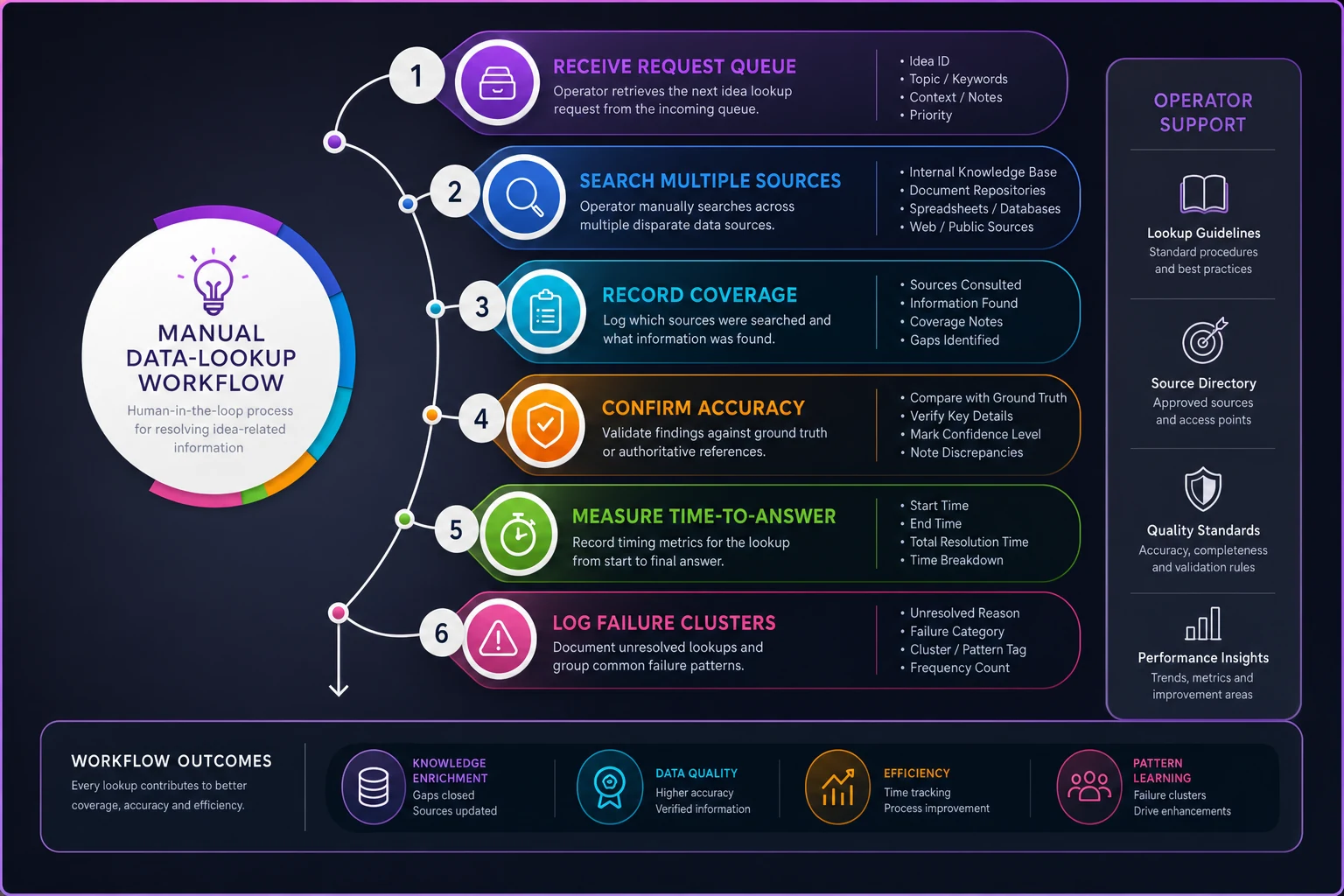
Pick 30–50 real, representative requests. Have a person answer each one manually using whatever sources exist. Track:
-
Coverage what % of requests you could answer at all
-
Accuracy of those answered, what % were correct on later verification
-
Time-to-answer how long each lookup actually took
-
Effort variance how wildly the time swung between easy and hard cases
The 7-day cadence
-
Day 0 Assemble 30–50 real request samples. Set thresholds.
-
Days 1–3 Answer each manually. Log source, time, and confidence.
-
Day 4 Verify a random sample of answers against ground truth.
-
Day 5 Analyze coverage, accuracy, time distribution.
-
Day 6 Identify failure clusters — which request types broke down?
-
Day 7 Go/no-go.
Evidence thresholds
-
Strong go ≥ 85% coverage and ≥ 90% accuracy on verified answers, with reasonable time-per-lookup.
-
Iterate coverage or accuracy in the 70–85% band — feasible but needs a narrower scope or a better source.
-
No-go coverage or accuracy below ~70%, or time-per-lookup so high and unpredictable it can't scale.
The insight most teams miss: average accuracy hides the failures that matter. If you're 90% accurate overall but 100% of your errors cluster in the highest-value request type, you don't have a 90% problem — you have a scope problem. Always break results down by request type before you trust the headline number.
Choosing the right recipe
Don't run all three at once, and don't default to whichever feels most comfortable. Match the recipe to the biggest unknown in your idea.
| Your biggest unknown | Use this recipe |
|---|---|
| "Does anyone actually want this / pay for this?" | Customer-Call Validation |
| "Even if they want it, does it deliver real value?" | Concierge Pilot |
| "Can we even produce the answer reliably?" | Data-Lookup Test |
A quick rule of thumb: if you're not sure which unknown is biggest, ask "what would embarrass us most three months from now?" If it's "we built something nobody wanted," start with calls. If it's "people wanted it but it didn't work," go concierge. If it's "the data was garbage," run the lookup test first.
When these recipes are a bad idea
Rapid validation isn't universal. A few honest cases where you should not run one of these:
-
When you already have the behavioral evidence. If existing customers are actively asking for the thing and telling you they'll pay, don't run a call sprint to re-confirm what you already know. Go build.
-
When the decision is reversible and cheap. If shipping the real thing costs less than running the validation, just ship it and watch. Validation exists to de-risk expensive commitments.
-
When leadership has already decided. If the outcome won't actually change the plan, you're doing theater. Skip it or be honest that it's a comms exercise, not a decision tool.
Who should not do this at all: teams that won't pre-commit to a kill threshold. If your organization can't stomach saying "no-go" after a week of work, these recipes will just generate expensive false confidence. The threshold discipline is the whole product. Without it you're just doing activity.
Making the Friday decision actually stick
The last mile is the review meeting, and it's where good sprints still fall apart. Keep it to 30 minutes. Open with the thresholds you wrote on day zero — read them out loud before showing results so nobody moves the goalposts after seeing the data. Then walk the evidence against them. Decision. Done.
Whatever you decide, capture it somewhere reusable so the next team doesn't repeat the same test blind. A clean handoff matters as much as the test itself — if you get a "go," the validated-idea handoff packet approach keeps the momentum from evaporating between validation and whoever builds the thing. And if you're wondering where these ideas should even come from in the first place, the lightweight funnel from suggestion box to pilot pairs naturally with these seven-day recipes — one feeds the pipeline, the other tests what's in it.
The teams that get real value from 7-day rapid validation without engineering support aren't the ones with the fanciest tests. They're the ones who decided what "yes" and "no" meant before they started, ran the smallest honest experiment they could, and had the discipline to actually kill the things that didn't clear the bar. Everything in these three recipes is downstream of that one habit.
Ready to transform your innovation process?
Join 2,000+ companies using GoIdeafy to unlock team creativity, prioritize impactful ideas, and accelerate growth.