

Vote gaming rarely shows up as one obvious cheat. It shows up as a slow tilt in the numbers that nobody can quite explain. The R&D team's idea keeps landing in the top three even when the write-up is thin. A quiet department suddenly produces 40% of the upvotes during a two-week campaign. A submission that had 12 votes on Friday afternoon has 90 by Monday morning, and half of them came from accounts that had never voted before.
The problem with internal voting is that everyone knows each other. That's the whole point of a collaborative program — but it's also the exact condition that makes gaming easy and detection awkward. People trade votes over lunch. Managers "encourage" their teams to support a pet idea. Someone spins up a shared login. None of it feels like fraud to the people doing it. It just feels like teamwork.
This post is a heuristics rulebook — not a philosophy piece about fairness, but a practical set of signals, thresholds, and staged remediation steps you can actually run against your voting data. The goal isn't to catch everyone. It's to keep the signal clean enough that winning ideas win because they're good, not because someone worked the system.
Why gaming happens in the first place (and why it's usually not malicious)
Before the heuristics, it helps to be honest about the incentive structure, because that's where all of this originates.
When votes are tied to visible outcomes — funding, recognition, a spot on the leadership dashboard — you've created a currency. And people optimize currencies. The moment an employee realizes that 50 votes gets their idea in front of the innovation council, the vote stops being a signal of quality and starts being a target. This is Goodhart's Law playing out in your ideation tool: when a measure becomes a target, it stops being a good measure.
-
Social coordination — "Hey, go vote for my idea, I'll vote for yours." Friendly, reciprocal, and completely corrosive to the data.
-
Hierarchical pressure — a manager nudges their reports to support something. Nobody says no to their boss.
-
Account manipulation — shared logins, dormant accounts reactivated to vote, or one person voting through multiple identities.
The reason this matters for detection: your heuristics need to distinguish enthusiasm from manipulation. A viral idea that legitimately excites 200 people looks statistically similar to a coordinated push, if you only count votes. The difference lives in the metadata — timing, account behavior, network patterns — not in the vote total itself.
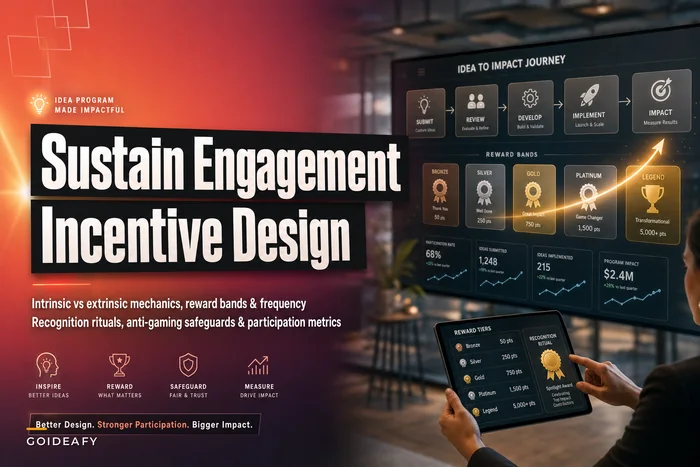
If your program is also fighting low engagement, the temptation to look the other way gets stronger, because any activity feels like good activity. That's a trap. Fixing participation the right way — through incentive and recognition designs that sustain engagement — is what makes anti-gaming controls sustainable. You can't police votes if you're desperate for them.
The heuristics rulebook
These are signals, not verdicts. A single flag means "look closer," not "punish someone." You want at least two or three signals firing together before you act.
Capture, evaluate, and act on ideas without friction.
GoIdeafy streamlines the entire innovation lifecycle from idea submission to implementation.
- Centralized idea capture
- Collaborative evaluation tools
- Progress tracking & analytics
No credit card required
1. Timing heuristics
-
Burst detection More than roughly 60% of an idea's votes arriving within a single 30-minute window, outside of any announced campaign event. Real interest trickles; coordinated pushes spike.
-
Off-hours clustering A block of votes at 2am from a normally 9-to-5 workforce. Not automatically bad — night-shift teams exist — but worth cross-referencing against the voters' usual activity.
-
Sequential timestamps Votes landing every few seconds in a tidy sequence. Humans browsing don't vote with metronome precision. This often means someone is voting through a list, or a script is.
2. Account anomaly heuristics
-
Dormant reactivation Accounts that haven't logged in for 90+ days suddenly appearing to vote on a single idea, then going quiet again.
-
Zero-context voters Accounts that only ever vote, never submit, never comment, never browse other ideas. Real participants leave a trail across the platform.
-
Same-device fingerprints Multiple "different" accounts voting from the same device or IP in quick succession. This is the strongest single signal of identity manipulation.
-
New-account surge A cluster of accounts created within days of a vote, all voting the same way. Rare in internal programs — people usually have existing SSO accounts — which is exactly why it's a loud flag when it happens.
3. Coordination / network heuristics
-
Reciprocity pairs Employee A votes for B's idea; B votes for A's idea; the timing is close. Two data points is noise. A cluster of ten reciprocal pairs all resolving within the same afternoon is a vote-trading ring.
-
Team-block voting A single team or reporting line supplying a disproportionate share of votes to one idea — say, 80% of an idea's support coming from one 12-person department. Usually hierarchical pressure rather than fraud, but it distorts outcomes just as much.
-
Copycat voting patterns A set of accounts that vote for the exact same slate of ideas in the same order. People with genuinely independent opinions diverge.
The signal-strength table
| Heuristic | Signal strength | Common false-positive cause | Default action |
|---|---|---|---|
| Same-device multiple accounts | Very high | Shared kiosk / hot-desk | Freeze votes, investigate |
| Sequential/scripted timestamps | High | Bulk import glitch | Quarantine, verify |
| Dormant account reactivation | Medium-high | Legit re-engagement campaign | Flag, monitor |
| Reciprocity pair clusters | Medium | Genuine collaborative teams | Review context |
| Team-block concentration | Medium | Idea genuinely relevant to one team | Weight-adjust, don't punish |
| Off-hours clustering | Low-medium | Night shift / global teams | Cross-reference only |
| Zero-context voters | Low | New but genuine participants | Watch, no action |
The point of the table is restraint. High-strength signals like same-device voting justify action on their own. Low-strength signals never do — they only matter stacked against something else.
The monitoring layer: what to actually watch
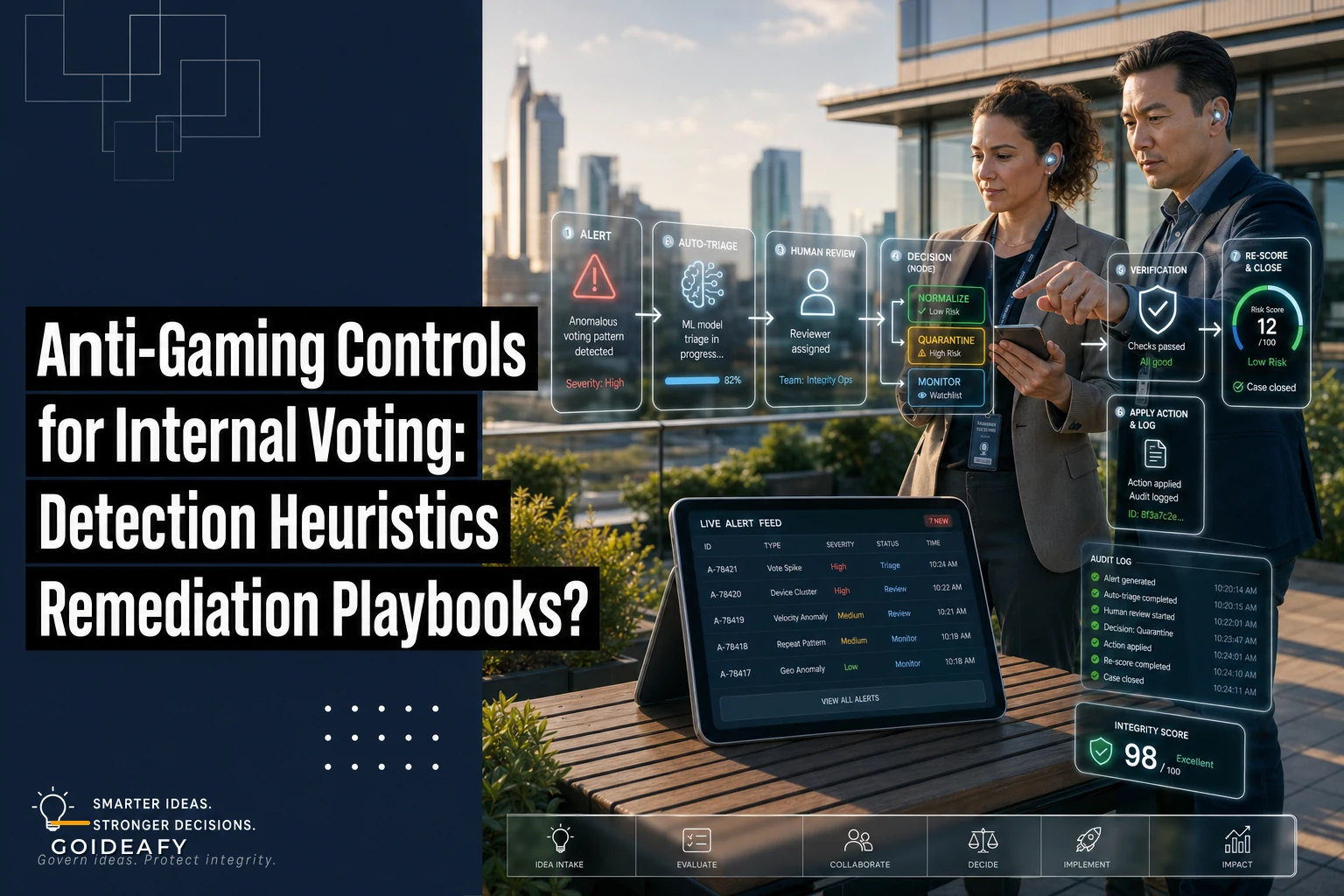
You can't run these heuristics manually on a program with any real volume. What works is a lightweight monitoring setup that runs checks continuously and only surfaces exceptions. Most modern idea-management and voting platforms can be configured to emit these alerts, and where they can't, a simple scheduled query against the vote log covers most of it.
A few example alerts worth wiring up:
-
ALERTVote velocity anomaly
— Idea #4471 received 74 votes in 22 minutes (baseline: ~5 votes/hour). Triggered burst-detection threshold. -
ALERTDevice collision
— 4 distinct accounts voted for Idea #4471 from device fingerprintd9f2…within 6 minutes. -
ALERTReciprocity cluster
— 8 mutual-vote pairs detected across submissions from Team Atlas within a 3-hour window. -
ALERTDormant reactivation
— 11 accounts inactive >90 days cast their only recent vote on Idea #4471.
Notice all four of those could point at the same idea. When multiple independent heuristics converge on one submission, your confidence goes way up. One alert is a maybe. Four alerts stacking on the same idea is a case.
The trick is calibrating thresholds to your own baseline. A 500-person company and a 5,000-person company have completely different "normal" vote velocities. Spend the first month collecting baselines before you turn on hard thresholds, or you'll drown in false positives and teach everyone to ignore the alerts.
Staged remediation playbooks
Detection without a graduated response is how programs blow up trust. If your only tool is "disqualify and accuse," you'll either overreact to innocent enthusiasm or avoid acting at all. Stage it.
Stage 1 — Silent monitoring
Something tripped a low or medium signal. You do nothing visible. You add the idea and the accounts to a watchlist and let more data accumulate. Most flags die here because they turn out to be benign — a team that genuinely cares about a relevant idea, a legitimate re-engagement push.
Stage 2 — Vote normalization
Two or more medium signals, or a confirmed team-block concentration. You don't remove anyone. You re-weight the affected votes so no single team or reciprocal cluster can dominate. For example, cap any single reporting line's contribution to an idea at a fixed percentage of total votes. This handles the most common real-world case — hierarchical pressure — without anyone getting called a cheater. It's the fairest, least dramatic fix, and it should be the default.
Stage 3 — Quarantine and verification
A high-strength signal fired — same-device voting, scripted timestamps. You freeze the flagged votes (not the whole idea) and quietly verify. That might mean checking with IT on the device fingerprint, or a low-key conversation with the account owner. Keep it factual: "We noticed several votes from a shared device — can you help us understand?" Often there's a boring explanation, like a shared conference-room laptop.
Stage 4 — Removal and program action
Only after verification confirms genuine manipulation. Remove the fraudulent votes, restore the idea's real ranking, and — importantly — communicate the rule, not the person. "Votes from shared logins are being removed and the affected submissions re-scored." No public shaming. The goal is deterrence and clean data, not a trial.
Here's the sequence as a runnable process:
-
Alert fires → logged to the anti-gaming queue with the triggering heuristic(s).
-
Auto-triage → single low-strength flag routes to Stage 1; multiple or high-strength flags escalate.
-
Human review → a designated moderator confirms the signal isn't an obvious false positive.
-
Choose stage → normalize (Stage 2), quarantine (Stage 3), or continue monitoring (Stage 1).
-
Verify if needed → factual, private outreach before any removal.
-
Apply action + log → record what was done and why, so decisions are auditable later.
-
Re-score and close → recompute rankings, update the leaderboard, archive the case.
That audit log in step 6 matters more than people expect. The first time someone contests a decision — and someone will — being able to show exactly which signals fired and what you did is the difference between a defensible process and a political mess.
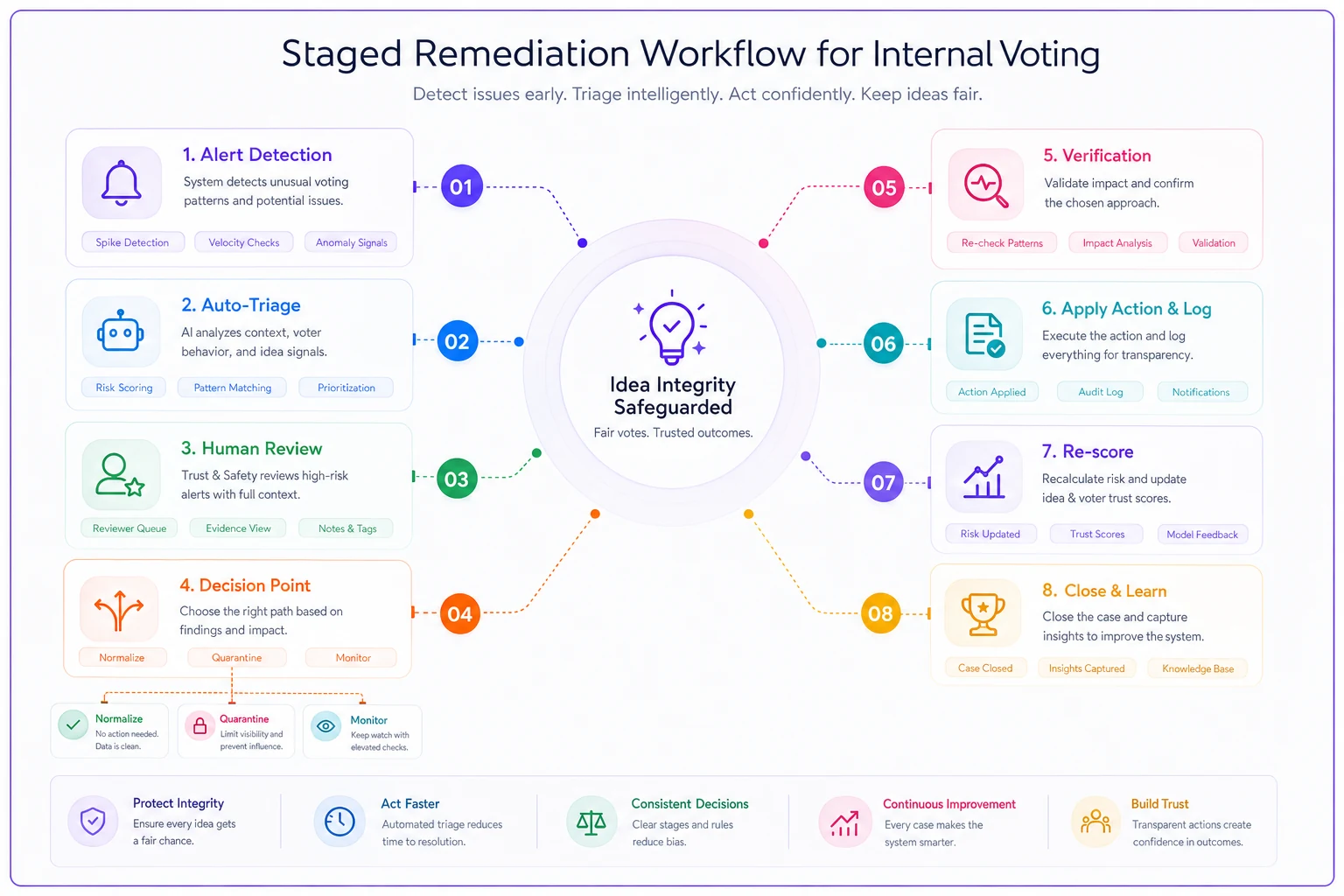
A simple visual of the stages helps align moderators and stakeholders on the expected flow and audit points.
A real scenario
A mid-sized software company — roughly 1,800 employees — ran quarterly innovation campaigns where the top-voted ideas got a small pilot budget, somewhere around $10k each. Engagement looked healthy on paper: a few thousand votes per cycle.
The problem surfaced when the same three or four teams kept winning, quarter after quarter, regardless of idea quality. Facilitators had a gut feeling something was off but no data to back it up. When they finally pulled the vote logs and ran basic heuristics, the pattern was ugly: one team was generating close to 35% of its idea's votes from within its own reporting line, all clustered in the final 48 hours before voting closed. Another had a tight reciprocity ring — about a dozen people reliably voting for each other's submissions every cycle.
Nobody thought they were doing anything wrong. It was just how the game had evolved. But newer employees had quietly stopped submitting, because "you had to be in the right clique to win."
They didn't nuke anyone. They introduced Stage 2 normalization — capping any single team's contribution to an idea at 20% of its votes — and turned on burst and reciprocity alerts for future cycles. The next campaign, the winning ideas shifted noticeably. Two submissions from teams that had never placed before made the top five. Submission volume from outside the usual clusters climbed by something like a third over the following two quarters. Nobody was punished, and the leaderboard finally meant something again.
When to actually invest in this — and when not to
This makes sense when:
-
Votes are tied to real stakes — budget, recognition, visibility.
-
You have enough volume that patterns are statistically meaningful (a few hundred votes per cycle minimum).
-
You've already seen the same names or teams winning suspiciously often.
This is a bad idea when:
-
Your program is brand new and you're still fighting for any participation at all. Policing an empty room signals distrust and kills fragile momentum. Fix engagement first.
-
Votes are purely advisory and don't drive resource decisions. If nothing is at stake, nobody games it.
Who should skip this entirely: small teams — say under 50 people — where everyone can see everyone's submissions anyway. At that scale, transparency and a facilitator judgment call beat any algorithm. Heuristics are for the size where you can't eyeball it.
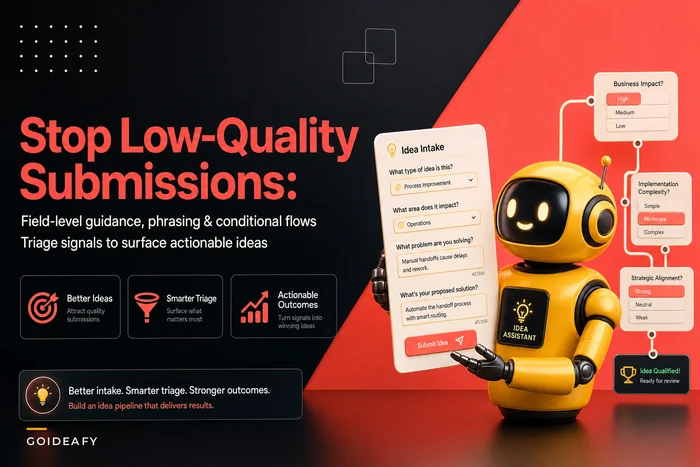
One more thing worth saying: gaming is often a symptom, not the disease. If people are trading votes, it's frequently because idea quality is low enough that social capital matters more than merit. Tightening the front door with better intake fields and triage signals that surface genuinely actionable ideas reduces the incentive to game, because strong ideas stop needing a vote-trading boost to stand out.
The mindset that keeps this working
Teams that handle vote integrity well share one trait: they treat detection as maintenance, not enforcement. They're not on a hunt. They're keeping the measurement instrument calibrated.
That framing changes how you run it. You default to normalization over removal. You communicate rules, not accusations. You assume good faith until the metadata says otherwise, and even then you verify before acting. Handled that way, anti-gaming controls don't make people feel surveilled — they make the winners feel legitimate, and the losers feel like they lost fairly.
Start with the baselines. Wire up two or three of the highest-strength alerts. Stage your responses so the default is gentle. And keep the audit log honest, because sooner or later you'll need to prove your process was fair — probably to the exact person who was gaming it.
Ready to transform your innovation process?
Join 2,000+ companies using GoIdeafy to unlock team creativity, prioritize impactful ideas, and accelerate growth.