

Your product team launches a customer co-creation program. Marketing loves it. Sales promises it'll boost retention. Three months later, legal is freaking out about IP ownership, your backlog is drowning in poorly-scoped submissions, and engineers refuse to look at anything coming from external sources.
This happens to about 70% of customer co-creation initiatives. Not because the concept is flawed, but because teams skip the boring operational groundwork that makes these programs actually function.
The IP ownership mess nobody warns you about
A fintech startup I worked with learned this lesson the expensive way. They invited their top 50 enterprise clients to submit feature ideas through a simple portal. No consent forms, no IP transfer language, just "tell us what you want to see."
Six months later, a client sued them for implementing "their" idea without compensation. The client had submitted a workflow optimization concept that the product team had actually been developing internally for months. But without proper intake documentation showing the company already had this in development, and without clear IP assignment language, they ended up in a $400k settlement.
The real kicker? Their legal team had warned them about this exact scenario. Product leadership thought they were being overly cautious.
Most teams miss about customer co-creation IP protection that you need three distinct layers of consent and documentation, not just a basic submission agreement.
First, the pre-submission disclosure. Before customers even see your submission portal, they need to acknowledge that your company might already be developing similar features. This isn't just legal protection—it sets realistic expectations about what co-creation actually means.
Second, the submission itself needs explicit IP transfer language. Not "we might use your idea" but actual assignment of rights. Your legal team needs specific language here based on your jurisdiction, but the key components stay consistent: full transfer of rights, no expectation of compensation, no ongoing ownership claims.
Third, and this is where most programs fail, you need a parallel documentation system showing your internal development timeline. When a customer submits an idea for automated reconciliation and you've had that on your roadmap for eight months, you better have timestamped evidence of those internal discussions.
Why your triage thresholds are probably wrong
Most customer co-creation programs set up basic triage rules: business value, technical feasibility, strategic alignment. Then they wonder why 90% of submissions get stuck in evaluation limbo.
Capture, evaluate, and act on ideas without friction.
GoIdeafy streamlines the entire innovation lifecycle from idea submission to implementation.
- Centralized idea capture
- Collaborative evaluation tools
- Progress tracking & analytics
No credit card required
The problem isn't the criteria. It's the thresholds.
A B2B software company running a customer co-creation playbook had what looked like solid triage rules. Any submission needed to hit minimum scores across five dimensions before moving to product review. Sounds reasonable, except they set those thresholds based on internal feature proposals, not external submissions.
External submissions operate on completely different quality curves. A customer describing a workflow problem won't articulate it the same way your product manager would. They're solving their specific pain point, not thinking about platform architecture or scalability.
Your triage thresholds need two separate tracks. Internal proposals might need 7/10 technical clarity to advance. External submissions should move forward at 4/10 if the problem statement is clear, even if the proposed solution is technically nonsensical.
Here's a threshold framework that actually works for external submissions:
| Criteria | Internal Threshold | External Threshold | Why Different |
|---|---|---|---|
| Problem Clarity | 8/10 | 9/10 | Customers excel at describing pain |
| Solution Viability | 8/10 | 3/10 | Their solutions often miss constraints |
| Business Case | 7/10 | 5/10 | They know their needs, not market size |
| Technical Spec | 6/10 | 2/10 | Don't expect architecture knowledge |
| Strategic Fit | 8/10 | 6/10 | They see tactics, not strategy |
The external track focuses heavily on problem validation while being lenient on solution quality. You're mining for problems worth solving, not fully-formed features.
Pro-tip: Maintain separate scoring templates for internal and external submissions to avoid conflating expectations.
The external track focuses heavily on problem validation while being lenient on solution quality. You're mining for problems worth solving, not fully-formed features.
Integration patterns that prevent backlog contamination
You've got clean IP agreements and smart triage thresholds. Now you need to get these external ideas into your development process without destroying your existing backlog hygiene.
The worst approach, which about half of teams default to, is dumping external submissions directly into your main product backlog. Within weeks, your carefully groomed backlog becomes a graveyard of half-baked customer requests that nobody wants to own.
The second-worst approach is keeping them completely separate. Now you're running parallel planning processes, duplicating evaluation work, and missing obvious connections between internal initiatives and customer needs.
The integration pattern that works requires a three-stage buffer system.
Stage one is the raw submission buffer. Everything lands here first, regardless of quality. This isn't even in your product management tools yet—it's in whatever system handles the initial intake. Could be a form database, could be a dedicated co-creation platform. Keep the noise away from your working backlog.
Stage two is the evaluation queue. Submissions that pass initial triage move here for deeper analysis. This lives in your product management system but in a clearly separated space. Not a different project, but maybe a dedicated epic or a special tag that keeps these items visually distinct.
Stage three is where things get interesting: the integration checkpoint. Every sprint or cycle, you explicitly review evaluation queue items against your current roadmap initiatives. Instead of treating external submissions as standalone items, you're looking for three specific integration patterns:
Visualizing the three-stage buffer helps teams map submissions into the workflow.
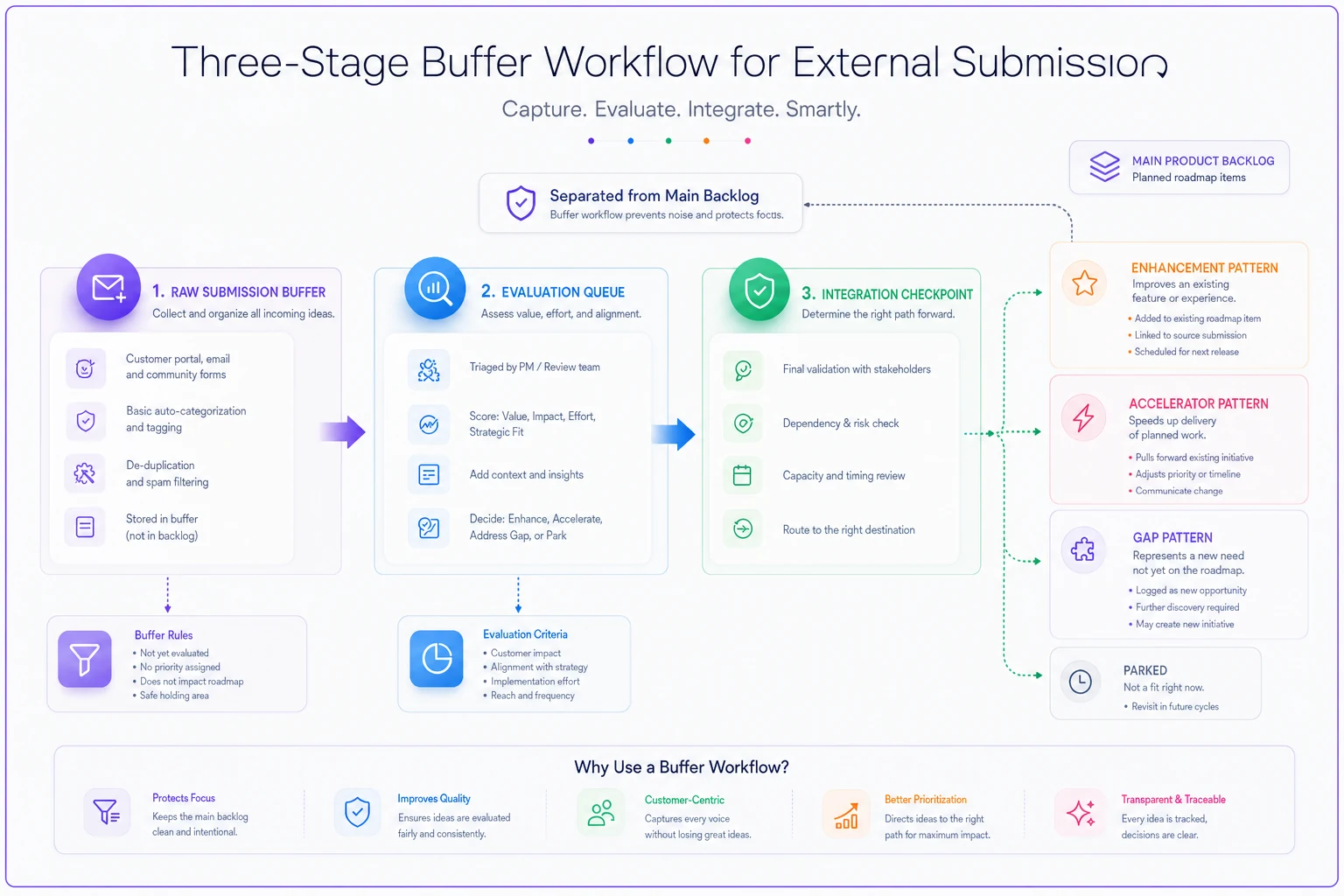
Enhancement Pattern: The submission describes a problem you're already solving but highlights an edge case or user segment you missed. These get absorbed into existing initiatives as acceptance criteria or user stories.
Accelerator Pattern: The submission validates something on your future roadmap. These don't become new items—they become evidence that helps prioritize existing roadmap items sooner.
Gap Pattern: The submission identifies a genuine blind spot that requires new roadmap consideration. These are rare, maybe 5-10% of quality submissions, but they're gold when you find them.
A marketplace platform I helped set up used this exact pattern. They processed around 200 customer submissions monthly. Only 8-12 became gap pattern items that warranted new backlog entries. Another 40-50 became enhancements to existing work. The rest either validated current priorities or got archived as "interesting but not now."
Without this buffer system, all 200 would have polluted their backlog. With it, they maintained backlog hygiene while still capturing customer insights.
The consent ladder most programs skip
Legal consent isn't binary. You don't just get blanket permission to use customer ideas however you want. Smart customer co-creation programs build a consent ladder that matches different levels of customer involvement with appropriate legal coverage.
Level 1: Passive submission consent. Customer shares an idea with no expectation of involvement. This needs basic IP transfer but nothing elaborate.
Level 2: Active feedback consent. Customer agrees to provide feedback on prototypes or designs related to their submission. Now you need consent for ongoing communication and possibly NDA coverage if you're sharing unreleased features.
Level 3: Co-development consent. Customer becomes an active participant in building the solution. This requires more complex agreements covering everything from attribution rights to prototype testing liability.
Level 4: Reference consent. Customer agrees to be a public reference for the feature they helped create. This needs separate marketing and PR consent beyond just product development rights.
Most programs try to jump straight to Level 4, asking customers for full co-development partnership and reference rights in the initial agreement. That's like asking someone to move in together on the first date.
Start every customer at Level 1. Build the higher levels of consent only when both parties see value in deeper collaboration. A productivity software company learned this after their first co-creation attempt crashed when they asked 100 customers for Level 4 consent upfront. Only three agreed. When they rebuilt with a consent ladder, they got 78 Level 1 participants, with 12 naturally progressing to Level 4 over six months.
Your privacy language is probably inadequate
Standard privacy policies don't cover customer co-creation scenarios. You're not just collecting data; you're collecting intellectual property, competitive insights, and often detailed workflow information that might include their customers' data patterns.
Data retention rights: How long can you keep their submission after you've decided not to implement it? Standard privacy policies talk about personal data retention, not idea retention.
Derivative works: If you build something inspired by but different from their submission, what are your obligations? Most privacy policies don't address derivative intellectual property.
Competitive disclosure: If a customer submits an idea that you later see from a competitor, what can you share? Your standard privacy policy probably doesn't cover competitive intelligence scenarios.
Multi-tenant implications: If Customer A's submission would affect Customer B's experience, what are your disclosure obligations? Standard privacy language rarely addresses feature impact transparency.
"Submissions and any related information may be retained indefinitely for product development purposes, even if not implemented. We may develop similar or related features independently or based on multiple sources, including but not limited to your submission. No submission creates any obligation for feature development, timeline commitment, or progress disclosure. Features developed from submissions may be made available to all customers without attribution or compensation."
That's harsh but necessary. Soften it with a separate "how we handle your ideas" document that explains your ethical approach beyond just legal minimums.
The operational burden everyone underestimates
Running a customer co-creation program isn't a part-time job for your product team. The operational overhead is roughly 3-4 hours per week per 50 active submissions in your pipeline.
That includes:
-
Initial intake and categorization
15 minutes per submission
-
IP and consent verification
10 minutes per submission
-
Triage evaluation
20 minutes per submission
-
Integration checkpoint review
30 minutes per 10 submissions
-
Customer communication
10 minutes per submission
-
Legal and compliance checks
5 minutes per submission
For a program handling 200 submissions monthly, that's basically a half-time role just for operations, not counting actual evaluation and implementation work.
Teams that don't budget for this operational overhead end up with one of two failures. Either submissions pile up unreviewed, destroying customer trust, or they rush through intake without proper documentation, creating legal and technical debt.
The fix isn't hiring more people. It's building operational workflows that reduce the per-submission overhead through intelligent automation and clear process definition.
An industrial equipment manufacturer cut their per-submission processing time from 70 minutes to 22 minutes by implementing structured intake forms that automatically categorized submissions, templated legal responses that covered 80% of scenarios, and automated initial triage scoring based on keyword matching and submission patterns.
When to reject the entire co-creation model
Sometimes the best customer co-creation playbook is not having one at all.
If you're in a highly regulated industry where customer suggestions could create compliance complications, skip it. A healthcare platform learned this after realizing that implementing customer-suggested features could inadvertently violate HIPAA if customers didn't fully understand regulatory constraints.
If your competitive advantage comes from unique insights customers don't have, co-creation can actually hurt. A predictive analytics company found that customer suggestions consistently pushed them toward more obvious features, diluting their differentiation.
If you're resource-constrained and choosing between customer co-creation and improving your existing idea funnel, fix your internal process first. External submissions add complexity to an already complex process.
The integration sweet spot
The most successful customer co-creation programs find their sweet spot in the integration pattern. They don't treat external submissions as sacred or special. They treat them as one input among many, with clear operational rules about how that input flows through their existing development machinery.
A project management software company nailed this balance. They process about 150 customer submissions monthly, but only 20-30 ever become visible in their product planning discussions. The rest either validate existing plans, highlight edge cases in current development, or get filed as "future consideration" with clear criteria for resurrection.
Their secret? They built their customer co-creation playbook on top of their existing operational foundation, not as a replacement for it. The intake forms, consent frameworks, and triage thresholds all connect to their standard product development workflow. They're not running two systems; they're running one system with a carefully managed external input stream.
That's the difference between customer co-creation that works and co-creation that becomes an operational nightmare. The programs that succeed don't treat external submissions as special snowflakes requiring unique processes. They build robust intake operations that transform messy external input into clean internal work items.
Your customer co-creation playbook shouldn't be a revolutionary new process. It should be a set of operational rules that let external ideas flow through your existing machinery without gumming up the works. Focus on the boring stuff—consent forms, IP assignments, triage thresholds, integration patterns—and the exciting innovations will follow.
Teams that skip this operational foundation always end up in the same place: overwhelmed by submissions they can't process, exposed to legal risks they didn't anticipate, and struggling to extract value from customer insights buried in operational chaos.
Build the operational foundation first. The innovation comes easier when you're not drowning in process debt.
Ready to transform your innovation process?
Join 2,000+ companies using GoIdeafy to unlock team creativity, prioritize impactful ideas, and accelerate growth.