

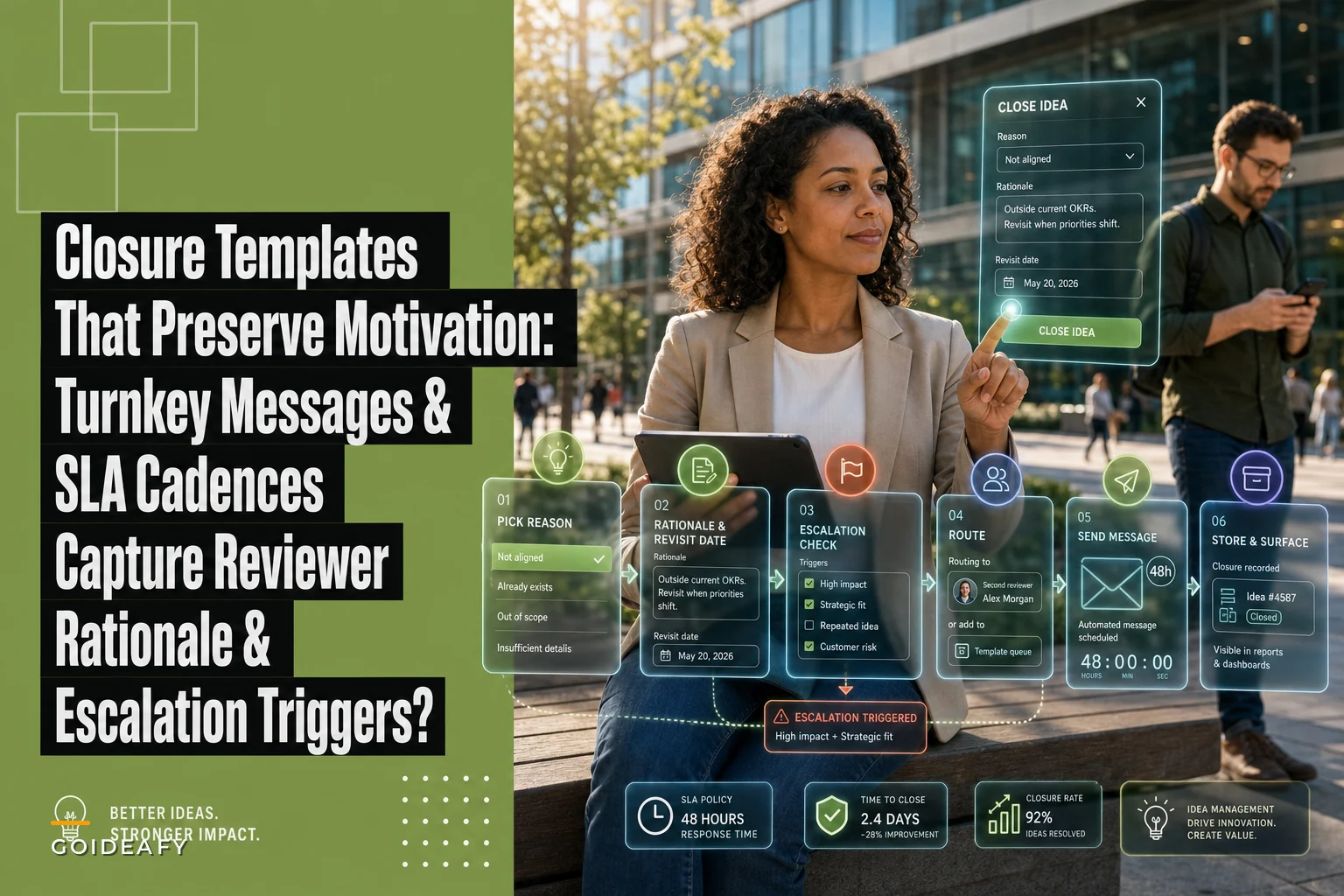

Closing an idea is the one moment in your program where you can do the most damage with the least effort. A badly worded rejection reaches the submitter, not just the evaluator. It gets screenshotted. It gets talked about in Slack. And unlike a score buried in a spreadsheet, a closure message is the thing a person actually reads and remembers.
Most innovation teams spend enormous energy on intake and triage, then close ideas with a single line: "Thanks for your submission, we've decided not to proceed at this time." That sentence does two terrible things at once. It tells the submitter nothing useful, and it tells your future self nothing either. Six months later when a similar idea shows up, nobody can reconstruct why the first one died.
This post is about fixing that specific gap — the closure layer — with ready-to-run messages mapped to triage outcomes, SLA cadences so closures actually happen on time, escalation triggers for the edge cases, and reviewer fields that force people to write down why so the reasoning survives.
The closure moment is where motivation quietly dies
There's a pattern worth naming. Participation in idea programs rarely collapses because of a single dramatic event. It erodes. And one of the biggest erosion sources is the closure experience.
Think about what the submitter sees. They spent 40 minutes writing up an idea. Maybe they pulled a colleague into it. They hit submit, waited three weeks hearing nothing, and then got a templated "no" with zero reasoning. The message they take away isn't "this idea wasn't right." It's "nobody actually read it, and this whole thing is theater."
Multiply that across a few dozen people and you get the slow decline most programs eventually fight. We've written separately about the engagement side of this in Fix Falling Participation: Incentive and Recognition Designs That Sustain Idea Program Engagement, but recognition schemes can't save you if the closure experience is actively insulting people.
The strange part is that a good closure can be more motivating than a maybe. "We're not funding this, and here's the specific reason, and here's the one thing that would change our mind" tells the submitter they were taken seriously. People can handle a no. What they can't handle is a no that feels like a dismissal.
Map messages to triage outcomes, not to a generic "yes/no"
The core mistake in closure templates is treating "rejected" as one outcome. In reality, ideas get closed for very different reasons, and each reason deserves a different message and a different next step.
Capture, evaluate, and act on ideas without friction.
GoIdeafy streamlines the entire innovation lifecycle from idea submission to implementation.
- Centralized idea capture
- Collaborative evaluation tools
- Progress tracking & analytics
No credit card required
| Triage outcome | What really happened | What the message must say | Door left open? |
|---|---|---|---|
| Duplicate | Already exists in backlog or shipped | Point to the existing item, credit the overlap | Yes — invite them to join it |
| Out of scope | Good idea, wrong program/owner | Redirect to the right team, name a person | Yes — warm handoff |
| Not now / timing | Valid but blocked by capacity or sequencing | Explain the blocker, give a revisit date | Yes — explicit revisit |
| Insufficient evidence | Can't evaluate as written | Say exactly what's missing | Yes — resubmit path |
| Declined on merit | Evaluated, didn't clear the bar | Give the specific reason, acknowledge effort | Rarely |
| Superseded | A better version won | Credit them, show what won | Yes — contributor role |
The single most important column is the last one. A "duplicate" closure that just says "this already exists" feels like a loss. A duplicate closure that says "someone's already working on this — want to join them?" turns a dead end into a connection. Same underlying fact, completely different human outcome.
A quick note on the "declined on merit" row: this is the only one where the door usually stays closed, and it's also the one people write the laziest messages for. That's backwards. The merit decline is where you most need specificity, because that's the submitter most likely to feel judged.
Ready-to-run closure messages
Here are starter templates for the categories above. The point isn't to copy them verbatim — it's to show the structure: acknowledge, explain, redirect or close, and keep it human.
Duplicate
> Hi [name] — this overlaps closely with [existing idea + link], which [owner] is already moving forward. Your framing on [specific angle] was sharper than the original, though. Want me to connect you two? There's real value in you being part of it.
Out of scope
> Thanks for this. It's a solid idea, but it sits better with [team] than with our program — we focus on [scope]. I've flagged it to [person] and cc'd you. Not a dead end, just a different door.
Not now / timing
> We like this and it's staying in the backlog, but we can't resource it this quarter because [specific blocker — e.g., the data platform migration]. I've tagged it for revisit in [month]. I'll ping you then.
Insufficient evidence
> We couldn't fully evaluate this yet. The gap is [specific missing piece — e.g., who the primary user is, or rough cost]. If you can add that, resubmit and it goes straight back into review — no re-queue.
Declined on merit
> We took this through full review and decided not to proceed. The main reason was [specific — e.g., the projected lift didn't justify the integration cost]. That's not a reflection on the thinking behind it — the [specific strength] was genuinely good. Thank you for putting it in.
Notice what every one of these does: it names something specific. The bracketed specifics are the entire value. A template with no specifics filled in is just a form letter with better grammar.
SLA cadences: closure has to happen on a clock
The second failure mode is timing. Ideas don't get rejected — they get forgotten. They sit in "under review" for two months because nobody owns the clock, and then the closure, whenever it finally comes, lands with a dead thud because the submitter already assumed the answer.
-
Acknowledgment within 2 business days of submission. Automated is fine here — the goal is just "we got it, here's what happens next and roughly when."
-
First triage decision within 7–10 business days. This is the decision, not necessarily the message.
-
Closure message sent within 2 business days of the decision. This is the one everyone forgets.
-
Timing-based revisit on the date promised, no exceptions. A broken revisit promise is worse than never making one.
The gap between "decision made" and "message sent" is where most programs leak trust. The decision exists in someone's head or in a spreadsheet cell, but the human on the other end hears nothing. Collapsing that gap to 48 hours is the single highest-leverage change most programs can make.
Collapsing that gap to 48 hours is the single highest-leverage change most programs can make.
If you're running high volume, the operational mechanics of keeping closures moving tie directly into shift and triage ownership, which we covered in the Moderator & Curator Playbook for High-Volume Idea Streams: Shift Rotas, Triage SOPs and Automation Handoffs. Closure SLAs only hold if someone's shift explicitly owns them.
Escalation triggers: the edge cases that need a human before closure
Not every idea should be closed by whoever happens to be on triage. Some closures carry risk — of demotivating a key contributor, of killing something strategically relevant, or of a reputational blowup if the submitter is senior or vocal.
-
High-engagement idea. If it drew significant internal votes or comments, a quiet close will be noticed publicly. Escalate.
-
Repeat submitter about to get their third "no." A pattern worth catching — this person is one closure away from checking out of the program entirely.
-
Senior or cross-functional submitter. Not because they deserve special treatment, but because the closure will travel further.
-
Close reason = "not now" with no revisit date. That's a soft "no" pretending to be a "maybe." Force a real date or a real decline.
-
Low reviewer confidence. If the evaluator flags uncertainty, don't let a shaky "no" go out unchecked.
The goal of escalation isn't to slow everything down. It's to make sure the 5–10% of closures that actually carry weight get a second set of eyes, while the routine 90% flow through on the SLA clock.
The reviewer field that saves you six months from now
Here's the part almost everyone skips: capturing why in a structured way, at the moment of closure, so it's reusable later.
When a reviewer closes an idea, the close itself should require a few short fields — not an essay, just enough signal:
-
Close reason (pick from the categories above — not free text)
-
Primary rationale (one or two sentences
the actual reason)
-
What would change the answer (optional, but gold when present)
-
Related existing idea (link, if duplicate or superseded)
-
Revisit date (required if reason = "not now")
The difference this makes shows up later. When a near-identical idea arrives, the reviewer can pull up the prior closure and see not just that it was declined, but why, and whether the blocker still applies. That's the entire difference between "we rejected this before, next" and "we rejected this before because of X, and X is now resolved — let's reopen it."
Without these fields, institutional memory lives in whoever happened to be in the room. People leave. Memory leaves with them. You end up re-litigating the same ideas every year, which is exactly the kind of waste nobody budgets for because it's invisible.
A short workflow for how it fits together
Idea gets closed → reviewer picks a close reason → required fields capture rationale and (if applicable) revisit date → system checks escalation triggers → if triggered, routes to second reviewer; if not, queues the matching closure template → reviewer personalizes the bracketed specifics → message sends within the 48-hour window → closure reason and rationale are stored, searchable, and surfaced automatically when similar ideas appear.
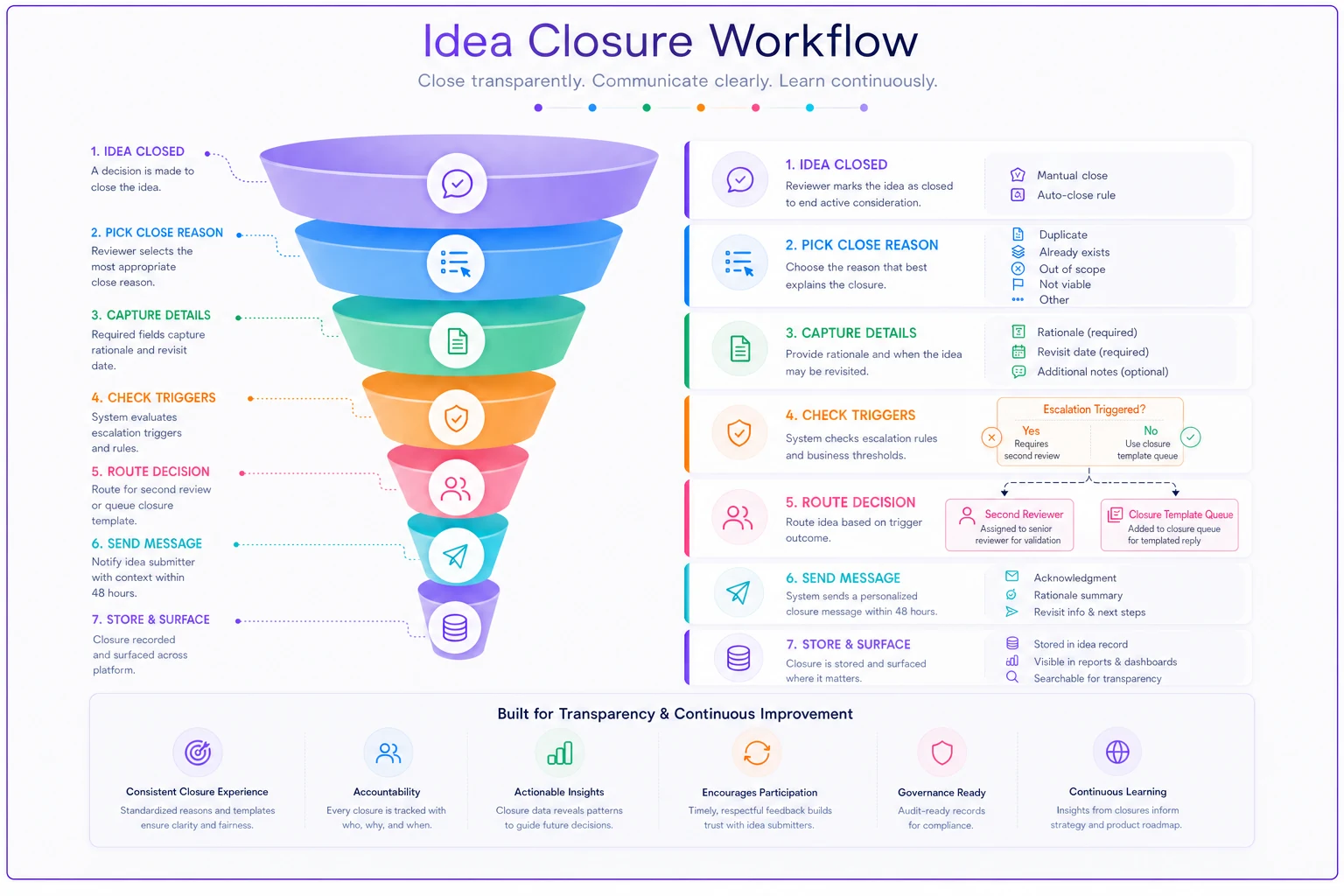
The reasoning capture is the quiet hero here. The templates make closures kind. The fields make them useful.
A realistic before/after
A mid-sized logistics company ran an internal idea program with around 400 submissions a year across a few business units. Their closure process was a single generic rejection line, sent whenever someone remembered, often weeks after the decision.
The symptoms were predictable. Repeat submissions of ideas that had already been declined — the team estimated roughly a quarter of "new" ideas were variations on things already closed. Participation among second-time submitters had dropped off noticeably. And nobody could explain why specific ideas had been killed, because the reasoning never got written down.
They changed three things: category-mapped closure messages, a hard 48-hour window between decision and message, and five required reviewer fields at close. Nothing fancy.
Within a couple of quarters, duplicate re-submissions fell to a much smaller share because reviewers could point people to the prior decision and its reasoning. Second-submitter drop-off eased — people who got specific, redirecting closures came back. And the "not now" pile stopped being a graveyard, because every one of them now carried a real revisit date that someone actually honored. No dramatic revenue number here — the win was quieter: the program stopped feeling like a black hole.
When this is overkill
This full setup — categories, SLAs, escalation, reviewer fields — is justified when you're handling enough volume that closures are getting dropped or genericized. Roughly speaking, once you're past a hundred-ish ideas a year across multiple reviewers, the informal approach starts breaking down.
When to keep it lighter: a small team closing a handful of ideas a month, where everyone knows everyone, probably doesn't need escalation triggers. A good set of templates and the habit of writing down why is enough. Don't build governance for volume you don't have.
Who should not bother with the reviewer fields: nobody, honestly. Even a two-person program benefits from writing down the close reason. It's the lowest-cost, highest-return part of this whole thing, and the one people most reliably skip.
The quiet point
Closure is usually treated as the end of the process — the part that happens after the interesting work. But it's the part your submitters judge the program on, and it's the part your future reviewers depend on. A closed idea that was handled well leaves a person willing to submit again and a record someone can learn from. A closed idea handled badly leaves a quietly disengaged employee and a decision nobody can reconstruct.
Templates mapped to real triage outcomes, a clock that forces timely closure, escalation for the cases that matter, and a few required fields that capture reasoning — that's the whole kit. None of it is complicated. It just has to actually get done, every time, which is exactly why putting it on rails matters more than making it clever.
Ready to transform your innovation process?
Join 2,000+ companies using GoIdeafy to unlock team creativity, prioritize impactful ideas, and accelerate growth.