



The programs that fall apart aren't the ones with too few ideas. They're the ones where 400 submissions land in a quarter and two moderators try to handle them on top of their day jobs. By week three, the queue has a backlog nobody wants to open. By week six, contributors stop submitting because their last three ideas got a canned "thanks, we'll review this" and nothing else.
This is a staffing and workflow problem disguised as an engagement problem. If you've already fixed intake quality and you're still choking on throughput, the fix isn't better forms — it's a moderation operation that runs on defined shifts, clear triage rules, and a handful of decisions that automation can take off the moderators' plate.
This piece is narrow on purpose. It's about the operational mechanics of moderating a high-volume idea stream. Not governance, not scoring models — just the day-to-day of who reviews what, when, and how.
The failure mode nobody names: moderation as a side hustle
Most idea programs staff moderation the same way: pick one enthusiastic innovation lead, maybe a second, and tell them to "keep an eye on the queue." That works fine at 30 submissions a month. It collapses somewhere between 120 and 200.
When moderation is unscheduled, people do it in the gaps — a few minutes between meetings, sometimes at the end of the day. Ideas get read but not actioned. A submission gets a quick skim, the moderator thinks "I'll come back to that one," and it sinks. Two weeks later there are eighty "I'll come back to that" ideas and no clear order to work through them.
The pattern shows up in the numbers if you look. In programs running 150+ submissions a month without scheduled moderation, median time-to-first-response tends to drift past 9–11 days. Contributors read that silence as rejection. Participation drops, which ironically reduces the queue — and everyone concludes the program "found its natural level" when really it just exhausted the people submitting.
The fix has three parts: a triage SOP so decisions are consistent, a shift rota so coverage is predictable, and automation handoffs so humans only touch what actually needs judgment.
Start with triage priorities, not review order
The instinct is to review ideas in the order they arrive. That's the worst possible rule at volume, because it treats a duplicate typo-riddled one-liner the same as a fully-formed proposal from someone in the affected department.
Capture, evaluate, and act on ideas without friction.
GoIdeafy streamlines the entire innovation lifecycle from idea submission to implementation.
- Centralized idea capture
- Collaborative evaluation tools
- Progress tracking & analytics
No credit card required
Triage means sorting before reviewing. Every incoming idea gets a priority band on the first pass, and moderators work the bands, not the timestamps.
A triage band structure that holds up under load:
| Band | What lands here | Target first-touch | Who handles it |
|---|---|---|---|
| P1 – Time-sensitive | Tied to a live deadline, incident, or seasonal window | Same day | Lead moderator |
| P2 – High-signal | Clear problem, named owner area, some evidence | 2 business days | Any shift moderator |
| P3 – Standard | Reasonable idea, needs clarification | 4–5 business days | Rotated |
| P4 – Low-signal / incomplete | Vague, one-liners, missing basics | Weekly batch | Junior/curator |
| Auto | Duplicates, off-topic, spam | Automated | System, human spot-check |
The key thing most teams miss: the first pass isn't a review. It's a sort. A moderator doing a first pass should spend 30–60 seconds per idea deciding which band it belongs in — not evaluating merit. Merit evaluation happens inside the band, at the band's pace. Mixing sorting and evaluating is what makes moderators slow; every idea becomes a mini-debate before it's even been categorized.
One more thing on P4. Low-signal doesn't mean bad. It means the idea needs enrichment before anyone can judge it — a quick clarifying question, a nudge to add the affected process, a link to a similar past submission. Batching these weekly instead of handling them one-off is what keeps them from eating the whole week.
Shift-based staffing so coverage doesn't depend on one person's calendar
Once triage bands exist, coverage becomes a scheduling problem, and scheduling problems have known solutions. The goal is simple: at any point during business hours, someone owns the queue, and everyone knows who that is.
A rota model that works for a two-to-five person moderation team:
-
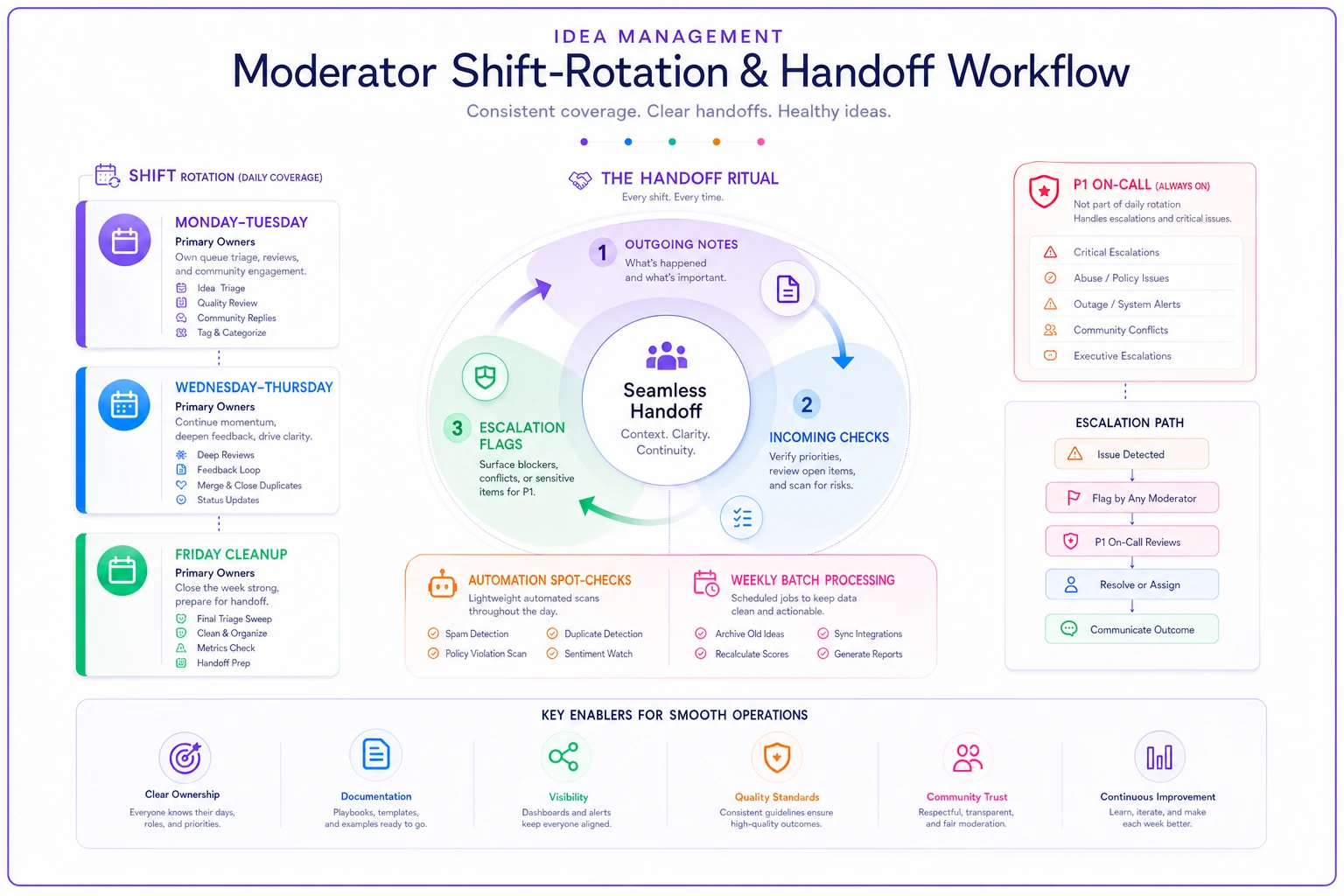
Split the week into ownership blocks, not shared responsibility. Monday–Tuesday is one moderator's queue. Wednesday–Thursday is another's. Friday is batch-and-cleanup, rotated. Shared ownership means no ownership; someone always assumes the other person "probably got it."
-
Assign a P1 on-call separate from the queue owner. Time-sensitive ideas can't wait for the block owner to be free. One person carries the P1 pager for the week — usually the lead — and only gets pinged for genuine P1s.
-
Define a handoff ritual between blocks. At the end of a block, the outgoing owner leaves a two-line note: what's still open, what's waiting on a contributor reply, anything that got escalated. Fifteen minutes. This is the single highest-leverage habit in the whole system and it's the first one teams skip.
-
Cap the queue owner's other commitments during their block. If someone owns Monday–Tuesday's queue while also carrying a full meeting load, the queue loses. Even reducing their meeting load by a third during that block changes the outcome.
Worth borrowing from support teams: separate the person doing reactive work (the queue owner) from the person doing proactive work (curation, synthesis, follow-ups). When one person does both, reactive always wins and proactive never happens. This connects to how asynchronous ideation with clear synthesis SLAs keeps distributed teams from stalling — the coverage logic is the same, just applied to moderation instead of contribution.
Here's a quick visual of the weekly shift handoff and ownership workflow.
Under roughly 80 submissions a month, a formal rota is overkill — a single owner with a backup is fine. Rotas start earning their keep around 120+ monthly submissions, or whenever you have more than two moderators and coverage gaps are causing missed P1s. Below that threshold you're adding process overhead for a problem you don't have yet.
Don't build a rota if your moderators can't actually protect their blocks. A schedule on paper that everyone ignores because their "real job" keeps intervening is worse than no rota — it creates the illusion of coverage while the queue quietly rots. Fix the availability problem first, or the schedule is theater.
Grey-area decision rules: the part that quietly kills consistency
Triage bands handle the obvious cases. The hard part is the ambiguous ones, and inconsistency here erodes contributor trust faster than slow responses ever will.
The classic grey areas in an idea stream:
-
An idea that's sort of a duplicate of something already in the backlog, but with a new angle
-
Something clearly good but far outside the current program scope
-
A well-argued idea from a senior person that a rubric would score low
-
An idea that's really a complaint dressed up as a suggestion
-
Two contributors submitting near-identical ideas hours apart
Without written rules, each moderator resolves these differently, and contributors notice. Two people submit similar ideas; one gets merged and credited, the other gets closed as a dupe with no credit. That's a trust fracture, and it spreads.
A decision-rules cheat sheet solves most of it. Keep it short — a page — and make it the tie-breaker moderators reach for instead of improvising:
-
Near-duplicate with a new angle → keep both, link them, note the distinction. Never silently close the newer one.
-
Good but out of scope → route to a "parked / future scope" list with a real note to the contributor, not a rejection. Out-of-scope isn't the same as bad.
-
Seniority vs. rubric conflict → the rubric wins on scoring, but the moderator flags it for a second look rather than auto-closing. Judgment gets logged, not hidden.
-
Complaint-as-suggestion → acknowledge the underlying problem, ask for the "what would you change" version, reband once it comes back.
-
Simultaneous near-identical submissions → both contributors get co-credit, idea gets merged. Credit is cheap; resentment is expensive.
Grey-area rules aren't about getting every call "right." They're about getting every call consistent, so contributors can predict how their submission will be treated. Predictability is what keeps people submitting. For the deduplication side specifically, this pairs well with disciplined backlog hygiene rules and deduplication workflows — the moderation rules handle the in-the-moment call, the hygiene rituals clean up what slips through.
Automation handoffs: draw the line between mechanical and judgment work
This is where a lot of teams either over-automate or under-automate. Over-automate and contributors get robotic dismissals that feel worse than silence. Under-automate and moderators burn their scarce judgment time on tasks a simple rule could handle.
The clean division: automation handles the mechanical, humans handle the judgment. Lookups, matches, routing, reminders — all fair game to hand off. Reading intent, weighing merit, writing a real response — stays with a person.
A practical handoff map:
-
Deduplication candidates (flag likely matches — don't auto-close them)
-
Spam and off-topic filtering, with a human spot-check queue
-
Acknowledgement-of-receipt messages (as long as they're honest about timeline)
-
Routing to the right band based on completeness and keywords
-
Nudging contributors when an idea is waiting on their reply
-
Reminding the queue owner of aging items before they breach the band's target
Keep with humans:
-
The final duplicate/keep-both call
-
Any rejection or "parked" decision that a contributor will read
-
Merit evaluation of any kind
-
Grey-area calls from the cheat sheet
-
Anything involving credit or attribution
The mistake worth naming: teams automate the decision when they should only automate the surfacing. An automated dedup flag that says "this looks 80% similar to Idea #214, review?" is enormously helpful. A system that closes the new idea as a duplicate on its own will eventually close a genuinely different idea and burn a contributor. Surface, don't decide.
Every automation also needs a fallback. When the system isn't sure, it should send to a human — not make a call. The value isn't removing humans from the loop. It's making sure humans only see the fraction of items that actually need them.
Daily and weekly moderator rituals
Systems don't run themselves; rituals keep them alive. These are deliberately small — anything longer gets skipped.
Daily (queue owner, ~20 minutes):
-
First-pass sort of everything that arrived overnight into bands
-
Clear all P1s and P2s aging past target
-
Check the automation spot-check queue for false matches
-
Reply to anything waiting on a moderator response
Weekly (whole team, ~45 minutes):
-
Batch the P4 low-signal items — enrich, nudge, or close with a real note
-
Review anything the grey-area rules flagged for a second look
-
Read the handoff notes from each block; catch anything that fell between owners
-
Scan aging metrics
how many items breached their band target, and why
Monthly (lead):
-
Sanity-check whether the band targets still match volume
-
Review which automation rules are producing false flags and tune them
-
Rotate rota assignments if the current split is causing burnout
The weekly second-look review is the ritual most teams skip and most need. It's the pressure valve for consistency — the place where "did we handle these three grey-area calls the same way we handled last month's?" actually gets asked. Without it, decision drift accumulates quietly and you only notice when a contributor complains.
Block the weekly second-look on calendars so it actually happens.
Without it, decision drift accumulates quietly and you only notice when a contributor complains.
A real scenario: a mid-size manufacturer's internal idea program
A manufacturing company ran an employee suggestion program across four sites. Volume had climbed to roughly 180–210 submissions a month, handled by two innovation coordinators alongside their regular roles. Time-to-first-response had crept to about 12 days. Participation from the plant floor — historically their best source of practical ideas — had dropped noticeably over two quarters, and exit comments in their pulse checks kept mentioning "nothing happens with suggestions."
They didn't add headcount. They restructured how the two coordinators worked. Ownership blocks split the week. A one-page triage band structure replaced ad-hoc review. Duplicate flagging and receipt acknowledgements got automated, with a human spot-check on the dedup flags. The weekly batch handled the low-signal pile that used to clog the daily flow.
Within about two months, first-touch response landed inside the P2 target for most submissions, and same-day for the time-sensitive ones. The backlog of untouched items — which had sat around 90 — dropped to something they could clear in a normal week. Floor participation started recovering the following quarter, slowly. Not a dramatic revenue story; the point was that the program stopped quietly dying, and the two people running it stopped dreading the queue.
What actually moved the needle wasn't automation. It was separating sorting from reviewing, and giving each coordinator a block they owned. Automation just kept the mechanical work from stealing their time.
Who should not build this
If your program runs under roughly 80 submissions a month, skip most of this. A single owner, a simple priority flag, and honest response timelines will serve you better than a rota and a decision cheat sheet you'll never fully use. Process overhead you don't need becomes its own drag.
Likewise, if your real problem is that ideas never lead anywhere — that they get reviewed promptly and then vanish into a void — moderation isn't your bottleneck. Fixing triage speed won't help if the downstream funnel is broken. Sort out where accepted ideas go first.
Bringing it together
High-volume idea moderation fails in a predictable way: unscheduled work, arbitrary review order, inconsistent grey-area calls, and humans doing mechanical tasks that eat the time they need for judgment. Each of those has a matching fix — shift rotas for scheduling, triage bands for order, a decision cheat sheet for consistency, and automation handoffs that surface rather than decide.
None of it requires more people. It requires deciding, in advance, who touches what and when — and then protecting that decision from the day-job pressure that always tries to override it. The programs that survive at volume aren't the ones with the most moderators. They're the ones where the moderation actually runs like an operation instead of a favor.
High-volume idea moderation fails in a predictable way: unscheduled work, arbitrary review order, inconsistent grey-area calls, and humans doing mechanical tasks that eat the time they need for judgment. Each of those has a matching fix — shift rotas for scheduling, triage bands for order, a decision cheat sheet for consistency, and automation handoffs that surface rather than decide.
None of it requires more people. It requires deciding, in advance, who touches what and when — and then protecting that decision from the day-job pressure that always tries to override it. The programs that survive at volume aren't the ones with the most moderators. They're the ones where the moderation actually runs like an operation instead of a favor.
Ready to transform your innovation process?
Join 2,000+ companies using GoIdeafy to unlock team creativity, prioritize impactful ideas, and accelerate growth.