



Most innovation programs don't die because of bad ideas. They die in the gap between "this pilot looks promising" and "someone with authority actually made a call." That gap is where cross-functional escalations go to rot — an idea needs legal sign-off, a budget line, and a product owner's blessing, and nobody can say who owns the final yes. So the idea sits. People lose interest. The momentum you spent three months building evaporates in two weeks of email threads.
A decision rights matrix fixes this, but not the way most teams build it. The usual version is a dusty RACI chart nobody opens. The version that actually works treats escalation as a real operational path with named roles, trigger conditions, time limits, and a meeting cadence built around it. This article is about building that — the kind you can hand to a confused team lead on a Tuesday and they'll know exactly what to do.
Why escalation bottlenecks form (and why they get worse as you scale)
Early in an innovation program, escalation is informal. There are maybe 15 ideas in flight, everyone knows each other, and if something needs a decision, you walk over to the VP's desk or drop a message in a channel. It works because the whole operation fits in one person's head.
The problem is that this informal system doesn't fail gradually. It fails suddenly, around the point where you've got multiple business units feeding ideas into a shared pipeline and the number of cross-functional decisions crosses some invisible threshold. Suddenly the VP who used to approve things in hallway conversations is a bottleneck for 40 pending decisions, half of which don't actually need her at all.
The bottleneck is rarely a lack of authority. It's a lack of clarity about authority. Three different people each assume someone else owns the decision. Or worse — two people both think they own it, they quietly disagree, and the idea bounces between them while everyone stays polite.
A few patterns that reliably create escalation jams:
-
Ideas that touch money and risk at the same time. Finance wants to defer, risk wants more review, and the sponsor wants to move. No single owner, so it stalls.
-
Decisions that are "small enough to ignore but big enough to block." A $4k experiment budget doesn't feel worth escalating, but without it the whole pilot waits.
-
Silent vetoes. A stakeholder who never says no but also never says yes. They just don't respond, and the default behavior is to wait.
-
Re-litigation. A decision gets made, then someone senior who wasn't in the room reopens it, and the team learns the real lesson: decisions here aren't final, so why rush?
That last one is poison. Once a team believes decisions can be quietly overturned, they stop treating any decision as real, and your escalation path becomes theater.
What actually breaks at scale
Most governance docs miss something important. The escalation problem isn't one problem — it's several that show up at different stages of growth, and the fix for one makes the next worse if you're not careful.
Capture, evaluate, and act on ideas without friction.
GoIdeafy streamlines the entire innovation lifecycle from idea submission to implementation.
- Centralized idea capture
- Collaborative evaluation tools
- Progress tracking & analytics
No credit card required
| Stage | What escalation looks like | What breaks |
|---|---|---|
| Single team, ~10–20 ideas | Informal, hallway conversations | Nothing yet — but no record of who decided what |
| Multiple teams, shared pipeline | A few named approvers, ad hoc meetings | Approvers become bottlenecks; unclear ownership on cross-cutting ideas |
| Multi-unit program, 100+ ideas/quarter | Formal gates, committees | Committee overload; everything escalates because nobody wants to own risk alone |
| Enterprise-wide | Governance board, portfolio reviews | Slow by design; good small ideas die waiting for a board that meets monthly |
The trap in the middle rows is over-centralization. A team gets burned by a bad call, so they route everything through a committee. Now the committee meets weekly, the agenda has 30 items, and each one gets four minutes. Decisions get rubber-stamped or deferred, and you've reinvented the original bottleneck with more overhead.
Teams that handle this well do the opposite. They push decisions down to the lowest level that can safely own them, and reserve escalation for the genuinely ambiguous cases. That only works if people trust the boundaries — which is exactly what a decision rights matrix defines.
If you haven't already settled on how authority flows across your org, it's worth getting that foundation right first. The structure of your escalation path depends heavily on your underlying innovation governance model — a centralized hub and a federated model need completely different matrices.
The core of a decision rights matrix that works
Forget the five-column RACI template for a second. A useful escalation matrix answers four questions for every type of decision:
-
Who can decide this alone? (The default owner — no escalation needed.)
-
What triggers an escalation? (Specific, numeric, unambiguous conditions.)
-
Who decides once it's escalated? (Named role, not a department.)
-
How long do they have before it auto-escalates again? (A clock, so silence isn't a veto.)
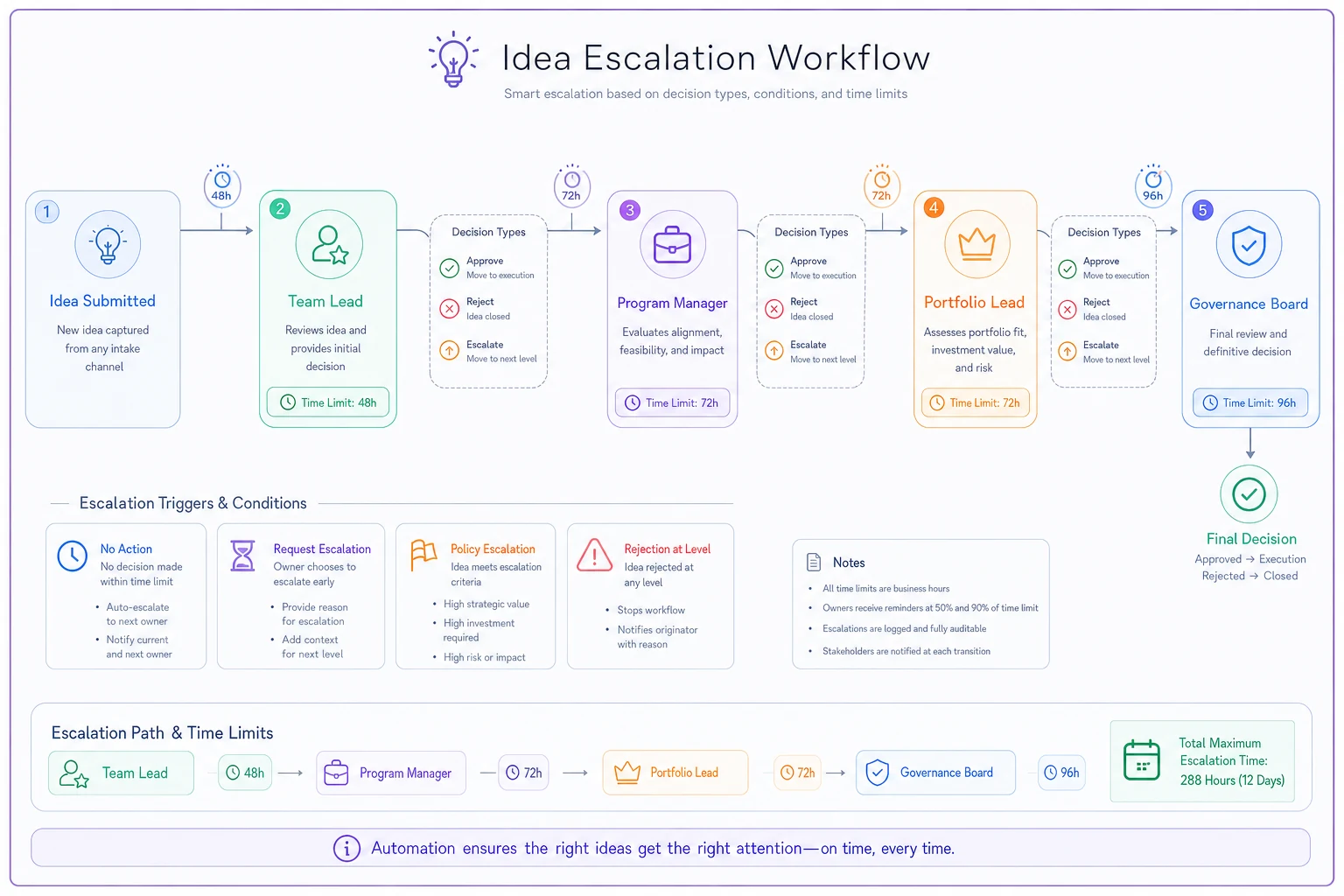
That fourth point is the one almost everyone skips, and it's the most important. A decision right without a deadline is just a polite suggestion. The clock is what prevents silent vetoes and stalled threads.
Here's what the actual matrix looks like for a mid-sized innovation program:
| Decision type | Default owner | Escalation trigger | Escalation owner | Time limit |
|---|---|---|---|---|
| Experiment budget ≤ $5k | Team lead | None | — | — |
| Experiment budget $5k–$25k | Program manager | Spend exceeds $25k or crosses 2+ units | Portfolio lead | 3 business days |
| Any customer-facing pilot | Product owner | Involves PII or regulated data | Risk + legal review pair | 5 business days |
| Pilot-to-scale decision | Portfolio lead | Requires new headcount or >$50k | Governance board | Next scheduled review |
| Cross-unit resource conflict | Program manager | Two leads escalate the same ask | Portfolio lead | 2 business days |
The magic isn't in the specific numbers — yours will differ. It's that every row has a trigger, a named owner, and a clock. When a team lead is staring at an $18k experiment that touches customer data, they can look at two rows and know exactly who signs off and how long it should take.
Always set an explicit time limit on escalations so silence can't be treated as a veto.
Below is a simple workflow visualization of how a decision moves from owner to escalation owner and how the clock triggers auto-escalation.
One thing worth sitting with: the single most common fix teams make after adopting a matrix like this is raising the threshold for what needs escalation at all. They realize their team leads were escalating $3k decisions out of habit, and once the matrix explicitly says "you own this, go," throughput jumps without adding anyone.
Worked escalation scenarios
Abstract matrices fall apart the moment reality gets messy. So here's how three realistic scenarios actually run through the system.
Scenario 1: The ambiguous-owner pilot. A customer-support team runs a small pilot using an AI tool to auto-draft responses. It's cheap — under $5k — so by the matrix, the team lead owns it. But midway through, they realize the tool is processing customer PII. That trips the "involves PII or regulated data" trigger. The decision immediately moves to the risk + legal review pair, with a 5-day clock. The team lead doesn't have to guess or ask around. They flag it, the clock starts, and if legal doesn't respond in 5 days, it auto-escalates to the portfolio lead. No silent veto, no three-week limbo.
Scenario 2: The cross-unit resource fight. Two business units both want the same data engineer for competing pilots next sprint. Each program manager thinks their pilot is more important. Under the old informal system, this would've turned into a slow political standoff. Under the matrix, "two leads escalate the same ask" is an explicit trigger that routes to the portfolio lead with a 2-day clock. The portfolio lead makes the call, it's recorded, and — critically — it's final. No reopening it next week.
Scenario 3: The pilot that wants to become real. A validated pilot needs two new hires and about $60k to scale. That's above the portfolio lead's authority, so it goes to the governance board at the next review. This one's supposed to be slow — scaling decisions deserve scrutiny. The mistake here would be letting the team feel like the slowness means rejection. The matrix sets the expectation up front: this class of decision happens at the monthly review, here's the date, so the team preps a proper case instead of pestering people.
Notice the pattern across all three: the matrix doesn't make every decision fast. It makes every decision predictable. The team always knows who, when, and by when. That predictability is what actually removes the bottleneck — not raw speed.
Meeting cadences that match the decisions
A matrix without a meeting rhythm is half a system. Decisions need venues, and the wrong cadence quietly recreates the bottleneck. If your only decision venue is a monthly board meeting, everything waits up to a month. If you escalate everything to a weekly committee, you drown.
Match cadence to decision weight:
-
Daily / async triage (team level) Team leads clear anything they own. No meeting — handled in the flow of work. Most decisions should die here.
-
Weekly program sync (30–45 min) Program managers resolve mid-tier escalations, cross-unit asks, and anything with a 2–5 day clock. Tight agenda, decisions recorded live.
-
Biweekly portfolio review (60 min) Portfolio lead handles scaling readiness, resource conflicts that couldn't resolve at the program level, and anything approaching the board threshold.
-
Monthly governance board Pilot-to-scale calls, new headcount, significant budget. Slow by design, with pre-read materials due 3 days ahead.
The number one cadence mistake is having venues that don't line up with the matrix's time limits. If your matrix says a decision auto-escalates in 3 business days but the only venue that can decide it meets every two weeks, your clock is a lie. Walk the matrix and the calendar together, row by row, and make sure every time limit has a venue that can actually honor it.
Where tooling helps (and where it doesn't)
Most of this is a people-and-process problem, and no software fixes a matrix nobody agreed on. But once you have the matrix, keeping it alive is genuinely hard to do by hand. Triggers get missed because someone didn't notice an experiment crossed a budget line. Clocks get ignored because nobody's watching the calendar on 40 parallel decisions. Decisions get made in a thread and never recorded, so three months later nobody remembers who approved what.
This is where an AI-assisted innovation management platform earns its keep — not by making decisions, but by enforcing the plumbing around them. The useful version watches the pipeline and routes items automatically: when a pilot's budget field crosses $25k, it flags the escalation and notifies the named owner. When a clock expires with no response, it auto-escalates and logs the delay so you can see where decisions chronically stall. It keeps a clean record of who decided what and when, which quietly solves the re-litigation problem because there's an auditable trail.
The point isn't automation for its own sake. It's that a decision rights matrix only works if the triggers and clocks are actually enforced, and humans are bad at watching dozens of parallel conditions. Let the system handle the watching so your people can handle the deciding.
When this makes sense — and when it's overkill
It makes sense when:
-
You've got multiple teams or units feeding a shared pipeline.
-
Decisions regularly stall and nobody can name the owner.
-
You're seeing re-litigation — decisions getting quietly reopened.
-
Cross-functional sign-offs (legal, finance, risk) are common and slow.
It's a bad idea when:
-
You're a single team with fewer than ~20 ideas in flight. Informal still works, and a matrix adds overhead you don't need yet.
-
Your real problem is idea quality, not decision speed. A matrix routes decisions faster; it won't make a weak pipeline stronger.
-
Leadership won't commit to making decisions final. If the board reopens calls on a whim, no matrix survives contact with that culture. Fix the culture first.
Who should not do this: teams that haven't yet agreed on their basic governance model. Building an escalation matrix on top of unsettled authority just formalizes the confusion. Sort out who owns what at the structural level, then build the escalation layer on top.
A short real scenario
A manufacturing company running an internal idea program across four plants had a recurring problem: validated pilots kept dying in the handoff between plant teams and central engineering. Roughly 60 ideas reached pilot stage over two quarters, but only a handful made it to scale — not because they failed, but because the "who approves the scale-up budget" question had no clear owner. Decisions averaged somewhere around five to six weeks of back-and-forth, and by then the plant teams had moved on.
They built a matrix with four decision tiers and tied each to an existing meeting. The biggest change wasn't speed on the hard decisions — it was that the easy ones stopped escalating. Plant leads got explicit authority up to $10k, which cleared most of the clutter. The genuinely cross-cutting decisions dropped from five-plus weeks to under two, mostly because the clock-and-auto-escalate rule killed the silent waiting. Scale-up conversion roughly doubled over the next two quarters. Nothing dramatic in any single meeting — just fewer ideas quietly dying between them.
Worth noting: a lot of the value they captured came after the pilot approvals, where decisions about sustaining and resourcing scaled ideas had previously gone fuzzy. If that resonates, the same clarity applies downstream — a lot of programs leak value precisely because post-pilot decisions have no owner, which is its own benefits-realization problem.
Building your first version
You don't need to map every decision type on day one. Start with the ones that actually stall.
-
List your last 10–15 stalled or re-litigated decisions. These are your real bottlenecks, not hypothetical ones.
-
Group them into 4–6 decision types. Budget tiers, customer-facing pilots, resource conflicts, scale decisions. Keep it coarse.
-
Assign a default owner to each — the lowest level that can safely decide it.
-
Write specific triggers. Numeric where possible. "Over $25k," not "significant spend."
-
Name the escalation owner — a role and a person, never a department.
-
Set a clock on every escalation path. Then check it against your actual meeting calendar.
-
Add one rule that decisions are final unless new material information appears — and get leadership to say it out loud.
Run it for a quarter, then revisit. You'll almost certainly find you were escalating things that didn't need it, and that a couple of trigger thresholds were set too low. Adjust. The matrix is a living artifact, not a stone tablet.
When a promising idea hits a decision point, nobody should have to ask "who decides this?" The answer should already be written down, with a name and a deadline attached. That's the whole game — turning the murky middle of your pipeline into a path people can actually walk.
When a promising idea hits a decision point, nobody should have to ask "who decides this?" The answer should already be written down, with a name and a deadline attached. That's the whole game — turning the murky middle of your pipeline into a path people can actually walk.
Ready to transform your innovation process?
Join 2,000+ companies using GoIdeafy to unlock team creativity, prioritize impactful ideas, and accelerate growth.