



Every innovation team has that spreadsheet. The one tracking 47 pilots from the last two years where 38 showed positive results, 31 exceeded their success metrics, and exactly 8 actually scaled into sustained operations. The other 30? Stuck in what I'd call the adoption valley—that weird space where everyone agrees the pilot worked but nobody quite knows how to make it permanent.
The problem isn't that pilots fail. Most pilots succeed at proving the concept. The real issue is that teams treat pilot completion like crossing a finish line when it's really just reaching base camp. What happens after determines whether that promising idea becomes an embedded operational improvement or just another slide in next quarter's innovation retrospective.
The pattern keeps repeating: teams plan meticulously for pilot execution but completely wing it on adoption planning. They measure pilot KPIs religiously but have no framework for tracking benefits realization for innovation after deployment. They celebrate pilot success, then wonder six months later why nobody's using the new process.
Why successful pilots die in the adoption valley
The adoption valley kills more innovations than failed pilots ever could. Your pilot team runs a successful test with the customer service department. Response times drop 42%, satisfaction jumps 8 points, the team loves the new workflow. Everyone celebrates. The steering committee approves broader rollout. Then nothing.
Three months later, only two of twelve planned departments have adopted it. The original pilot team has moved on. Customer service slowly drifts back to old processes because the temporary support structure disappeared. Nobody's tracking whether those response time improvements even held. The innovation gets marked "implemented" in the portfolio tracker, but operationally it's already dead.
This happens because pilot success creates a dangerous assumption—that proving something works means people will naturally adopt it. But adoption requires completely different muscles than experimentation. Pilots thrive on controlled conditions, dedicated resources, and enthusiastic volunteers. Adoption happens in the messy reality of competing priorities, change fatigue, and managers who weren't even in the room when the pilot was designed.
The worst part is most organizations don't realize adoption failed until months later. They assume silence means success. By the time someone notices the innovation isn't being used, the momentum is gone, the pilot team has dispersed, and nobody quite remembers why those specific process changes mattered in the first place.
Building adoption planning into pilot design (not after)
Smart teams start adoption planning before the pilot launches. Not vague "change management" planning, but specific adoption architecture that treats scaling as seriously as testing.
Capture, evaluate, and act on ideas without friction.
GoIdeafy streamlines the entire innovation lifecycle from idea submission to implementation.
- Centralized idea capture
- Collaborative evaluation tools
- Progress tracking & analytics
No credit card required
Start with stakeholder mapping that goes beyond pilot participants. Map three circles of impact: direct users who'll interact with the innovation daily, adjacent teams who'll need to adjust their workflows, and downstream beneficiaries who'll see indirect results. For each group, document their current state, required behavior changes, and specific adoption barriers.
Create adoption personas that capture realistic resistance patterns. The overwhelmed middle manager who already has seventeen initiatives on their plate. The technical expert who built the current process and sees any change as implicit criticism. The frontline employee who's been burned by previous "improvements" that just made their job harder. These aren't obstacles to overcome—they're design constraints to incorporate.
Skeptics converted through involvement often become the strongest adoption champions.
Most critically, define your adoption success gates before pilot launch. Not just "did the pilot work?" but specific criteria for scaling readiness:
-
Production systems can handle 10x pilot volume
-
Integration points with existing tools validated
-
Failover procedures documented and tested
-
Support processes established beyond the pilot team
Organizational readiness gate:
-
Adoption champions identified in each target department
-
Middle management explicitly aligned on resource allocation
-
Training materials created for different user personas
-
Rollback procedures clear if adoption struggles
Value readiness gate:
-
Benefits tracking automated or systematized
-
Baseline metrics captured for all adoption areas
-
Value attribution model agreed with finance
-
Reporting cadence established with stakeholders
These gates become your adoption DNA—baked into the pilot from day one, not bolted on after the fact.
The adoption plan template that actually works
Forget generic change management templates. Adoption planning for innovation needs structure that acknowledges the unique challenges of scaling experimental work. Here's the framework that consistently drives results:
Pre-pilot adoption groundwork
Document the "adoption story" before running the pilot. Not marketing fluff—the operational narrative of how this innovation moves from pilot to production. Include specific timeline milestones, resource requirements at each stage, and clear ownership transitions.
Build your benefits baseline while designing the pilot. Capture current state metrics not just for pilot participants but for all planned adoption areas. This seems obvious but gets skipped constantly—you can't prove benefits realization for innovation if you don't know what "before" looked like.
Create the adoption coalition early. Identify one skeptical stakeholder from each adoption area and involve them in pilot design. Not to convince them, but to understand their specific concerns and build solutions into the approach. Skeptics converted through involvement often become the strongest adoption champions.
During-pilot adoption preparation
Run adoption previews while the pilot executes. Monthly sessions where pilot teams share learnings with future adoption areas. Not polished presentations—working sessions showing real challenges and solutions. Let future users see the messy middle, not just the victories.
Document the "hidden work" that makes pilots successful. That daily standup the pilot team runs. The Slack channel where they troubleshoot issues. The informal Thursday check-ins with stakeholders. These invisible support structures matter more than formal processes when it comes to adoption success.
Track adoption leading indicators during the pilot:
-
Questions from non-pilot areas about the innovation
-
Requests to observe pilot activities
-
Voluntary attendance at pilot reviews
-
Unsolicited suggestions for improvement
Low engagement on these signals adoption failure regardless of how good the pilot metrics look.
Post-pilot adoption execution
Never announce pilot success without announcing the adoption plan. Same presentation, same meeting. Success celebration immediately followed by "here's exactly how we scale this"—specific dates, named owners, resource commitments.
The adoption plan should detail the following three waves:
-
Wave 1 (Months 1–2)
Controlled expansion — Deploy to one additional team or department. Original pilot team provides daily support. Capture detailed adoption friction points. Adjust approach based on learnings.
-
Wave 2 (Months 3–4)
Supported scaling — Deploy to 3–4 additional areas. Shift support from pilot team to adoption champions. Establish help desk or FAQ resources. Begin tracking benefits across all areas.
-
Wave 3 (Months 5–6)
Sustainable operations — Complete planned rollout. Transition to business-as-usual support. Implement automated benefits tracking. Conduct adoption retrospective.
Visualize the three-wave adoption workflow:
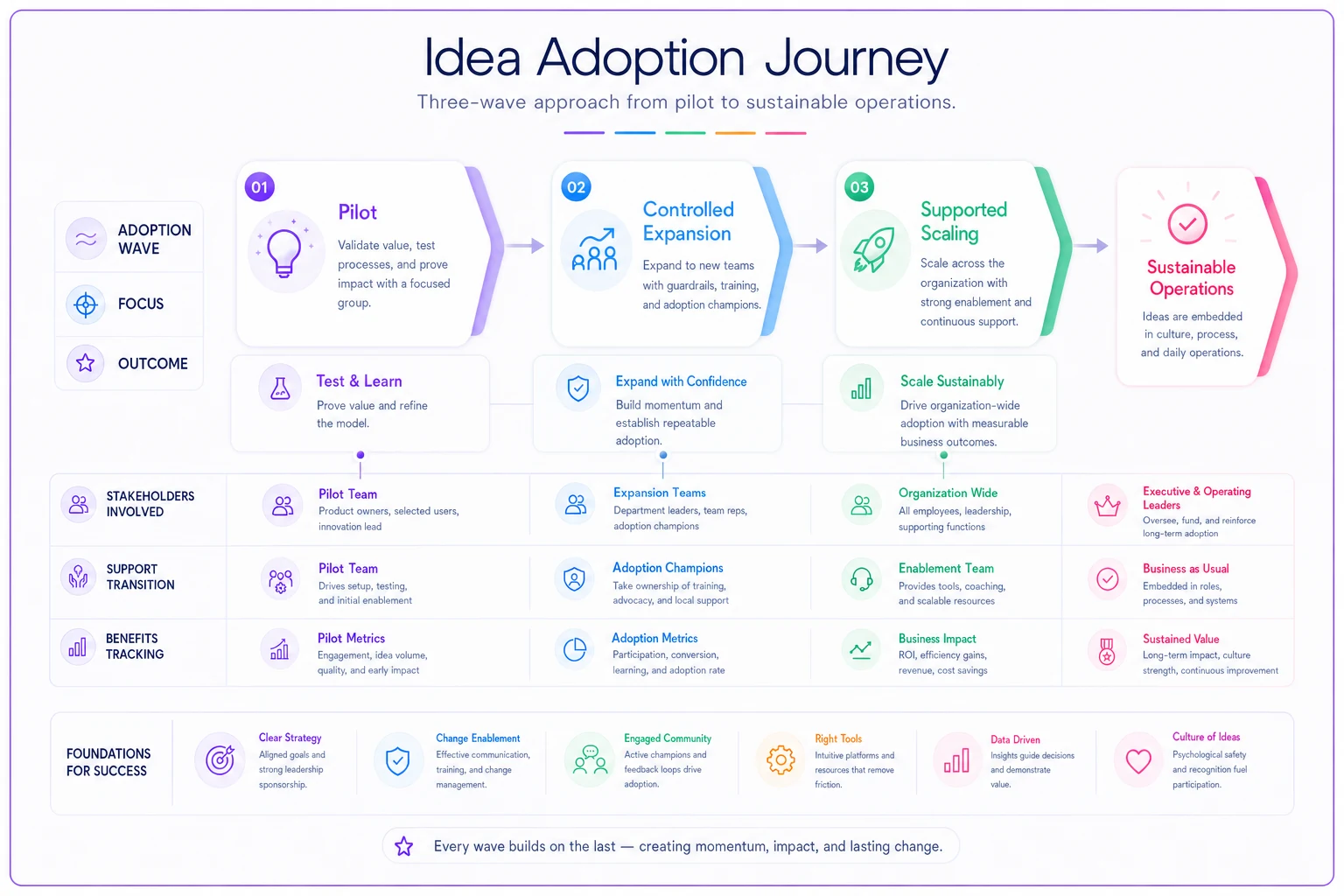
Each wave has specific success criteria, resource requirements, and rollback triggers if adoption stalls.
Stakeholder engagement templates that prevent ghosting
The fastest way to kill post-pilot adoption is stakeholder ghosting—when previously engaged executives suddenly become unavailable once real resources are actually needed. Structured engagement templates help maintain momentum.
The adoption commitment charter
Before pilot launch, get written commitment for post-pilot resources. Not vague "we'll support successful pilots" statements. Specific commitments:
"If this pilot achieves [specific metrics], we commit to:
-
Dedicating [X hours] of [specific person's] time for adoption support
-
Funding [specific amount] for scaling infrastructure
-
Adjusting [specific processes] to accommodate the innovation
-
Communicating adoption requirements to [specific teams]
Make leaders sign this before the pilot starts. It feels awkward. Do it anyway. The discomfort of asking for specific commitments upfront prevents the much worse disaster of assumed support that never materializes.
Structured stakeholder check-ins
Replace random update meetings with templated engagement sessions:
Monthly pilot progress review (30 minutes):
-
Metrics update (5 min)
-
Adoption planning progress (10 min)
-
Resource needs for next month (5 min)
-
Risk discussion (5 min)
-
Stakeholder input and decisions needed (5 min)
Adoption readiness review (before pilot ends):
-
Pilot results summary (10 min)
-
Adoption plan walkthrough (15 min)
-
Resource commitment confirmation (10 min)
-
Success gate evaluation (10 min)
-
Go/no-go decision (5 min)
Quarterly benefits review (post-adoption):
-
Benefits realized vs. projected (10 min)
-
Adoption challenges and solutions (10 min)
-
Resource adjustments needed (5 min)
-
Scale or maintain decision (5 min)
Keep these templates consistent across all pilots. Stakeholders know what to expect, meetings stay focused, and adoption planning gets equal weight with pilot results.
Adoption KPIs that measure real value (not vanity metrics)
Most teams track adoption with metrics like "number of users trained" or "departments deployed to." These vanity metrics tell you nothing about whether benefits realization for innovation actually happened. You need KPIs that measure behavioral change and value capture.
Behavioral adoption metrics
Usage intensity: Not just who's using it, but how much. Track weekly active users divided by total trained users. Below 60% after three months signals adoption failure regardless of other metrics.
Process adherence rate: Percentage of relevant workflows using the new approach versus reverting to old methods. Measure through system logs, not surveys—people misreport adoption, systems don't.
Time to proficiency: How long before new users reach pilot-level performance? Pilots often succeed because expert users drove them. If regular employees take months to get there, the innovation probably won't scale the way you're expecting.
Support ticket trends: Track help requests over time. Should spike during initial rollout then decline steadily. Sustained high support needs indicate the innovation requires unsustainable hand-holding.
Value realization metrics
Benefits velocity: How quickly do promised benefits appear in new adoption areas? If the pilot showed 20% efficiency improvement in month one, new areas should show similar gains on similar timelines. Slower realization suggests the pilot conditions were too unique to replicate.
Benefits persistence: Do improvements stick after support structures fade? Measure key metrics at 30, 60, and 90 days post-adoption. Benefits that decay indicate process regression.
Indirect value capture: Track unexpected benefits beyond pilot scope—other departments adapting the innovation for different uses, reduced errors in downstream processes. These indirect benefits often exceed direct value but only appear through systematic tracking.
Adoption ROI clarity: Can finance clearly attribute cost savings or revenue gains to the innovation? Not estimates or projections—actual tracked value. If you can't draw a straight line from innovation to financial impact after six months, executive support will erode.
Early warning indicators
The table below maps each early warning signal to what it typically indicates and what action it should trigger:
| Warning Signal | What It Indicates | Action to Take |
|---|---|---|
| Champion disengagement | Adoption failure weeks before metrics show it | Re-engage champion or reassign role |
| Low manager mention rate | Innovation not embedded in operational thinking | Run targeted manager alignment session |
| No voluntary expansion requests | Forced adoption with no organic pull | Reassess value delivery and user friction |
| Rising support tickets past month 2 | Unsustainable hand-holding required | Redesign onboarding or simplify workflow |
These signals matter because they surface problems early, when there's still time to course-correct.
Success gates that prevent premature scaling
Success gates stop you from scaling innovations that aren't ready. But most gates focus on pilot metrics while ignoring adoption readiness. You need gates that evaluate both innovation maturity and organizational capacity.
Technical stability gates
Load testing completion: Can systems handle 5x expected volume? Not theoretical capacity—actual stress testing with realistic data patterns. Many pilots succeed processing dozens of transactions daily, then crash when handling hundreds.
Integration validation: Do all connection points with existing systems remain stable under normal operating conditions? Pilots often rely on manual workarounds or temporary integrations that break immediately at scale.
Failure recovery validation: What happens when things break? Document and test rollback procedures, data recovery processes, and business continuity plans. The middle of an adoption rollout is the wrong time to discover you can't revert changes.
Organizational readiness gates
Change saturation assessment: How many other initiatives are competing for attention in target adoption areas? If teams are already managing three system upgrades and two process changes, even good innovations will struggle. Sometimes the right adoption strategy is waiting for clearer skies.
Skill gap analysis: Can average employees succeed with standard training, or does the innovation require specialized expertise? Pilots often succeed through heroic efforts by talented teams. If normal operations can't replicate that, adoption will underperform.
Political alignment check: Are key stakeholders genuinely aligned, or just not actively opposing? Watch for passive resistance signals: delayed decisions, resource delays, delegated attendance at reviews. These indicate headwinds that will intensify during adoption.
Value clarity gates
Baseline establishment: Do you have solid before-state metrics for all adoption areas? Without baselines, you can't prove value, and without proven value, support disappears.
Attribution model agreement: Does finance agree with how you're calculating benefits? Get written confirmation that your value measurement approach will be accepted for ROI calculations. Many innovations die when finance retroactively rejects the benefit calculations.
Value threshold validation: Will the innovation still deliver meaningful value at scale? Some pilots show strong ROI because fixed costs spread across small volumes. At scale, the economics can flip.
Post-implementation retrospectives that close the loop
Most teams run pilot retrospectives but skip adoption retrospectives. This leaves massive learning on the table and practically guarantees repeat mistakes. Structure adoption retrospectives to capture insights that actually improve future scaling.
The three-lens retrospective approach
Lens 1: Process effectiveness
What worked and broke in the adoption process itself? Not the innovation—the way you scaled it. Did the wave approach work? Were stakeholder templates useful? Which support structures proved critical versus nice-to-have?
Document specific process lessons in this order:
-
Which adoption activities delivered the highest impact
-
Where teams needed more support than expected
-
What documentation gaps created friction
-
How accurate the resource estimates actually were
Lens 2: Innovation evolution
How did the innovation change during adoption? Solutions never scale exactly as piloted. Track what adapted through this sequence:
-
Features added or removed based on user feedback
-
Process modifications required for different departments
-
Unexpected use cases that emerged organically
-
Technical adjustments made for scale
Lens 3: Value realization
Did promised benefits materialize across adoption areas? Compare actual value to projections by working through these four questions in order:
-
Which benefits scaled linearly versus degraded at volume
-
What unexpected costs emerged during adoption
-
Where value varied significantly across different teams
-
How long the lag was between adoption and actual value capture
This analysis improves benefits realization for innovation by creating more realistic value models for future initiatives.
The adoption story archive
Document each adoption journey as a complete narrative—not a boring project report, but something that captures the human side of scaling innovation.
Start with pilot success and initial excitement. Document the first adoption challenges, which usually surface around week three when pilot support fades. Capture the moment when momentum either builds or stalls. Include quotes from skeptics who converted and champions who struggled.
These stories become invaluable references. When a new pilot team says "our innovation is different," you can show them five or six previous "different" innovations that faced identical adoption challenges. Pattern recognition prevents repeat failures.
Archive specific artifacts: stakeholder communication that worked (and what didn't), training materials that drove adoption, support tickets that revealed hidden friction, meeting notes from critical turning points, and metrics dashboards that maintained visibility. These aren't nice-to-haves—they're the institutional memory that keeps future adoption from starting at zero.
Benefits validation and continuous tracking
Quarter 1 post-adoption: Confirm benefits are stable. Initial gains often reflect enthusiasm and attention—real value appears when innovations become routine.
Quarter 2 post-adoption: Identify value expansion opportunities. Users familiar with innovations often discover unexpected applications. These emergent benefits can exceed planned value.
Quarter 3 post-adoption: Assess sustainability. Can the innovation maintain value without special attention? If benefits require constant reinforcement, it's not truly embedded.
Quarter 4 post-adoption: Make scale or sunset decisions. Either expand successful innovations to additional areas or formally close unsuccessful adoptions. Zombie innovations that drain resources indefinitely are a real problem.
Making benefits realization systematic, not heroic
The gap between pilot success and scaled value isn't about innovation quality—it's about adoption architecture. Teams that systematically plan, track, and support adoption convert somewhere around 70% of successful pilots into sustained operations. Teams that wing it are typically in the 20% range or below.
This isn't about perfect execution. Adoption remains messy, political, and unpredictable. But structured approaches dramatically improve the odds by addressing predictable failure points before they kill momentum.
The templates, gates, and frameworks here aren't rigid requirements—they're starting points that need adjustment for your context. A 50-person startup needs different adoption approaches than a 5,000-person enterprise. But the core principles hold: plan adoption before pilots, track behavioral change not vanity metrics, and maintain engagement through structured retrospectives.
Most importantly, treat adoption as a first-class concern equal to innovation itself. The best idea poorly adopted delivers zero value. An average idea brilliantly adopted transforms operations. Build your innovation funnel to emphasize adoption planning from the start, not as an afterthought once pilots succeed.
The innovation graveyard is full of brilliant pilots that proved tremendous value then died quiet deaths in the adoption valley. When you connect pilot design to adoption planning, create clear success gates, and systematically track benefits realization, those promising pilots turn into embedded operational improvements that actually stick.
Stop treating pilot completion as the victory. Successful adoption is the real goal. Build metrics that track actual value delivery, not just pilot results. The companies that master this transition don't just run successful innovation programs—they systematically transform their operations through sustained benefits realization for innovation.
Your next pilot is probably already in flight. The question isn't whether it will succeed at proving its concept. The question is whether you've built the adoption architecture to convert that success into lasting operational value. Without that architecture, you're just adding another slide to next quarter's retrospective deck.
Ready to transform your innovation process?
Join 2,000+ companies using GoIdeafy to unlock team creativity, prioritize impactful ideas, and accelerate growth.