
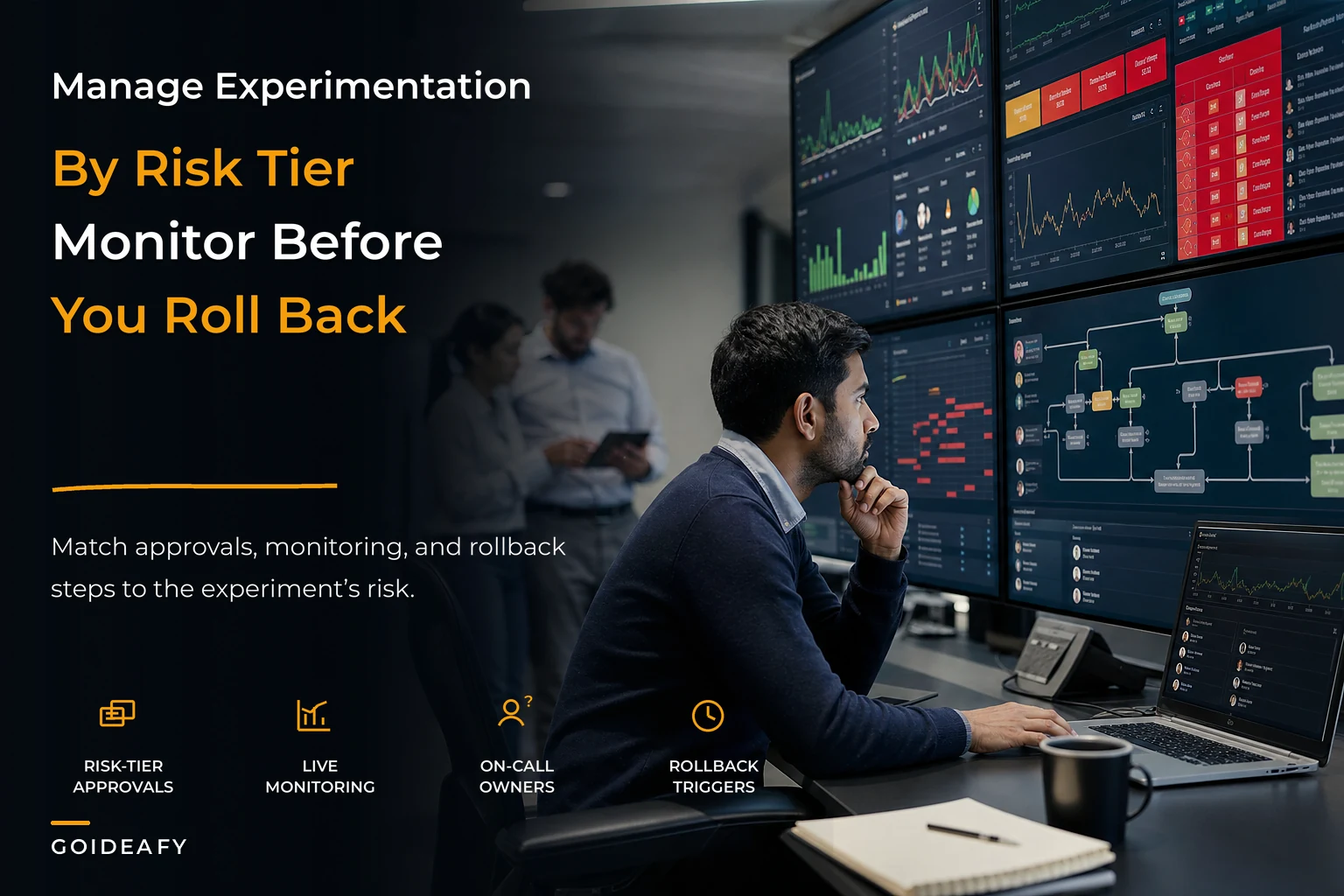

Most experimentation programs don't fail because teams run bad experiments. They fail because every experiment — whether it's a copy tweak on a landing page or a change to how refunds get processed — goes through the same approval process. Either everything gets rubber-stamped and eventually something blows up, or everything gets scrutinized and nobody wants to run experiments anymore because the paperwork isn't worth it.
The fix isn't more oversight. It's proportional oversight. A button color test should not require the same sign-off chain as rerouting live customer payments. When you treat all experiments as equally risky, you teach your best people to either sneak experiments through unofficially or stop bothering entirely. Both outcomes are worse than the risk you were trying to manage.
This is a systems problem. Approvals, monitoring, rollback plans, and the people responsible for each all have to connect. Get one piece wrong and the whole thing either grinds to a halt or leaks risk quietly until something expensive breaks.
Why one-size-fits-all approval breaks down
The failure pattern is pretty predictable. A program starts small — a handful of people running low-stakes tests — and governance is informal. Someone has an idea, they ask a manager, they run it. Fine. Then the program grows. More teams, more experiments, higher stakes. Leadership gets nervous after one experiment causes a visible problem, so they add an approval gate. Then another. Then a review committee that meets weekly.
Then the review committee becomes the bottleneck. Experiments pile up waiting for the Thursday meeting. A team that wants to test a new onboarding email waits nine days for approval on something that could have been reversed in thirty seconds. Meanwhile, the genuinely risky experiments — the ones touching billing, data handling, or operational workflows — get the same fifteen minutes of attention as the email test, because the committee is drowning.
This happens because governance gets designed around the worst-case experiment and then applied to everything. The intent is good. The result is that your low-risk work moves at high-risk speed, and your high-risk work doesn't get the depth of review it actually needs.
Tiering decouples these. Different risk means different approvals, different monitoring, and different rollback requirements. A team running a UX test on a marketing page should be able to self-authorize and ship the same day. A team piloting a change to how inventory gets reordered across three warehouses should go through real scrutiny — because if that one goes sideways, you're not reverting a webpage, you're untangling real-world operations.
The risk-tier model
Here's a working four-tier model. Adjust the thresholds to your business, but the structure holds across most programs.
Capture, evaluate, and act on ideas without friction.
GoIdeafy streamlines the entire innovation lifecycle from idea submission to implementation.
- Centralized idea capture
- Collaborative evaluation tools
- Progress tracking & analytics
No credit card required
| Tier | Example experiment | Blast radius | Required approval | Monitoring obligation | Rollback expectation |
|---|---|---|---|---|---|
| T1 – Low | Copy, layout, button, non-critical UX test | Small % of users, cosmetic | Self-serve by experiment owner | Standard dashboard check at 24h and 72h | Feature flag off, instant |
| T2 – Moderate | Pricing display, checkout flow tweak, new email sequence | Revenue-adjacent, reversible | Peer reviewer + team lead | Daily metric review, alert thresholds set | Flag off + comms draft ready |
| T3 – Elevated | Changes to data collection, support workflows, partial payment logic | Touches money, data, or support load | Domain owner + risk reviewer | Real-time alerting, named on-call owner | Documented step-by-step rollback, tested once before launch |
| T4 – High | Operational pilot: fulfillment routing, refund automation, anything touching compliance | Live operations, regulatory exposure | Cross-functional sign-off incl. legal/ops | Dedicated monitoring window + daily standup during pilot | Full playbook, dry-run completed, named decision-maker for abort |
The tier isn't determined by how complex the experiment is, or how much engineering it takes. It's determined by blast radius — what breaks, how many people it affects, and how hard it is to undo. A technically trivial change (flip a config that changes refund eligibility) can be T4. A technically complex change (a whole new recommendation UI shown to 2% of traffic behind a flag) can be T1.
Teams constantly tier by effort or by department politics instead of by reversibility. If you can only remember one rule: the harder it is to undo, the higher the tier.
How teams actually assign a tier
Tiering only works if assigning a tier is fast and consistent. If people argue about which tier something belongs to, you've just reinvented the committee bottleneck in a different shape. A short triage checklist at submission time solves most of this.
-
Does it touch money (pricing, billing, refunds, payouts)?
-
Does it change what customer data gets collected, stored, or shared?
-
Does it alter a live operational process real staff depend on?
-
Can it be fully reversed in under a minute without side effects?
-
What's the maximum number of users or transactions exposed if it goes wrong?
-
Is there any regulatory or contractual obligation in the affected area?
-
If this fails silently, how long until someone notices?
That last question is underrated. Plenty of experiments are reversible but invisible when broken — a change to a background process, a silent data pipeline tweak, a scoring adjustment. Those deserve a tier bump specifically because the damage accumulates before anyone sees it. An experiment that fails loudly and immediately is often safer than one that fails quietly for two weeks.
Assigning a tier should take about five minutes.
Assigning a tier should take about five minutes. If it takes a meeting, the criteria aren't clear enough.
Monitoring obligations by tier
Approval gets an experiment started. Monitoring is what keeps it from becoming a slow-motion problem. Most programs underbuild this part, because approval feels like the "serious" step and monitoring feels like something you'll get to.
For T1, monitoring is light and mostly automated — you're watching that the core metric didn't crater and nothing obviously broke. A glance at the dashboard at one day and three days is usually enough.
For T2 and T3, you need defined thresholds before launch. Not "we'll keep an eye on conversion," but "if checkout completion drops more than 4 points for two consecutive hours, the flag goes off automatically." Naming the threshold in advance is what separates real monitoring from someone occasionally remembering to check. The pattern that breaks down: teams launch with good intentions, get busy, and only notice a problem when a customer complains.
For T4 operational pilots, monitoring becomes a small operational commitment on its own. A named on-call owner. A daily standup during the active window. Real-time alerting on the specific operational metrics the pilot could disrupt — not vanity metrics, the ones that actually signal something broke. If you're piloting a change to fulfillment routing, you're watching ship times and error rates, not pageviews.
A simple diagram of who watches what and how alerts escalate clarifies responsibilities quickly.
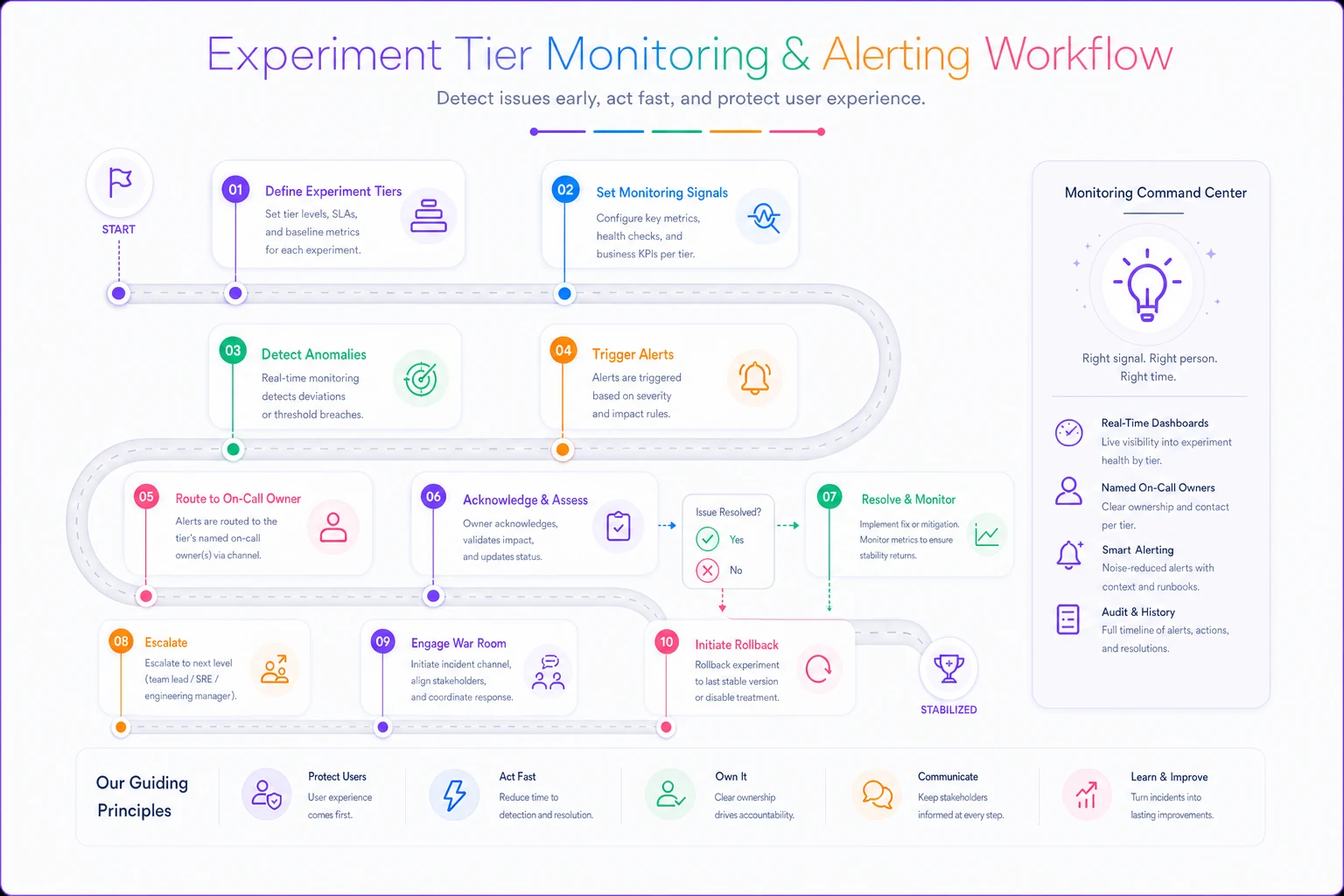
Across all tiers: monitoring intensity should match how long it takes to notice and how much accrues while you're not looking. A high-traffic, slow-to-detect experiment needs tighter monitoring than a low-traffic, fails-loudly one, even at the same nominal tier.
Rollback playbooks: the part everyone skips until they need it
A rollback plan that lives in someone's head is not a rollback plan. The whole reason higher-tier experiments need documented, tested rollbacks is that the moment you actually need one is the worst possible moment to be figuring it out — metrics are dropping, someone's asking questions, and the person who built the thing is on vacation.
-
What's the abort trigger? The specific condition that means "stop now" — a metric threshold, an error spike, a support ticket surge, or a manual judgment call by a named person.
-
Who makes the call? One named decision-maker, plus a backup. Not "the team." A team can't decide in five minutes.
-
What are the exact rollback steps? Numbered, in order, specific enough that someone who didn't build it could execute them.
-
What's the state after rollback? Does reverting leave data in a weird half-state? Are there in-flight transactions to handle? For operational pilots this is where the real work hides.
-
Who gets notified, and what do they get told? Internal stakeholders, affected customers if any, support staff who'll field questions.
-
How do you confirm the rollback actually worked? The check that proves you're back to baseline, not just that you flipped the switch off.
For T4, add one more requirement: dry-run the rollback before launch. Not a mental walkthrough — actually execute the rollback path in a safe environment and time it. Teams are regularly surprised that the "instant" rollback they assumed takes forty minutes in practice because of a data cleanup step nobody accounted for.
This is also where a lot of value leaks after the fact. Even clean rollbacks teach you something, and if you're not capturing that, you're paying for failures without banking the learning. The same discipline that keeps pilots from quietly losing their gains — worth reading more on in this benefits-realization playbook — applies to rollbacks too: the experiment isn't done when you flip the flag off, it's done when you've recorded why and fed it back into how you tier.
Worked example: low-risk UX test
A mid-sized SaaS team runs a T1 test — reordering the fields on a signup form to see if a shorter first step lifts completion. Blast radius: cosmetic, fully behind a flag, affects new signups only.
-
Approval The experiment owner self-authorizes. No meeting.
-
Monitoring Signup completion rate on the dashboard, checked at 24 and 72 hours. An automated alert if completion drops more than a few points.
-
Rollback Flag off. Thirty seconds. No data concerns because nothing persistent changed.
They ship it Tuesday morning. By Thursday they've got enough signal — completion up a few points, nothing dramatic but real. Total governance overhead: maybe twenty minutes across the whole thing. That's the point. Low-risk work should feel almost frictionless, because the cost of being wrong is tiny and reversible.
Worked example: high-risk operational pilot
Now the other end. The same company wants to pilot automated refund approvals — routing refund requests under a certain dollar amount straight through without manual review, to cut support load. This is T4. It touches money, it changes a live support workflow, and a mistake means either refunding things that shouldn't be refunded or blocking legitimate ones.
-
Approval Support ops lead, finance, and a risk reviewer sign off. Legal confirms there's no contractual issue with the refund terms. This takes a week, and it should.
-
Scope control The pilot runs on refunds under a set threshold, for one product line, for a two-week window — roughly 15% of refund volume, not all of it. Containing blast radius is itself a risk control.
-
Monitoring Real-time alerting on auto-approval rate, total dollars auto-refunded per day, and any spike in refund volume that might indicate abuse. A named on-call owner. A ten-minute daily standup during the pilot to review the numbers.
-
Abort trigger If auto-refunded dollars exceed the daily cap, or if refund request volume jumps more than a set percentage over baseline, the automation pauses and everything reverts to manual review.
-
Rollback Documented and dry-run before launch. Flipping off the automation routes everything back to the manual queue — but the playbook also specifies how to handle refunds that were in-flight at the moment of rollback, which is the part a naive version would miss.
Two days in, auto-refund dollars run higher than projected because a pricing edge case let a batch of larger refunds slip under the threshold. The alert fires. The named owner pauses the automation, and the in-flight queue gets handled manually per the playbook. Total exposure: contained to a known, capped amount rather than discovered weeks later in a finance reconciliation. The pilot didn't "fail" — the risk system did exactly what it was supposed to do.
Where this breaks at scale
Tier drift. Over time, teams start reflexively tagging things T1 to skip approval. Without periodic auditing — pulling a sample of recent T1 experiments and asking whether they really belonged there — the whole model erodes into "everything is low risk." A monthly spot-check keeps people honest.
Monitoring debt. As experiment volume grows, nobody can manually watch everything. If your monitoring obligations depend on humans remembering to check dashboards, they will quietly stop being met. Higher tiers especially need alerting that runs whether or not anyone's paying attention.
Orphaned experiments. Experiments get launched and never formally closed. The flag stays on for months. Nobody's monitoring it anymore because everyone assumes it ended. At scale this is real risk accumulation — live changes in production with no owner. A lifecycle rule (every experiment has an end date and a required closeout) prevents this.
Approver bottleneck migration. When you fix the committee bottleneck with tiering, the T3/T4 reviewers can become the new bottleneck if too many experiments escalate. If you notice everything creeping up to T3, that's a signal your T1/T2 criteria are too conservative, not that you need more reviewers.
The connective tissue across all of these is ownership. Every tier, every experiment, needs a named human accountable for it from launch to closeout. Programs that scale cleanly treat "who owns this" as a required field, not an afterthought. The same funnel discipline that turns raw ideas into contained micro-experiments — covered in this piece on turning employee ideas into fast micro-experiments — is what feeds a tiering model cleanly, because experiments arrive already scoped and owned.
When a heavy risk model makes sense — and when it doesn't
It makes sense when: you're running experiments that touch money, customer data, or live operations; you have multiple teams experimenting independently; a past experiment has already caused a visible problem; or you operate under real regulatory or contractual constraints.
It's a bad idea when: your entire program is cosmetic, low-traffic UX testing with instant rollback and no financial exposure. Building a T4 playbook process for a team that only ever reorders landing-page sections is pure ceremony. You'll spend more on governance than the risk is worth, and your people will route around it.
Who should not do this yet: very early programs running their first handful of experiments. Start with two tiers — "reversible and low-stakes, just do it" versus "touches something that matters, get a second set of eyes." Add the finer tiers only when volume and variety force you to. Over-engineering governance before you have the experiment volume to justify it is one of the most reliable ways to kill a young program.
Making the whole thing hold together
Tiered risk management works because it matches the cost of oversight to the cost of being wrong. That sounds obvious written down, but almost every program that struggles with experimentation governance has violated it in one direction or the other — either strangling cheap experiments or waving through expensive ones.
If you build nothing else, build three things: a fast, consistent way to assign a tier, alerting that doesn't depend on human memory for your higher tiers, and a documented, tested rollback for anything that touches money, data, or live operations. Everything else is refinement.
The programs that run hundreds of experiments without a major incident aren't the ones with the heaviest process. They're the ones where the low-risk stuff moves fast and the high-risk stuff gets real attention — and where someone's name is attached to every experiment from the day it launches to the day it's formally closed. Done right, risk management is what lets teams move faster, not slower. It just moves the friction to the places where friction actually earns its keep.
The programs that run hundreds of experiments without a major incident aren't the ones with the heaviest process. They're the ones where the low-risk stuff moves fast and the high-risk stuff gets real attention — and where someone's name is attached to every experiment from the day it launches to the day it's formally closed. Done right, risk management is what lets teams move faster, not slower. It just moves the friction to the places where friction actually earns its keep.
Ready to transform your innovation process?
Join 2,000+ companies using GoIdeafy to unlock team creativity, prioritize impactful ideas, and accelerate growth.