

A pilot fails. Someone schedules a "lessons learned" session three weeks later. Half the team has already rolled onto new work, the Slack channel is archived, and the person who ran the experiment is now reconstructing events from memory and a few leftover dashboards. The retrospective produces a document. The document goes into a shared drive folder. Nobody opens it again.
This is the normal failure mode, and it's worth being blunt about why: most retrospective processes are built around documentation instead of reuse. The output is a record, not an input to future decisions. That distinction changes everything about how you design the template, what evidence you demand, and how you decide whether a failed pilot's artifacts get cataloged or quietly retired.
What follows is a toolkit — template-first retrospective prompts, a short learning report format, evidence thresholds for reuse, and a decision tree for sorting what to keep. The whole thing is built around one assumption: a retrospective only matters if it changes what someone does six months from now.
The core problem: retrospectives optimize for closure, not retrieval
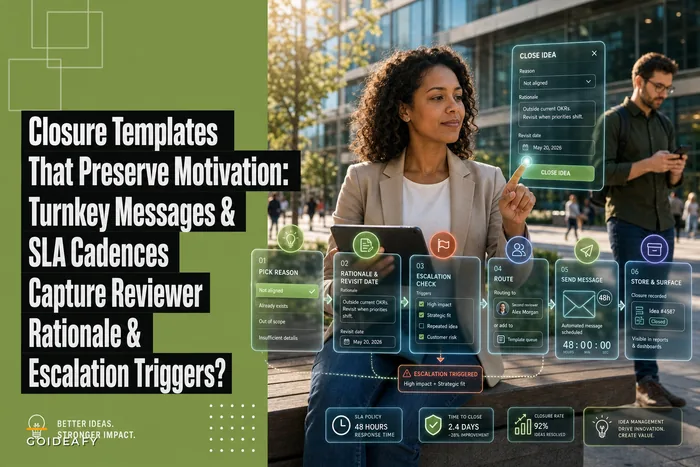
When a team writes up a failed pilot, the unspoken goal is usually emotional and administrative. Close the loop. Give people a sense of ending. Satisfy whatever governance step requires a sign-off. We've written separately about closure templates that preserve motivation and capture missing context, and that side of the work matters — but closure and reuse are two different jobs, and most teams try to force one template to do both.
The pattern you see repeatedly: retrospective docs organized chronologically ("what we did in week 1, week 2...") or emotionally ("what went well / what didn't"). Both formats are useless for retrieval. Nobody searching for prior art thinks "let me find a pilot that went well in week 2." They think: "Has anyone tried pricing experiments with our enterprise segment and what happened?"
That retrieval question is structured around conditions, decisions, and outcomes. If your template isn't structured the same way, the knowledge is effectively lost the moment the meeting ends — even though the file technically exists.
Template-first prompts that force the right content
The fix starts with the template, not the meeting. Give people a blank "write up your learnings" box and you get narrative sprawl. Give them specific prompts and you get structured, comparable records. Template-first means the questions handle the structure so the team only has to supply answers.
Capture, evaluate, and act on ideas without friction.
GoIdeafy streamlines the entire innovation lifecycle from idea submission to implementation.
- Centralized idea capture
- Collaborative evaluation tools
- Progress tracking & analytics
No credit card required
-
Hypothesis as stated at kickoff Copy-paste the original hypothesis, word for word. Not a reconstructed version. If it was never written down, that's finding number one.
-
What we believed that turned out false The single assumption that, had you known it, would have changed the decision to run the pilot.
-
What was true but we underweighted The signal that existed before the pilot and got ignored.
-
Decision points and the information available at each Three to five moments where someone chose a direction, plus what they knew at that moment.
-
The kill condition — defined vs. actual What would have told you to stop, versus what actually made you stop. These are rarely the same, and the gap is usually the lesson.
-
Transferable vs. context-specific Which findings apply beyond this exact pilot, and which were quirks of timing, team, or market.
Fill the template within 5 to 7 business days while the pilot is still warm.
That last prompt is the one most templates skip, and it's the most important for reuse. A finding like "the integration took longer than expected" is context-specific and nearly worthless. A finding like "any pilot touching the billing system needs a 3-week legacy-API buffer that we consistently forget to budget" is transferable and saves the next team a month.
One operational note: fill the template while the pilot is still warm. The honest window is about 5 to 7 business days after a pilot stops. After two weeks, memory smooths over the messy decision points — which are exactly the parts worth capturing.
Keep the learning report short on purpose
There's a strong temptation to make failed-pilot writeups thorough, as if length equals rigor. The opposite is true. A 10-page retrospective signals that nobody filtered. A one-page learning report forces the team to decide what actually matters.
-
One-line summary of the pilot and its outcome
-
The falsified assumption (the headline learning)
-
Two to four transferable findings, each tagged with a confidence level
-
Evidence pointers — links to the dashboard, the raw data, the decision log
-
Reuse verdict — catalog, retire, or revisit later
-
Owner and date
The depth lives in the linked evidence, not the prose. The report is an index, not an encyclopedia. If someone needs the full story, they follow the pointers. Most people never will — they just need to know the assumption that got falsified and whether it's relevant to what they're about to try.
Something worth watching: teams that write short reports tend to write more of them. When the format takes 40 minutes instead of a full afternoon, retrospectives stop feeling like punishment and actually happen for the small failed experiments too — which are often where the reusable lessons hide.
Evidence thresholds: not every "learning" deserves to be reused
There's a quieter problem here that causes real damage. A pilot fails, someone writes "customers don't want self-service onboarding," and that sentence hardens into organizational truth. Eighteen months later, a different team avoids a genuinely good idea because of one underpowered pilot with 11 users and a broken signup flow.
| Confidence tier | What it means | What you're allowed to do with it |
|---|---|---|
| Signal | One pilot, small sample, confounded or messy conditions | Note it. Flag for retest. Do NOT block future work based on it. |
| Pattern | Repeated across 2–3 pilots, or one clean pilot with adequate sample | Catalog it. Use it to adjust future pilot design. |
| Established | Consistent across multiple contexts and teams | Treat as a planning assumption. Bake it into templates and checklists. |
Practical rule: a single failed pilot almost never produces an "Established" finding. It produces a Signal, maybe a Pattern if the data was clean. Forcing teams to label the tier prevents the most expensive mistake in innovation — killing a direction permanently based on one weak experiment.
A real example of how this plays out: a mid-market product team ran a pilot on a referral-incentive mechanic, got roughly 60 participants, saw weak uptake, and nearly wrote "referral incentives don't work for our users" into permanent lore. Grading it as a Signal instead of a fact kept the door open. A later, better-instrumented test with a cleaner audience segment performed fine. The only thing that saved the second attempt was the evidence tier forcing honesty about the first.
The reuse decision tree: catalog, retire, or revisit
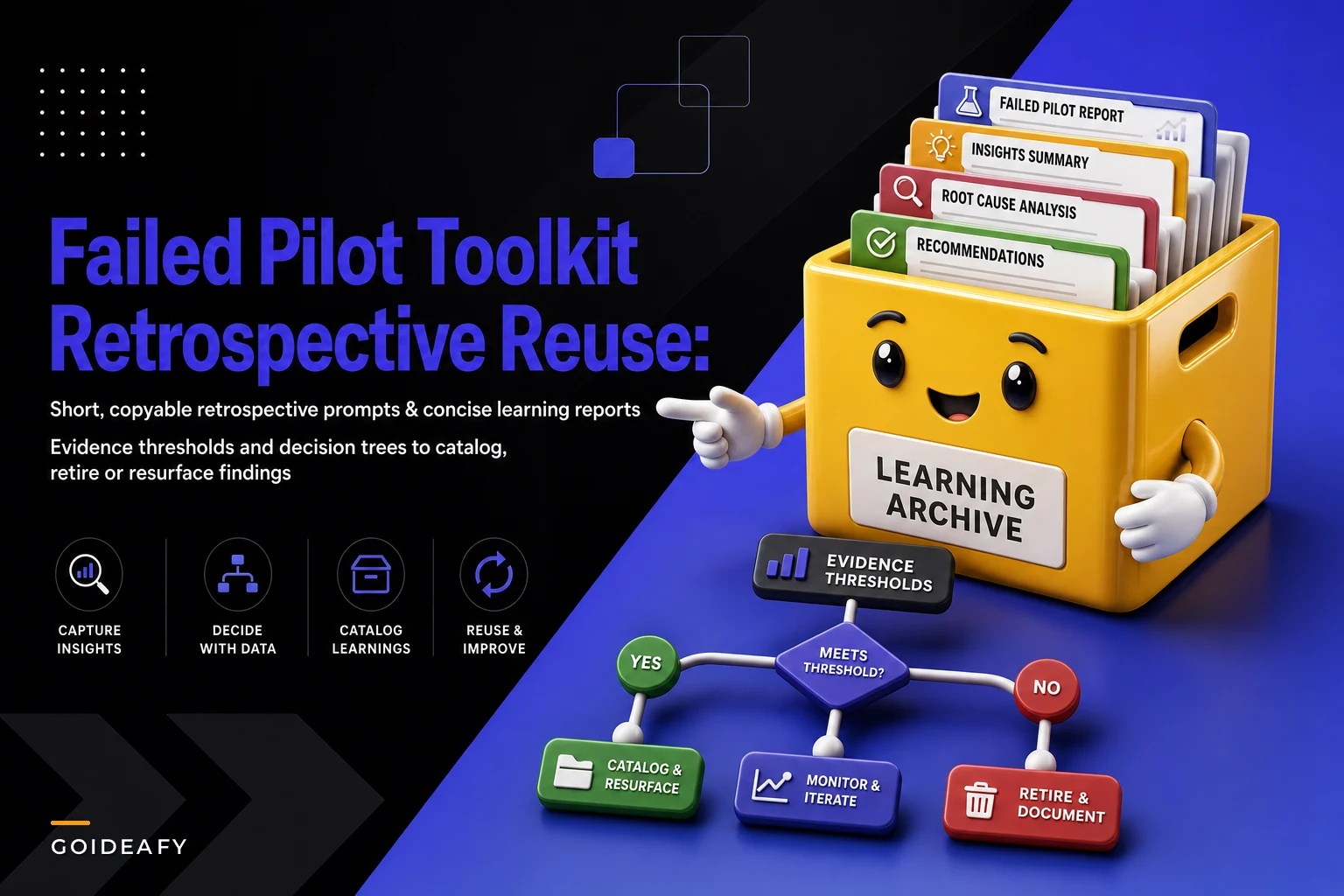
START: Pilot retrospective complete │ ▼ Did the pilot produce at least one transferable finding graded Pattern or higher? │ No ──┼── Yes │ │ ▼ ▼ Is there a reusable Is the finding likely artifact (test harness, to stay true, or tied survey, pipeline, etc)? to changing conditions? │ │ No ──┼── Yes Stays ──┼── Condition- │ │ true │ dependent ▼ ▼ ▼ ▼ RETIRE CATALOG CATALOG CATALOG asset only as durable with expiry/ (findings learning revisit date inconclusive)
-
Did the pilot produce at least one transferable finding graded Pattern or higher? - No → go to step 2 - Yes → go to step 3
-
Is there a reusable artifact (a test harness, a survey instrument, a landing page, a data pipeline) even if the findings were weak? - No → Retire. Archive the one-page report for audit, remove from the active catalog. - Yes → Catalog the asset only, with a note that findings were inconclusive.
-
Is the finding likely to stay true, or is it tied to conditions that change (market, pricing, a specific tool)? - Stays true → Catalog as a durable learning. Link it into relevant pilot templates. - Condition-dependent → Catalog with an expiry/revisit date. Flag for review when conditions shift.
The expiry concept matters more than people expect. A finding like "this payment provider's API can't handle our volume" is true until the provider ships an upgrade. Cataloging it with a 12-month revisit date prevents a stale "fact" from blocking a future pilot. Durable findings — like "our enterprise buyers won't self-serve contracts over a certain deal size" — don't need expiries because the underlying behavior is stable.
When you consistently route artifacts this way, your catalog stays lean and trustworthy. This connects directly to how you structure the records themselves — the metadata and lifecycle governance in the internal experiment catalogue is what makes any of these cataloged findings findable later. A decision tree without a well-structured catalog just moves the clutter one folder over.
Where lightweight automation earns its place
None of this requires software to work. You can run the whole toolkit with a shared doc and some discipline. But a few specific points in the workflow are where manual process quietly breaks down.
The first is the tagging and retrieval step. Humans are inconsistent at tagging. One person files under "pricing," another under "monetization," a third under "revenue experiments," and now your catalog has three siloed buckets for the same topic. AI-assisted tagging — where the system reads the learning report, suggests consistent tags, and surfaces near-duplicate prior pilots — fixes a problem that pure discipline rarely solves at scale. The retrospective author approves or corrects the suggestion; they don't start from a blank field.
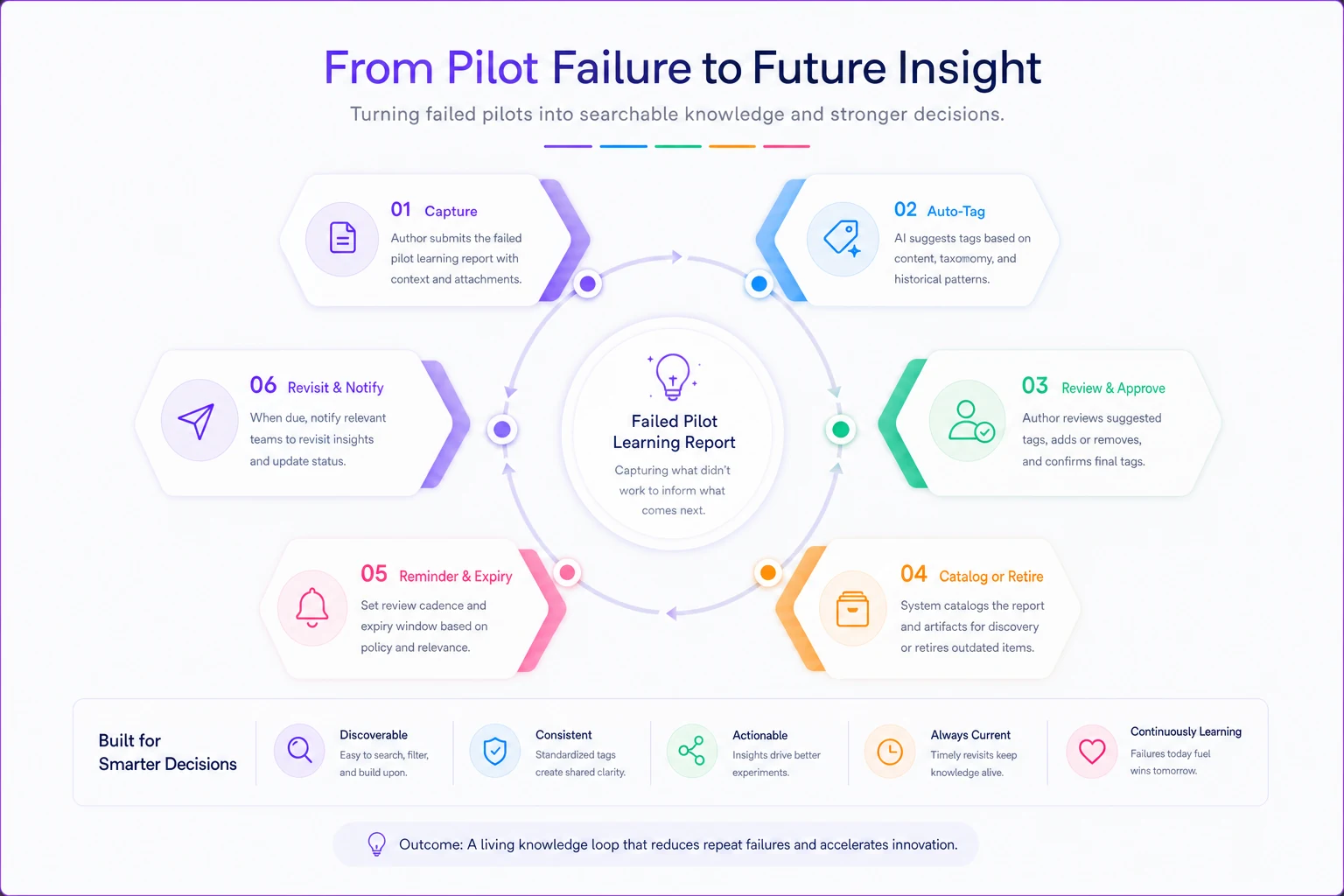
The second is the revisit reminder. Condition-dependent findings with expiry dates only help if someone actually gets pinged when the date arrives. In practice, those reminders die in a spreadsheet nobody checks. A workflow platform that owns the lifecycle — flagging findings for review, nudging the owner, and quietly retiring reports that pass their audit window — keeps the catalog honest without anyone babysitting it.
The point isn't to automate judgment. Evidence grading and the keep/retire decision should stay human. Automation just removes the two tasks people are reliably bad at: consistent tagging and remembering to revisit old conclusions.
When this toolkit is overkill
Be honest about scope. If your team runs three pilots a year, you don't need a decision tree — you'll remember all three. The reuse machinery pays off once you're running enough experiments that nobody can hold the full history in their head. That's usually somewhere north of 15 to 20 pilots a year, or multiple teams running pilots in parallel who can't see each other's work.
It's also a bad fit for teams whose pilots are wildly heterogeneous. If no two experiments share enough context for findings to transfer, the "transferable vs. context-specific" prompt will almost always land on context-specific, and you're doing paperwork for nothing. Strip the toolkit down to just the one-page report and skip the catalog entirely.
And if your organization punishes failed pilots, fix that first. No template rescues a retrospective where people are protecting themselves. You'll get sanitized reports with no falsified assumptions — which are worse than useless because they look complete while hiding the actual lesson.
Bringing it together
A failed pilot is only wasted if the organization learns nothing it can reuse. The retrospective process that prevents that waste is narrower than most teams assume: template-first prompts that force structured, comparable answers; a one-page learning report that acts as an index rather than a story; evidence tiers that stop weak conclusions from hardening into permanent facts; and a decision tree that sorts artifacts into catalog, retire, or revisit instead of saving everything by default.
Run that honestly and the shape of your innovation program changes. Teams stop re-running experiments that already failed for known reasons. Good directions stop getting killed by one underpowered pilot. And the next person who asks "has anyone tried this?" actually gets a real answer instead of a folder full of chronological writeups nobody can parse.
Start with the template. Everything else in the toolkit only works because the prompts forced the right content in the first place.
Ready to transform your innovation process?
Join 2,000+ companies using GoIdeafy to unlock team creativity, prioritize impactful ideas, and accelerate growth.