


Most innovation managers treat their community of practice like a monthly meeting series. Set up a Teams channel, schedule some workshops, hope people show up. Then wonder why participation drops after month three.
Scaling an innovation community of practice requires the same operational rigor you'd apply to any critical business function. You need governance structures, clear progression paths, and rituals that become embedded in how people work—not bolted on top of everything else they're already doing.
The difference between thriving innovation communities and dead Slack channels usually comes down to three things: governance scaffolding, mentor progression ladders, and onboarding rituals that actually stick.
The Governance Gap That Kills Most Communities
Innovation communities fail when they run on enthusiasm alone. You get that initial burst of energy—people volunteer to lead workstreams, everyone's excited about the possibilities—then reality hits around week eight. The volunteers get pulled back into their day jobs. Meetings get rescheduled. The community slowly bleeds momentum until it exists only as a line item in someone's quarterly update.
The problem isn't motivation. Most organizations try to run innovation communities without proper governance infrastructure, treating community management like a side project instead of an operational function that needs clear roles, decision rights, and accountability mechanisms.
What works is building a lightweight but explicit governance model from day one. Not heavy bureaucracy—that kills innovation faster than anything—but clear enough structure that the community can run itself without depending on a single person's energy.
Start with a three-tier moderator staffing model:
-
Champions own specific innovation domains or challenge areas. These aren't just subject matter experts; they're operational owners responsible for keeping their domain active.
-
Facilitators run the actual sessions, manage collaboration tools, and keep discussions moving.
-
Members contribute ideas and feedback but aren't responsible for community operations.
The key distinction is making these real roles with real accountability, not honorary titles. Champions should have explicit time allocation—typically 10–15% of their week—built into their performance goals. Facilitators need clear session targets and engagement metrics. Without this operational clarity, you're just hoping people will volunteer their nights and weekends indefinitely.
Building Champion Nomination Systems That Don't Create Politics
Choosing the right Champions determines whether your innovation community becomes a genuine source of breakthrough ideas or just another corporate committee. Most organizations get this wrong by either appointing Champions from above—which kills grassroots credibility—or letting it become a popularity contest, which creates political dynamics that poison the culture.
Capture, evaluate, and act on ideas without friction.
GoIdeafy streamlines the entire innovation lifecycle from idea submission to implementation.
- Centralized idea capture
- Collaborative evaluation tools
- Progress tracking & analytics
No credit card required
The nomination process needs to balance grassroots support with operational capability. A hybrid model works well: community members can nominate Champions, but nominees must demonstrate specific competencies before confirmation.
Evaluate potential Champions on four dimensions: domain expertise, facilitation skills, network reach, and operational bandwidth. That last one is where most nomination processes fall apart. Someone might be your best innovation thinker, but if they're already stretched across three initiatives, making them a Champion just sets everyone up for failure.
Run nomination cycles quarterly, not annually. Annual cycles create stagnation; monthly cycles create chaos. Quarterly hits the right balance between stability and renewal.
Document the nomination process explicitly—eligibility criteria, nomination windows, evaluation timelines, transition protocols. This prevents the "why wasn't I considered?" conversations that quietly poison community trust.
Mentorship Ladders That Create Natural Progression
Innovation communities thrive when members see a clear path forward. Not everyone wants to become a Champion, but everyone should understand how to deepen their involvement if they choose to. Mentor ladder systems create those natural progression paths without turning mentorship into yet another obligation.
The typical mistake is creating mentorship programs that feel like extra work on top of already full schedules. Instead, embed mentorship into the natural flow of innovation work.
Structure your ladder around project involvement, not time commitment:
-
Entry-level members observe and contribute to existing innovation projects.
-
As they demonstrate capability, they lead project workstreams.
-
Proven workstream leaders become eligible to mentor new members through their first projects.
Each ladder rung should have clear, observable behaviors signaling readiness for progression. Moving from Observer to Contributor might require participating in three ideation sessions and submitting at least one idea that reaches prototype stage. Moving from Contributor to Workstream Lead might require successfully shepherding an idea through your innovation governance framework to pilot stage.
Behavioral markers beat time-based progression because motivated members can advance quickly while others can stay at comfortable involvement levels without feeling pressured. This keeps the community from becoming either too exclusive or too loose.
Build peer mentoring into each progression step. When someone becomes a Workstream Lead, pair them with an experienced Lead for their first project—not a formal mentoring relationship with scheduled check-ins, just operational support embedded in actual work. After completing one project with that support, they operate independently.
Community Health Metrics Beyond Participation Rates
Most innovation communities track the wrong things. They count session attendance, ideas submitted, maybe engagement rates on their collaboration platform. These surface metrics miss what actually matters: is the community generating valuable innovations that get implemented?
Real community health shows up in second-order metrics. Track idea progression velocity—how quickly do ideas move from submission to prototype? Monitor cross-functional participation—are you getting input from operations, not just R&D? Measure implementation rates—what percentage of community-generated ideas actually make it to production?
One metric worth paying close attention to is community metabolism: how quickly the community processes ideas from inception to decision. Healthy communities make go/no-go decisions within roughly 30 days of idea submission. Slow metabolism kills innovation energy. People stop contributing when their ideas sit in limbo for months.
A simple dashboard tracking four core health indicators works well:
| Metric Category | What to Track |
|---|---|
| Velocity | Avg. time from idea to prototype, % of ideas receiving feedback within 72 hours, avg. decision cycle time |
| Diversity | Department representation across active members, seniority mix in leadership roles, geographic distribution |
| Impact | Number of implemented innovations, estimated value created, % of strategic initiatives influenced by community ideas |
| Engagement | Peer-to-peer collaboration frequency, knowledge sharing activity, sustained involvement over time |
These metrics need to be visible to the entire community, not buried in management reports. When members see their collective impact, it reinforces why participation matters. It also creates natural accountability—no Champion wants their domain showing the slowest progression velocity on a public dashboard.
Onboarding Rituals That Actually Stick
New member onboarding determines whether your innovation community grows or just churns through participants. Most organizations treat onboarding as orientation—here's how we work, here's where to submit ideas, good luck. Then they wonder why new members never become active contributors.
Effective onboarding isn't about information transfer; it's about creating immediate value exchange. New members need to experience both giving and receiving value within their first week, or they'll drift back to observer mode permanently.
Design "Day One Contribution" protocols. Every new member should contribute something meaningful in their first session, even if it's just providing structured feedback on existing ideas. This breaks the observer mindset and establishes active participation as the default from day one.
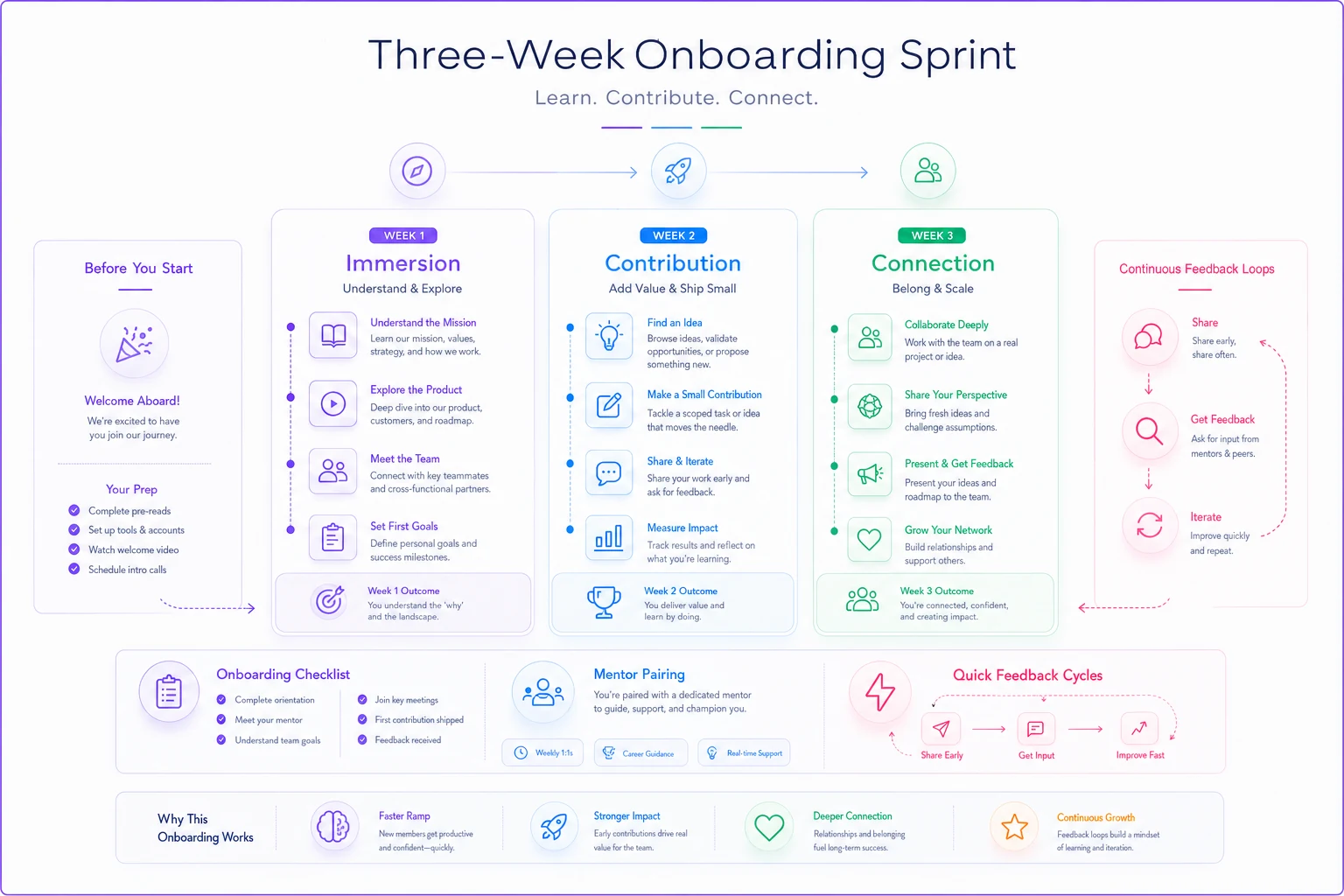
Structure onboarding as a three-week sprint:
Week 1 – Immersion: New members join an active innovation project as observers with specific observation tasks—documenting assumptions, identifying overlooked risks, suggesting alternative approaches. They're inside real work immediately, which also provides value to existing projects.
Week 2 – Contribution: New members workshop their own innovation challenge with support from experienced facilitators. Could be a problem from their day job or a challenge assigned by their Champion. The goal isn't to fully solve it but to experience the community's innovation process firsthand.
Week 3 – Connection: New members present their workshopped idea to a mixed group of Champions and peers. This creates visibility, builds network connections, and often leads to natural collaboration.
Onboarding culminates in a simple certification checklist confirming the new member has experienced each core community function: submitted an idea, provided feedback on others' ideas, participated in a workshop, and connected with at least three members outside their department.
Visualize the three-week onboarding sprint as a simple workflow.
Make new member tasks provide immediate value to existing projects to ensure buy-in.
This serves two purposes. It ensures every member has the basic skills to contribute effectively, and it creates a sense of belonging—they're not just attending meetings, they're part of the community in a real way.
Ready-to-Run Certification Frameworks
Certification sounds formal, but it shouldn't feel like corporate training. The best certification frameworks validate practical capability through actual work, not knowledge tests.
Design certification around innovation project milestones. Can members use your ideation tools? Can they build a business case? Can they facilitate a productive brainstorming session? Those are the things worth validating.
A framework that works in practice:
Foundation Level (All Members):
-
Submit one idea through your innovation platform.
-
Provide structured feedback on three peer ideas.
-
Participate in one ideation workshop.
-
Complete one innovation sprint, even as an observer.
Facilitator Level (For Those Running Sessions):
-
Successfully facilitate three ideation sessions with satisfaction scores above 4.0.
-
Document and share one innovation method or tool.
-
Mentor two new members through foundation certification.
-
Generate at least five implemented quick wins from facilitated sessions.
Champion Level (For Domain Owners):
-
Launch and sustain one innovation workstream for a minimum of three months.
-
Develop and deliver one innovation capability training.
-
Generate at least one scaled innovation with measurable impact.
-
Build a cross-functional coalition for at least one major initiative.
These aren't knowledge tests—they're proof of operational capability. Someone either facilitated those sessions or they didn't. The quick wins either got implemented or they didn't. This removes subjectivity while keeping the focus on what actually matters.
Make certification visible but not hierarchical. Simple badges in your collaboration platform work fine. The goal is helping members understand capabilities across the community, not establishing pecking orders.
The Operational Reality of Scaling Innovation Communities
Without proper operational infrastructure, the pattern tends to look the same everywhere. Initial enthusiasm carries things for about two months. A few dedicated Champions keep things moving into month three or four. By month six, the community exists mostly in name only, with sporadic activity whenever someone remembers to schedule a session.
Communities that are still thriving years later didn't succeed because they had more innovative people. They had better operational systems. They treated community governance the way they'd treat any critical business function—clear roles, progression paths, metrics, and embedded rituals that didn't depend on anyone's memory or goodwill.
You also don't need a massive transformation to build these systems. Start with the three-tier governance model. Add behavioral progression ladders. Implement health metrics that track real impact, not just activity. Design onboarding around immediate value exchange. Build certification that validates capability through actual work.
Every governance structure, every progression ladder, every certification requirement should make innovation easier, not harder. The moment your community infrastructure becomes a barrier rather than an enabler, you've lost the thread.
Innovation communities fail when they rely on heroic effort from a few dedicated people. They succeed when they build systems that let ordinary people contribute extraordinary ideas. That's not about talent—it's about the operational infrastructure that either enables or constrains it.
Understanding how to measure psychological safety in your idea program participation matters here too. Even well-designed governance can stall if members don't feel safe contributing. The operational systems and cultural conditions have to work together, or neither fully lands.
The organizations getting this right aren't necessarily the most innovative by nature. They're simply the ones who recognized that scaling innovation requires the same operational discipline as scaling any other business capability—governance, progression paths, and rituals that sustain momentum long after the initial excitement fades.
Ready to transform your innovation process?
Join 2,000+ companies using GoIdeafy to unlock team creativity, prioritize impactful ideas, and accelerate growth.