


The moment you grow past one or two trusted evaluators, your scoring quietly stops being about the ideas. It becomes about who happened to land on the panel that week.
Most teams don't notice this until something embarrassing surfaces — two nearly identical submissions getting wildly different scores, or a department head quietly asking why the same three people keep killing their pilots. By then the damage is reputational, and winning back trust in your evaluation process takes months.
This piece is a working evaluation panel rotation playbook: the selection rules, rotation schedules, diversity quotas, conflict-of-interest handling, and QA sampling you need to run panels at scale without them drifting into inconsistency or favoritism. It assumes you already have a rubric and some evaluators. The problem here is narrower and more annoying — keeping those panels reliable as headcount, volume, and politics all grow at once.
The specific failure: panel composition becomes invisible
Here's the pattern that shows up again and again once a program scales.
In the early days, you have maybe four evaluators. Everyone knows everyone. Scoring feels consistent because the same small group is calibrating constantly — informally, over lunch. Then volume triples. You recruit twelve more reviewers. Suddenly you're assembling panels ad hoc, grabbing whoever has bandwidth that sprint.
Nobody is tracking composition. And that's the whole problem.
A typical example looks like this: an idea from the supply-chain team gets routed to a panel of three engineers and a finance analyst. None of them have operational context for warehouse workflows. They score it a 4 out of 10 on feasibility — not because it's infeasible, but because they can't see the feasibility. Two weeks later, a near-duplicate idea lands in front of a panel with an ops lead on it and scores an 8.
Same idea. Different room. Different outcome. The variance isn't in the ideas — it's in the composition nobody designed.
Why this happens (and why it gets worse with scale)
Panel assignment usually optimizes for the wrong thing: availability. Whoever has a free hour gets pulled in. That feels efficient. It's actually how bias compounds.
Capture, evaluate, and act on ideas without friction.
GoIdeafy streamlines the entire innovation lifecycle from idea submission to implementation.
- Centralized idea capture
- Collaborative evaluation tools
- Progress tracking & analytics
No credit card required
A few forces make it worse as you grow:
-
The "reliable volunteer" trap. A handful of evaluators always say yes. They end up on 40–50% of panels. Their preferences quietly become the program's de facto scoring standard, and nobody voted for that.
-
Domain clustering. Technical people are easier to recruit for technical programs, so panels skew heavily toward one function. Ideas that need commercial or operational judgment get systematically underscored.
-
Conflict blindness. When you knew everyone personally, you knew who shouldn't review a given submission. At twenty-plus evaluators, that institutional memory is gone, and someone ends up scoring their own team's idea without anyone noticing.
None of this gets captured anywhere. Composition decisions happen in DMs and hallway conversations, which means you can't audit them, can't correct them, and can't prove the process was fair when someone challenges a decision.
If your evaluators are also stretched thin on throughput, these problems multiply — which is exactly why panel composition and evaluator shift planning need to be designed together, not as separate exercises.
The real cost of unmanaged panels
A mid-market program processing around 600–700 ideas a year through panels — if panel composition variance is causing even 8–10% of ideas to be mis-scored badly enough to flip a decision, that's roughly 50–60 ideas a year going the wrong way. Some good ones die. Some weak ones eat pilot budget.
The budget hit is bad, but the trust hit is worse. What tends to happen in programs that let this drift is a slow collapse in submission quality. Good contributors stop participating because they conclude the outcome is a coin flip depending on who's in the room. You can't easily measure that — it just shows up as a quiet decline in your best people engaging.
There's also an audit problem. When an executive challenges why their business unit's ideas keep stalling, "we assigned whoever was free" is not an answer that survives the meeting.
The rotation playbook: what actually works
The fix isn't complicated, but it requires treating panel composition as a designed system rather than a scheduling afterthought. Here's the structure.
1. Selection rules: define pools before you define panels
Don't pick individuals. Pick from pools.
Segment your evaluator roster into dimensions that matter for your program — typically function (engineering, ops, commercial, finance), seniority, and domain depth. Every panel then has composition requirements pulled from these pools, not a list of favorite names.
-
At least 2 different functions represented
-
At least 1 evaluator with direct domain context for the idea's category
-
No more than 1 evaluator above a certain seniority (so senior voices don't anchor the room)
The panel is assembled against a spec, and the spec is visible.
2. Rotation schedule: cap exposure, force fresh eyes
Set a hard ceiling on how often any single evaluator sits on panels. A workable target is no more than 25–30% of panels in a rolling quarter for any one person. This breaks the "reliable volunteer" monopoly and spreads the calibration load.
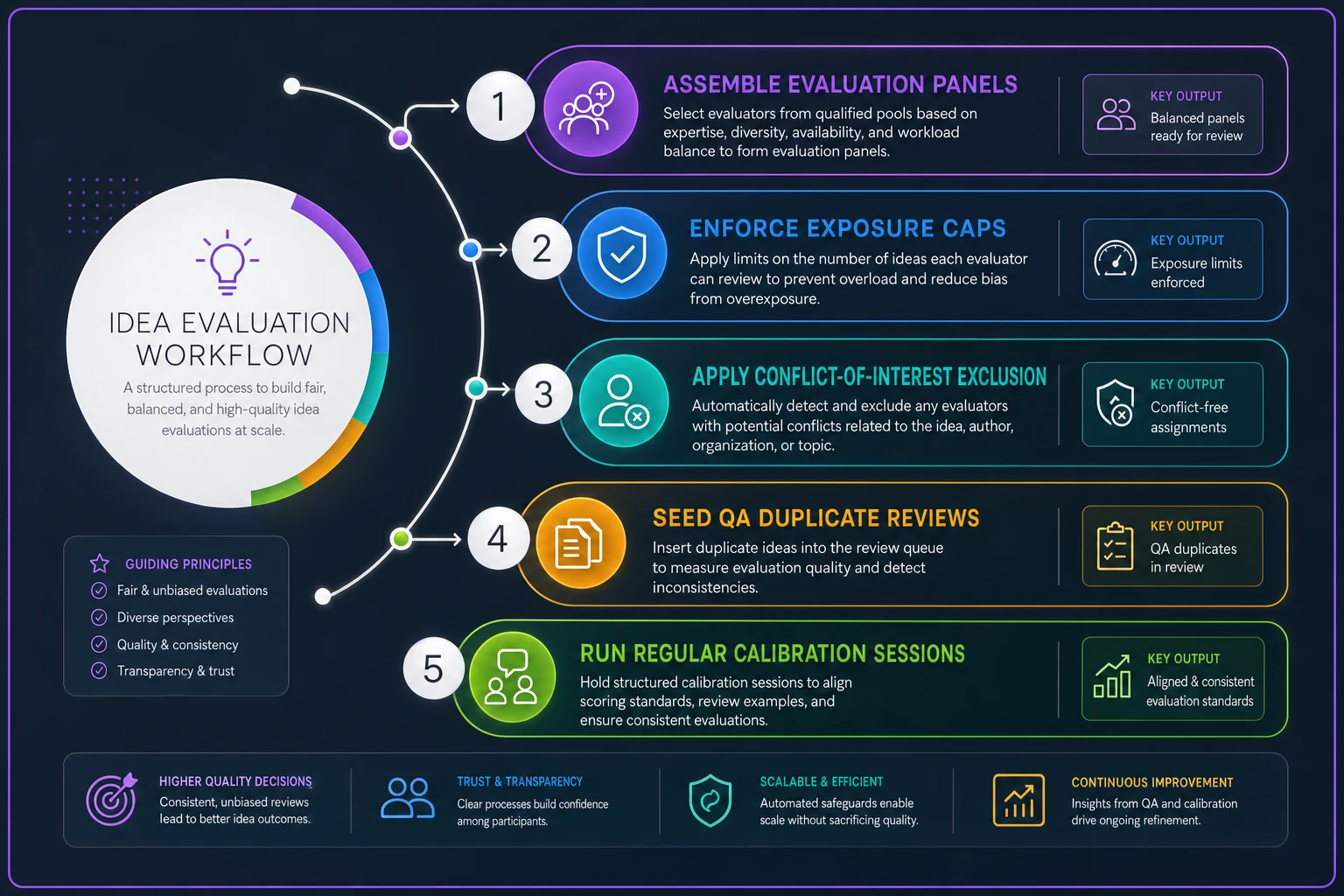
Below is a simple depiction of the panel assignment and QA workflow.
Rotation should also stagger — you don't want an entire panel to turn over at once, because then you lose continuity of judgment. Rotate roughly half the seats each cycle so there's always institutional memory in the room alongside fresh perspective.
Make pool specs visible so anyone can check a panel against its composition requirements.
3. Diversity quotas: treat them as reliability tools, not optics
This word makes people nervous, so be precise about what it means here. Diversity quotas in evaluation panels aren't about demographics for their own sake — they're about reducing correlated error.
When every evaluator thinks the same way, they make the same mistakes together, and the panel feels confident while being systematically wrong. Deliberately mixing function, tenure, risk appetite, and background forces disagreement to the surface, which is where real evaluation quality lives.
| Dimension | Minimum requirement | Why it matters |
|---|---|---|
| Functional mix | ≥ 2 functions | Prevents single-lens feasibility scoring |
| Domain context | ≥ 1 with direct context | Avoids "can't see it" undervaluation |
| Seniority spread | Mix of senior + non-senior | Reduces anchoring by loudest voice |
| Tenure mix | ≥ 1 newer evaluator | Fresh assumptions, fewer institutional blind spots |
| Risk appetite | Not all conservative | Keeps bold-but-viable ideas alive |
The quotas don't need to be perfect every time. They need to prevent the obviously bad compositions — all one function, all one seniority band, all the same team.
4. Conflict-of-interest rules: make exclusion automatic, not optional
The reliable way to handle conflicts is to make them a blocking condition in assignment, not a judgment call.
-
No evaluator scores an idea from their own direct team
-
No evaluator scores an idea where they're named as a potential owner or beneficiary
-
No evaluator scores an idea submitted by their direct manager or direct report
-
Disclosed personal conflicts auto-exclude, no debate required
The key word is automatic. If conflict checking depends on someone remembering the org chart, it will fail at scale. It needs to be a rule applied at assignment time, every time.
5. QA sampling: catch drift before it becomes a pattern
Rotation and quotas prevent bad composition. QA sampling catches whether your panels are actually scoring consistently once composed.
-
Seed duplicate reviews. Route a small percentage of ideas — somewhere around 5–8% — to two independent panels without telling either they're part of a check.
-
Measure score divergence. Compare the two panels' outputs. Small gaps are normal. Large, repeated gaps on the same idea categories signal a calibration problem.
-
Tag the outliers. Flag individual evaluators who consistently score far from panel consensus — in either direction. Harsh graders and easy graders both distort outcomes.
-
Feed it back. Bring divergence data into calibration sessions rather than just noting it in a dashboard nobody reads.
This mirrors the sampling logic in high-volume triage work — the same principles behind a solid moderator and curator playbook apply here, just aimed at panel scoring rather than intake moderation.
Calibration cadence: the part everyone skips
Rotation without calibration just spreads inconsistency more evenly. You need both.
-
Monthly micro-calibration (30–45 min) The panel pool reviews 2–3 recently scored ideas blind, scores them independently, then compares. Short, frequent, low-ceremony.
-
Quarterly deep calibration (half-day) Review the QA sampling divergence data. Discuss the ideas with the widest score gaps. Realign on rubric interpretation where drift has crept in.
-
Onboarding calibration for every new evaluator Before anyone scores live ideas, they score a standard set of past ideas with known consensus outcomes. If they're way off, they shadow before they score solo.
Frequency matters more than depth. Monthly light touches keep a panel aligned far better than one intensive session twice a year. Calibration is a muscle — it atrophies fast.
If you haven't done calibration exercises before, the mechanics of running them well are worth getting right, because a weak rubric makes calibration impossible. The approach in building a bias-resistant evaluation rubric pairs directly with the cadence here — you calibrate against the rubric, so the rubric has to be strong first.
A real scenario
A regional insurance firm running an internal innovation program had grown from 5 evaluators to 19 over about a year. Volume was around 540 ideas annually. Submitters were complaining — loudly — that outcomes felt random.
When they looked at the data, two things jumped out. First, four evaluators were on more than half of all panels. Second, nearly 60% of panels had zero representation from the business unit the idea came from.
They rebuilt around pools and composition rules. Capped individual panel exposure at roughly 30% per quarter. Required at least one domain-context evaluator per panel. Started seeding around 6% of ideas as blind duplicate reviews.
Within two quarters, score divergence on the duplicate-reviewed ideas dropped noticeably — the gap between independent panels narrowed by more than half on the categories that had been worst. Submission volume from previously disengaged business units ticked back up. Nothing dramatic overnight, but the complaints about randomness mostly stopped, which was the real win.
The interesting part: they didn't change their rubric or their people. They changed who sat in which room, and how often. That alone fixed most of it.
When this makes sense — and when it doesn't
When to build this out:
-
You're running more than ~10 evaluators and assembling panels regularly
-
You're processing enough volume that you can't track composition by memory
-
You've had at least one visible "same idea, different score" incident
-
Submitters are starting to question fairness
When it's overkill:
-
You have 3–5 evaluators who calibrate constantly and informally — formal rotation rules add bureaucracy you don't need yet
-
Your volume is low enough that every evaluator sees nearly every idea anyway
-
You're still figuring out your rubric — fix that first, because rotation can't rescue a vague scoring standard
Who should not do this:
teams that haven't nailed down a rubric at all. Rotation and calibration both assume there's a shared standard to calibrate toward. Without it, you're just rotating people between different versions of guesswork.
Making it sustainable
The honest obstacle is tracking. Pools, exposure caps, conflict rules, quota compliance, QA sampling rates, calibration attendance — managing all of that in a spreadsheet works for about a quarter before it quietly rots and people revert to grabbing whoever's free.
This is where an operational platform that handles evaluator assignment earns its place — applying conflict rules and composition quotas automatically at assignment time, flagging when an evaluator's exposure is creeping past the cap, and surfacing score divergence from QA samples without someone manually compiling it. The goal isn't to replace judgment. It's to make the composition decisions auditable and consistent so your evaluators can focus on the actual ideas.
But the tooling is secondary. The rules come first. A team that genuinely enforces pools, exposure caps, and automatic conflict exclusion with a disciplined spreadsheet beats a team with great software and no agreed standard, every time.
Get the composition right, keep the calibration frequent, and sample enough to catch drift early.
Do that, and your panels stay reliable no matter how many evaluators you add — which is the entire point of scaling in the first place.
Ready to transform your innovation process?
Join 2,000+ companies using GoIdeafy to unlock team creativity, prioritize impactful ideas, and accelerate growth.