



Most open innovation programs don't fail at the idea stage. They fail somewhere in the mess between "we found a great partner" and "that partner's idea is now running inside our business." The scouting looks healthy, the pipeline looks full, the leadership deck has logos. Then eighteen months in, someone asks a simple question — how many partner ideas have we actually integrated? — and the room goes quiet.
That gap is almost always structural. Partner models, scouting, governance, and integration routes get built by different people at different times, and nobody stitches them into one operating system. So this piece treats the whole thing as a system: the partner model you pick shapes how you scout, which shapes the governance you need, which shapes how ideas cross the line from "theirs" into "yours" through contracts, IP arrangements, and handoffs.
If you're scaling open innovation networks past a handful of pet relationships, the comparison below matters more than any single scouting tactic.
## Start With the Partner Model, Because Everything Downstream Inherits Its Flaws
The first real decision isn't who to partner with. It's what shape the partnership takes, because that shape determines how much governance you'll need to bolt on later. Teams tend to copy whatever model their last employer used, which is how a corporate-venture mindset ends up running a startup-accelerator program with none of the right muscles.
Each model has a different natural failure point. Pick one that mismatches your integration capacity and you'll generate ideas you can never absorb.
| Partner Model | Best For | Scouting Intensity | Governance Load | Common Failure Point |
|---|---|---|---|---|
| Bilateral strategic partnerships | Deep, few relationships | Low (relationship-led) | Medium (bespoke contracts) | Over-reliance on one champion who leaves |
| Open consortium / pre-competitive | Shared-cost R&D, standards | Medium | High (multi-party IP) | Decision paralysis, free-riders |
| Startup/scout network | Early-stage tech access | High (continuous) | Medium | Pipeline inflation, no integration path |
| Supplier-led co-development | Operational improvements | Low | Low–Medium | IP ownership disputes on "joint" work |
| University / research labs | Long-horizon science | Medium | High (publication vs. exclusivity) | Timeline mismatch, licensing friction |
The consortium model attracts the most enthusiasm and causes the most quiet suffering. It sounds efficient — share the cost, share the risk, pool the brains. In practice, a 6-member consortium with equal votes and unequal commitment turns into a committee where the two most invested members carry the work and everyone splits the IP evenly. That's not a partnership, that's a subsidy.
Bilateral has the opposite problem. It works beautifully until the one person who holds the relationship moves roles. There's no contract clause for "the only human who understood this deal just left," so the whole thing goes dormant.
When each model actually makes sense
-
Bilateral You have a small number of partners who move the needle, and you can afford to write custom terms for each.
-
Consortium The problem is genuinely pre-competitive — safety standards, shared infrastructure, regulatory groundwork — and no single member would fund it alone.
-
Scout network You have real integration capacity downstream. If you can only absorb three ideas a year, don't build a scouting engine that surfaces three hundred.
-
Supplier co-development The improvement lives inside an existing operational relationship and the IP boundaries are drawable up front.
Who should not do this
If your internal pipeline already loses most of its own ideas before pilot, adding external partners just adds volume to a leaky funnel. Fix the absorption problem first. A consortium is also a bad idea if you can't commit a named, funded team — showing up with good intentions and no budget is how you become the free-rider everyone resents.
## Scouting Playbooks: Match the Search to the Model, Not the Other Way Around
Scouting goes wrong when it becomes a standalone activity disconnected from what you can actually do with what you find. The symptom is a beautiful landscape report nobody acts on. The cause is that scouting was treated as research instead of as the front of a conveyor belt.
Capture, evaluate, and act on ideas without friction.
GoIdeafy streamlines the entire innovation lifecycle from idea submission to implementation.
- Centralized idea capture
- Collaborative evaluation tools
- Progress tracking & analytics
No credit card required
A working scouting playbook has three layers, and most teams only build the first one.
-
Sourcing — where leads come from (events, scouts, partner referrals, open calls, academic networks). Everyone does this.
-
Filtering — the explicit thesis that tells you what's in scope. Without a thesis, scouts bring back whatever's shiny.
-
Routing — the pre-decided path each type of find takes toward a decision. This is what separates programs that integrate from programs that collect.
Tie your scouting thesis directly to funded priorities. If a find doesn't map to a problem someone already owns budget for, it doesn't enter the pipeline — it goes into a "watch" list instead. This sounds harsh and it saves enormous waste. The portfolio lens matters as much externally as internally, and the same logic from aligning funding to impact applies here: a partner idea with no funded home is not an opportunity, it's a liability that consumes evaluation time.
Tie your scouting thesis directly to funded priorities.
A realistic scouting cadence
-
Weekly Scouts log new finds against the active thesis. Quick triage — in, watch, or out.
-
Monthly A routing review. Each "in" find gets assigned an owner and a next step, or it drops to "watch."
-
Quarterly Thesis refresh. Priorities shift, so the filter has to shift with them.
The failure mode here is skipping the monthly routing review. Finds pile up, ownership never gets assigned, and six months later nobody remembers why that startup was interesting. A scouting engine without routing is just an expensive bookmarking habit.
## Governance for Consortium Projects: The Part Everyone Rushes
Consortium governance is where good intentions meet contract reality, usually too late. The energy at the start of a multi-party project goes into vision and scope. The thing that actually determines success — who decides what, who owns what, and who does what when someone drops out — gets left as "we'll figure that out."
You won't figure it out later. Later is when the money's been spent and the IP is contested.
The structural problem with consortiums is that contribution is uneven but rights are often equal. Three founding members do 80% of the work; a latecomer with a small check holds the same veto. The fix isn't fairness in some abstract sense — it's tiering. Rights, voting weight, and IP access should track contribution, and that has to be written before anyone commits resources.
A workable consortium governance layer includes:
-
A decision matrix that separates operational decisions (made by the working team) from strategic ones (made by the steering group). Without this split, every small choice escalates and the project crawls.
-
Contribution tiers that map funding, people, and IP into weighted rights.
-
An exit protocol. What happens to shared IP when a member leaves? If you don't answer this at signing, you'll answer it in a deposition.
-
A background-IP register. Each member lists what they bring in, so there's no later fight over whether something was "created jointly" or walked in the door already built.
-
Foreground-IP rules. Who owns what's created during the project, and who gets to use it — exclusively or not.
The quiet consortium killer
Decision paralysis. A 7-member steering group that requires unanimity will stall on anything controversial, and the controversial things are usually the ones that matter. One pattern that works: unanimity for IP and membership changes, weighted majority for everything else. It keeps the project moving while protecting the decisions that genuinely need everyone's sign-off.
## Integration Routes: Where Partner Ideas Live or Die
Most frameworks skip this section. It's also the one that decides whether open innovation returns anything. A partner-sourced idea has to physically cross from the partner's world into yours — through a contract, through an IP arrangement, through a handoff to whoever will actually run it. Each of those is a point where things stall.
Scouted find → evaluation → term sheet → contract → IP arrangement → receiving-team handoff → funded pilot → scale decision
Every arrow is a place the idea can die. The two deadliest are contract and handoff.
The contract and IP layer
Treating legal as a gate at the end instead of a design input at the start is the most common mistake. When legal only sees the deal after the technical and commercial terms are set, they find problems that force everything to reopen. Bring the IP question in early and the whole route speeds up.
Three IP arrangements cover most partner-sourced ideas:
-
Licensing — partner keeps ownership, you get rights to use. Fast, lower commitment, good for testing.
-
Joint ownership — both parties own the foreground IP. Flexible-sounding, operationally painful. Who can license it to a third party? Who enforces it? Joint ownership without a management agreement is a slow-motion dispute.
-
Assignment / acquisition — you take ownership outright. Cleanest downstream, most expensive and slowest to agree.
For early-stage finds, licensing-with-an-option is usually the smart route: cheap to start, with a pre-agreed path to deeper rights if the pilot works. The option clause is the part teams forget, and it's the one that saves a renegotiation later.
Customer-sourced ideas carry their own IP and consent traps, worth handling with a dedicated intake process — the same discipline we lay out for avoiding common pitfalls in customer co-creation applies directly to partner intake: get consent and ownership clarity before the idea enters your pipeline, not after someone's already built on it.
The handoff layer
Even with a clean contract and clear IP, ideas die at the handoff. The receiving team — the business unit that will actually run the thing — often inherits a partner idea with no context, no owner, and no budget line. They treat it as someone else's project, and it withers.
A handoff that survives includes:
-
A named receiving owner who agreed in advance to take it.
-
The context
why this, why now, what problem it solves.
-
The constraints
what the contract and IP arrangement allow and forbid.
-
A funded first step, however small.
-
A readiness checklist the receiving team signs off on.
The checklist matters more than it looks. A handoff without an explicit acceptance step is just a thing you threw over a wall.
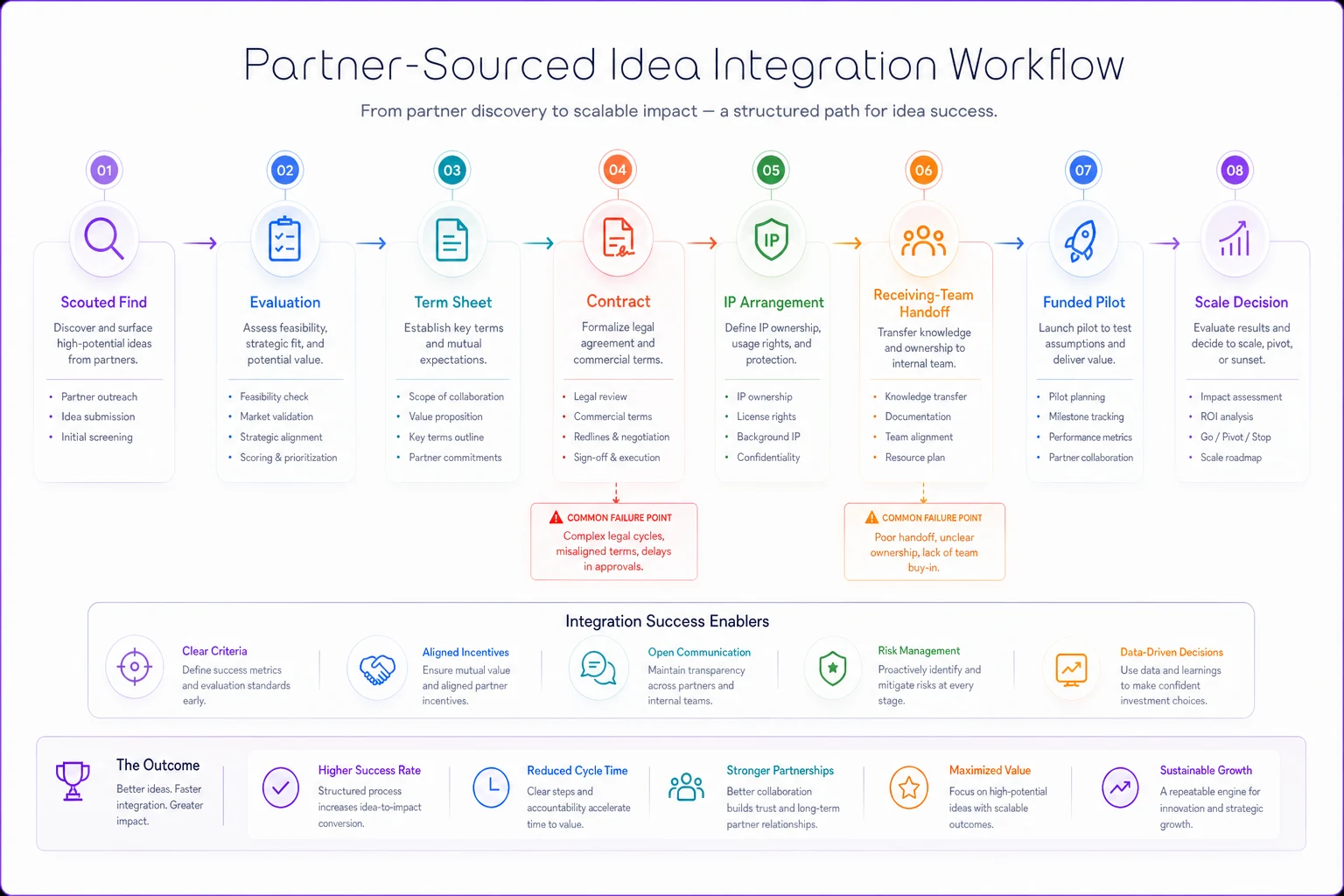
This diagram maps the route and highlights common failure points.
## A Real Scenario: Consortium That Almost Collapsed Over IP
A mid-market industrial manufacturer joined a four-member pre-competitive consortium to develop a shared predictive-maintenance approach. Everyone put in roughly equal cash — somewhere around €120k each per year — but the manufacturer contributed two full-time engineers while the others sent people part-time.
Eighteen months in, the project produced a genuinely valuable method. Then the fight started. The background-IP register didn't exist, so one member claimed a core piece had "walked in" with them. Foreground-IP rights were equal, so the manufacturer that did most of the work faced the same licensing terms as a member that had mostly watched.
The project nearly dissolved. What saved it was a retroactive governance exercise: they built the contribution tiers they should have built at the start, documented background IP from each member's records, and rewrote foreground rights to weight usage by actual contribution. It cost them roughly three months and a chunk of goodwill. Had those structures existed on day one, the method would have reached pilot something like two quarters earlier.
The outcome was fine in the end — the method did reach production, and the manufacturer saw a meaningful drop in unplanned downtime on the lines where it ran. But the lesson stuck: the technical work was never the risk. The governance vacuum was.
## Bringing the System Together
The reason these pieces have to be designed as one system is that they constantly feed each other. The partner model sets your governance load. Your scouting thesis sets what enters the pipeline. Your governance handles how decisions and IP get resolved. Your integration routes decide whether anything actually lands. Break the chain anywhere and the whole thing leaks — usually silently, because a stalled partner idea doesn't make noise, it just quietly never happens.
A practical sequence for building or fixing this:
-
Pick the partner model deliberately, based on how many ideas you can genuinely absorb — not on how many you can source.
-
Write the governance before the money moves, especially contribution tiers, IP registers, and exit protocols for anything consortium-shaped.
-
Tie scouting to funded priorities, with a routing review that assigns ownership monthly.
-
Treat IP as a design input, pulling legal in at term-sheet stage, not contract stage.
-
Pre-agree every handoff to a named, funded receiving owner with an acceptance checklist.
As your network scales, the coordination cost rises faster than the number of partners — more relationships, more contracts, more handoffs, more places to lose track of who owns what. The teams that scale open innovation networks well aren't the ones with the most partners. They're the ones who built the plumbing between scouting and integration before the volume arrived, so that a good idea found on Monday has a clear, owned, funded path to running inside the business — instead of ending up as one more logo on a slide and one more question nobody wants to answer.
As your network scales, the coordination cost rises faster than the number of partners — more relationships, more contracts, more handoffs, more places to lose track of who owns what. The teams that scale open innovation networks well aren't the ones with the most partners. They're the ones who built the plumbing between scouting and integration before the volume arrived, so that a good idea found on Monday has a clear, owned, funded path to running inside the business — instead of ending up as one more logo on a slide and one more question nobody wants to answer.
Ready to transform your innovation process?
Join 2,000+ companies using GoIdeafy to unlock team creativity, prioritize impactful ideas, and accelerate growth.