

Most idea platforms get built backwards. The team stands up a submission form, a voting widget, and a Kanban board, gets a few hundred ideas flowing, and then — usually around the time a pilot touches customer data or a regulated workflow — security shows up with a questionnaire. That's when the whole thing stalls. Nobody designed for retention. Nobody can explain who approved what. The event log is a mess of inconsistent field names, and producing an export an auditor will accept takes a week of manual cleanup.
The governance problem isn't that idea platforms lack rules. It's that the rules live in people's heads, scattered across Slack threads and half-maintained Confluence pages. When the program is small, that works fine. When it scales across business units, touches procurement, or gets pulled into a SOC2 audit, the informal system collapses — and by then you've got thousands of records that were never captured in a standards-compliant way.
This is a systems article, not a tips list. The goal is to show how the pieces — event contracts, retention policy, audit fields, approver matrices — actually connect, where they break under load, and what a defensible setup looks like end to end.
Why idea platform governance breaks the moment you scale
The core failure is that early-stage idea programs optimize for throughput and governance optimizes for provability. Those two goals pull in opposite directions, and almost nobody reconciles them until forced to.
A program launches, ideas flow, and the team adds features reactively — a scoring field here, a new status there, a custom label for "pilot-ready." Each addition seems reasonable in isolation. But six months in, the data model has no canonical shape. The same real-world event — "idea moved to evaluation" — gets recorded three different ways depending on who triggered it and which integration fired. One path writes status: evaluating, another writes stage: review, and a Zapier automation someone quietly built writes state: 2.
Scale that across three business units and you've got:
-
No canonical event contract, so analytics and audit exports can't be trusted
-
No retention policy, so you're holding personal data and IP-sensitive submissions indefinitely with no legal basis
-
No audit fields, so you can't answer "who approved this pilot and when" without archaeology
-
No approver matrix, so approvals happen by whoever's available, which is exactly what SOC2 flags
The breakage isn't dramatic. It's slow. Then a customer co-creation pilot needs IP consent proof, or a regulated experiment needs a risk-tier audit trail, and suddenly the informal system owes a debt it can't pay.
Start with the event contract, because everything downstream depends on it
If you only fix one thing, fix the event contract. It's the foundation that retention, audit, and approval all stand on. An event contract is a canonical, versioned definition of what gets recorded every time something meaningful happens to an idea — submission, triage, evaluation, approval, pilot start, closure.
Capture, evaluate, and act on ideas without friction.
GoIdeafy streamlines the entire innovation lifecycle from idea submission to implementation.
- Centralized idea capture
- Collaborative evaluation tools
- Progress tracking & analytics
No credit card required
The discipline here is the same one you'd apply to experiment event schemas and minimal instrumentation: define the event names once, lock the field set, version the contract, and make every integration conform to it rather than inventing its own shape.
A workable canonical event looks like this in plain terms:
-
event_id— unique, immutable, generated once -
event_type— from a closed vocabulary (idea.submitted,idea.triaged,idea.evaluated,idea.approved,pilot.started,idea.closed) -
entity_id— the idea it refers to -
actor_id— who caused it (person or system) -
actor_role— their role at the time of the event, not their current role -
timestamp— UTC, ISO 8601, no exceptions -
payload— type-specific data, with a fixed schema per event type -
contract_version— so you know which schema the record conforms to -
source_system— which integration or UI wrote it
The single most common mistake: capturing actor_role by looking it up at query time instead of recording it at write time. People change roles. Someone who approved a pilot as an evaluator in March might be a program lead by September. If your audit export derives their role from the current org chart, your record is wrong — and an auditor will catch it. Role at time of action is an audit fact. Freeze it.
The second common mistake is letting event types grow organically. Every time someone wants a new status, the vocabulary expands, and within a year you've got 40 event types, half of which mean the same thing. Keep the closed vocabulary small and route nuance into the payload, not into new event names.
A quick note on event versioning
Contracts change. That's fine — what matters is that old records stay readable. When you bump contract_version from 1.0 to 1.1, you never retroactively rewrite old events. The version field tells every downstream consumer which shape to expect. Teams that skip versioning hit a migration nightmare the first time they change a field, because now half their history is in one format and half in another with nothing to distinguish them.
Retention and archival: the policy procurement will ask about first
Once events are canonical, retention becomes a policy question instead of a technical scramble. It will come up — retention is one of the first things a procurement security review asks about, right alongside encryption and access control.
The mistake most programs make is treating retention as one global number ("we keep everything for 7 years"). That approach is both over-retention and under-retention simultaneously: you're holding personal data longer than you should while sometimes deleting audit records you're legally required to keep.
Retention has to be tiered by data class. Here's a workable breakdown:
| Data class | Example records | Retention (active) | Archival | Deletion trigger |
|---|---|---|---|---|
| Idea content (non-sensitive) | Titles, descriptions, votes | 24–36 months | Cold storage after active | On program closure + 1 yr |
| Audit / approval events | Approval records, actor logs | 7 years | Immutable archive | Legal review required |
| Personal data | Submitter identity, contact info | Duration of participation | Pseudonymized after exit | On data-subject request |
| IP-sensitive submissions | Customer co-creation, patents | Per contract terms | Encrypted archive | Per IP agreement |
| Pilot operational data | Experiment metrics, results | 36 months | Aggregated after | On aggregation |
The important structural insight: audit events and content events need separate retention clocks. You might delete the idea's descriptive content after three years for privacy reasons, but keep the immutable approval record — who approved it, when, under what version — for seven. If those two things share a retention policy, you're forced to choose between a privacy violation and an audit gap.
Archival is where the standards-first framing earns its keep. An archived record should be exportable in the same canonical shape it was written in, verifiable against its contract_version, and stored somewhere write-once so nobody can quietly edit history. The ability to prove a record hasn't changed matters as much as the record itself.
Audit fields: the difference between "we think" and "we can prove"
Audit fields are the small, boring additions that turn a workflow into an auditable one. They add nothing to the user experience — and they're the exact thing that blocks a SOC2 sign-off when missing.
Every state-changing action needs, at minimum:
-
Who did it (
actorid+ frozenactorrole) -
When (UTC timestamp)
-
What changed (before/after state)
-
Why, when a reason is required (approval justification, rejection rationale)
-
Under what authority (which approval rule or policy applied)
That fifth field is the one teams forget. It's not enough to know that Dana approved a pilot on March 3rd. You need to know that Dana approving it was valid — that the approval matrix granted her the authority for that risk tier and budget band at that time. Without the authority link, an auditor can't distinguish a legitimate approval from someone clicking a button they shouldn't have had access to.
For anything touching regulated workflows, the audit-field requirements get stricter, and the metadata and risk-tier discipline from regulated experiment intake applies directly — risk classification has to be captured at intake and carried through every subsequent event, not bolted on when the auditor asks.
The approver matrix: SOC2-aligned without becoming a bureaucracy
This is where governance usually overcorrects. Teams get scared by an audit, then build an approval process so heavy that every idea needs four sign-offs, and the program quietly dies because nobody wants to shepherd a submission through a two-week maze.
The fix is a risk-tiered approver matrix. Low-risk ideas get a lightweight path. Only ideas that touch money, data, or customers climb the approval ladder. SOC2 doesn't require that everything be heavily approved — it requires that approvals be appropriate, documented, and enforced.
A sane matrix looks like this:
| Risk tier | Example | Required approvers | SLA |
|---|---|---|---|
| Tier 0 — trivial | Internal process tweak, no data | Auto-approve + log | Instant |
| Tier 1 — low | Small pilot, no customer/PII | Program lead | 2 business days |
| Tier 2 — moderate | Pilot touching internal data | Program lead + data owner | 5 business days |
| Tier 3 — high | Customer-facing or PII | Lead + data owner + security | 10 business days |
| Tier 4 — regulated | Regulated workflow or IP-sensitive | Tier 3 + legal/compliance | Case-by-case |
Separation of duties is non-negotiable at Tier 2 and above. The person who submits an idea cannot be the sole person who approves its pilot. This is one of the first things a SOC2 auditor tests, and one of the easiest to accidentally violate when a small team wears multiple hats.
Map the matrix to roles rather than people so reorgs don't break approvals.
The matrix maps to roles, not people. When Dana leaves, the "data owner" approval slot doesn't vanish — it points to whoever holds that role. If your approvals are wired to individuals, every reorg breaks your governance.
Mapping approvals to actual workflows (the part that usually gets skipped)
A matrix on paper is useless if the platform doesn't enforce it. The link between the approver matrix and the live workflow is where governance either becomes real or stays theater.
Here's how the workflow logic runs end to end:
[Idea Submitted] ↓ [Risk Classification at Intake] ↓ [Approval Path Set by Matrix] ↓ [State Transition Attempted] ↓ [Platform Checks: Required Approvals Logged?] ↓ ↓ YES NO ↓ ↓ [Advance] [Block + Route to Approver Role] ↓ [SLA Clock Starts] ↓ [Approval Logged as Canonical Event] ↓ [Re-evaluate Risk Tier] ↓ [Advance or Escalate]
Visual workflow:
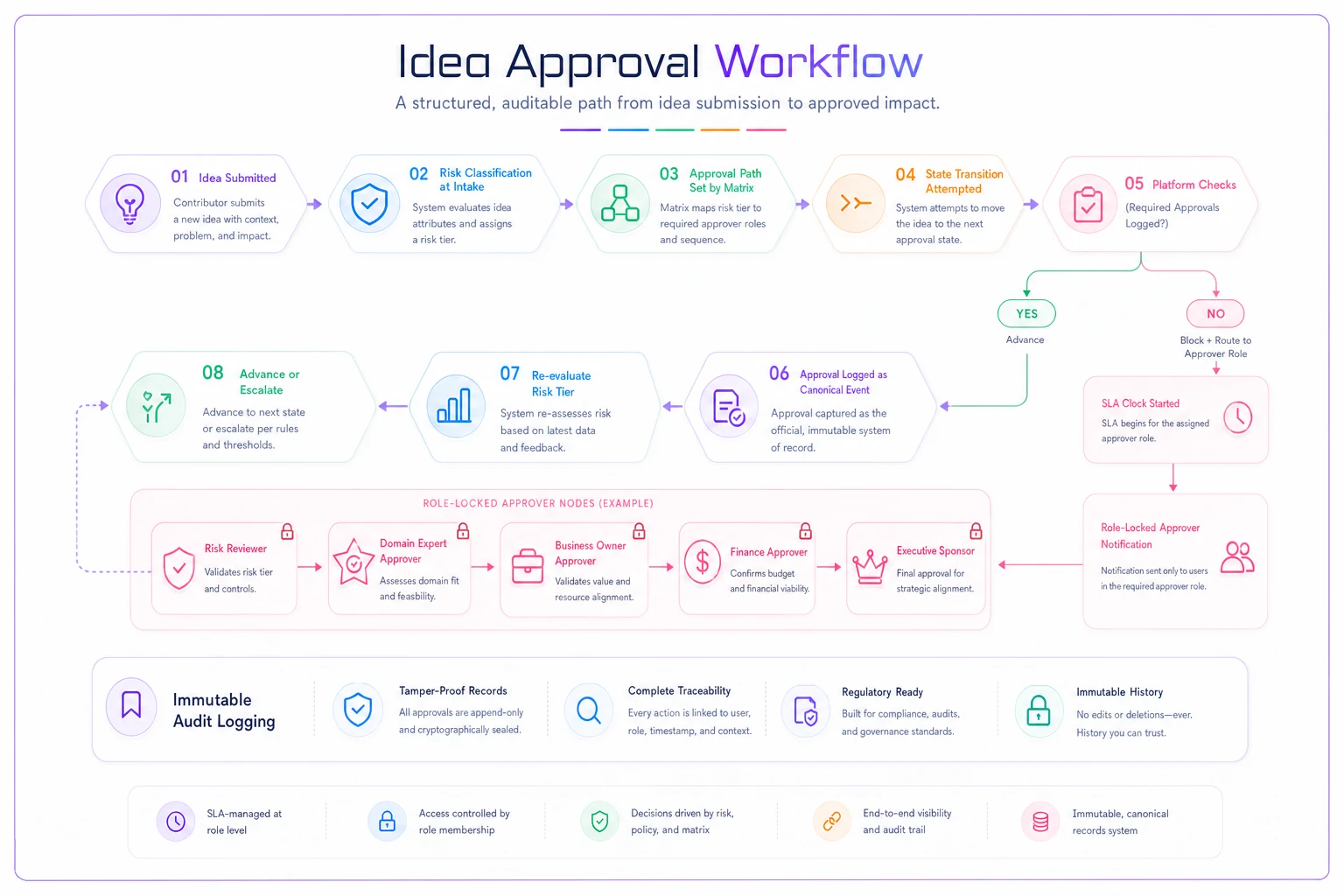
The subtle failure point is classification drift. An idea gets classified Tier 1 at intake, then during evaluation someone realizes it actually touches PII. If the platform doesn't re-trigger the approval path when the risk tier changes, you've got a Tier 3 idea running on Tier 1 approvals — a gap that won't surface until an audit samples it. Risk tier has to be re-evaluated at each major transition, and a change in tier has to force a re-approval.
A real scenario: what this looks like when it goes wrong, then right
A mid-market manufacturer — somewhere around 600 employees — ran an internal idea program across three divisions for about two years. Decent participation, roughly 40–50 submissions a month, a handful of pilots running at any time. No formal governance; approvals happened over email and in standups.
Then a pilot touching production-line sensor data got escalated during a routine security review. Procurement asked a straightforward question: show us who approved this pilot, under what authority, and prove the record hasn't been altered. The team couldn't. The approval lived in an email thread. The idea's status history was inconsistent across the platform and two integrations. Producing a clean export took the better part of a week, and even then there were gaps the security team flagged.
The remediation wasn't a rebuild — it was a standards retrofit. They defined a canonical event contract, backfilled what they could, and froze actor_role on new events. They wired the tiered approver matrix into the pilot-progression workflow so nothing could reach pilot status without logged approvals. They separated audit-event retention (7 years, immutable) from content retention (36 months).
The measurable change wasn't about idea volume — that stayed roughly flat. It was about provability. At the next security review, the export that had taken a week came out in under an hour, in a canonical shape, verifiable against contract versions. Tier 3 pilots that used to stall for two to three weeks in ambiguous approval limbo settled into a predictable 10-day path. The program stopped being the thing security dreaded reviewing.
When this level of rigor actually makes sense
Not every program needs a SOC2-aligned approver matrix. Be honest about where you are.
This makes sense when:
-
Your pilots touch customer data, PII, or regulated workflows
-
You're operating across multiple business units with different owners
-
Procurement or security reviews are part of your reality
-
You're handling customer co-creation or IP-sensitive submissions
This is overkill when:
-
You're a single team running an internal suggestion box with no sensitive data
-
You have fewer than a hundred ideas total and no pilots touching money or customers
-
Nobody outside the program will ever audit it
Who should NOT do this yet: brand-new programs still proving they can sustain participation. If you don't yet have reliable idea flow, bolting on heavy governance will kill the program before it finds its footing. Get the funnel working, then layer in standards — but design the event contract early even if you defer the rest, because retrofitting canonical events onto thousands of inconsistent records is the single most painful part of this whole effort.
The runnable checklist procurement and security will ask for
Use this as a readiness audit. If you can't check a box, that's your next gap.
-
[ ] Canonical event contract defined, versioned, and documented
-
[ ] All integrations write conforming events (no rogue field names)
-
[ ]
actor_rolefrozen at write time, not derived at query time -
[ ] Closed event-type vocabulary, small and maintained
-
[ ] Tiered retention policy by data class, documented with legal basis
-
[ ] Audit events on a separate retention clock from content
-
[ ] Immutable, write-once archival with verifiable integrity
-
[ ] Audit fields on every state change (who/when/what/why/authority)
-
[ ] Risk tier captured at intake and carried through every event
-
[ ] Approver matrix mapped to roles, not individuals
-
[ ] Separation of duties enforced at Tier 2+
-
[ ] Approval requirements enforced in the live workflow, not just documented
-
[ ] Risk-tier re-evaluation at each major transition
-
[ ] SLA clocks and escalation paths on pending approvals
-
[ ] Clean, canonical export producible on demand
If you're evaluating platforms rather than building, fold these into your selection criteria directly — the vendor questions and contract clauses in the RFP and pilot toolkit for idea-management software pair well with this checklist, since most of these requirements have to be verified during procurement, not discovered afterward.
Bringing it together
Idea platform governance feels painful because it's usually approached as a cleanup project — something you do after the mess exists. By then you're backfilling inconsistent records, reconstructing approvals from email threads, and trying to explain to an auditor why the same event has three different names.
A standards-first approach flips the sequence. Define the canonical event contract first, so every record is auditable from birth. Tier your retention by data class so privacy and audit obligations stop fighting each other. Capture audit fields — especially frozen roles and approval authority — on every state change. Build a risk-tiered approver matrix mapped to roles, and wire it into the live workflow so it enforces instead of merely documenting.
None of this meaningfully slows a healthy program down. Low-risk ideas still move fast; only the pilots that genuinely touch money, data, or customers climb the ladder. What you gain is the ability to say we can prove it — and in any organization where security and procurement have a vote, that's the difference between a program that scales and one that gets quietly shut down the first time someone asks a hard question.
Ready to transform your innovation process?
Join 2,000+ companies using GoIdeafy to unlock team creativity, prioritize impactful ideas, and accelerate growth.