

If your innovation program has ever tried to run a pilot touching patient records, payment data, or anything a regulator cares about, you already know the moment things start unraveling. It's rarely the experiment itself. It's intake. Someone submits a "quick test" idea, an enthusiastic sponsor greenlights it, and three weeks later your compliance lead asks a question nobody can answer: where's the consent basis for this data, and who approved it?
That gap — between an idea getting momentum and the controls catching up — is where regulated experiments quietly pile up risk. This piece is a working set of regulated experiment controls templates: required metadata fields, a risk-tiered approval matrix, sample audit-log entries, and prefilled approval forms you can adapt for healthcare, finance, and sensitive-data pilots. No theory. Just the scaffolding that keeps a pilot auditable from the first form field onward.
Start with the intake form, because that's where the evidence trail begins
Most intake forms for regulated experiments fail the same way: they ask what's the idea and who's sponsoring it, then stop. By the time a privacy officer or auditor gets involved, half the fields that actually matter were never captured — and reconstructing them from Slack threads and email chains is a nightmare.
A checklist-first intake form flips the burden. Instead of free text, it forces the submitter to declare the things that determine risk tier before anyone can approve anything. If a required field is blank, the form doesn't submit. That single constraint prevents most of the "we'll figure out consent later" problems.
Here's the minimum required metadata set for any experiment touching regulated or sensitive data:
Identity and ownership
-
Experiment ID (auto-generated, immutable)
-
Submitter name + role
-
Accountable owner (must be a named individual, not a team)
-
Sponsoring business unit
Data characterization
-
Data categories involved (PHI, PII, PCI/cardholder, financial account, special-category personal data, none)
-
Data source system(s)
-
Approximate record count in scope
-
Whether data leaves the production boundary (yes/no — this one field drives a lot of downstream decisions)
-
Retention period for experiment data
-
De-identification / pseudonymization applied (yes/no + method)
Consent and lawful basis
-
Legal basis for processing (consent, legitimate interest, contract, legal obligation — for GDPR-adjacent work)
-
Consent artifact reference (link to the actual consent text or waiver)
-
Whether existing consent covers this secondary use (this is where most healthcare pilots trip)
-
Vendor/third-party data sharing involved (yes/no + DPA reference)
Scope and controls
-
Experiment start / planned end date
-
Rollback mechanism described (yes/no)
-
Monitoring owner during the live window
The consent fields deserve extra attention. This is the one area people consistently underestimate. In healthcare pilots especially, the trap isn't absence of consent — it's scope of consent. A patient consented to treatment and data use for care delivery. That doesn't automatically extend to using their records to train a triage model or test a new scheduling algorithm. The "does existing consent cover this secondary use?" field is deliberately phrased to force a no when the honest answer is "we're not sure." A blank or hedged answer there should route straight to legal, not to a sponsor who wants to move fast.
Risk-tiered approval matrix: who signs off, and why it scales
Flat approval processes break because they treat a dashboard color-change experiment the same as a pilot exporting 40,000 patient records to a vendor sandbox. Either everything drowns in approvals, or nothing gets proper scrutiny. A tiered matrix fixes this by letting the metadata decide the tier automatically.
Capture, evaluate, and act on ideas without friction.
GoIdeafy streamlines the entire innovation lifecycle from idea submission to implementation.
- Centralized idea capture
- Collaborative evaluation tools
- Progress tracking & analytics
No credit card required
The logic: intake fields map to a risk score, the score maps to a tier, and the tier maps to a required approver set. Nobody has to argue about whether something is "a big deal" — the form already answered it.
| Risk Tier | Trigger conditions (any one qualifies) | Required approvers | Target approval SLA | Audit requirements |
|---|---|---|---|---|
| Tier 0 — Minimal | No regulated data; synthetic or fully de-identified data; no prod access | Accountable owner self-certifies | Same day | Intake record only |
| Tier 1 — Low | PII, no special categories; data stays inside prod boundary; <1,000 records | Owner + line manager | 2 business days | Intake + approval log |
| Tier 2 — Elevated | PHI/PCI/financial account data; OR data leaves prod boundary; OR 1k–50k records; OR third-party sharing | Owner + Privacy/Compliance + Data owner | 5 business days | Full audit log + DPA check + rollback plan |
| Tier 3 — High | Special-category data at scale (>50k); OR model training on regulated data; OR cross-border transfer; OR vulnerable populations | Owner + Privacy + Legal + CISO + Exec sponsor | 10 business days | Full audit log + DPIA + monitoring plan + sign-off record |
Two things worth flagging from watching these matrices actually run.
First, the "data leaves prod boundary" flag is worth more than record count. A 300-record export to someone's laptop is often riskier than a 20,000-record query that never leaves a locked environment. Raw volume alone is a lazy proxy — weight your triggers accordingly.
Second, approver fatigue kills Tier 2. When every mid-sized pilot needs four signatures, people learn to downgrade their answers to stay in Tier 1. The fix isn't more enforcement — it's making Tier 0 and Tier 1 genuinely frictionless so there's no incentive to game it. When the honest low-risk path is fast, people stop lying their way down.
Prioritize data-boundary triggers over raw record count when auto-scoring to avoid underestimating exposure.
For the deeper mechanics of how tiers connect to rollback and ongoing monitoring obligations, the tiered compliance model and rollback playbook covers that side of the system. This piece is specifically about intake and approval.
Sample audit-log entries that actually hold up
An audit log that only records "approved by Jane on 3/14" is useless when someone asks what exactly was approved and on what basis. Entries need to capture state transitions, the metadata snapshot at approval time, and any conditions attached. Here's what usable entries look like for a Tier 2 healthcare pilot.
[2026-03-10 09:14 UTC] EXP-2026-0412 | status: SUBMITTED submitter: r.okafor@org (Clinical Ops Analyst) datacategories: [PHI] recordcountestimate: 8,400 leavesprodboundary: false consentsecondaryuse: UNCERTAIN -> routed to Privacy autotier: 2
[2026-03-11 15:02 UTC] EXP-2026-0412 | status: UNDERREVIEW reviewer: privacy-team (m.adler) note: "Existing treatment consent does NOT cover model eval. Requires de-identification before use." conditionadded: COND-01 "De-identify prior to processing"
[2026-03-13 11:40 UTC] EXP-2026-0412 | status: REVISED submitter update: deidentificationapplied: true (method: safe-harbor) recordcountestimate: 8,400 (de-identified) datacategories updated: [PHI -> de-identified]
[2026-03-14 10:21 UTC] EXP-2026-0412 | status: APPROVED approvers: [dataowner: s.liang, privacy: m.adler, owner: r.okafor] conditions: [COND-01 satisfied] monitoringowner: r.okafor plannedend: 2026-05-14 rollbackplan_ref: RBK-2026-0412
Notice what the log preserves: the fact that consent was flagged uncertain, the specific condition privacy attached, the revision that satisfied it, and a metadata snapshot at the moment of approval. If a regulator asks six months later why PHI was used, the answer is right there — it wasn't, because the de-identification condition was enforced before approval closed.
The common mistake is logging only the happy path. Capture rejections and "uncertain" routes too. The entries that tend to save you in an audit are the ones showing you caught something and required a fix — not the clean approvals. A log full of nothing but smooth approvals actually looks more suspicious, not less.
Prefilled approval forms, tailored by domain
Generic approval forms force reviewers to re-derive context every time. Prefilling domain-specific fields — and pre-populating the standard conditions a given data type almost always requires — cuts review time and reduces the chance a reviewer forgets something.
Healthcare (PHI) pilot — prefilled defaults:
-
Default lawful basis prompt
"Does this use fall within original treatment/payment/operations consent? If no, attach IRB/waiver or de-identify."
-
Pre-checked condition
"No re-identification attempts permitted"
-
Required attachment
de-identification method or IRB reference
-
Auto-flag
any export outside the covered environment → Tier 3 escalation
Finance (PCI / account data) pilot — prefilled defaults:
-
Default control
"No cardholder data (PAN) in experiment environment — tokenized values only"
-
Pre-checked condition
"Experiment environment excluded from PCI CDE unless explicitly scoped"
-
Required attachment
data flow diagram
-
Auto-flag
production transaction data in a non-prod environment → mandatory CISO review
Sensitive-data / special-category pilot — prefilled defaults:
-
Default prompt
"DPIA required — attach or justify exemption"
-
Pre-checked condition
"No automated decisions affecting individuals without human review"
-
Required attachment
data minimization justification
-
Auto-flag
vulnerable populations involved → Legal + Exec sponsor added automatically
What makes prefilling work is that most risk in a given domain is predictable. Nearly every PCI pilot needs the tokenization condition. Nearly every PHI pilot needs the secondary-use question answered honestly. So bake those in as defaults the submitter has to actively acknowledge or override — rather than hoping a reviewer remembers to ask. The friction moves to the right place: upfront, on the person who actually knows the data.
A workflow that ties it together
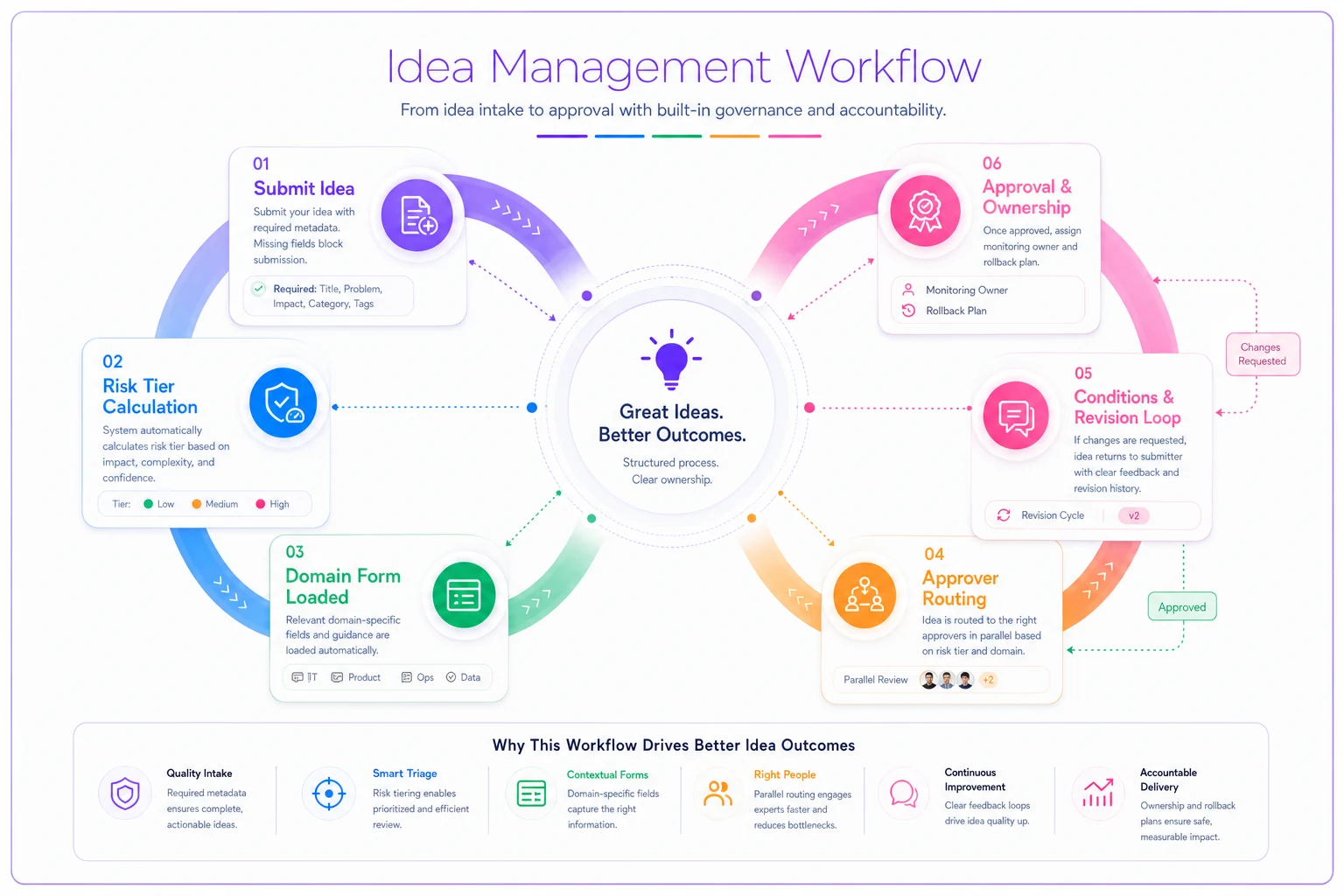
Here's how the pieces run in sequence, as an actual intake-to-approval flow:
-
Submitter opens the intake template. Required metadata fields block submission until complete. Consent and data-boundary fields are mandatory.
-
Risk tier auto-calculates from the metadata. The submitter sees their tier and the approver list before submitting — no surprises.
-
Domain-specific prefilled form loads based on data category. Standard conditions appear pre-checked; the submitter acknowledges or justifies exceptions.
-
Routing fires automatically. Tier 0 self-certifies and logs. Tiers 1–3 route to the required approver set in parallel, not in sequence, so you don't lose days waiting on one signature.
-
Reviewers add conditions or reject. Every action writes an audit-log entry with a metadata snapshot.
-
Conditions must be satisfied before status flips to APPROVED. The system won't let an approval record close with open conditions.
-
Monitoring owner and rollback reference are locked in at approval. The experiment can't go live without both named.
Showing the tier and approvers before submission eliminates one of the most frustrating failure modes in practice: someone fills out a form, waits four days, and only then learns they needed a DPIA. Transparency upfront is cheaper than rework later, every time. That's the quiet win step 2 delivers, and it's easy to underestimate until you've watched a team lose a week to it.
A real scenario: a mid-market health-tech pilot
A health-tech company with around 180 employees wanted to pilot a readmission-risk flag using historical patient records. Their intake process at the time was a shared doc and a Slack approval. The pilot launched, ran for about three weeks, and then a routine privacy review caught that the records used for the model eval weren't covered by the original consent — and roughly 8,000 records had been pulled into a vendor sandbox without a signed DPA in place.
Shutting it down and remediating took close to six weeks: re-scoping the data, getting the de-identification done properly, backfilling the DPA, and documenting everything for their compliance file. The experiment itself was fine. The intake was the failure.
After moving to a checklist-first intake with auto-tiering, the same type of pilot a quarter later got flagged at submission. The "secondary use covered?" field came back uncertain, which auto-routed to privacy, which attached the de-identification condition before any data moved. Time from submission to approved-and-safe-to-run was about five business days, and nothing left the environment without the right basis. No remediation. No compliance fire drill. The approval record told the whole story on its own.
When this makes sense — and when it's overkill
When to build this out fully: You're running pilots that touch PHI, PCI, financial account data, or special-category personal data; you operate in a space with real regulators; or you've already had one near-miss where you couldn't reconstruct who approved what. If any of those are true, the intake scaffolding pays for itself the first time an auditor asks a question.
When it's overkill: Early-stage teams running experiments on fully synthetic data, internal-only non-personal metrics, or public data don't need a Tier 3 DPIA gate. Forcing heavyweight intake on genuinely low-risk work just teaches people to route around the system. Keep Tier 0 nearly invisible.
Who should NOT do this blindly: If you don't have a named privacy or compliance function to sit in the approver seats, don't fake it with a generic "manager approval." An approval matrix with unqualified approvers is worse than no matrix — it manufactures a paper trail that implies scrutiny that never happened. Build the reviewer capacity first, or at minimum establish an external advisor relationship before turning on Tier 2+.
A few adjacent things worth getting right
Two related patterns reinforce this intake system. If your experiments involve external partners or customer-contributed data, the consent and IP mechanics get thornier — the intake and consent patterns for customer co-creation covers the collaboration-specific traps a purely internal matrix won't catch.
And if you're evaluating platforms to run any of this on, audit and control requirements belong in your vendor evaluation from the start — the RFP and pilot toolkit has the integration test cases and contract clauses to make sure whatever tool you pick can actually produce the audit trail you'll need.
Closing thought
Regulated pilots don't usually blow up because of bad intent or sloppy experiments. They blow up because the controls arrive after the decision instead of being built into the moment of intake.
When the form itself refuses to submit without a consent basis, when the tier calculates from the metadata, and when every approval leaves a snapshot behind, compliance stops being a separate step someone has to remember. It just becomes how an experiment gets born. Start with the intake form, make the required fields genuinely required, and let the risk tier do the arguing for you.
Ready to transform your innovation process?
Join 2,000+ companies using GoIdeafy to unlock team creativity, prioritize impactful ideas, and accelerate growth.