

A small ideation program with 40 people and one enthusiastic sponsor almost never has a psychological safety problem. Everyone knows each other. People share half-baked ideas because the room is warm, the sponsor nods, and nobody's reputation is on the line. Then the program hits 400 participants, then 2,000, then goes global across five business units — and the warmth doesn't scale with it. Participation thins out. The same six confident voices dominate. People stop submitting anything that isn't polished and "safe."
What's frustrating is that most leaders don't notice this happening. The dashboards still look fine for a while. Idea volume might even go up because you added more people. But the distribution of who's contributing narrows, and the quality of early-stage, weird, uncomfortable ideas — the ones that actually matter — drops off a cliff.
This isn't a culture poster problem. It's an operating problem. Safety at scale lives or dies in the small, repeated interactions between managers and their teams, and in whether your program has the governance to catch erosion before it becomes permanent. That's what this piece is about: the rituals, the cadence of signals, and the remediation machinery that keeps inclusive ideation intact as headcount multiplies.
Why safety erodes as the program grows (and nobody sees it)
The core issue is that psychological safety doesn't degrade uniformly. It degrades locally. One manager's team can quietly become a place where people stop speaking up, while the program average stays healthy. Averages hide the teams that are failing.
A few patterns show up again and again as programs scale:
-
The founder-energy fades. Early programs run on one or two passionate people personally encouraging contributions. You cannot personally encourage 2,000 people. The behavior that created safety was never systematized, so it evaporates.
-
Managers inherit the program without the skill. When ideation expands into new business units, you suddenly have dozens of middle managers who never signed up to run inclusive ideation sessions. They default to whatever management style they already had — which, for many, means talking more than listening.
-
Visibility changes incentives. In a 40-person program, a bad idea is forgotten by lunch. In a 2,000-person program with leaderboards and executive visibility, a bad idea feels like a permanent mark. People self-censor rationally.
-
Evaluation gets harsher as volume grows. More submissions means evaluators get stricter and faster to manage load. Submitters feel the chill even if nobody intends it.
The through-line is that growth adds distance — between sponsors and contributors, between managers and the behaviors that build safety, between a tentative idea and a forgiving audience. Everything that follows is about closing that distance mechanically, because you can no longer close it personally.
The layer most programs skip: manager rituals as infrastructure
You can run all the pulse surveys you want, but if the manager-to-team interaction isn't structured, you're measuring a problem you have no mechanism to fix. The manager layer is where safety is produced or destroyed, and in most growing programs it's completely unmanaged.
Capture, evaluate, and act on ideas without friction.
GoIdeafy streamlines the entire innovation lifecycle from idea submission to implementation.
- Centralized idea capture
- Collaborative evaluation tools
- Progress tracking & analytics
No credit card required
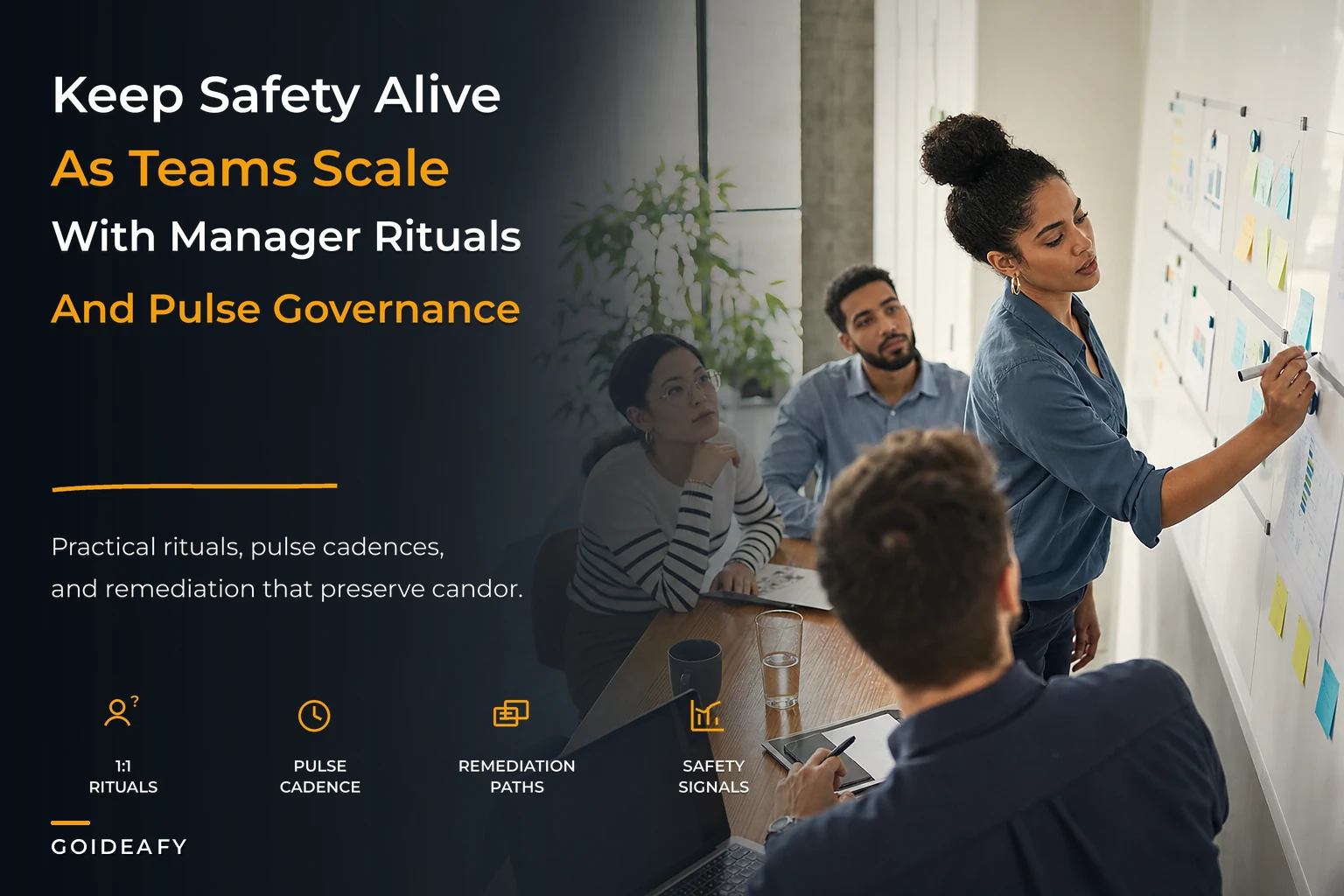
A "ritual" sounds soft, but operationally it's just a recurring, templated interaction with a defined purpose and a defined output. The reason rituals matter is that they remove the dependency on any individual manager being naturally great at this. A mediocre manager running a good ritual produces better safety outcomes than a good manager improvising.
The idea-safe 1:1. Once a month, inside the regular 1:1, the manager spends ten minutes specifically on ideation. Not "do you have any ideas," which produces nothing, but structured prompts: What's something you noticed this month that annoyed you but you didn't report? What's an idea you had but assumed wouldn't fly? Who on the team had a good idea you think got overlooked? That last question matters a lot — it turns individuals into advocates for others, which is how quiet contributors get surfaced.
The team ideation standup. A short, recurring team ritual where the explicit rule is that early-stage ideas are welcome and nobody evaluates on the spot. Separating generation from judgment is the single most important design choice in any of this. When people know their raw idea won't be shot down in the same meeting it's shared, they share more. The manager's job here is purely to capture and acknowledge, not to critique.
The closure acknowledgment. When an idea gets declined, the manager personally references it in the next 1:1. Not a form letter — an actual human acknowledgment that the idea was seen and why it didn't move forward. This is where a lot of safety quietly bleeds out: people submit, hear nothing or get a cold automated rejection, and conclude the whole program is theater.
Pro-tip: In the team ideation standup, explicitly state the rule separating generation from judgment before anyone shares; it materially increases raw idea volume.
These aren't events you run once. They're a cadence. And cadence is where most programs fall apart, because nobody is tracking whether managers actually do them.
Scaled pulse cadences: measuring safety where it actually lives
If manager rituals are the production mechanism, pulse cadences are the sensor network. The mistake most programs make is running one quarterly survey, reading the top-line number, and feeling reassured. That number is nearly useless for operational purposes because it hides the local collapses we talked about.
For the mechanics of building out participation metrics and remediation playbooks, the companion piece on measuring psychological safety in your idea program goes deeper. What matters here is the cadence design — how often you measure, at what granularity, and how you avoid survey fatigue while still catching problems early.
The trap is a false choice between "survey too often and annoy everyone" and "survey too rarely and miss the erosion." The way out is a layered cadence, where different signals run at different frequencies:
| Signal | Cadence | Granularity | What it catches |
|---|---|---|---|
| Behavioral participation data | Continuous (passive) | Per team / per manager | Narrowing contributor base, dominant-voice concentration |
| Micro-pulse (1–2 questions) | Monthly | Per team | Early dips in "safe to share" sentiment |
| Full safety survey | Quarterly | Per unit | Deeper diagnostic, trend confirmation |
| Post-decision pulse | Event-triggered | Per submitter | Whether rejections damaged safety |
The behavioral layer is the one people underuse. You don't need to ask whether participation is narrowing — you can see it. If a team of 30 had 18 unique contributors last quarter and 7 this quarter, that's a signal no survey will give you as fast. Concentration of contribution — a handful of people producing most submissions — is often the earliest warning sign that the rest of the team has gone quiet.
The post-decision pulse is the other high-value signal. A single question sent a few days after someone's idea is closed — did you feel your idea was fairly considered? — catches the exact moment safety is most at risk. If a particular evaluator or manager consistently produces low scores on this, you've found a problem you can actually act on.
A quick note on what not to measure into the ground
More data isn't better here. If you survey monthly and never visibly act on the results, you reduce safety, because people learn that speaking up through the survey also does nothing. Every pulse cadence needs a visible feedback loop — which brings us to governance.
Remediation governance: what happens when a signal goes red
This is the part almost everyone neglects. You can build solid rituals and a sophisticated pulse network, and still fail, because when a signal goes red, nobody owns the response. The metric sits in a dashboard, someone frowns at it in a monthly review, and nothing changes.
Remediation governance is simply: a defined owner, a defined trigger, a defined response, and a defined follow-up for each kind of safety problem. Without it, your measurement system is just anxiety generation.
-
Trigger definition. Decide in advance what "red" means. For example: a team's unique-contributor count drops by more than a third quarter over quarter, or a team's micro-pulse safety score falls below a set threshold two months running. Thresholds set in advance prevent the endless debate about whether a dip "really matters."
-
Routing. The signal goes to a specific person — usually the manager's manager or a program ops lead — not to a committee. Committees diffuse responsibility until nothing happens.
-
Diagnosis conversation. Before any intervention, a conversation with the manager to understand context. Sometimes a drop is benign (a team reorg, a major deadline). Sometimes it's a manager who's been shutting people down. You can't fix what you haven't diagnosed.
-
Intervention. This ranges from light (coaching the manager on the ritual they've been skipping) to heavy (direct involvement in the team's ideation sessions for a period). The intervention should match the severity.
-
Re-measurement. Check the same signal 30–60 days later. If it hasn't recovered, escalate. A remediation that nobody verifies is just a hopeful note.
Visualized, the remediation flow highlights routing to an owner, a diagnosis conversation, a matched intervention, and a re-check of the original signal after 30–60 days.
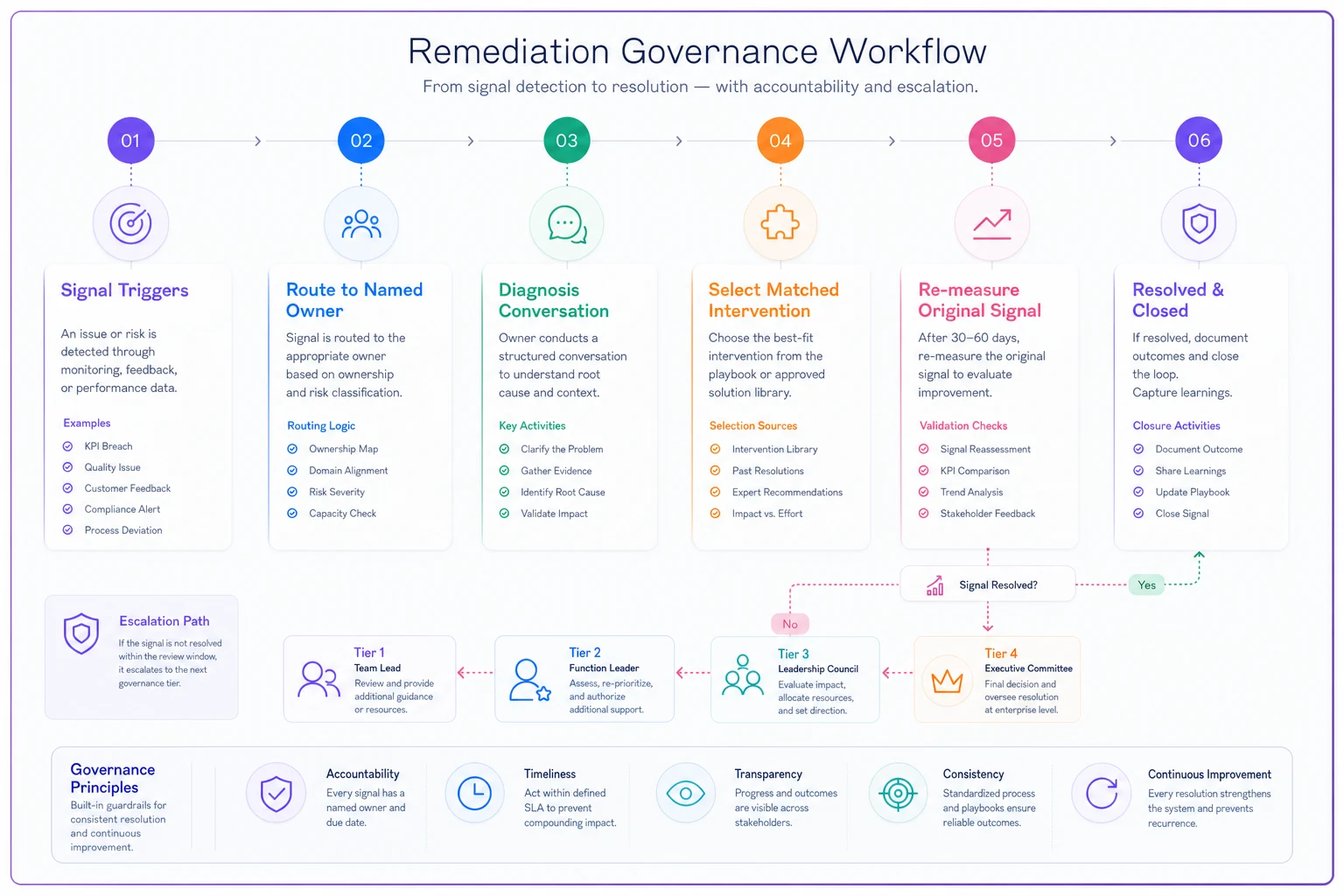
What makes this governance real rather than theatrical is the re-measurement step. Most programs intervene and move on, assuming the problem is solved. Half the time it isn't, and the only way you'll know is by looping back to the signal that triggered the response in the first place.
This connects naturally to how you structure your broader program governance. If you're building out the surrounding operating structure — mentor ladders, onboarding, community norms — the piece on scaling an innovation community of practice covers the governance scaffolding that remediation plugs into.
Templates that make the rituals actually happen
A ritual without a template becomes "something managers are supposed to do" — which means it doesn't happen. The template is what makes it repeatable by someone who isn't naturally good at it.
1:1 ideation module (drop into an existing 1:1):
-
One warm-up
What's a small frustration you hit this month?
-
One surfacing question
Any idea you had but didn't submit? What stopped you?
-
One advocacy question
Whose idea on the team deserves more attention?
-
One follow-up
reference any of their past submissions and what happened to them
-
Close
one concrete next step if an idea has legs
Manager coaching checklist (for the person developing managers):
-
- [ ] Does the manager separate idea generation from evaluation in team sessions?
-
- [ ] Does every submitted idea get a human acknowledgment within a week?
-
- [ ] Is the manager tracking who isn't contributing, not just who is?
-
- [ ] When ideas are declined, does the manager explain why, personally?
-
- [ ] Does the manager know their team's current participation spread?
-
- [ ] Has the manager run the ideation 1
1 module every month this quarter?
The coaching checklist is the one that actually drives behavior change. You're not auditing managers to punish them — you're giving them a concrete definition of what "good" looks like, which most have never been given. "Be more inclusive" is unactionable. "Separate generation from judgment and acknowledge every idea within a week" is something a person can actually do.
A realistic scenario of how this plays out
Consider a mid-sized manufacturing group that expanded its ideation program from a single plant to seven sites over about eighteen months. Program-wide idea volume looked healthy — it had roughly doubled as more people joined. But leadership noticed something odd: nearly all the ideas that progressed to pilots were coming from two of the seven sites.
When they added behavioral tracking per site, the picture got clearer. At the two strong sites, somewhere around 40% of eligible staff had submitted at least one idea in the quarter. At three of the newer sites, that figure was closer to 10–12%, and most of those submissions came from a small cluster of supervisors. The sites weren't short on ideas — they were short on safety. People at the newer sites had learned, quickly, that submitting felt risky and pointless.
The intervention wasn't a motivational campaign. It was operational: the three weak sites' managers were put on the coaching checklist, the ideation 1:1 module was rolled out, and a post-decision pulse was switched on so rejected submitters got a human reason instead of silence. Over the next two quarters, unique contributor rates at the lagging sites climbed from that low-teens range into the high 20s — not matching the strong sites, but no longer flatlining. A couple of the pilots that eventually mattered most came from a site that had previously contributed almost nothing.
Nothing dramatic happened. No new culture initiative. The fix was treating local safety erosion as a measurable, ownable, repairable operations problem.
When heavy governance is overkill (and when it isn't)
Not every program needs this full apparatus, and installing it too early wastes effort and annoys people.
When this makes sense: You're past a few hundred active participants, you've got multiple managers running their own teams, and you've started to notice contribution concentrating in a few voices or a few teams. If your sponsor can no longer personally know most contributors, you need mechanisms to replace that personal touch.
When it's a bad idea: If you're still small — under a hundred people, one team, one engaged leader — building formal remediation governance is premature. You'll spend more time administering the system than you'd ever spend fixing the problems it catches. At that scale, a leader who genuinely pays attention outperforms any template.
Who should not do this: Programs with no executive willingness to actually act on red signals. If leadership won't support a manager being coached or redirected when their team goes quiet, don't build the sensing apparatus. All you'll create is visible problems that nobody fixes, which is worse than not measuring at all. The measurement implies a promise; broken promises cost you more safety than you started with.
Where the tooling fits — quietly
Most of this can run on spreadsheets and calendar reminders at first, and honestly that's where many programs should start. The reason tooling eventually matters is coordination at scale: once you're tracking per-team participation spread, running layered pulse cadences, routing red signals to owners, and verifying remediation 60 days later across dozens of teams, the manual version collapses. People forget the follow-up. Signals sit unrouted. The verification step gets skipped because nobody's reminding anyone.
This is where an operational platform with light automation earns its place — not to replace the human rituals, which are the whole point, but to make sure the cadence actually runs. Automatic surfacing of teams whose contributor base is narrowing, event-triggered pulses after decisions, reminders that keep the coaching loop alive, and a clear record of which red signals got remediated and whether they recovered. The automation handles the remembering and routing so the humans can spend their attention on the conversations that actually build safety. The tool should disappear into the background; the rituals should stay front and center.
The tool should disappear into the background; the rituals should stay front and center.
Psychological safety at scale isn't a value you declare — it's an output your operating system either produces or fails to produce, team by team, month by month. Small programs get it for free from proximity and enthusiasm. Growing programs have to manufacture it deliberately, because the distance that growth creates will quietly suffocate the exact ideas you built the program to capture.
The programs that sustain inclusive ideation aren't the ones with the best mission statements. They're the ones that treat manager rituals as infrastructure, measure safety where it actually lives — locally, continuously — and have the governance to catch and repair erosion before it hardens. Build that machinery, keep it running, and the warmth of the early days becomes something you can carry to two thousand people instead of forty.
Ready to transform your innovation process?
Join 2,000+ companies using GoIdeafy to unlock team creativity, prioritize impactful ideas, and accelerate growth.