


Most innovation programs die in the gap between "our KPIs look great" and "the board approved more money." Not because the work was bad. Because the numbers that make sense inside the program never got translated into the language a board uses to move capital.
A board doesn't care that your submission-to-pilot conversion rate improved 14%. They care whether the next $800k gets a better risk-adjusted return than paying down debt or buying back shares. Those are two completely different conversations, and the governance ladder is what connects them. Without it, you end up with a program running on activity metrics and a board funding on gut feel — and both sides quietly resent each other.
This piece walks through the actual rungs: how program-level KPIs roll into fundable bundles, how you attach a risk-adjusted expected value to each ask, who decides what at each level, and the one-page memo skeleton that holds the whole thing together. The goal isn't more reporting. It's fewer, sharper decisions made faster.
Why the KPI-to-funding gap keeps reappearing
The gap isn't a reporting problem. It's a translation problem that shows up at predictable seams in the operation.
Program teams instrument what they can measure daily: participation, throughput, cycle time, pilot pass rates. Boards allocate against what they can defend quarterly: expected value, downside exposure, strategic fit, opportunity cost. These vocabularies don't overlap, so someone has to do the translation — and in most organizations, nobody owns that job. The innovation lead assumes finance will do it. Finance assumes the innovation lead will bring a business case. The result is a deck full of charts that answers questions the board wasn't asking.
A second reason: KPIs get presented individually. You show twelve metrics, each trending up or down, and the board has to assemble them into an investment thesis in real time, during a 20-minute agenda slot. That almost never works. People default to whoever tells the most confident story, not whoever has the strongest numbers. The whole point of a governance ladder is to pre-assemble those metrics into bundles that map directly to a decision.
The third reason is cadence mismatch. Programs run on weekly and monthly rhythms. Boards meet quarterly, sometimes less. If your funding asks only surface at board meetings, you're forcing a quarter's worth of accumulated decisions into one crowded session — which means most of them get deferred, and deferral is where momentum dies.
The ladder: four rungs, each with a job
Think of this as a ladder with four rungs. Each rung has its own KPIs, its own decision rights, and its own cadence. Information moves up; authority moves down. The failure mode is when a rung tries to do another rung's job — when a steering committee re-litigates pilot-level metrics, or a board gets asked to approve a $15k experiment.
Capture, evaluate, and act on ideas without friction.
GoIdeafy streamlines the entire innovation lifecycle from idea submission to implementation.
- Centralized idea capture
- Collaborative evaluation tools
- Progress tracking & analytics
No credit card required
| Rung | Owns | Primary KPIs | Decision Rights | Cadence |
|---|---|---|---|---|
| Program team | Pipeline health | Submission volume, triage SLA, pilot pass rate | Spend up to ~$10k per experiment | Weekly |
| Portfolio council | Bundle performance | Risk-adjusted EV per bundle, cycle time, kill rate | Reallocate within approved envelope, ~$10k–$100k | Monthly |
| Steering committee | Strategic fit & capacity | Bundle-level rEV, resource load, dependency risk | Approve asks ~$100k–$500k, escalate above | Monthly or bi-monthly |
| Board | Capital allocation | Portfolio rEV vs. hurdle rate, downside exposure, strategic alignment | Approve asks above ~$500k, set envelope | Quarterly |
create an image depicting a governance ladder workflow: program team -> portfolio council -> steering committee -> board, showing information moving up and authority moving down, with decision thresholds and typical cadences labeled.
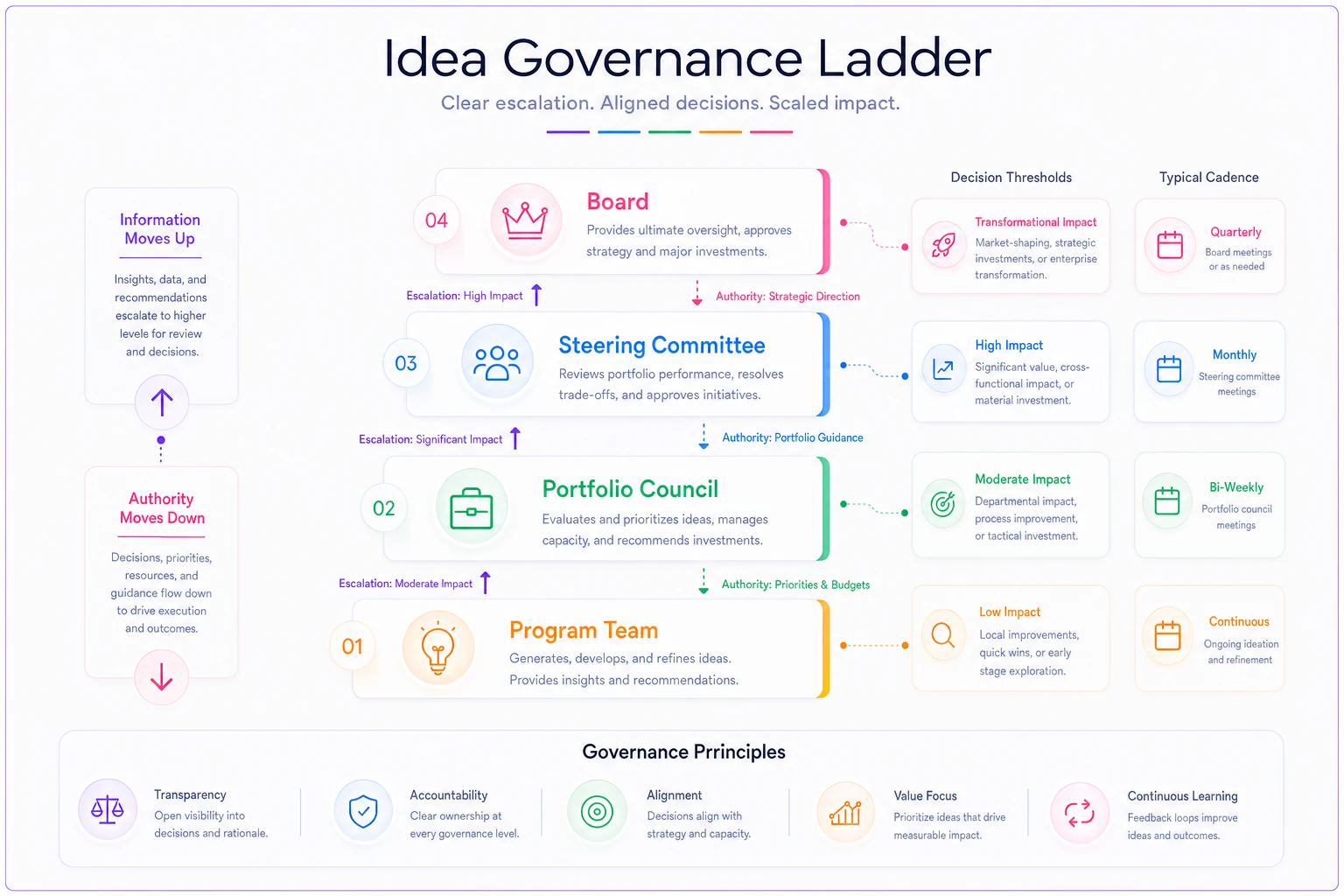
The dollar thresholds are examples — set yours to match your organization's size. What matters is that each rung has a clear ceiling, and anything above that ceiling climbs to the next rung with a memo, not a meeting invite.
The quiet benefit here is that most decisions never reach the board at all. A healthy ladder resolves maybe 80–90% of funding decisions below the board line. The board only sees the asks that genuinely require their authority, which is exactly the conversation they're equipped to have. This connects directly to the kind of structure described in a decision rights matrix for cross-functional escalations — the ladder is essentially that matrix applied to money instead of approvals.
Bundling KPIs so a board can actually decide
A single metric is almost never fundable on its own. Boards fund theses, and a thesis needs a bundle of metrics that together make a case. The art is choosing which metrics travel together.
A workable bundle has four components:
-
A demand signal — evidence the opportunity is real (validated pilots, customer pull, measured pain)
-
An execution signal — evidence the team can deliver (cycle time, pilot pass rate, prior reuse)
-
A value signal — the expected financial or strategic return, risk-adjusted
-
A downside signal — what you lose if it fails, and how fast you'd know
Here's the mistake most teams make: they bring the demand and value signals to the board and leave out the execution and downside signals. That reads as salesmanship, not stewardship. Boards fund people who show them the downside first. A bundle that leads with "here's what we lose and here's how fast we'll know" earns more credibility than one that leads with upside — even when the upside is identical.
A typical bundle looks like this. Say you're asking to scale a supply-chain resilience experiment from pilot to limited rollout. Your bundle isn't "the pilot worked." It's: three validated pilots showing roughly 8–12% reduction in expedite shipping costs (demand + value), an average pilot-to-rollout cycle of under 90 days from your last four efforts (execution), and a capped downside of the rollout budget plus a defined 60-day checkpoint where you'd kill it if savings fall below 5% (downside). Now the board has a thesis, not a chart.
For guidance on which conversion metrics actually carry weight versus which are noise, the breakdown in innovation program metrics that prove ROI is a useful companion — the bundles here pull from that same metric set, just reassembled for a funding audience.
Risk-adjusted expected value without the false precision
Boards are allergic to two things: numbers that look too confident, and no numbers at all. Risk-adjusted expected value (rEV) threads that needle if you do it honestly.
The computation itself is simple. For each funding ask:
-
Estimate the gross value if it works — in a range, not a point. (e.g., $400k–$700k annual savings)
-
Assign a probability of success based on evidence, not optimism. Validated pilots push this up; untested assumptions push it down.
-
Multiply the midpoint by the probability to get expected value.
-
Subtract the risk-weighted downside — the cost of failure times the probability of failure.
-
Divide by the capital asked to get a rough return multiple the board can compare across asks.
A worked example. You're asking for $150k. Gross value range is $400k–$700k, midpoint $550k. Based on three clean pilots, you put success probability at 60%. Expected value is $330k. If it fails, you've burned $150k plus maybe $30k in distraction cost — call it $180k downside at 40% probability, so $72k risk-weighted downside. Net rEV is $258k against a $150k ask, roughly a 1.7x risk-adjusted return. Now compare that to the other asks on the table.
The point of this isn't the exact figure. It's that every ask gets scored the same way, so the board compares apples to apples instead of comparing whoever's most persuasive. The discipline of forcing a probability number — and defending it with evidence — is where most of the value lives. Teams that can't explain why their probability is 60% rather than 85% usually discover their thesis is thinner than they thought.
One honest caveat: resist the urge to over-engineer this. A Monte Carlo simulation on a $150k ask signals you're hiding behind math. A clear range, a defensible probability, and a named downside beat a precise-looking model every time.
Cadence: matching the rhythm of decisions to the rhythm of meetings
The single biggest fixable failure is cadence mismatch. Programs generate fundable decisions continuously; boards meet rarely. If every ask waits for the board, you get a funding traffic jam four times a year.
The fix is a cascading cadence where lower rungs absorb most of the flow:
-
Weekly at the program level
experiments funded and killed under the $10k line. No memo required, just a log.
-
Monthly at the portfolio council
reallocation within the approved envelope, bundle performance review, and preparation of any asks that need to climb higher.
-
Monthly or bi-monthly at the steering committee
approve mid-size asks, pre-digest board asks so they arrive fully formed.
-
Quarterly at the board
approve only the large asks and set the next envelope.
The crucial move is pre-digestion. By the time an ask reaches the board, the steering committee has already pressure-tested the rEV, the bundle, and the downside. The board isn't discovering the ask — they're ratifying or rejecting a thesis that's already been stress-tested one rung down. That turns a 45-minute debate into a 10-minute decision.
A pattern worth watching: when board meetings routinely run long on innovation items, it's almost never a board problem. It's a sign the rung below isn't doing its pre-digestion job, so raw asks are climbing all the way up. The fix is downstream, not at the board table.
The one-page memo skeleton
Every ask that climbs a rung travels as a one-page memo. Not a deck. One page forces clarity and makes the memo reusable — same skeleton every time, so readers know exactly where to look.
The skeleton:
-
The ask (one sentence)
what you want and how much. "$150k to scale the expedite-cost pilot to three distribution centers."
-
The bundle (four lines)
demand, execution, value, downside signals.
-
rEV (two lines)
the computation and the resulting multiple.
-
The decision needed (one line)
approve / reject / approve-with-conditions, and by when.
-
The kill condition (one line)
the specific metric and date at which you'd stop.
-
What you're NOT asking for (one line)
scope boundaries, so nobody assumes this is the first of ten.
Name the boundary or kill condition early in the memo to avoid wedge fears and speed board decisions.
That last line matters more than people expect. Boards hesitate on asks that feel like the thin end of a wedge. Naming the boundary — "this is a capped rollout, not a commitment to company-wide deployment" — removes the fear that approving one thing commits them to five.
Two sample memos, worked
> Ask: $85k to run a 90-day customer co-creation pilot in the SMB segment. > Bundle: Two enterprise pilots showed ~11% uplift in feature adoption (demand/value); our last three co-creation efforts averaged 74 days to results (execution); downside capped at $85k with a 45-day go/no-go (downside). > rEV: Gross value $300k–$450k, midpoint $375k × 55% = $206k EV; risk-weighted downside ~$45k; net rEV ~$161k on $85k = ~1.9x. > Decision needed: Approve within two weeks to hit Q2 start. > Kill condition: Stop at day 45 if adoption uplift tracks below 4%. > Not asking for: Full-segment rollout or dedicated headcount.
> Ask: $650k to industrialize three validated pilots into a shared platform. > Bundle: Three pilots delivering combined $1.1M–$1.6M annual savings (value); platform reuses existing infra from two prior builds (execution); phased spend with a 120-day checkpoint (downside). > rEV: Midpoint $1.35M × 65% = $878k EV; risk-weighted downside ~$210k; net rEV ~$668k on $650k = ~1.0x year one, rising to ~2.1x by year two. > Decision needed: Approve this quarter to lock vendor capacity. > Kill condition: Pause phase two if year-one realized savings fall below $600k. > Not asking for: Permanent platform team or multi-year commitment beyond phase one.
Notice sample B honestly shows a roughly break-even first year. Hiding that would be worse than disclosing it — boards find out eventually, and a memo that undersold the ramp earns more trust than one that oversold it.
Where this holds up and where it strains as you scale
A single-business-unit program with a handful of pilots a quarter can run a lightweight version — maybe three rungs, maybe just a shared spreadsheet of asks scored the same way. The ladder earns its complexity as volume grows.
What changes at scale is the coordination load. With one business unit, the portfolio council can hold every bundle in their heads. Across six units running dozens of experiments, the bundles start colliding — two teams asking to fund variations of the same thesis, or asks that compete for the same scarce engineering capacity without anyone noticing until the board meeting. That's where the ladder shifts from a nice-to-have to load-bearing. The portfolio rung's real job at scale is catching duplication and dependency conflicts before they climb.
The approach described in aligning funding to impact with a portfolio lens pairs naturally here — the ladder is how individual asks move; the portfolio lens is how you keep the whole set balanced as it moves.
When this actually makes sense
-
You're running enough funding decisions that board meetings have become a bottleneck
-
Finance and innovation keep talking past each other on value
-
You've had good pilots stall because nobody could translate them into an ask
-
You operate across multiple units with competing claims on the same capital
When it's overkill
-
You run a handful of experiments a year and the CEO signs off directly
-
Your total innovation budget is small enough that rEV theater costs more than it saves
-
You don't yet have validated pilots to score — fix your pipeline before building the ladder
Who should NOT start here
-
If your program lacks reliable KPIs at the pilot level, a governance ladder just formalizes bad inputs. Garbage climbs the ladder as efficiently as gold. Get your measurement foundation solid first — the innovation capability maturity model diagnostic is a reasonable place to assess whether you're ready, or whether you're trying to build a funding system on top of metrics you don't trust yet.
When your coordination needs grow, the ladder moves from helpful to essential because it prevents collisions and duplicates before they consume board time.
A real scenario
A mid-market industrial manufacturer, roughly 600 employees, had an innovation program producing solid pilots but almost no board funding beyond the original seed budget. Every quarter the innovation lead walked in with a deck of maybe fifteen charts, the board asked a few skeptical questions, and most asks got "let's revisit next quarter." Over a year, exactly one pilot got scaled.
They rebuilt around a ladder. Program-level spend under $10k moved to the team. A portfolio council met monthly and reallocated within a fixed envelope. Mid-size asks went to a steering committee, and only asks above roughly half a million climbed to the board — as one-page memos with rEV attached, pre-digested one rung down.
The shift wasn't dramatic in presentation. It was dramatic in throughput. Over the following three quarters, the board saw four asks instead of fifteen scattered charts, and approved three of them — because each arrived as a scored thesis with a named downside and a kill condition, not a hopeful chart. Board time on innovation dropped to about fifteen minutes per session. More things got funded and the board felt more in control, which is the combination that usually seems impossible to pull off simultaneously.
The takeaway
The governance ladder isn't bureaucracy. It's the opposite — it's what lets most decisions happen fast and low, so the few that need board authority arrive clean. The translation work between program KPIs and capital allocation has to live somewhere, owned by someone, done the same way every time. When it doesn't, persuasive people get funded over strong evidence, and quarterly traffic jams kill good ideas through deferral.
Build the rungs. Bundle the metrics. Attach an honest rEV. Pre-digest one rung down. And put every ask on one page with the downside named first. Do that consistently, and the exec investment memo stops being the thing you dread writing before each board meeting and becomes the shortest, clearest document in the room.
Ready to transform your innovation process?
Join 2,000+ companies using GoIdeafy to unlock team creativity, prioritize impactful ideas, and accelerate growth.