



Most maturity models fall apart the moment someone tries to use them in a real budget meeting. They describe five neat stages, hand you a color-coded chart, and then leave you standing in front of a CFO who wants to know why "Level 3" deserves another $400k. The problem isn't the concept of maturity. The problem is that most models measure feelings about capability instead of evidence of it.
An innovation capability maturity model is only useful if it forces you to point at actual operating artifacts — SLAs, funding gate records, role definitions, decision logs — and say "here's the proof we operate at this level." Without that, you're just grading your own homework.
This is a systems piece, not a definitions piece. The goal is to show how the parts of an innovation engine connect, where they quietly break as you scale, and how to tie each maturity stage to something you can actually defend in front of the executive team.
Why maturity assessments drift from reality
The most common failure isn't scoring too high. It's scoring based on the wrong signals.
A team will look at their idea intake volume — say, 900 submissions last year — and conclude they're running a mature, high-participation program. But volume is an activity metric, not a capability metric. When you trace those 900 ideas forward, you often find maybe 40 got real evaluation, 6 got funded, and 2 produced anything you'd call an outcome. That's not a Level 4 engine. That's a suggestion box with good marketing.
Capability lives in the transitions, not the stages. The hard part is never "having ideas." It's moving an idea from evaluated to funded, from funded to piloted, from piloted to scaled — and doing it repeatably without a specific executive personally dragging it through each gate. When a single sponsor's calendar is the reason things move, you don't have a capability. You have a bottleneck wearing a cape.
The other reason assessments drift: people confuse tooling maturity with process maturity. Buying a platform doesn't move you up a stage. Plenty of organizations run sophisticated software on top of a broken decision process, which just means they now generate broken decisions faster.
The five stages, defined by evidence not vibes
Each stage is defined by what you can show, not what you believe.
Capture, evaluate, and act on ideas without friction.
GoIdeafy streamlines the entire innovation lifecycle from idea submission to implementation.
- Centralized idea capture
- Collaborative evaluation tools
- Progress tracking & analytics
No credit card required
| Stage | What it feels like internally | Operating evidence that proves it |
|---|---|---|
| 1 — Ad hoc | Innovation happens when someone champions it | No standard intake, no evaluation rubric, funding decided case-by-case in hallway conversations |
| 2 — Repeatable | There's a process, but it depends on specific people | Documented intake form, a scoring method used inconsistently, one funding source with informal gates |
| 3 — Defined | The process exists on paper and mostly gets followed | Written evaluation rubric, calibrated scoring, published funding gates with criteria, named roles with defined decision rights |
| 4 — Managed | The engine runs on metrics and SLAs, not heroics | Portfolio-level dashboards, gate SLAs with cycle-time targets, benefits-realization tracking after pilots, role changes triggered by pipeline load |
| 5 — Optimizing | The system improves itself deliberately | Recalibration cadence, funding reallocation based on realized outcomes, documented experiments on the process itself |
The jump most organizations get stuck on is Stage 2 to 3. Stage 2 works fine at small scale — 3 or 4 business units, a couple hundred ideas, one enthusiastic sponsor. The wheels come off when you try to run the same informal process across a dozen units and thousands of ideas. That's where you need a real governance and decision-rights structure, which is the core of a proper innovation operating model.
The operational evidence checklist
When you run the diagnostic, don't ask people how mature they feel. Ask them to produce artifacts. If they can't produce it, that capability doesn't exist — no matter how confidently it gets described in the meeting.
-
Intake
Is there a single, standardized way ideas enter the pipeline, or does each unit invent its own? Pull three real submissions from the last month and check if they used the same structure.
-
Evaluation
Is there a written rubric, and can you show two evaluators scored the same idea within a reasonable range? Calibration evidence is what separates Stage 2 from Stage 3.
-
Funding gates
Are gate criteria published before decisions, or reconstructed after? Ask to see the criteria doc dated earlier than the last funding decision.
-
Decision rights
Can someone name — without hedging — who can kill an idea, who can fund a pilot, and what dollar threshold requires escalation?
-
SLAs
Is there a target time from submission to first response, and from evaluation to funding decision? More importantly, is that target measured?
-
Benefits realization
After a pilot ends, is there a record of what value it actually produced versus what was promised? This one exposes a lot of supposedly mature programs instantly.
-
Reallocation
When a bet underperforms, is there evidence the funding actually moved somewhere better, or did it just quietly persist?
Pull two recently scored submissions and compare evaluator scores to see if calibration evidence actually exists.
That last cluster — SLAs, benefits realization, reallocation — is where Stage 4 lives. If you want a deeper method for proving realized value flows back into decisions, the portfolio rebalancing approach is worth pairing with this checklist.
Where the system breaks as you scale
Innovation engines don't fail all at once. They fail at connection points, and those connection points shift depending on size.
At small scale, the failure is usually intake and follow-through. Ideas come in, someone means to look at them, and then the quarter ends. The bottleneck is attention. A single coordinator can hold the whole thing in their head, which works right up until they leave or get promoted, at which point the institutional memory walks out the door with them.
At mid scale — several units, real budget — the failure moves to the funding gate. You now have more good ideas than money and no consistent way to choose between them. Two units pitch similar pilots; both get funded because nobody connected the dots. Or a well-liked executive's pet project sails through while a stronger idea from a quieter team stalls. The bottleneck is decision consistency, and it's expensive. A typical example: two business units independently pilot overlapping customer-retention tools, spending a combined $130k–$150k, and only discover the redundancy at the readout.
At large scale, the failure is realization and reallocation. You have plenty of process, plenty of pilots, plenty of dashboards — and value still leaks because nobody owns the handoff from "successful pilot" to "operationalized capability." Pilots end, teams disband, and the promised savings never show up in anyone's P&L. The bottleneck is accountability across the pilot-to-scale boundary.
The pattern underneath all three: coordination cost grows faster than idea volume. Doubling submissions doesn't double the workload — it roughly triples it, because now you're also managing deduplication, cross-unit conflicts, and portfolio-level tradeoffs. Programs that don't plan for that curve get overwhelmed and retreat back to hero-driven decision-making, which quietly drops them a full maturity stage.
The investment-prioritization matrix
Once you've diagnosed the real stage and found the breaking connection points, the C-suite question becomes: where does the next dollar go? Not everything is worth fixing at once, and fixing things out of order wastes money.
| Capability gap | Blocking severity | Effort to fix | Priority |
|---|---|---|---|
| No standardized intake | Medium | Low | Do first — cheap, unblocks everything downstream |
| Inconsistent evaluation | High | Medium | Do early — this is where bad bets originate |
| Undefined funding gates | High | Medium | Do early — pairs naturally with evaluation |
| No pilot benefits tracking | High | High | Fund deliberately — this is where value leaks |
| No portfolio reallocation | Medium | High | Sequence later — needs the tracking layer first |
| Advanced process experimentation | Low | High | Last — only worth it once Stage 4 is stable |
The mistake executives make is funding the shiny end first — portfolio dashboards and reallocation frameworks — while intake and evaluation are still broken. You end up with a beautiful dashboard reporting on garbage inputs. Fix the flow from the front. Standardized intake and a calibrated evaluation rubric are low-to-medium effort and unblock nearly everything downstream.
A five-step diagnostic you can run in a quarter
You don't need a six-month consulting engagement to figure out where you stand. A focused diagnostic works like this:
-
Pull artifacts, not opinions. Give each unit two weeks to produce the evidence from the checklist above. What they can't produce is your answer.
-
Score by transition, not stage. For each handoff — intake→evaluation, evaluation→funding, funding→pilot, pilot→scale — rate how repeatable it is without a specific person driving it.
-
Map the bottleneck. Find the single transition where the most ideas die or stall. That's your constraint, and it's almost never where people expect.
-
Run the prioritization matrix. Plot fixes by blocking severity and effort. Sequence them front-to-back through the pipeline.
-
Attach each fix to an operating artifact. A fix isn't real until it produces an SLA, a gate criteria doc, or a documented role change. "We'll evaluate better" is not a deliverable. "Evaluations complete within 10 business days, scored against the published rubric, by the named panel" is.
That last step is what separates a diagnostic that actually changes behavior from a slide deck that gets admired and forgotten.
The flow below is worth keeping in front of you while you work through the diagnostic. Each arrow is where you score repeatability — not the boxes themselves. That's where the real diagnostic work happens.
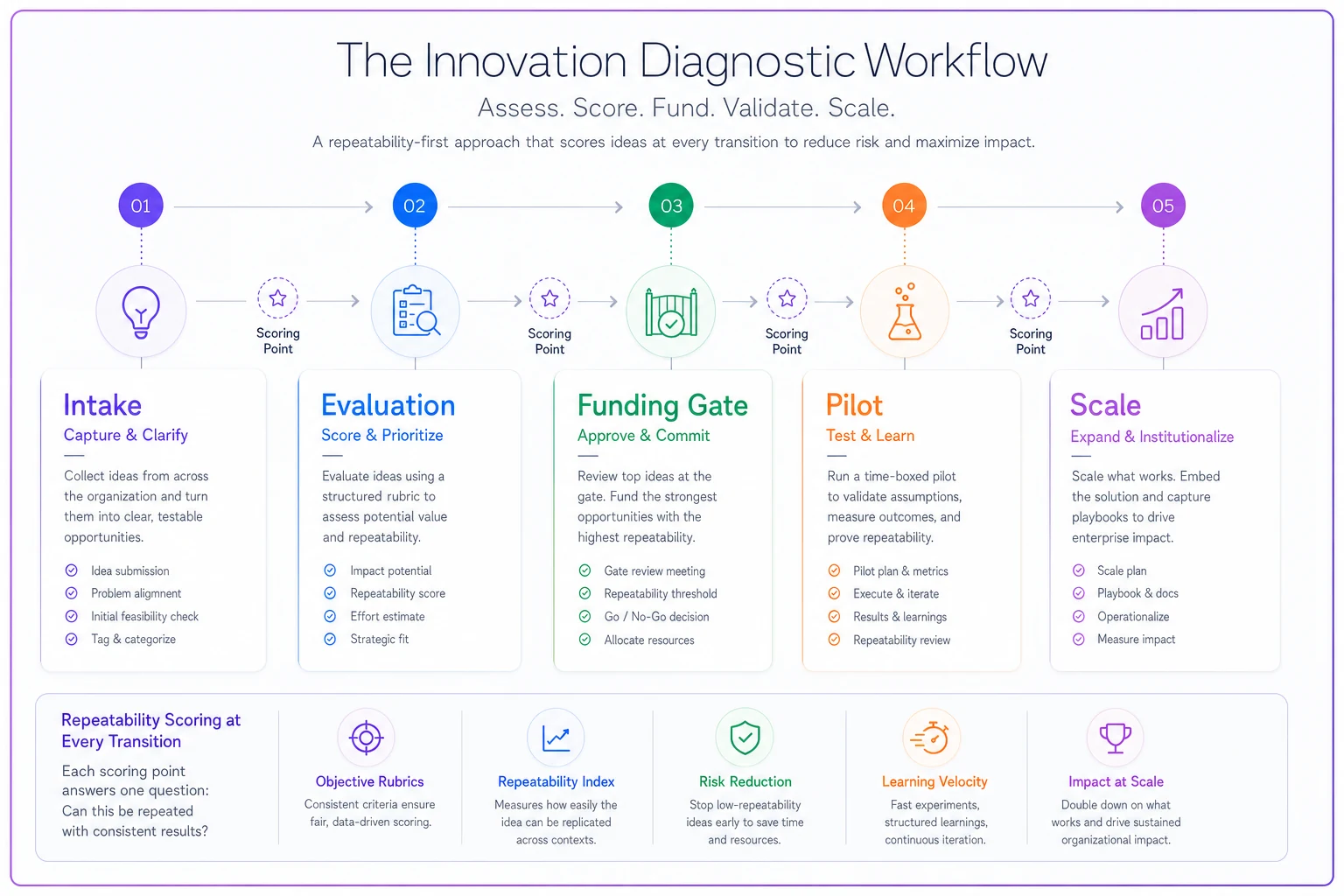
Score each arrow on how well that transition holds up without a named person pushing it through. When you find the arrow where ideas consistently pile up or disappear, that's your constraint — and that's where the investment conversation should start.
Tying the roadmap to real operating artifacts
A maturity roadmap that lives in strategy language never survives contact with a Monday morning. The roadmaps that actually move programs forward are written as changes to how work happens.
-
SLAs
"First response within 5 business days; funding decision within 20." When cycle time is a measured commitment, gates stop being where ideas go to disappear.
-
Funding gates
Published criteria with dollar thresholds and named approvers. A pilot under $25k clears at the unit level; anything above escalates to the portfolio board.
-
Role changes
Moving from a part-time coordinator to a dedicated portfolio owner is itself a maturity milestone. Stage 4 usually requires someone whose actual job is the health of the pipeline — not a volunteer squeezing it in between other duties.
The point of anchoring to artifacts is that they're auditable. Six months later you can check whether the SLA held, whether gates used the published criteria, whether the new role exists and has real decision rights. Maturity you can audit is maturity you can defend in a budget conversation. And to make any of it defensible, you need the flow metrics that connect activity to outcomes — the conversion and cycle-time formulas in this executive metrics breakdown give you the numbers to put behind each gate.
A real scenario: a mid-size manufacturer stuck at Stage 2
A regional industrial manufacturer — roughly 1,100 employees, four business units — ran what they proudly called a mature innovation program. On paper: an idea portal, an annual "innovation summit," and around 600 submissions a year.
The diagnostic told a different story. When they pulled artifacts, they had intake but no consistent evaluation. Scoring was done by whoever had time, with no shared rubric, so two evaluators would rate the same idea wildly differently. Funding happened in an annual budget meeting where the loudest VP tended to win. Of those 600 ideas, about 25 got real evaluation, 5 got funded, and roughly 2 produced measurable outcomes — and even those weren't tracked after the pilot ended.
Real stage: barely Stage 2, despite Stage 4 aspirations.
They sequenced fixes front-to-back. First, a standardized intake form and a calibrated evaluation rubric with two-reviewer scoring — low effort, done in about a month. Then published funding gates with a $25k unit-level threshold and a monthly decision cadence instead of one annual scramble. Finally, a lightweight benefits-realization log so pilots reported actual versus promised value 90 days out.
Twelve months later, submissions were flat — around 620. But evaluated ideas jumped to roughly 90, funded pilots to about 14, and they killed two overlapping pilots early after the shared rubric surfaced the redundancy, saving somewhere in the range of $60k–$70k. More importantly, funding decisions stopped depending on who was in the room. That's the actual signal of moving from Stage 2 to Stage 3 — decisions that survive without a specific person driving them.
When this diagnostic makes sense — and when it doesn't
It makes sense when you're about to make a real investment decision and need to defend it, when innovation spans multiple units and coordination is getting expensive, or when leadership disagrees about how mature the program actually is. The artifact-based approach settles those arguments fast, because you're pointing at evidence instead of trading opinions.
It's a bad idea when your program is genuinely brand new. If you're running your first 50 ideas, you don't need a maturity model — you need to just run the loop a few times and see what breaks. Diagnosing the maturity of something that barely exists is a waste of everyone's afternoon.
It's the wrong tool for organizations where leadership isn't actually willing to change funding behavior. If the annual budget meeting is politically untouchable, no maturity assessment will fix it. The diagnostic will correctly tell you you're stuck at Stage 2, nothing will move, and everyone will be mildly annoyed at the report.
Bringing it together
Maturity isn't a badge you earn once. It's the degree to which your innovation engine keeps working when specific people leave, when volume triples, and when the money gets tight. Every stage above is really a statement about how much the system depends on heroics versus how much it runs on repeatable, auditable process.
The engines that keep climbing treat the maturity model as an operational checklist tied to real artifacts — intake standards, calibrated rubrics, published gates, measured SLAs, role definitions that change as load grows. When your platform and process are set up so that the evidence generates itself as work happens — decision logs, cycle-time records, benefits-realization data captured automatically rather than reconstructed under pressure — the diagnostic stops being an annual event and becomes something you can check on any given Tuesday.
That's the quiet marker of a Stage 4 engine: the proof is always there, because the system was built to leave a trail.
Ready to transform your innovation process?
Join 2,000+ companies using GoIdeafy to unlock team creativity, prioritize impactful ideas, and accelerate growth.