


Campaign surges break the steady-state rules. A normal idea stream might see 40–60 submissions a week, handled comfortably by two moderators on a rotating schedule. Then marketing launches an innovation challenge tied to a product anniversary, or leadership pushes a company-wide "fix our biggest customer pain" sprint, and suddenly you're staring at 900 submissions in nine days. The rota that worked all year collapses in 72 hours.
The trap isn't the volume itself. It's that most teams treat a surge like a bigger version of normal operations, when it's actually a different operating mode — with a hard start date, a hard end date, and a cleanup bill that comes due afterward. This piece is about running that temporary mode deliberately: the staffing multipliers, the throwaway SLAs, the canned responses, the dedup windows, the spike automations, and — the part almost everyone skips — the rollback and cleanup rituals that stop a surge from permanently bloating your backlog.
Why surges fail when you treat them like "normal but more"
Steady-state moderation optimizes for consistency: predictable SLAs, calibrated evaluators, slow-and-steady backlog hygiene. Surges optimize for something else — throughput under a deadline, with the deliberate acceptance that quality bars loosen temporarily and get re-tightened later.
During a surge, two things spike at once: submission volume and duplication rate. In a normal week, maybe 8–12% of ideas are near-duplicates of something already in the system. During a themed campaign — "how do we reduce shipping costs" — that number can hit 35–45%, because everyone is answering the same prompt from the same recent frustration. So you're not just getting more work; you're getting more redundant work, which means naive throughput scaling makes your post-campaign backlog dirtier, not just bigger.
The second misread: teams scale people but not rules. They pull in four extra moderators, hand them the standard SOP, and wonder why triage quality drops. The standard SOP assumes the moderator has context, knows the recurring themes, and recognizes regulars. A temp moderator on day two of a 10-day surge has none of that. They need a thinner, surge-specific ruleset — not the full playbook.
The staffing multiplier: how many extra hands, and for how long
The question everyone asks is "how many moderators do we add?" The better question is "what's our multiplier against baseline throughput, and when does it ramp and un-ramp?"
Capture, evaluate, and act on ideas without friction.
GoIdeafy streamlines the entire innovation lifecycle from idea submission to implementation.
- Centralized idea capture
- Collaborative evaluation tools
- Progress tracking & analytics
No credit card required
A rough model that holds up across most mid-market programs:
| Expected surge volume (vs. baseline) | Moderator multiplier | QA/lead multiplier | Ramp-in lead time |
|---|---|---|---|
| 2–3x baseline | 1.5x | 1x (existing lead absorbs) | 3–5 days |
| 4–6x baseline | 2.5–3x | 1.5x (add a surge lead) | 1 week |
| 7–10x baseline | 4x | 2x (dedicated surge lead + QA) | 2 weeks |
| 10x+ | 4x + async overflow pool | 2x + daily calibration | 2–3 weeks |
Two things consistently get underfunded here.
First, the multiplier for leads and QA. Teams double the moderators but keep one lead, who then becomes the bottleneck for every escalation and edge case. A surge lead who does nothing but unblock, answer "is this a dupe?" questions, and watch the SLA dashboard is worth more than two extra moderators.
Second, the ramp-in lead time — which is non-negotiable and consistently ignored. You cannot onboard three temp moderators on the morning the campaign launches. They need at least a short window to absorb the surge-specific ruleset, the canned snippets, and the dedup conventions. Onboarding during the flood means your extra capacity is net-negative for the first couple of days because your experienced people are busy training instead of triaging.
For internal campaigns, your best surge moderators aren't always from the innovation team. Borrowing people from adjacent functions — ops, PMO, a product analyst — works surprisingly well, but only if you give them a narrow lane (first-pass triage only, escalate anything ambiguous) rather than full decision authority.
Temporary SLA templates: loosen deliberately, publish clearly
Your year-round SLA might promise a first response within 48 hours and a triage decision within five business days. Under a 6x surge, holding that SLA either requires impossible staffing or quietly breaks it everywhere — which is worse, because submitters notice the silence.
The move is to publish a temporary campaign SLA that's explicitly different and explicitly dated. Something like:
-
Acknowledgment auto-confirmation on submit (instant), human eyes within 72 hours instead of 48
-
First triage decision within 10 business days of campaign close, not within 5 of submission
-
Detailed feedback batched — campaign-wide feedback summary within 15 business days, individual feedback only for shortlisted ideas
Submitters tolerate slower feedback if they know the timeline upfront. What destroys trust during a surge is the implicit promise of your normal pace followed by weeks of silence. A campaign banner that says "we expect 800+ ideas — here's our review timeline" resets expectations before anyone gets frustrated.
Keep the temporary SLA visibly separate from your standing SLA so you don't accidentally normalize the loosened numbers. More than one team has let their "temporary" 72-hour acknowledgment quietly become permanent because nobody ever formally switched it back.
Canned feedback snippets: the surge survival kit
During a surge, you cannot write bespoke feedback on 800 submissions. You also can't send cold rejections without torching participation for the next campaign. The resolution is a small, pre-written library of feedback snippets — not generic form rejections, but modular pieces moderators assemble quickly.
A workable snippet library for a surge covers maybe 8–12 common dispositions:
-
Merged into a cluster "We received several similar ideas around [theme]. We've grouped yours with them and the combined concept is moving to review."
-
Out of campaign scope "This is a solid idea, but it's outside this campaign's focus on [X]. We've routed it to the general backlog so it isn't lost."
-
Needs more detail to evaluate "Promising direction — but we'd need [specific missing piece] to assess it. We've flagged it for follow-up after the campaign."
-
Shortlisted "This made our shortlist for [campaign]. Expect a detailed review within [date]."
-
Duplicate of an active pilot "There's already work underway on this — we've linked you to that effort so you can plug in."
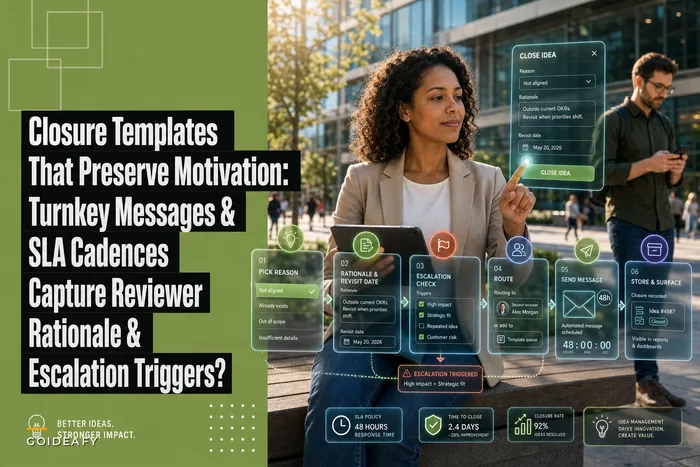
The mistake is writing snippets that sound canned. The fix is building them to require a filled-in blank — the theme, the missing piece, the pilot name. That one forced personalization keeps the response from reading like an automated brush-off. The thinking behind closure messages that keep people engaged is worth borrowing from closure templates that preserve motivation and capture missing context — a surge is exactly when closure quality slips, because volume pressure makes everyone want to just hit "reject."
Deduplication windows: the single highest-leverage surge control
This is where surges are won or lost. Because a themed campaign drives everyone toward the same handful of answers, duplication is your biggest hidden cost. Left unmanaged, you end up with a shortlist full of near-identical ideas and a post-campaign backlog that takes weeks to untangle.
A deduplication window is a short, defined period — usually the first 24–48 hours after each batch of submissions arrives — where a moderator's only job is clustering, not evaluating. You deliberately hold evaluation until dedup is done, because evaluating un-deduped ideas means re-reading the same concept five times.
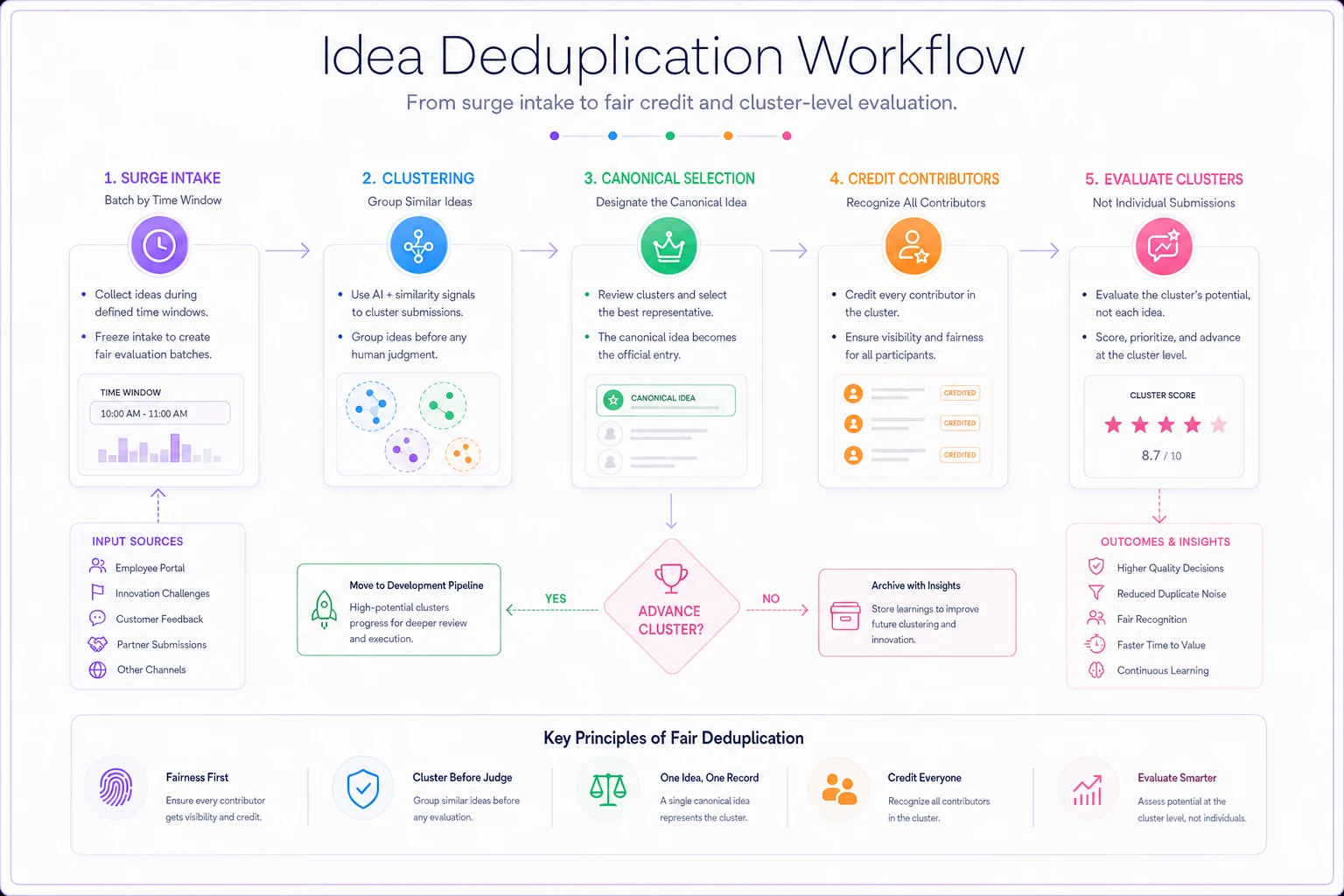
Here's a simple visual of the dedup workflow.
-
Batch intake by time window — group all submissions from each 24-hour period rather than processing one-by-one as they land.
-
Cluster before you judge — a moderator reads the batch purely to group similar concepts, assigning each a cluster tag. No accept/reject decisions yet.
-
Designate a canonical idea per cluster — pick the clearest expression of the concept as the "primary," link the rest to it.
-
Credit all contributors — the canonical idea carries a list of everyone who submitted a variant, so nobody feels erased. This matters enormously for participation.
-
Evaluate clusters, not submissions — review runs against ~120 clusters instead of 800 raw ideas.
That last number is the whole point. The arithmetic of clustering first can turn an impossible review load into a manageable one. The standing-operations version of this — recurring dedup and backlog discipline — is covered in backlog hygiene rules and deduplication workflows; the surge version just compresses the same logic into tight, repeated windows rather than a monthly ritual.
One mistake worth flagging: deduping after evaluation. Once reviewers have scored 800 individual ideas, merging duplicates means reconciling conflicting scores on the same concept — which is painful and political. Dedup is cheap before judgment and expensive after.
Automation during spikes: what to automate, what to leave alone
Automation during a surge should handle the mechanical, not the judgmental. The temptation is to auto-route or even auto-reject to keep up — that's how you accidentally bury a great idea and spend the next campaign rebuilding trust.
Safe surge automations:
-
Auto-acknowledgment on submit, with the campaign SLA timeline baked in.
-
Keyword-based pre-clustering that suggests (not assigns) likely dupes for a human to confirm — surface candidates, not automatic merges.
-
Scope flags that tag submissions missing a required campaign field, routing them to a "needs detail" lane.
-
Load balancing that distributes incoming batches evenly across the moderator pool instead of dumping everything on whoever's online.
-
SLA-breach alerts that ping the surge lead when a batch is aging past the window.
Automations to keep a human firmly in the loop on:
-
Any rejection or closure — never fully automated during a surge; the reputational cost of a wrong auto-reject is too high.
-
Final cluster merges — suggest, don't auto-execute.
-
Shortlisting — this is judgment, full stop.
The broader principle of blending automated handoffs with human triage is laid out in the moderator and curator playbook for high-volume idea streams; surge automation is that same logic dialed up for a temporary spike, with tighter guardrails because temp staff are involved.
When a heavy surge setup actually makes sense — and when it doesn't
When this is worth the overhead:
-
You're expecting 4x+ baseline volume over a bounded 2–12 week window.
-
The campaign has a theme (which guarantees high duplication and therefore high dedup payoff).
-
There's a hard deadline — awards, a leadership readout, a product milestone.
When this is overkill:
-
Volume is only 1.5–2x baseline. Your existing rota plus a temporary SLA tweak handles it. Spinning up temp staff and surge automations costs more than the flood.
-
The surge is open-ended with no clear end date — that's not a surge, that's growth, and it needs a permanent staffing change, not a temporary multiplier.
Who should NOT run a full surge setup: Teams without a functioning steady-state process. If your normal moderation is already chaotic, a surge playbook won't fix it — it'll just add temp staff to an undefined process and amplify the mess. Get the baseline rota and SLAs stable first.
The rollback and cleanup rituals nobody plans for
This is the section most teams skip, and it's the one that determines whether a surge leaves you stronger or buried. A campaign ends and everyone exhales — the temp moderators roll off, the surge lead goes back to their day job, and the loosened SLAs quietly stay loose. Three months later you've got a 600-item backlog of campaign leftovers nobody owns.
A cleanup ritual, run in the two weeks after campaign close:
-
[ ] Formally revert SLAs to standing values, with a dated note so the temporary numbers don't become permanent by accident.
-
[ ] Reconcile the backlog — every non-shortlisted idea gets a disposition: merged, routed to general backlog, parked with a reason, or closed with feedback. No idea left in limbo.
-
[ ] Resolve orphaned clusters — any cluster that never got a canonical idea or a decision gets assigned an owner.
-
[ ] Decommission surge automations — turn off the spike-specific rules so they don't fire during normal weeks and create noise.
-
[ ] Offboard temp staff with a debrief — 30 minutes capturing what the surge-specific SOP got wrong, so next campaign's onboarding is faster.
-
[ ] Credit and close the loop with submitters — send the batched campaign-wide feedback summary promised in your temporary SLA.
-
[ ] Archive the campaign as a reusable template — staffing multiplier used, actual dedup rate, snippet library, what broke.
The orphaned-cluster step is the one that bites hardest. During the rush, moderators create clusters they intend to come back to and never do. If you don't sweep for these during cleanup, they become permanent mystery entries that clog future dedup work. It's worth assigning one person specifically to this sweep — not as an afterthought, but as a scheduled task in the cleanup calendar.
A realistic surge: themed challenge at a mid-market manufacturer
A roughly 600-person manufacturer ran a six-week "reduce waste on the line" challenge. Baseline was about 50 submissions a week. The challenge pulled in close to 740 submissions over six weeks — peaking around 280 in the first week alone, roughly 5–6x normal.
The first week ran the old way: existing two-person rota, standard SLA, triage one-by-one as ideas arrived. By day four they were about 200 submissions behind, acknowledgment times had slipped past a week, and the shop floor was grumbling that nobody was reading their ideas.
They reset. Pulled in two moderators from the PMO and a process engineer as a surge lead, published a temporary SLA (72-hour acknowledgment, triage within 10 days of campaign close), and switched to 48-hour dedup windows with clustering before evaluation. The duplication rate turned out to be around 40% — a huge chunk of "fix the dust extraction on station 4" variants. Clustering collapsed roughly 740 submissions into something closer to 160 reviewable concepts.
The outcome wasn't dramatic in a splashy way — it was just finished on time instead of dragging for months. The shortlist came out of about 160 clusters instead of 740 raw ideas. Cleanup took about a week and a half, with every submitter getting either a cluster-credit note or batched feedback. The reusable template they saved meant the next campaign's ramp-in took days rather than a last-minute scramble.
A surge isn't a bigger backlog — it's a temporary operating mode with its own rules, its own staffing math, and its own exit plan. The teams that struggle are the ones that scale people but keep their steady-state rules, dedup after they evaluate, and never formally wind the surge down. The teams that handle it well treat the cleanup ritual as part of the campaign, not an afterthought, so each surge leaves behind a reusable template instead of a mess for next quarter to untangle.
Ready to transform your innovation process?
Join 2,000+ companies using GoIdeafy to unlock team creativity, prioritize impactful ideas, and accelerate growth.